
In the last month of life crisis and epiphany, I present you snippets from encounters with different walks of life: a foreign tourist, a DINK woman, a bookstore owner, a journalist, a newly graduate, that look into the quiet textures of Chinese society amid drastic changes. Of course, you are welcome to draw your own connections:
***
“How do you read it? From left to right? How do you know it’s a five-character poem?”
We were at Cixi’s Hall of Mental Cultivation at the Palace Museum. On a board up ahead, a five-character poem written by empire Qianlong about his grandfather’s great hunt in the West. I tried to explain that it reads more logically in fives, that the title appears on the far right, so we read right to left, and as for the content, I could only offer what the introductory words below provided.
My tour client Bob, a retired journalism professor, likes to ask the kinds of questions that dissect a work of art. In the context of Chinese calligraphy, the written rules were so embedded in me that I had forgotten how the direction of reading could explain the logic of an ancient text. It’s not about what you read, but how you read, even when you don’t understand the language one bits.
Bob is now at some kind of grand tour at this stage of his life, can explore his hobby around the world, yet, he observed new information like a freshman in college. Say his favorite artist is Mark Rothko. He travels to collect red, cinnabar, finding the best angle where a red wall meets the sky at the Palace Museum.
Earlier, in a gallery, we read calligraphy the way you might read a person, strong, thick strokes signaling confidence; square and upright ones suggesting someone who follows rules; curly, wandering lines belonging to the free-spirited. He spoke about handwriting the way others speak about faces. When we left, he hadn’t taken a single photo elsewhere. He refuses to, in a way that quietly dismays those who pose at every corner. Bob is old-fashioned, for a good reason. He did a piece on the impact of AI at college, and he walked away the piece the same assumption he had previously, that AI is slowly taking away the students’ basic learning abilities, simple like constructing a sentence from zero. To resemble a sentence, he said, takes practice and intelligence.
We also talked about higher ed, and did a bit of compare and contrast. I tried to explain the divide between STEM and humanities in China, how the national exam works, why in a country this populated, a single score can feel like the only fair measure. Bob questioned what fairness really means when everything rests on one number. In the US, he said, it’s letters of recommendation, extracurriculars, the story you can tell about yourself. I didn’t have a clean answer. I’m not sure either system knows what it’s measuring.
***
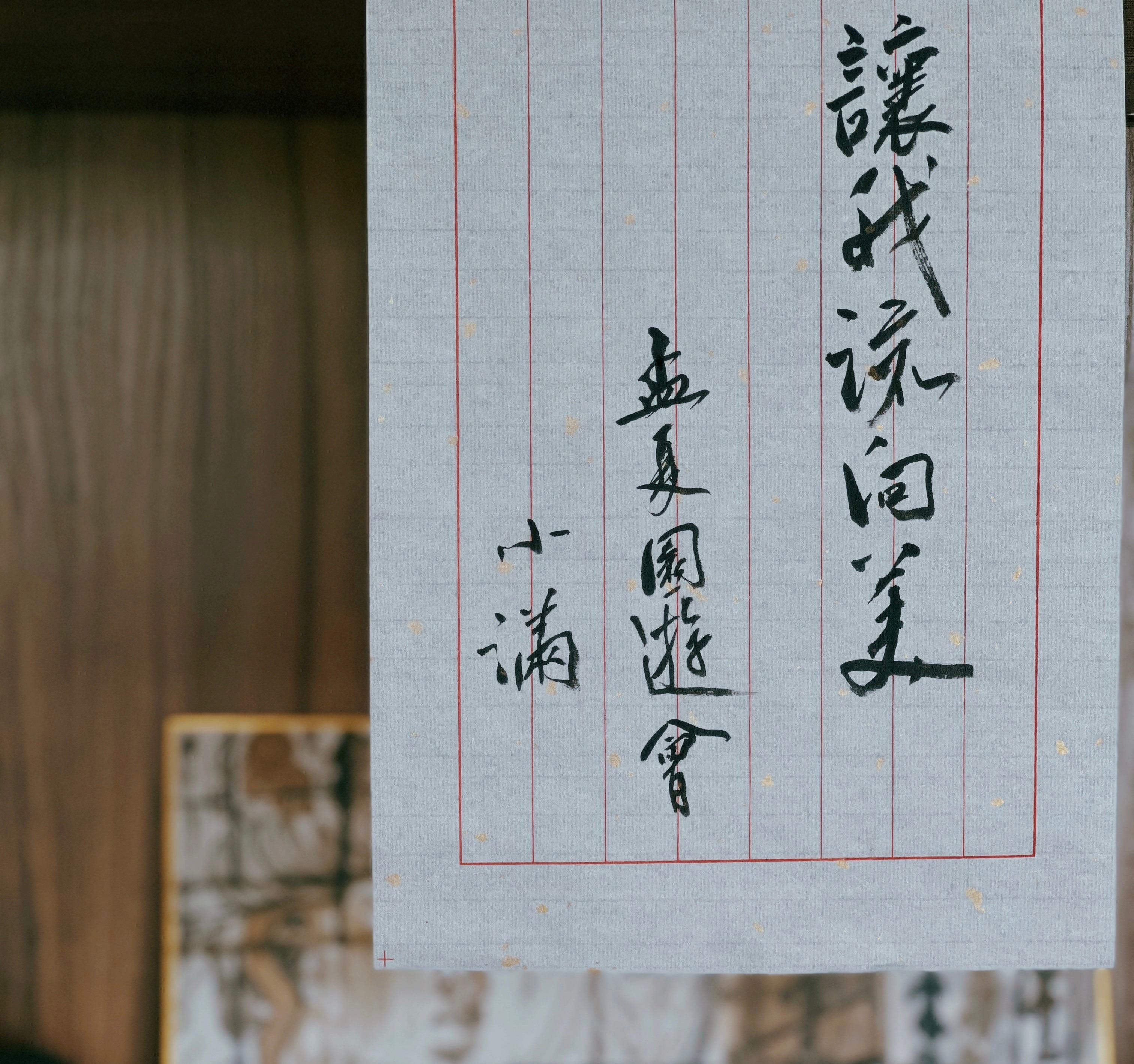
The girl in her forties was crying. Behind her hung a piece of Chinese calligraphy: let me flow towards beauty.
She had seemed happy when she arrived at our seasonal gathering. Then she told us about her puppy’s calm death. She said she had expected to feel grey that day, hollowed out, but instead she walked outside into bright blue sky and children jumping and shrieking under it. That contrast, she said, made her question something she couldn’t quite name about reality. Earlier that same day, she had also received news of her father’s death. Real life doesn’t pause for grief to arrange itself.
She went further. Unlike her coworkers, most of whom have two children minimum, she wonders who she will be when she is old, whether her thoughts will die with her, whether friends who have scattered into the noise of family life will drift too far to return. The woman sitting next to her nodded, said she had rehearsed that same fear in her head many times.
Something loosened in the room. We flowed toward each other like bubbles, briefly closer and closer, yet still separate, still ourselves. It was the most vulnerable I had ever witnessed strangers become, in a first meeting, without anyone deciding to be brave.
***
By the dim light of a bar, J was going through the reporting assignments that had stayed with her. In one, on an impulse, she asked her interviewee to define freedom in this country. He referenced Joey from Friends, raised an eyebrow, tilted his head, how you doing, meaning, she said, sexual freedom. The ability to want freely, to reach for it without apology.
***
At an early morning inside the book fair at Lang Yuan, we were surrounded by people who still believe in paper, my friend Bin, a literature graduate, and I stopped at a stand - whose book store was in Nanjing. Then I remembered a conversation from earlier that week, about feminist bookstores quietly appearing around the country, small and boutique, in cities you wouldn’t expect.
Feminist literature was very popular a few years ago, she said. Maybe it’s finally reaching the general public. A quiet movement in the making, running alongside the global one. What would the results look like?
A silver-haired woman at the next stand called our attention to her collection. Many of the books dated to Ming dynasty scholars. As we moved between stands, the dynasty kept appearing, its centralized way of life, she said, lowering her voice, felt familiar. She remained a little mysterious about what she meant.
“In this era, it’s easy to get lost,” she said. “Reading can really ground you.” Her eyes glinted behind her glasses, each word deliberate, as if reading were the one thing left to hold onto.
Then she held up a slim book, carefully, like a prize. Written by her daughter before the national exam. On the preface, her daughter, born in 2007, wrote that she had learned to dance with her pen, with her mother’s encouragement. The woman held it the way you hold something that proves something.
***
I pass this seafood wholesale place all the time, it’s next to the vet and on the route of our daily walk. One afternoon I was carrying my newly-washed puppy past when I noticed the woman from the store sitting on the stairs with a thick book.
“Is that the Bible?”
I was surprised by serious and causal the scene was, she was pointing her fingers line by line but sitting by the stairs makes me believe it’s her daily ritual. I’ve always been curious about people’s private relationships with the Bible, what they find in it, how they make the stories theirs. It also gave me a particular kind of chill, because I had just been preparing a writing workshop on 女娲 Nv wa , the female god who made humans from dirt in Chinese ancient mythology.
I invited myself to sit down.
She flipped through pages to show me: in the beginning, God made man in his own image; then Eve and Adam sinned, and God answered with mortality, with exile from the garden. The New Testament came after, the family tree of Jesus, the promise of restoration.
“We are not born to work or to fulfill earthly desire,” she said. “We are born to find God’s glory in them.” She pointed at the tree. At the air. Wherever her eyes landed, she said, she found glory.
Comments
Nothing yet. Say the first thing.
Sign in to join the conversation.