
Curious about China’s deep art history, but don’t want to wade through research? As a freelance journalist, I run intimate, research-grade cultural and art tours for foreign visitors. Beijing sites include the National Museum, 798 Art District, and more. Reach out for a customized route tailored to your curiosities. And welcome to my field notes. Here, I take you from artifact to artifact, piecing together an interesting discovery of history:
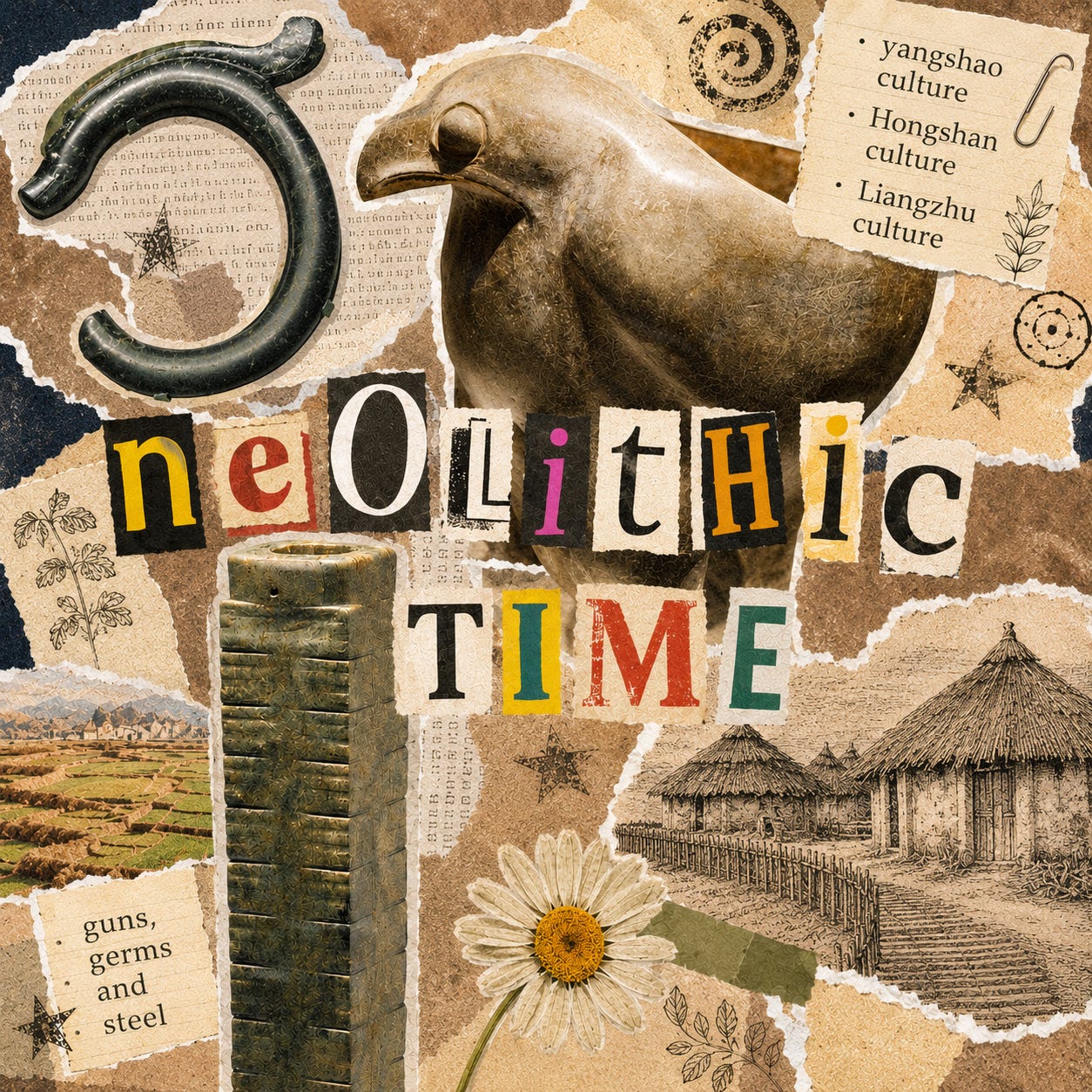
After my tour at the National Museum — specifically the Ancient China gallery, which holds 5,000 years of art — I kept thinking about a book I had to read for an American history class in high school, in Iowa: Jared Diamond’s Guns, Germs, and Steel. I fell asleep halfway through that class. But the amount of time that book kept being referenced later in my life emphasized a new way of interpreting the rise and fall of history. And now, standing in front of three key relics from three different prehistoric cultures, something clicked.
Diamond’s central argument is that geography determines what you can grow, and what you can grow determines how your society organizes itself, accumulates power, and ultimately whether it ends up conquering or being conquered. It’s a macro-scale argument about civilizational divergence.
These three Neolithic cultures emerged in overlapping centuries within what would eventually become China. Same geographical frame, roughly the same era, yet three completely different answers to the question of who holds power and why, based on what they ate and how they got it.
The Eagle-Shaped Pottery Ding | 鹰形陶鼎
Yangshao Culture | ~5000–3000 BCE | Yellow River Basin (Today Henan area)
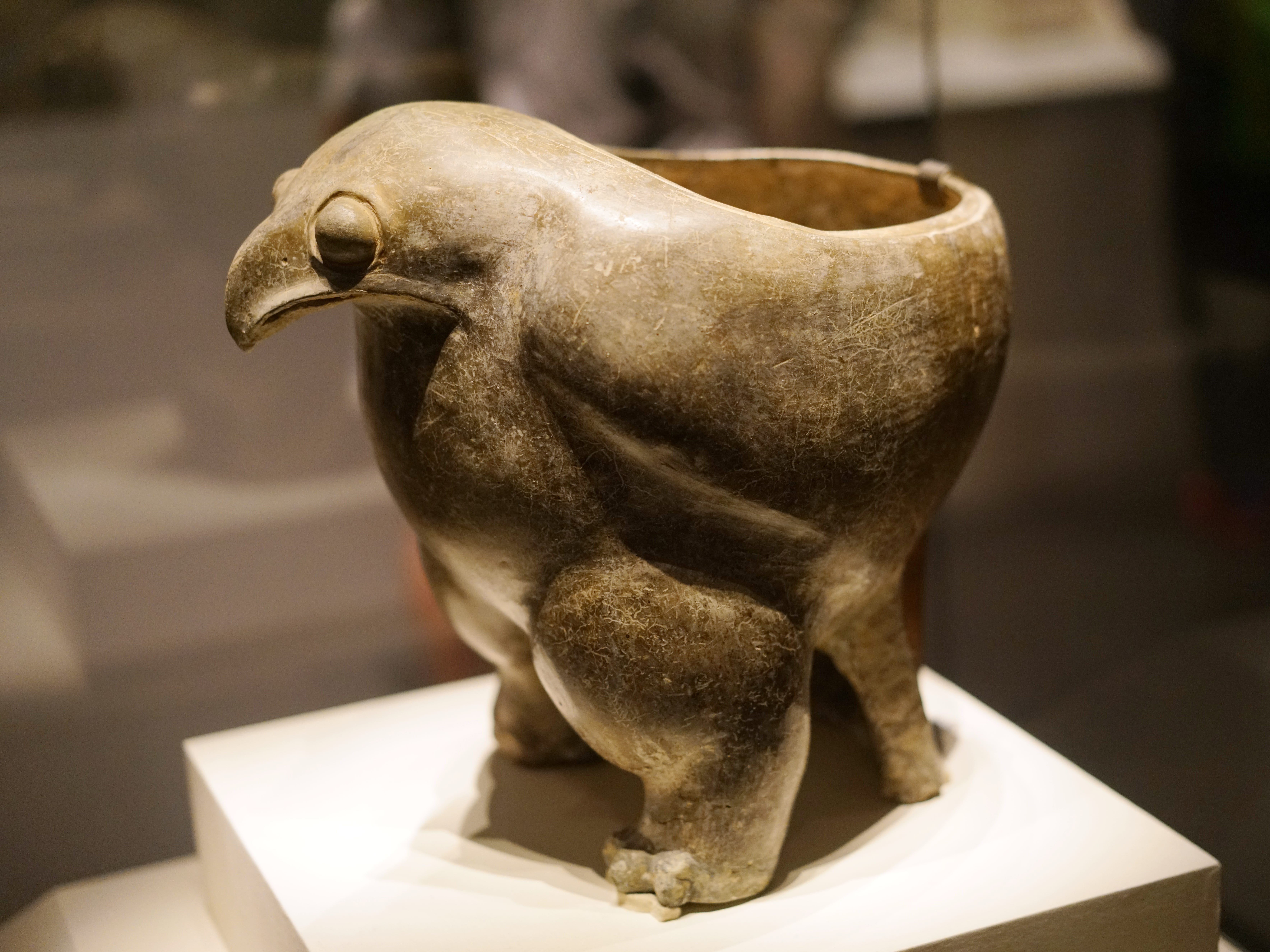
This is my favorite opener on the tour, because the eagle looks like something a child sculpted — squat, self‑satisfied, vaguely ridiculous. Apparently upon discovery, the farmer who found the relic thought it was a chicken feeder, in 2002, this pottery was included in China’s “irreplaceable list” of artifacts prohibited from being shown overseas. I once saw a short documentary about a woman trying to recreate an identical piece in her pottery studio, and how it retained some handprint of hers. It was weirdly intimate to think that this might be something people from 5,000 years ago made.
The Yangshao people were dry‑land farmers. Their main crop was millet — drought‑resistant, storable, and predictable. That predictability changes everything. When food is reliable, you don’t need gods to intercede as urgently. You need administrators. Someone to count the grain, allocate labor, manage the surplus. Their burial goods reflect this pragmatism. Jade artifacts are extremely rare in Yangshao tombs (far fewer than in Hongshan or Liangzhu) and the few that appear are mostly yue axes, symbols of military authority. This was a kingship built on practical governance, not ritual spectacle.
The Red Mountain Jade Dragon | 红山玉龙
Hongshan Culture | ~4700–2900 BCE | Northeast China (Today Inner Mongolia area)
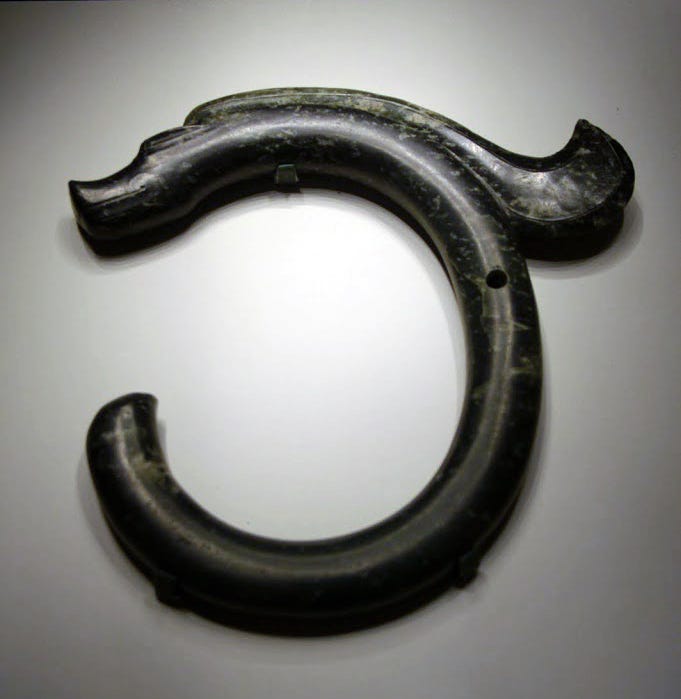
The Hongshan jade dragon is an C-shaped coiled form, carved from a single piece of nephrite, with no eyes, no scales, no horns, just pure, clean form. One of my past client has remarked that it looked like a fetus. It was found in a ritual burial, and was worn close to the body, probably by a shaman or a priest-chief.
The Hongshan people lived in the northeastern river valleys, today would be Liao River around Inner Mongolia area. They farmed, but they also fished, and is unpredictable. When your survival depends on forces beyond your control, you invest heavily in people who claim to mediate those forces, like the shaman. The jade dragon is designed to communicate with something beyond the human. Therefore power in Hongshan culture wasn’t held by the person who counted the grain, it was held by the person who knew how to talk to the sky.
The Jade Cong | 玉琮
Liangzhu Culture | ~3300–2300 BCE | Yangtze Delta (Today Hangzhou area)
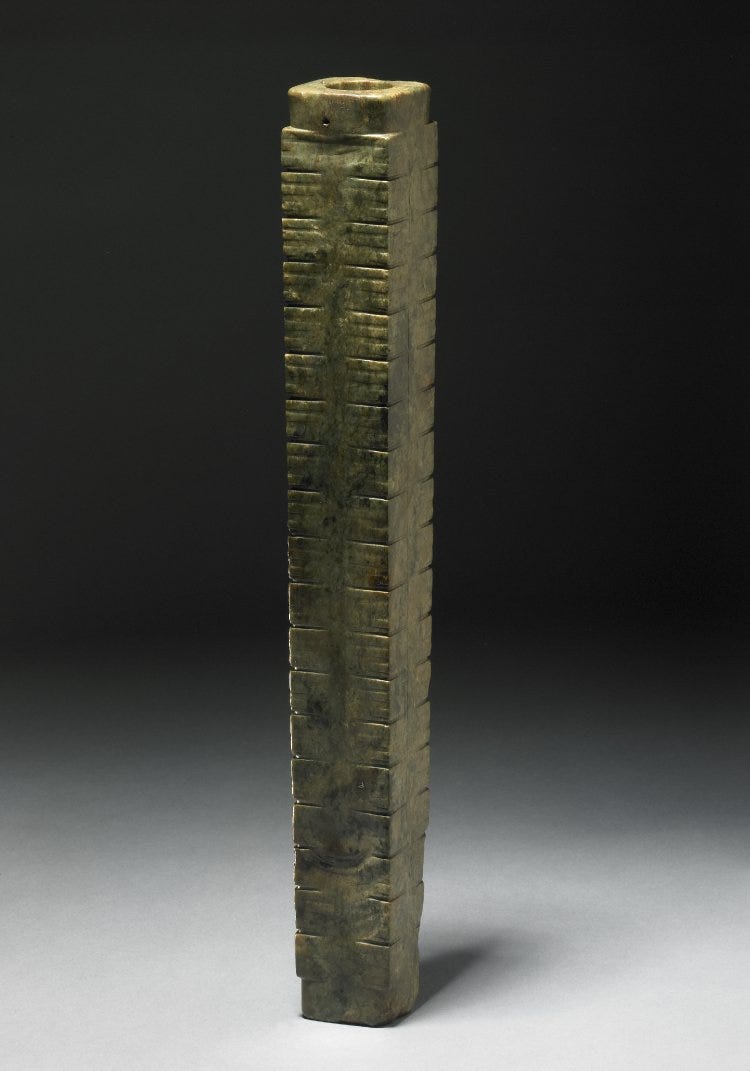
The jade cong is geometrically severe: a square outer profile, a cylindrical inner bore, carved with abstract masks that are simultaneously human and divine. The Liangzhu people grew rice. More importantly, they built hydraulic infrastructure to grow it — a system of canals, dams, and water‑management works covering hundreds of square kilometers, identified by archaeologists only in the last decade. UNESCO inscribed the Liangzhu site in 2019 partly on the strength of this engineering legacy (well worth a visit in Hangzhou, a beautifully preserved site with excellent educational exhibitions).
Rice agriculture in a river delta requires collective coordination at a scale that neither millet farming nor fishing demands. You can’t just build your own irrigation channel, the whole system has to work together. This creates a very specific kind of power: technocratic, institutional, hierarchical in a functional rather than symbolic way. But also deeply connected to ritual, because controlling the water meant claiming the mandate to do so. The cong synthesises both. Square (earth) containing circle (heaven): a universe in your hands, and the engineering knowledge to manage it.
According to the prominent Chinese archaeologist Li Boqian: “Societies dominated by divine power — like Hongshan and Liangzhu — poured enormous wealth into ritual and jade production, consuming excessive social surplus and eventually becoming unsustainable. Yangshao, which emphasized royal and military power, was more pragmatic and focused on social reproduction, which allowed it to continue and develop into a higher stage of civilization.”
Li Boqian’s observation fits Diamond’s framework remarkably well. Choices rooted in geography and subsistence set cultures on different trajectories. Some built for permanence; others built for transcendence. Only one of those strategies, it turns out, outlasted the Neolithic.
Hongshan, home to China’s earliest jade dragons, lies only 1.5 hours from Beijing by high-speed rail. Perfect for a half-day retreat into the Neolithic. Message me if you are interested.
Next issue: The oracle bone that recorded a rainbow, China’s earliest language of divination and fate.
Reference (参考文献)
· Diamond, Jared. Guns, Germs, and Steel: The Fates of Human Societies. W. W. Norton & Company, 1997.
· Li Boqian (李伯谦). 文明模式的选择与文明进程 (“The Choice of Civilizational Models and the Process of Civilization”). 相关访谈及论文,北京大学震旦古代文明研究中心。
· National Museum of China. Ancient China Basic Exhibition (展品说明与考古资料)。
· UNESCO World Heritage Centre. Liangzhu Archaeological Site. Inscribed 2019.
· 央视纪录片《如果国宝会说话》,相关各集(陶鹰鼎、红山玉龙、良渚玉琮)。
· Zhejiang Provincial Institute of Cultural Relics and Archaeology. Liangzhu: A 5,000‑Year‑Old Civilization, 2019.
Comments
Nothing yet. Say the first thing.
Sign in to join the conversation.