
Ok…took a little detour the last couple of weeks but we are back deep diving into the world of 3D Automotive Design!
This week we are going to be looking at one role and one role only in this world: The CMF Designer.
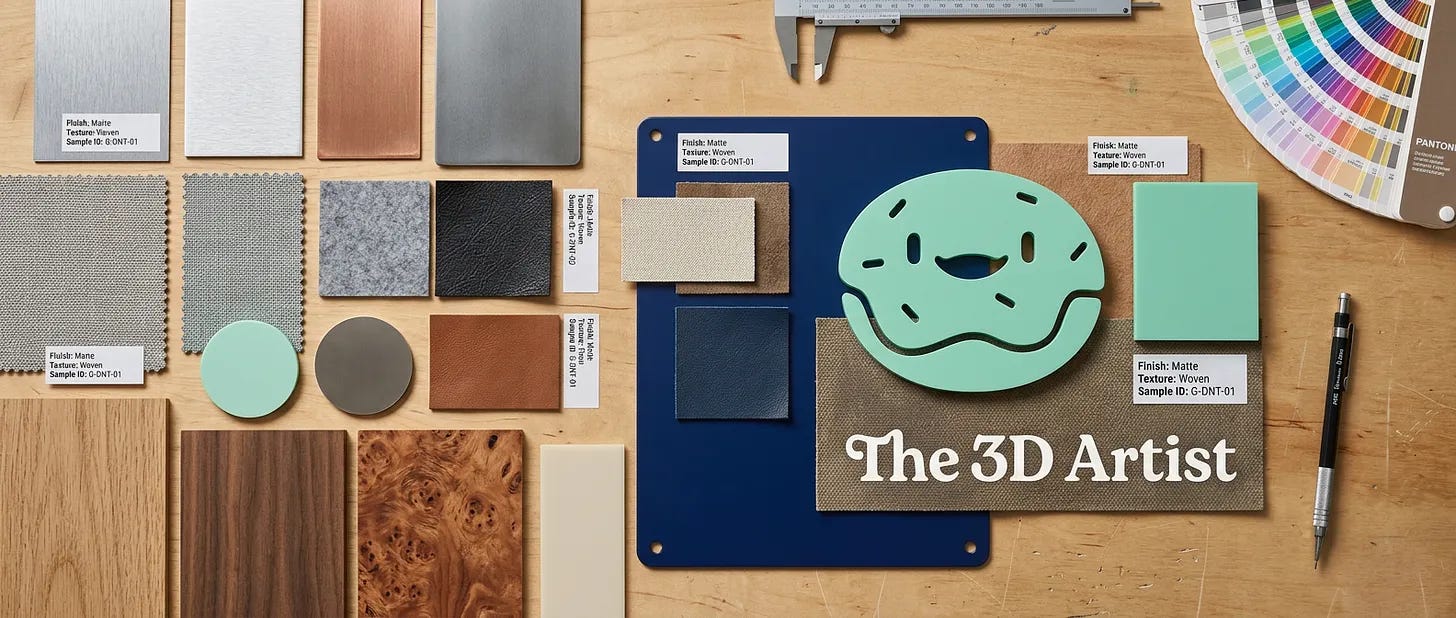
CMF stands for Color, Material, and Finish. I wrote a whole primer on the role a while back, because the title shows up across industries: fashion, footwear, consumer electronics, product design. The fashion series covered how CMF designers own the material language of a garment line. The product visualization series touched on how they define surface accuracy for consumer goods. Automotive CMF is the same discipline turned up to its highest difficulty setting.
In a car company, CMF designers own everything you touch, sit on, and look at. The leather grades and where each grade goes, the stitching pattern on the seat bolster, the grain on the dashboard, the knurling on the volume knob, the gloss level on the center console, and, of course, the paint. A single vehicle might ship with dozens of trim combinations, and each is a set of deliberate CMF decisions that someone had to visualize, defend, and get approved.
Nearly every image a CMF designer creates will never be seen by the public. Not the paint studies, not the interior explorations, not the hundred variations of gray leather. These images exist for one purpose: to let people inside the building make decisions. The renders are arguments in a meeting, not content for a campaign.
If you come from film, games, or commercial work, this might be an adjustment. Your entire training points toward making the image as compelling as possible. Cheat the light, nudge the saturation, scale the texture so it reads better in the frame. Every instinct you have was built for an audience that wants to feel something.
CMF work runs counter to the instinct. The render’s only job is to be the true version of the material, never the best version. If you scale a leather grain slightly because it looks better in the render, you have not improved the image. You have broken it. An executive is going to look at that image and approve a seat that does not exist. Six months later a physical sample arrives, the grain reads completely differently at real scale, and now there is an expensive conversation about why the thing everyone signed off on is not the thing in the room.
I learned this the embarrassing way when I first started working with CMF teams during my time at Adobe. My background is animated film. I spent years lighting shots to make audiences feel something, and I brought that muscle memory with me. For a CMF review, that’s contamination. The whole value of the image is that people can trust it, and every artistic liberty quietly spends that trust down.
So what does a CMF designer, or the 3D artist embedded in a CMF team, actually do all day? A surprising amount of it is capture and translation.
Physical materials come first. Suppliers send samples constantly: leathers, textiles, plastics, foils, paint plaques. Camille Audra, a CMF designer at Volvo, describes a typical day starting with reviewing supplier samples from ongoing developments, then evaluating color combinations outdoors in natural light and inside actual cars. One of the most digitally advanced design organizations in the world still walks outside to check color in sunlight, because they know exactly how much a lighting environment can lie.
Those physical samples then need digital twins. This is where the scanning workflow lives. Appearance scanners like X-Rite’s TAC7, HP’s Captis, and Vizoo’s xTex systems capture how a material actually responds to light: its color, its gloss, its texture, the way paint flakes sparkle as the viewing angle changes. The output is usually an AXF file, a format designed to carry measured appearance data rather than an artist’s interpretation.
But a scan is not a finished material. Someone has to process it. Check the scale against the physical sample, verify the color against the Pantone reference and the supplier’s master standard, and confirm the material behaves correctly across render engines, because a fabric that looks right in VRED and wrong in the configurator pipeline is wrong. This is meticulous, unglamorous work, and it is exactly the kind of thing that separates people who can make pretty renders from people automotive companies actually hire.
The toolset will be partly familiar. VRED sits at the center of most automotive review workflows. It’s an Autodesk tool discussed in Deep Dive 3 about tooling. 3ds Max, Blender, and Maya all show up depending on the studio. Substance 3D tools like Painter, Sampler, and Designer appear throughout the material pipeline. KeyShot handles fast design-review renders. And increasingly, the reviews themselves happen in VR, with designers and executives standing inside a full-scale virtual interior comparing trim options in real time. Being comfortable presenting inside a headset, and building assets that hold up when someone leans in close to inspect the stitching, is quickly becoming part of the job description.
One more detail from the hiring side that I love: some automotive CMF postings require candidates to pass the Munsell Hue Test, a formal test of color discrimination.
You got to have them good eye balls.

Every specialty has its hardest problem. For CMF, and honestly for material rendering in general, it is car paint.
Start with what paint actually is. The finish on a modern car only looks like one surface. Underneath, it’s a stack. An electrocoat layer bonded to the metal for corrosion protection. A primer for smoothness and adhesion. A basecoat that carries the color, and in metallic or pearlescent paints, millions of microscopic aluminum or mica flakes suspended in it. And a clearcoat over everything, because this object lives outside, in UV and salt and gravel, at highway speeds, for a decade or two.
Each layer does something optically. Light entering car paint travels into the stack, ricochets off flakes at different depths and orientations, and comes back out changed. That is why a metallic paint sparkles differently as you walk past it, and why the color seems to shift between the crown of a fender and the shadow under a door handle. Candy and tinted-clearcoat finishes push this even further: the clearcoat itself carries a hue, so light passes through a colored lens, hits the metallic base, and returns through the lens again. Depth is the entire point of the effect, and depth is precisely what a single-layer shader cannot fake.
Then add the industrial reality. Every automaker treats its paint formulas as closely guarded intellectual property. Each company processes and applies paint its own way, which means “silver” is never generic. There is only that company’s silver, applied through that company’s process, and the CMF team is accountable for the digital version matching the physical plaque under every lighting condition someone might judge it in. Cloudy day, direct sun, showroom, garage.
When people ask why automotive visualization is considered its own specialty, this is the answer. The paint alone is a career.
If you are reading this thinking the gap between your background and this world is too wide, let me introduce you to some actual automotive CMF leaders.
Dan Fidgett runs CMF design at Volvo as Vice President. He spent more than fifteen years in fashion and sportswear at Puma and Adidas before moving to cars. In interviews he talks about bringing a consumer-first mindset and trend fluency from fashion into automotive, and about materials like woven flax and recycled denim showing up in the EX30’s interior. The pipeline from fashion CMF to automotive CMF runs all the way to the VP level.
And for entertainment artists: if you have spent years as a lookdev or material artist making surfaces respond believably to light, you have been training for this the whole time. The software overlaps, the eye overlaps, but what changes is the goal. You stop performing for an audience and start reporting to a decision. Some of the strongest automotive material artists I met during my Adobe years came out of VFX and animation, and the ones who thrived were the ones who could put down the instinct to embellish.
Strip away the renders, the scans, and the material libraries, and what a CMF designer actually produces is trust. When the head of design looks at a screen and approves a $200 million interior program, they are trusting that what they see is what the supplier will deliver, what the factory will produce, and what a customer will run their hand across three years from now.

That trust is built one accurate material at a time, in thousands of images nobody outside the building will ever see. There is no portfolio piece at the end, no credit in a trailer, no post going viral. Just a car rolling off a line somewhere, looking exactly the way a room full of people agreed it would, because somebody’s renders told the truth.
We spend a lot of time in this field chasing images people will look at. There is something clarifying about a job where the entire measure of the work is whether people can believe it.
Join The 3D Artist Community on Skool
New 3D Artist swag is here!
We ran a design contest inside the community, and Randy Mills took it home with a CMYK sweatshirt design that’s honestly too good not to wear.
Grab yours today.



Get the Newest 3D Artist Swag!!
3D Digital Twins for Marketing and Physical AI, delivered - Rapid Pipeline
At SIGGRAPH, NVIDIA Advances Graphics and Simulation With Agentic and Physical AI - NVIDIA
From generation to direction: Autodesk launches 3D Editor + Canvas within Flow Studio - Autodesk News
Armature is a free AI-assisted standalone character rigging tool - CG Channel
Games industry mergers and acquisitions reportedly hit US$2.3 billion in Q2 2026 - ScreenHub
Mixos launches online 3D Painting app - Mixos
3D Generative CAD Announcement - LinkedIn
Link to Google Doc With A TON of Jobs in Animation (not operated by me)
Hello! Michael Tanzillo here. I am the Head of Technical Artists with the Substance 3D team at Adobe. Previously, I was a Senior Artist on animated films at Blue Sky Studios/Disney with credits including three Ice Age movies, two Rios, Peanuts, Ferdinand, Spies in Disguise, and Epic.
In addition to his work as an artist, I am the Co-Author of the book Lighting for Animation: The Visual Art of Storytelling and the Co-Founder of The Academy of Animated Art, an online school that has helped hundreds of artists around the world begin careers in Animation, Visual Effects, and Digital Imaging. I also created The 3D Artist Community on Skool and this newsletter.
www.michaeltanzillo.com
Free 3D Tutorials on the Michael Tanzillo YouTube Channel
Start writing today. Use the button below to create your Substack and connect your publication with The 3D Artist
Thanks for reading The 3D Artist! Subscribe for free to receive new posts and support my work. All views and opinions are my own!
No posts
Comments
Nothing yet. Say the first thing.
Sign in to join the conversation.