
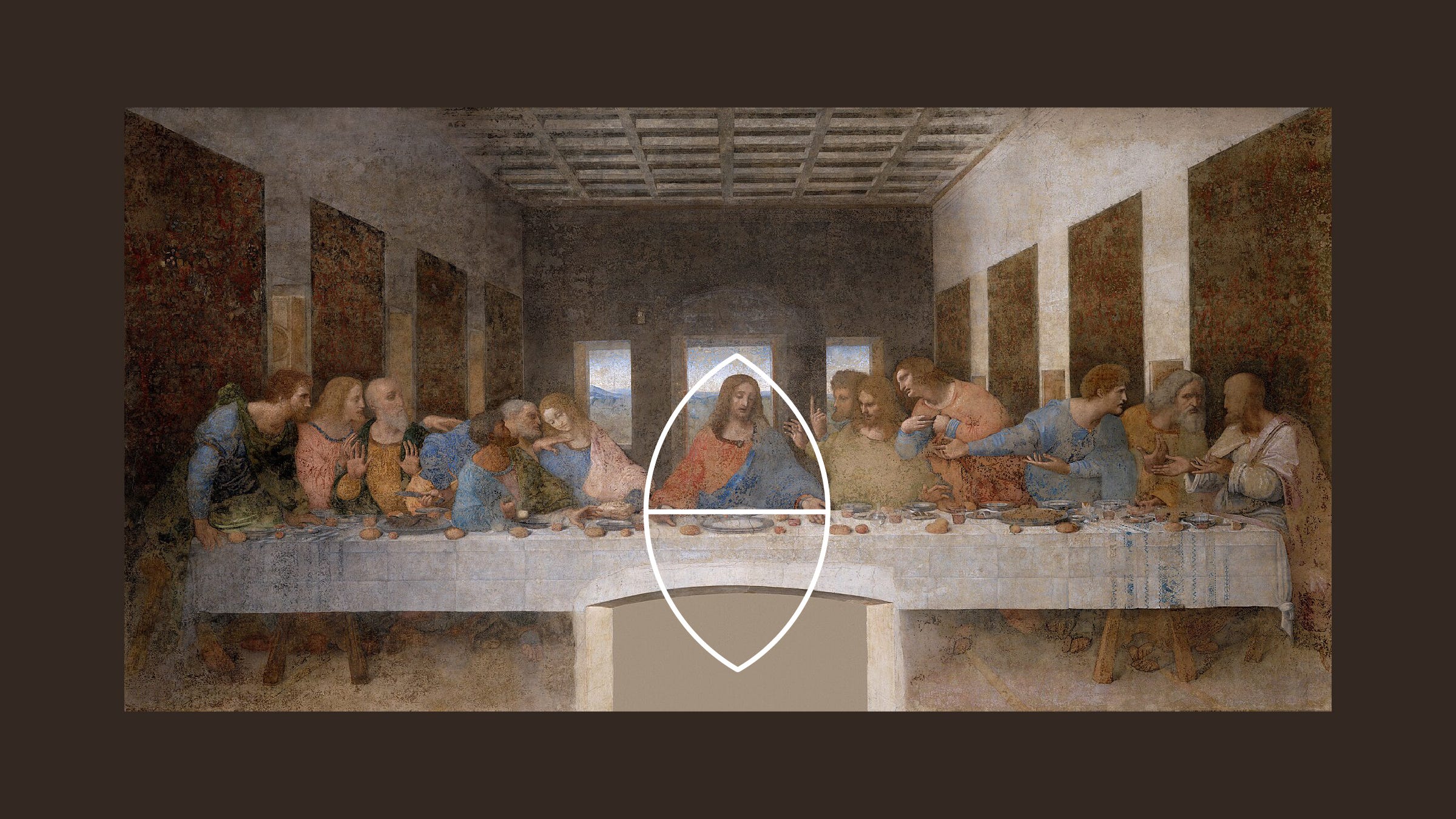
Dan Brown's The Da Vinci Code popularized the idea that the apparent absence of the legendary Holy Grail from Leonardo's Last Supper was intentional, drawing on the earlier, unsubstantiated theory advanced by the authors of The Holy Blood and the Holy Grail (1982), who argued that the Grail was not an actual vessel but the womb of Mary Magdalene, carrying the child—and thus the bloodline—of Jesus. [See: The Da Vinci Code movie clip]
My view is quite different. Since 2016, I have understood the mythological Holy Grail not as a literal drinking vessel, but as the immortal geometric vessel, virgin womb, and eternal law (sanatana dharma) of the vesica piscis and its indwelling radius or Divine Son.
For those who are not familiar with my work, the short history of how I came to this view is as follows. At the age of 24, in 1993, I came across the supramental yoga and writings of Sri Aurobindo, and immediately had the distinct feeling that not only was he my spiritual guide and family, but that his yoga and yogic mission and mine were one and the same. I did not know at the time that his mission (or mine) included recovering the lost sense, secrets, and eternal law of the Rig Veda. After 23 years of studying his teachings and the teachings of his collaborators (the Mother and Thea), the vesica piscis progressively revealed itself to me as the KEY to deciphering the ancient mystery of the zodiacal Vedic poetry. Simultaneously, it revealed itself to be a unifying key of a wide range of myths, symbols, and religious traditions, including those surrounding the pouring out of, or quest for sacred waters or the nectar of immortality (amrita), such as the quest for the Holy Grail, as well as the biblical Revelation of the river and “fountain of the water of life,” and the mythology of the pouring out of the purifying immortal waters of the Aquarian Water Jar.
The height of this revelatory process was coming to see, while looking at the curve of a dry creek, that the Vedic RIVER is a symbol of the arc or path of the vesica piscis flowing through the inner space of the zodiacal circle. With this flash of Vedic insight, I could see that the “seven rivers” (mothers, sisters, cows, mares, floods, paths, etc.) of the Vedic Hero-Son were the first seven vesicae piscium of the Zodiac, measuring out the entrance into the sign of Aquarius, known as Kumbha in India. Kumbha is one of the names the Vedic Poets gave to the zodiacal Water Jar, Pitcher, Pot, etc. Other Sanskrit names for this Water Jar found in the Rig Veda include: kalaśa (pitcher or beaker), camasa (cup), droṇa (wooden trough or vat), kośa (receptacle, cask), pātra (vessel), kavandha (cask, barrel, container), udriṇa (cask or reservoir), and samudra (reservoir, sea, or ocean).
I could see that the sacred vessel of the Vedas is not simply an eternal geometric form. It is the geometric form that—together with its indwelling Divine Son/Radius and the Earth's equinoxes and solstices—measures out the twelve months of the Zodiac as well as the long-forgotten zodiacal location of the Divine Son’s sevenfold birth, victory, or apocalypse, by whatever name.
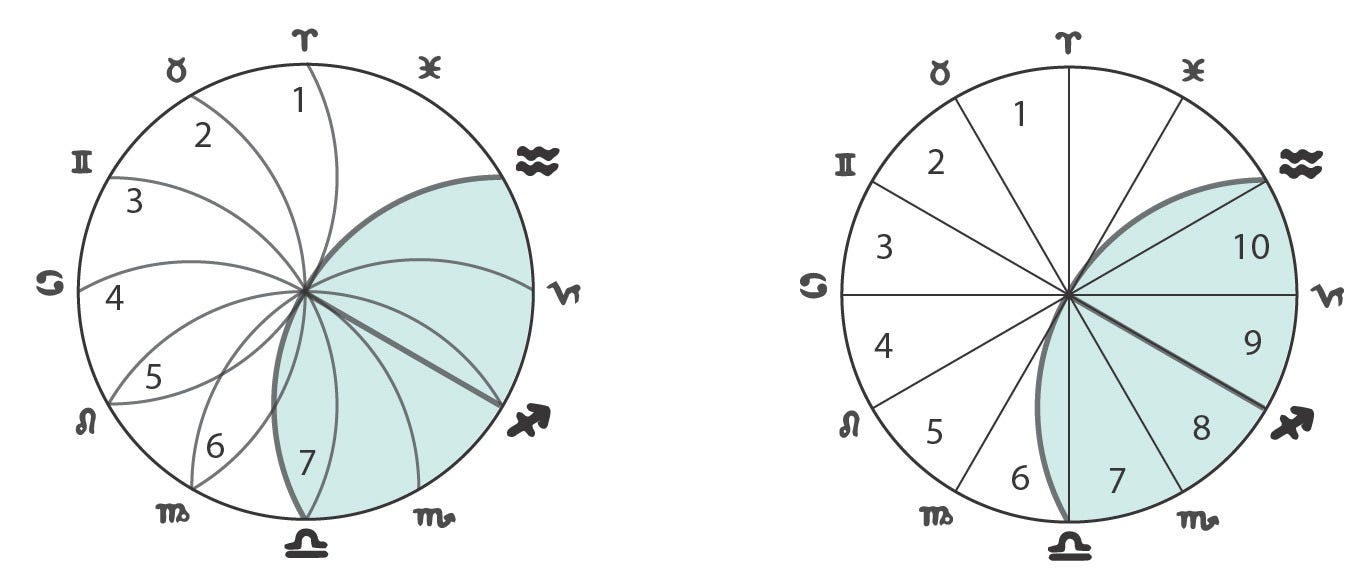
“BORN like a youngling he [= the Immortal Son Agni as the Sagittarian Sage/Stallion Soma Pavamana] hath clamoured in the wood [elsewhere ‘in the wooden vessel’], when he, the Red, the Strong, would win the light of heaven. He comes with heavenly seed that makes the water swell: him for wide-spreading shelter we implore with prayer. A far-extended pillar that supports the sky the Soma-stalk, filled full, moves itself every way.... Soma assumes white colour when he strives to gain…. Down the steep slope, through song, he comes to sacrifice, and he will burst the water-holding cask [divás kavandham... udríṇam] of heaven, Yea, to the shining milk-anointed beaker [kalaśa], as to his goal, hath stepped the conquering Courser.” — Rig Veda 9.74, excerpts, tr. RTH Griffith [Text in brackets and bold emphasis mine]
This zodiacal journey or quest of the Divine Son or Hero to the Holy Grail or Kumbha of Aquarius—via his form, vehicle, vessel, womb, mother, path, or seed of the vesica piscis—was lauded in so many varied and veiled ways by the Vedic Rishis that those unfamiliar with the zodiacal context of the poetry would simply never be able to understand what in the world they were actually describing. As evidenced in the language of the Rishis, their poetry and gnosis, and the location of the singular victory—hidden by its many descriptions—was an intentional mystery and puzzle, meant to be solved in and via the 360° course of the zodiacal Year/Yajña.
“I ask thee of the earth’s extremest limit, where is the centre of the world, I ask thee. I ask thee of the Stallion’s seed prolific, I ask of highest heaven where Speech abideth. This altar is the earth’s extremest limit; this sacrifice of ours is the world’s centre. The Stallion’s seed prolific is the Soma; this Brahman highest heaven where Speech abideth. Seven germs unripened yet are heaven’s prolific seed: their functions they maintain by Viṣṇu’s ordinance. Endued with wisdom through intelligence and thought, they compass us about present on every side…. Upon what syllable of holy praise-song, as twere their highest heaven, the Gods [take their seat],—Who knows not this, what will he do with praise-song? But they who know it well sit here assembled…. [1]
“They call [the Divine Hero-Son] Indra, Mitra, Varuṇa, Agni, and he is heavenly nobly-winged Garutmān. To what is One, sages give many a title they call it Agni, Yama, Mātariśvan. Dark the descent: the birds are golden-coloured; up to the heaven they fly robed in the waters. Again descend they from the seat of Order, and all the earth is moistened with their fatness. Twelve are the fellies, and the wheel is single; three are the naves. What man hath understood it? Therein are set together spokes three hundred and sixty, which in nowise can be loosened. That breast of thine exhaustless, spring of pleasure, wherewith thou feedest all things that are choicest, wealth-giver, treasure-finder, free bestower,—bring that, Sarasvatī, that we may drain it. By means of sacrifice [=the twelve-month zodiacal Yajna/Year] the Gods accomplished their sacrifice: these were the earliest ordinances.” — Rig Veda 1.164.34-39; 46-50 excerpts [2]
In Rig Veda 9.86, the sevenfold destination of the zodiacal Sage is specifically named “the waters’ lap” (upām upasth)—i.e. the waters’ vessel (kumbha)—as well as ṛtasya yonau, indicating the womb, source, or seat of ṛta (truth/order), which Griffith translated as “the place of sacrifice.”
In 2016, 144 years after Sri Aurobindo’s birth and in week of Thea’s passing, the geometric key, sacred syllable, and Holy Grail of this Vedic mystery or quest was simply dropped into my consciousness. From that astonishing point onwards, the Rig Veda, and all related pre- and post-Vedic symbolism, as well as the odd course and unfolding of my life—including a wide and wild variety of premonitory dreams—made increasingly perfect and cohesive sense.
Now in 2026, after discussing the incarnational continuity between Sri Aurobindo and Leonardo da Vinci, and investigating the sacred geometry of Leonardo’s Last Supper painting—identified in 2005 by my mentor Patrizia Norelli-Bachelet (Thea) as a veiled display of Leonardo’s zodiacal gnosis—it appears to me that the occult Holy Grail of Leonardo’s Last Supper is the vesica piscis itself—i.e. the Vedic and astrological Kumbha—held firmly in the hands of Leonardo’s Divine Son, as shown in Fig. 1 above. Note, as discussed in my previous series—The Sacred Geometry & Sanatana Dharma of Leonardo da Vinci’s Salvator Mundi—the Salvator Mundi painting attributed to Leonardo in 2011, also contains in itself the occult key, measure, and Holy Grail or sacred vessel of the vesica piscis.
Comments
Nothing yet. Say the first thing.
Sign in to join the conversation.