
As we begin to think about medieval-style lettering to label our dye plants, it is important to realize that dyers working in the Middle Ages would never have been capable of this task. Less than six percent of the population could read, and even fewer could write.
Most readers were in monasteries, the last bastions of literacy during that time -- but even there, a fair number of brothers knew little more than the shapes of the letters. Recent studies indicate that some of the scribes who copied out manuscripts were only working mechanically, repeating the shapes they saw before them, and were incapable of deciphering their meaning.
Still, every business in the village displayed a sign above the door. These signs were pictographs, not lettered: a tailor might have a large pair of scissors hanging over the entrance of his shop, a blacksmith might have the painted image of an anvil.
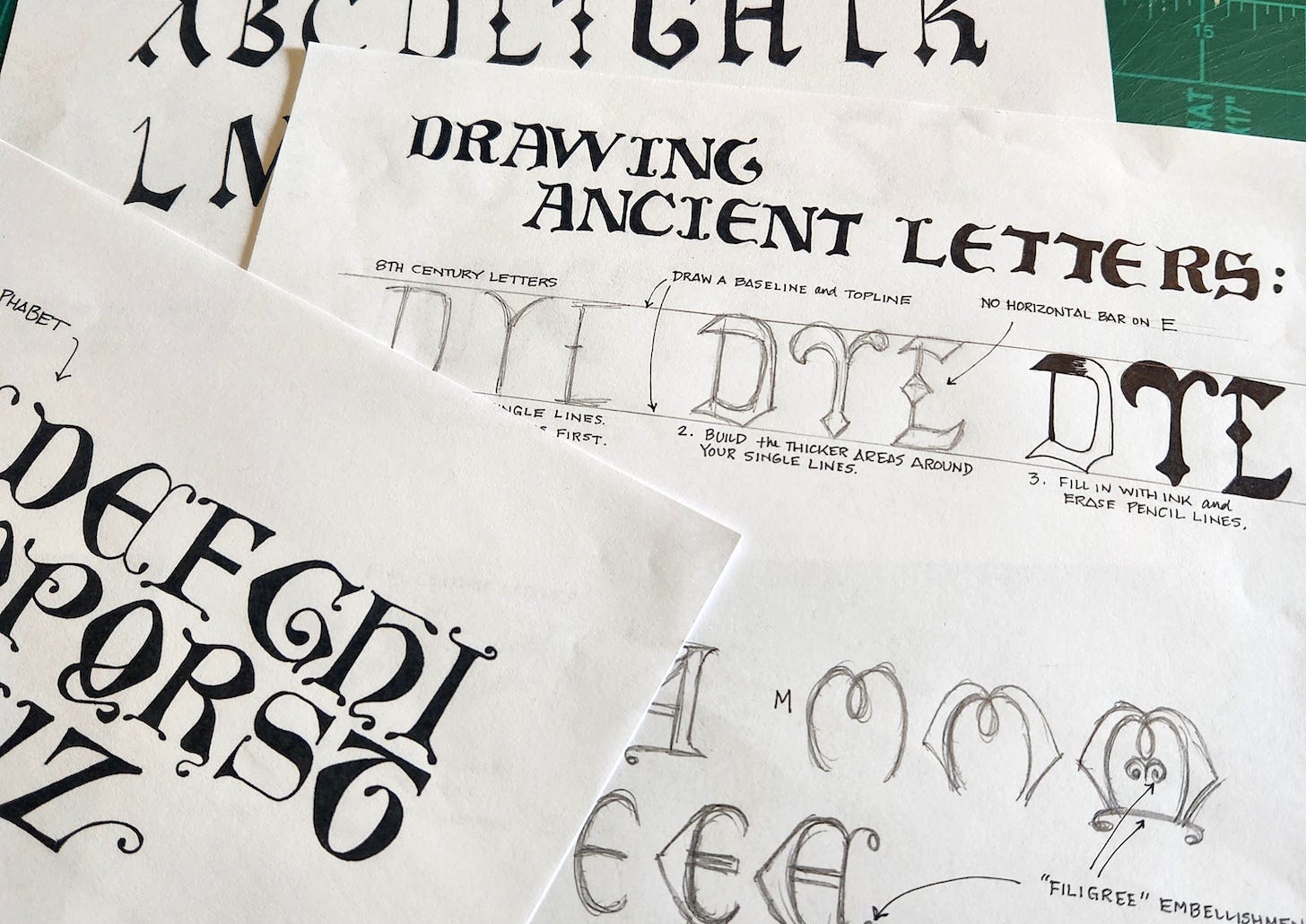
The letters on today’s printables come from three sources associated with the medieval period: an early 8th Century manuscript, a 14th Century decree in the British Museum, and a modern-day decorative alphabet influenced by texts from that time. There was no J or W, but it’s easy to flip an M to provide a W, and likewise to draw a curved tail on the letter I to create a simple J.
The main thing to remember is that medieval tools and methods were not precise. Lettering had a slightly rough or rustic look (which complements our plant subjects very nicely). Don’t make your lettering too tidy. :)
Comments
Nothing yet. Say the first thing.
Sign in to join the conversation.