
I’ve come here to tell you about a wine with no name. It wasn’t a Barbaresco, but it might have tasted the same …
Upgrade to Paid: Every paid subscription helps sustain our work at The 30 Second Wine Advisor. We appreciate you! Click here now to subscribe.
I should offer apologies for riffing on the folk-rock band America’s 1972 hit, A Horse With No Name, but this is one of those sorry-not-sorry situations. This week’s featured wine made me smile because it was so good, and it made me laugh, sort of, because its surprisingly uninformative label took a while to figure out.
So today I offer you the story of a wine nerd’s deep dive into discovering the story behind a delicious, obscure wine, that didn’t give away much from its label.
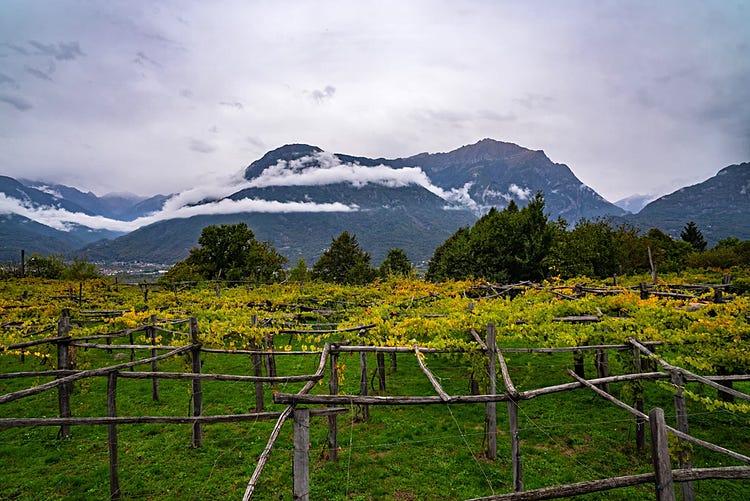
The Italian-Swiss Alps loom over pergola-trained vineyards in the Val d’Ossola in this image from Prünent, the Heroic Nebbiolo, by DEA, a small family producer of wine, honey, and saffron in the Val d’Ossola.
The single word “Munaloss” in a simple black serif font tops the front label, unadorned and white as printer paper. Below that, a pair of merging triangles suggests mountains. And at the bottom, the sans-serif “cantineGarrone” suggests a producer’s name.
Turn the bottle to the side, and we find a section in mostly tiny type in Italian: This is a red wine, contains sulfites, and is bottled by Cantine Garrone in Domodossola, Italy, a company that supports APAO, an organization long committed to sustainability and the development of mountain viticulture.
This tells us a little more, but leaves some basic wine questions unanswered: What’s a Munaloss? What grape is this made from, what’s the vintage, and where in Italy does it come from? A back label adds that it contains 12.5% alcohol, and that it’s imported by Kermit Lynch.
Finding the name of the always reliable Kermit Lynch sets us on the right track. A quick visit to the importer’s website, a short search for other resources, and we learn that this is an interesting wine indeed.
Cantine Garrone, it turns out, is in the Val d’Ossola (aka Valli Ossolane), a tiny region high up in the Italian Alps, bordering Switzerland on the northern edge of Piemonte. Locals claim that the Nebbiolo grape originated there, where it’s called Prünent, a variety that constitutes 80% of this wine. The remainder is sourced from Croatina, a dark, fruity red grape that’s also native to Northern Italy.
The grapes are grown by more than 40 individual growers from across the region, and, because it’s labeled as a simple table wine, regulations forbid a geographical or varietal label or a specific annual vintage, although an obscure “Lot MUN23” on the back label hints at a 2023 vintage. All this helps us grasp the obscure nature of this wine with (almost) no name.
It’s made by natural techniques, too, although it doesn’t declare itself a natural wine either . The grapes are hand-harvested, spontaneously fermented, macerate for a week to 10 days in stainless steel before pressing, then aged in stainless steel for a full year before being bottled unfined, unfiltered, and with minimal sulfiting.
Finally, how about that strange, not-too-Italian-sounding name “Munaloss”? Get ready for it: Historically, the local red wine was called “Ossolanum,” but regulators were uncomfortable with a name that was similar to the Valli Ossolane appellation. So the Garrones simply reversed the word Ossolanum, dropped the “O” that was now on the end, and came away with a new name with deep but subtle ties to its history.
“Delicious younger-vine Prünent blended with Croatina produces an immediately enjoyable, low-tannin red of character,” writes Dixon Brooke on the Kermit Lynch website. “Not only is it versatile and mouthwatering, but it also helps to preserve the agrarian way of life in this area of Italy by including the fruit of like-minded small farmers in the surrounding mountain valleys who do not bottle their own wine.”
How do you feel whan you pick up a wine with a truly uninformative label? Put it back, irritated, or leap into the joy of Internet research and learning new things?
Because this week’s featured wine is priced well above $20, I have to leave it behind our subscription paywall. Because I buy all the wines I review at retail and do not accept wine samples or other gratuities from the industry, I rely on the support of paid subscribers to help cover the cost of the wines I review.
If you haven’t become a paid subscriber yet, I’d love to have your support. Click here for information on our paid-tier edition. Our free-to-all edition featuring a quality wine for $20 or less will return in its biweekly cycle next week.

Support The 30 Second Wine Advisor with your paid-tier subscription. For $5 per month or $50 for a year (a 17% saving), you’ll receive additional wine notes funded by your subscriptions, enjoy quick direct access through Substack for wine-related questions, and gain my real appreciation for your support.
Comments
Nothing yet. Say the first thing.
Sign in to join the conversation.