
Monday’s episode with Anjney Midha, Founder @ AMP PBC:
Download the full transcript:
My 6 key takeaways:
The Reason Why Mistral Will Be a $100BN Company
The US Cloud Act requires that any data workloads managed by an American company must be accessible to the US government. For European entities running mission-critical logistics or defense, sending that context across the border is a non-starter. This creates a massive opening for local, sovereign infrastructure partners like Mistral to handle mission-critical workloads at scale.
Why Every VC Missed Anthropic’s First Round
When Anthropic pitched their seed round, they got 21 “nos” from top-tier investors. The reason? A total lack of technical literacy. Most VCs at the time didn’t even know what GPT-3 was and couldn’t grasp the concept of “compute multipliers”: the idea that you could produce intelligence for 6x less cost per dollar of capital.
How a16z Became a Major Buyer of Compute
Early on, Anjney recognized that compute access was the primary bottleneck for new incubations. By using the A16Z balance sheet to procure compute through the “Oxygen program,” they built the deep industry relationships and infrastructure trust necessary to scale the independent ecosystem.
The CCP Has Done Such an Incredible Job in Catching Up
The AI race in China isn’t just about chips; it’s a full-stack systems co-design race. By integrating Huawei chips with localized compute and using “adversarial distillation” to capture gains from Western models, they are producing performance improvements that rival the best Western hardware.
We Are Not in an AI Bubble. We Are in a GPU Wastage Bubble.
The crisis isn’t a lack of AI capability; it’s a standardization crisis. Because compute is not yet fungible, meaning you can’t easily move a workload from an H100 cluster to a Blackwell cluster, billions of dollars in compute are currently sitting unutilized and “stranded”. We are essentially in the “1885 pre-standardization era” of the electricity grid.
What Makes Dario at Anthropic So Special?
Dario Amodei operates with the obsessive “truth-seeking” mindset of an applied physicist rather than a traditional computer scientist. His brilliance lies in an empiricist approach: running endless experiments to derive general laws of reality, combined with a “ruthless” mission alignment that refuses to take shortcuts for profit.
Thursday’s episode with Rory O’Driscoll, GP @ Scale, Jason Lemkin, Founder @ SaaStr:
Download the full transcript:
My 6 key takeaways:
The Incumbent’s Big Problem and Why the Saas-Pocalypse Might Be Fair
Incumbents face a “doom loop” by building AI products only 60% as good as specialized competitors. While internal teams are proud, the market won’t pay for mediocre “check the box” features. To avoid a slow death spiral, companies must build agents good enough to charge for independently, as a 60% solution must ultimately be free.
Why the Whole Moat Discussion Is Bullshit
Traditional moats often act as prisons for customers rather than magnets for new ones. Long-term contracts keep users trapped but fail to generate “agentic revenue” or market excitement. True growth requires moving beyond defensive barriers to lure customers through innovation, as “prisoners” do not drive meaningful expansion.
Silicon Valley Thinks They’re Reinventing the World and They’re Not
Silicon Valley’s “overwrought intensity” and grandiosity serve as a powerful rallying cry for talent. Even if visions of massive unemployment are “airy fairy bullshit,” this energy keeps the innovation machine churning and provides mission clarity. Investors should focus on whether this idealism motivates teams enough to build trillion-dollar market caps.
The Quantum Leap of Agentic Cybersecurity
Anthropic’s Mythos model marks a quantum leap by autonomously finding code vulnerabilities. This agentic approach is the difference between a rifle and a machine gun, spewing “bullets” across large codebases. We are entering a transition phase where security may worsen as every site becomes instantly scannable and breachable by bad actors.
The Trillion-Dollar Ad Race and the Shift to Enterprise
OpenAI’s goal of $53 billion in ad revenue by 2029 is a logical move for a consumer product. However, ads alone won’t sustain massive burn rates; enterprise intelligence likely represents two-thirds of AI’s total value. While consumers want entertainment, corporations are paying for “thinking” and cognition.
Why Efficiency is Now a Strategic Choice, Not Just a Metric
High revenue per head is now a deliberate choice enabled by AI agents. The new team evaluation test is no longer just about re-hiring, but whether you would rather replace a person with a trained agent. Founders who fail to improve efficiency risk becoming stable but irrelevant “value plays” like IBM.
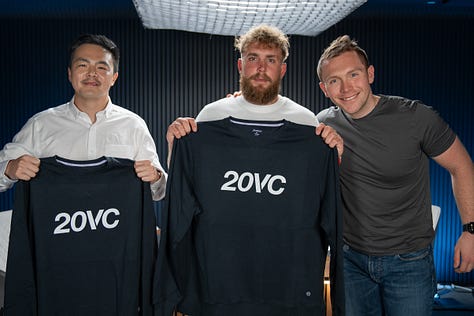
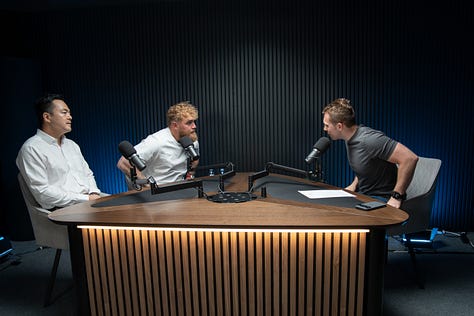
Saturday’s episode with Jake Paul & Geoffrey Woo @ Anti Fund:
Download the full transcript:
Behind the scenes:

Let us know what your big takeaways from this week’s shows were in the comments below!
Thank you for reading, and don’t miss the great guests we have next week:
Monday episode: Aaron Levie, CEO @ Box
Thursday episode: Jason Lemkin & Rory O’Driscoll
Saturday episode: Amjad Masad, Founder @ Replit
Thank you for reading 20VC.
This post is public so feel free to share it.
Thanks for reading 20VC! Subscribe for free to receive new posts and support my work.
Comments
Nothing yet. Say the first thing.
Sign in to join the conversation.