
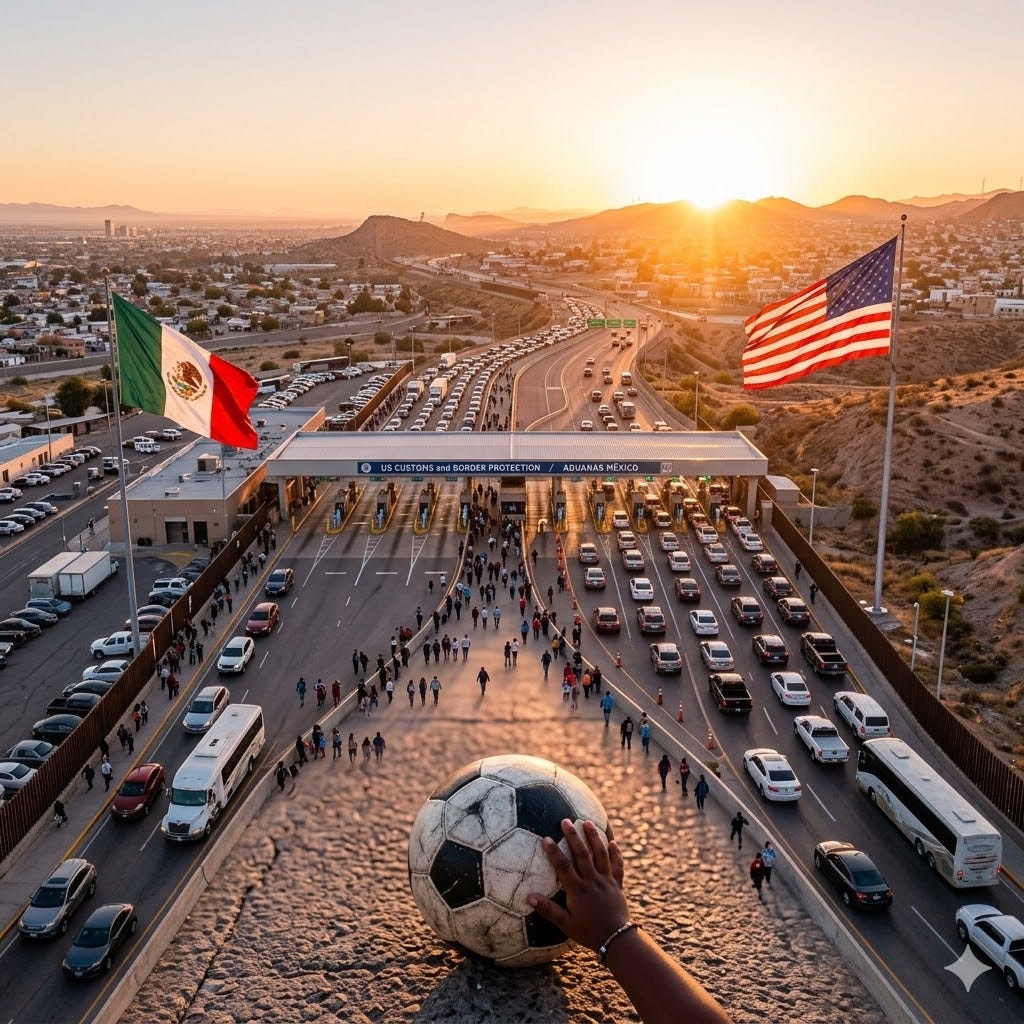
This week the border told three different stories, and none of them waited for permission. A former ambassador released a memoir admitting what he knew and stayed silent on while he still held the office to act. A Mexican president is demanding “irrefutable evidence” before extraditing a sitting governor accused of shielding a cartel, even as her own public overwhelmingly disagrees with the delay. And on a soccer field in Seattle, the United States men’s national team won its World Cup group for the first time since 2010, standing alongside a Mexican team doing the same. Accountability, sovereignty, and celebration, all playing out on the same line at the same time. That is the border. It does not wait for anyone’s book deal, press conference, or polling memo. It just keeps moving.
First time reading? Join thousands of intellectually curious readers. Sign up here.
I was in Mexico City last week, and one meeting at the US Embassy told me more about where this relationship is headed than any headline could. The conversation centered on technology, specifically the work underway to push back against Chinese surveillance and security technology that has quietly embedded itself across Mexican state and municipal governments. This is not an abstract policy debate. It is happening in command centers, camera networks, and procurement contracts in states up and down the country, and it has direct implications for border security cooperation between our two nations.
I am glad to see the United States taking a firmer posture here. Technology sovereignty is now a core pillar of trade policy, not a side issue, and Mexico’s security infrastructure is exactly the kind of sensitive ground where Chinese vendors should not have a foothold.
But hardware is only half the problem. A recent investigation into one of Mexico’s largest security technology vendors found that the company drew 95 percent of its revenue from government contracts, much of it funneled through a web of more than 60 related companies, some collecting commissions far above industry norms with little public record of what services were actually delivered. That is the other side of the technology fight: it is not enough to keep the wrong vendors out if the procurement system itself rewards opacity over results.
This is exactly the kind of structural reform conversation where firms like Intermestic Partners can help. Real technology partnerships between the US and Mexico need transparency built in from day one, not bolted on after the headlines hit. La rentabilidad del miedo: El negocio de la seguridad
Introducing the border art collection
I have spent my entire career at the intersection of two nations. I have sat across from diplomats, negotiated trade agreements, managed the busiest land ports of entry in the world, and walked the same desert ground that millions of people have crossed in search of something better. The border is not an abstraction to me. It is home.
For years, the walls of my office have told that story. Now I want to share it.
This week I am launching my Border Art Collection, a curated set of works that reflect the depth, complexity, and humanity of the U.S.-Mexico relationship. These are not decorative pieces. Each one carries a history, a people, and a point of view. The collection begins with the piece I consider the most fitting for where we stand today: a striking oil portrait of José Doroteo Arango Arámbula, the man the world knows as Pancho Villa, El Centauro del Norte.
Painted in July 2023 by artist Rita Amaya, the original hangs in my office in Phoenix. Every U.S. and Mexican business leader, diplomat, and official who walks through that door sees it. No one needs it explained. Villa was a fronterizo, a man of the border, who governed and operated across two nations as if boundaries were merely suggestions. He remains the only Mexican commander in history to launch a military invasion of the United States, forcing an American military response in 1916. He is complicated, defiant, and impossible to ignore, which is exactly what the border has always been.
Professional poster prints are now available for your home, office, boardroom, or any space where the U.S.-Mexico relationship matters. Visit my website for details, and follow along as the collection grows.
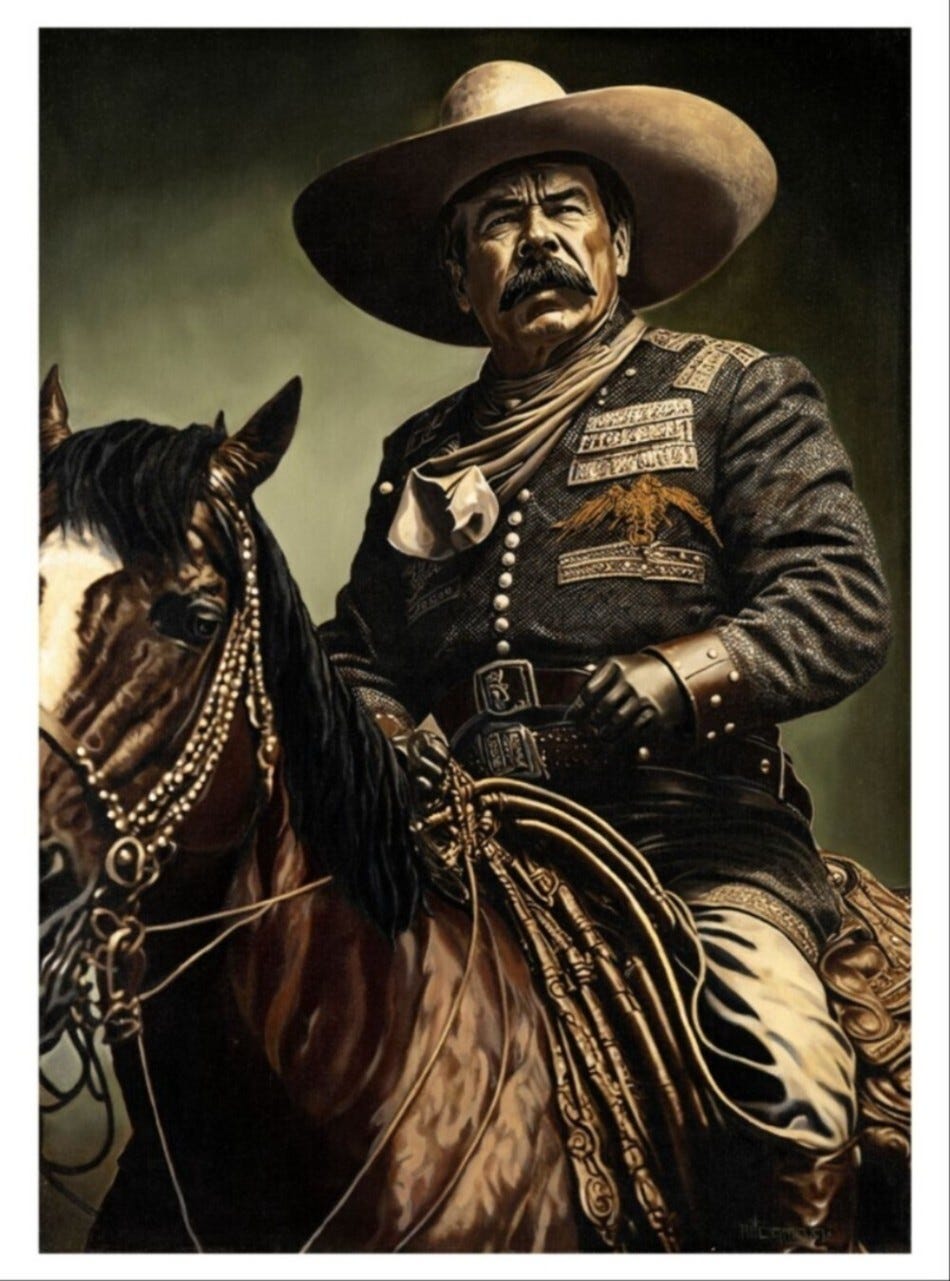
Pancho Villa - El Centauro del Norte
Born José Doroteo Arango Arámbula in Durango, Mexico, Villa commanded the largest military force of the Mexican Revolution, governed the border as if boundaries were suggestions, and remains the only Mexican commander to launch a military invasion of the United States.
Professional poster prints available now.
Shop now $25
Ken Salazar has a new book out, and the timing tells you everything. As ambassador to Mexico, Salazar had a front row seat to the border crisis and to the corruption that flourished under AMLO. Now, in his memoir, he reveals that he urged President Biden early on to call the border situation a crisis, even when the White House refused to acknowledge it as such. He even recruited a team and drafted a presidential platform, planning to challenge for the nomination when Biden stepped aside, before the party closed ranks around Kamala Harris instead, a decision he now calls “a mistake.”
Here is my problem with this. Where was that voice when it mattered? I served as Chief of Staff at US Customs and Border Protection. I know what it means to carry responsibility for a border in crisis, and I know the obligation that comes with it: you speak up when you can still change the outcome, not years later in a book tour. Salazar reportedly told DHS Secretary Mayorkas his concerns about the border, and Mayorkas’s response, as recounted in the book, was reportedly about his own political survival rather than fixing the problem. That exchange should have been a five alarm fire inside the administration. Instead it became a footnote, disclosed only once the consequences were already history.
The border did spiral out of control on his watch. Corruption did flourish under AMLO while Salazar served as the top US diplomat in Mexico City. And that breakdown, the images of an overwhelmed border dominating headlines, did help cost Democrats the White House. Salazar himself writes that the late 2024 border shutdown came too late, after images of an out of control border had already dominated the closing months of the campaign.
Public service is not a platform you build after you leave office. It is the courage to act while you still hold the pen. Too little, too late does not rewrite the record. It just sells books.
I just came back from Puebla, where the Smart City Expo LATAM Congress brought together representatives from more than a thousand cities, plus international organizations, companies, and academics to tackle the future of urban innovation across the region. More than 8,000 attendees and 320 speakers gathered, and for the first time, the US State Department participated officially in the event. That last detail matters more than people realize. InfobaeInfobae
The sessions covered everything from artificial intelligence and robotics to predictive analytics and autonomous systems for urban security and monitoring. What struck me most was not the technology on display. It was the opportunity sitting in plain sight. Every city represented in that room is a potential buyer of American technology, and right now too much of that market is being captured by vendors out of China rather than the United States. Infobae
This is where Phoenix comes in. I believe there is a real opportunity to bring a session of Smart City LATAM to Arizona. Phoenix already has the ingredients: a growing semiconductor base anchored by TSMC and Intel, a deep bench of technology companies, and a geographic position that makes it the natural American counterpart to what is happening in Puebla. Hosting this conversation here would do two things at once. It would showcase American smart city technology directly to the Latin American mayors, governors, and procurement officials who control billions in infrastructure spending. And it would cement Arizona’s role as the bridge between US innovation and Latin American urban development, not just a pass through point for goods on a truck.
This is exactly the kind of platform building that Intermestic Capital exists to support: putting American capital and American technology in the room before someone else does.
Mexico’s government is sitting on an extradition request for ten current and former Sinaloa officials, including sitting Governor Rubén Rocha Moya, and instead of acting, President Sheinbaum is asking Washington for “irrefutable evidence” before she will even consider handing them over. Sheinbaum has said her government will not cover for anyone who has committed a crime, but that if clear evidence does not exist, the Department of Justice indictment is political. I have heard that line before. It is the language of delay, not justice.
Here is what concerns me. A recent poll found that more than 70 percent of Mexicans believe Rocha is guilty of narco trafficking, and nearly 80 percent believe he should be extradited. The Mexican public sees this clearly even as their own government drags its feet. As someone who served as Chief of Staff at US Customs and Border Protection, overseeing a 13 billion dollar budget and 60,000 personnel, I know what a real evidentiary standard looks like in a binational law enforcement case. What Sheinbaum is describing is not that. U.S. prosecutors allege the Sinaloa officials shielded cartel members in exchange for bribes and political favor, and the indictment itself, unsealed in federal court, already represents a higher bar than a press conference talking point.
What makes this more troubling is the broader pattern. Reports have surfaced that CIA personnel were operating in the border state of Chihuahua without the knowledge of Mexico’s federal government, raising real questions about sovereignty and coordination at exactly the moment both countries need transparent cooperation, not parallel tracks.
This is the test of the Sheinbaum administration. Mexico cannot demand respect for its sovereignty while slow walking accountability for officials accused of protecting the very cartels destabilizing the border. Real binational security cooperation requires both countries acting in good faith, not political cover dressed up as due process.
For the first time since 2010, the United States men’s national team has won its World Cup group. A 2-0 victory over Australia clinched first place in Group D, making the USA the second nation to lock up a spot in the round of 32. As someone who grew up loving this game and watching it grow on both sides of the border, I do not say this lightly: this is a big deal.
Hosting the tournament always carries pressure, and the doubts about the USMNT were loud heading into this summer. ESPN’s own analysts had been making the case for weeks that the data pointed toward a real USMNT run, and now the team is backing it up on the field, in front of home crowds, with a swagger this program has not shown in over a decade.
Mexico is having its own moment too. El Tri won Group A after beating South Korea, taking the group on the head to head tiebreaker. Two North American teams sitting atop their groups in the same tournament, hosted across our two countries plus Canada, is exactly the kind of binational moment that should remind us what sports can do that politics often cannot. As US captain Tim Ream put it, this World Cup feels like a Super Bowl every single day for five weeks, and for border communities watching both flags fly, that energy is shared, not divided.
This tournament was always going to be bigger than soccer. Stadiums across the United States, Mexico, and Canada are generating real economic activity in host cities, and the optimism on the field right now is giving border region fans, on both sides, something to genuinely celebrate together.
Comments
Nothing yet. Say the first thing.
Sign in to join the conversation.