
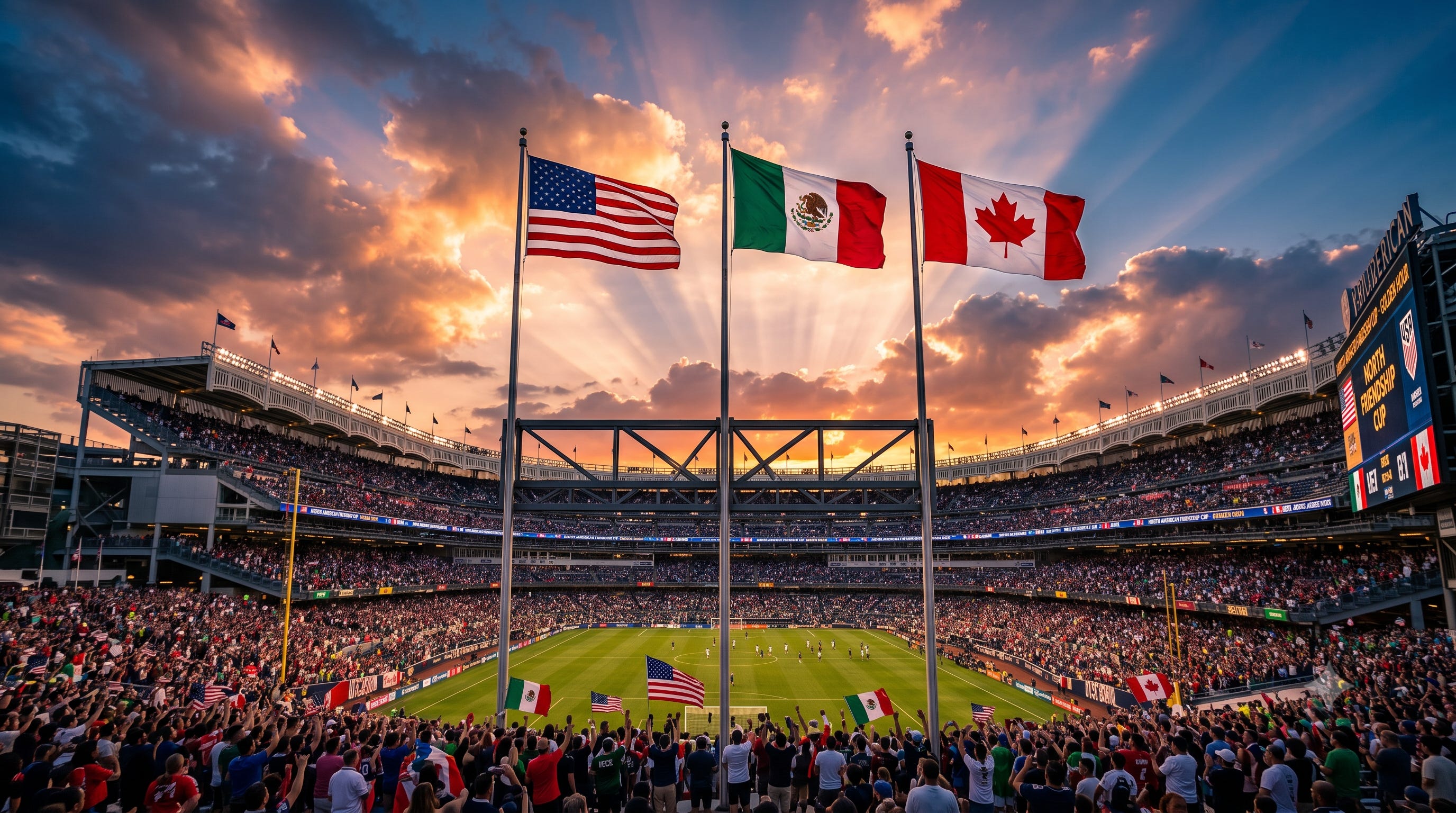
This week the World Cup gave us something rare: all three North American host nations still standing, still competing, still proving that this region is more than a backdrop for global events. It also gave a Spanish king a reason to walk into the National Palace and shake hands with a president who once refused to invite him to her inauguration. And it gave me a reason to revisit one of the darkest chapters in U.S.-Mexico law enforcement history through The Last Narc on Amazon Prime, a documentary that is impossible to watch without thinking about what is happening in Mexico right now. This edition covers the trade lesson buried in the Spain-Mexico diplomatic thaw, the sovereignty argument that Sheinbaum is using to stall U.S. extradition demands, and the World Cup moment that belongs to every fronterizo who ever dreamed bigger than the border. Let’s get into it.
First time reading? Join thousands of intellectually curious readers. Sign up here.
There is a lesson buried in this week’s visit by King Felipe VI of Spain to Mexico City, and it has nothing to do with soccer. The King met with President Claudia Sheinbaum at the National Palace last Thursday, the first such visit in seven years, and the symbolism was unmistakable. For years, the Mexican government under AMLO and then Sheinbaum demanded a formal apology from the Spanish Crown for the conquest of Mexico. Spain refused. The relationship went cold. Sheinbaum did not even invite the King to her inauguration in 2024.
And then reality intervened.
Despite the political chill, Spain remains Mexico’s second-largest trading partner within the European Union, with bilateral trade worth $11.1 billion. Earlier this month, Spain’s Economy Minister led a delegation of Spanish and Mexican business leaders in Mexico City to discuss plans to double bilateral trade by 2030. You can mouth off about history all you want. The global economy has no patience for it.
Sheinbaum and Felipe VI discussed bilateral trade, the economy, geopolitics, and what both sides called a strengthening of the bilateral relationship. The King acknowledged abuses during the conquest. Sheinbaum called the meeting “very cordial.” They agreed to work together at the Ibero-American Summit in November. Nobody got a formal apology. Business continued.
This is the lesson I want every border leader and every business community to internalize. Economic partnerships do not wait for perfect politics. The world is too interconnected, supply chains too interdependent, and the stakes too high for countries to let historical grievances block commercial opportunity. Mexico and Spain figured that out this week. It took a World Cup and $11 billion in annual trade to get there, but they got there.
For those of us working to deepen U.S.-Mexico economic integration through Intermestic Partners, the lesson is the same. Relationships are built on shared interest, not shared memory. And right now, shared interest is more powerful than ever.
Introducing the border art collection
I have spent my entire career at the intersection of two nations. I have sat across from diplomats, negotiated trade agreements, managed the busiest land ports of entry in the world, and walked the same desert ground that millions of people have crossed in search of something better. The border is not an abstraction to me. It is home.
For years, the walls of my office have told that story. Now I want to share it.
This week I am launching my Border Art Collection, a curated set of works that reflect the depth, complexity, and humanity of the U.S.-Mexico relationship. These are not decorative pieces. Each one carries a history, a people, and a point of view. The collection begins with the piece I consider the most fitting for where we stand today: a striking oil portrait of José Doroteo Arango Arámbula, the man the world knows as Pancho Villa, El Centauro del Norte.
Painted in July 2023 by artist Rita Amaya, the original hangs in my office in Phoenix. Every U.S. and Mexican business leader, diplomat, and official who walks through that door sees it. No one needs it explained. Villa was a fronterizo, a man of the border, who governed and operated across two nations as if boundaries were merely suggestions. He remains the only Mexican commander in history to launch a military invasion of the United States, forcing an American military response in 1916. He is complicated, defiant, and impossible to ignore, which is exactly what the border has always been.
Professional poster prints are now available for your home, office, boardroom, or any space where the U.S.-Mexico relationship matters. Visit my website for details, and follow along as the collection grows.
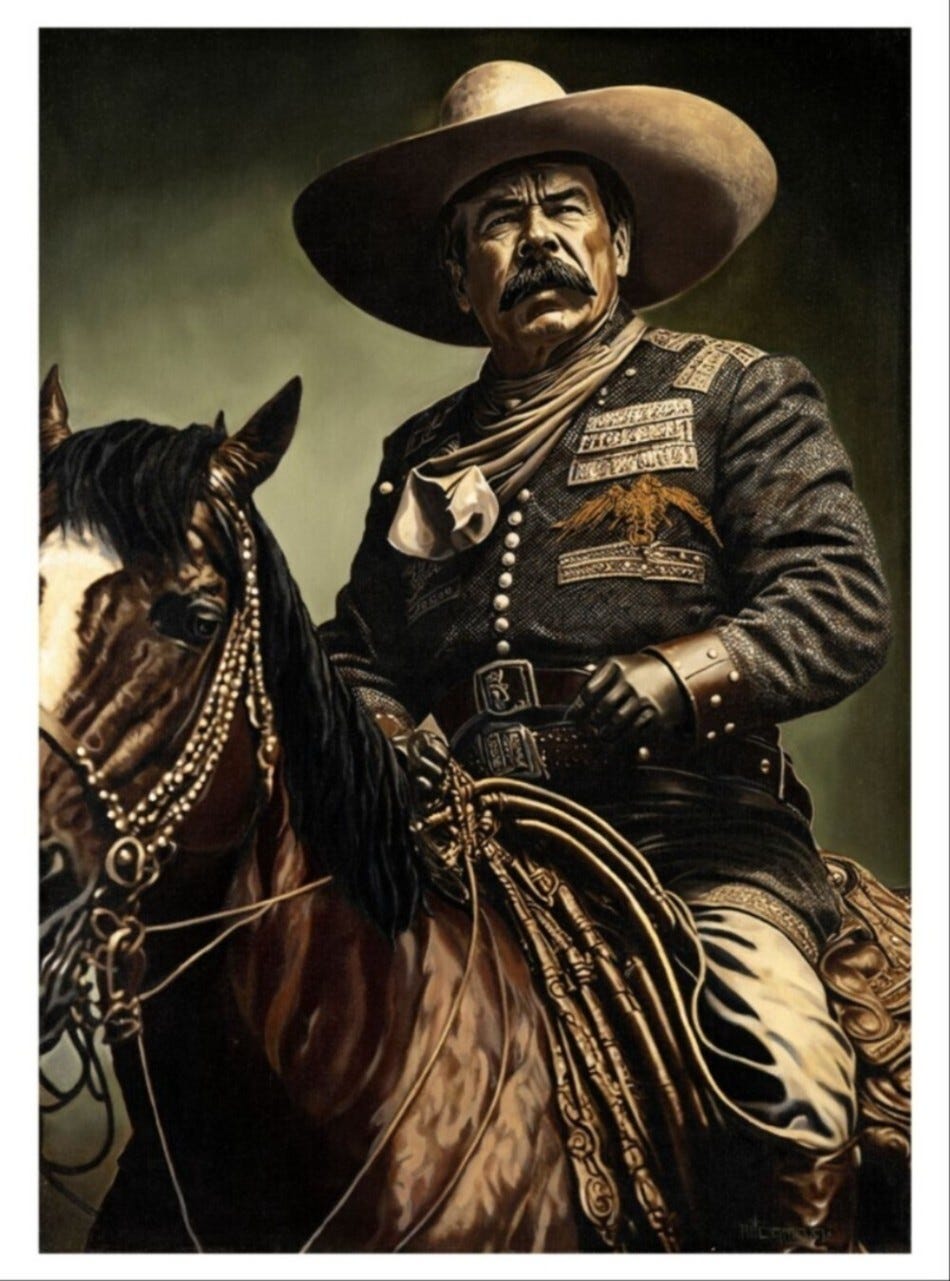
Pancho Villa - El Centauro del Norte
Born José Doroteo Arango Arámbula in Durango, Mexico, Villa commanded the largest military force of the Mexican Revolution, governed the border as if boundaries were suggestions, and remains the only Mexican commander to launch a military invasion of the United States.
Professional poster prints available now.
Shop now $25
I spent part of this week watching The Last Narc on Amazon Prime. If you have not seen it, stop what you are doing and watch it. It is one of the most important and disturbing documentaries about U.S.-Mexico drug enforcement ever produced. It tells the story of DEA Agent Enrique “Kiki” Camarena, kidnapped, tortured, and murdered in Guadalajara in 1985 by the Guadalajara Cartel with the knowledge and participation, the documentary argues, of elements of the Mexican government and Mexican intelligence.
What stayed with me was the argument that doesn’t seem to change. When U.S. investigators pushed for accountability, Mexican officials retreated behind “sovereignty” or how they love to say it “la soberania”. We will investigate our own people. You have no jurisdiction here. Trust us.
Kiki Camarena’s family is still waiting for full accountability more than four decades later.
Now look at what is happening today. The New York Times reported this week that the governors of Sonora and Tamaulipas are targets of U.S. federal investigations for alleged ties to organized crime. The Los Angeles Times had broken a similar story weeks earlier. Both governors denied everything. Sonora Governor Alfonso Durazo sent a letter directly to NYT editor A.G. Sulzberger demanding a retraction, calling the reporting speculative and without official basis.
Here is what I know from my years at CBP and from watching how federal investigations work: the U.S. Department of Justice does not confirm or deny an active investigation. That is standard practice. The earlier Sinaloa case is the template: the L.A. Times reported on Governor Rubén Rocha Moya, his visa was revoked, and within days the Southern District of New York unsealed an indictment against him for ties to Los Chapitos.
Governor Durazo’s denial means nothing until the indictment either comes or does not. The pattern is clear. Watch The Last Narc. Then watch the news. See any similarities?
The sovereignty argument never gets old in Mexico. It just gets more dangerous.
When AMLO demanded a Spanish apology for the conquest, it played well domestically. When his government dragged its feet on cartel accountability, it hid behind the same word: sovereignty. Now President Sheinbaum is using it to resist U.S. pressure to extradite officials accused of protecting drug traffickers. The arguments are dressed up differently each time. The logic is identical.
The Last Narc reminded me this week just how long that playbook has been running. The documentary details how Mexican officials, including elements of federal intelligence, not only failed to stop the torture and murder of DEA Agent Kiki Camarena in 1985 but may have actively participated. When the U.S. pushed for accountability, Mexico invoked sovereignty. American investigators were told to stand down, trust the process, and respect Mexican jurisdiction.
That was 40 years ago. Today the New York Times is reporting that Morena-affiliated governors and legislators have been cooperating as informants with the U.S. government, while simultaneously publicly denying any investigation. The NYT reported that the governors of Sonora and Tamaulipas are among the targets of U.S. corruption investigations, citing five people familiar with the inquiries. Sheinbaum questioned why these things were appearing in the press at all, asking publicly: “What is the intention behind taking away visas and then making it public?”
The answer, Madam President, is accountability. The same accountability Mexico has deferred for decades.
Sheinbaum has said the U.S. has not provided sufficient evidence for extradition. She says Mexico will investigate its own. We have heard that before. The families of Kiki Camarena heard it first.
This is a moment none of us on the border ever thought we would live to see. Three North American nations, three co-hosts, all still alive in the same World Cup that we built together. Today, Canada took down South Africa 1-0 at SoFi Stadium in Los Angeles. Tuesday night, El Tri defends home soil at the Estadio Azteca against Ecuador in front of one of the loudest crowds on the planet. Wednesday night, the USMNT walks into Levi’s Stadium and faces Bosnia and Herzegovina with a chance to keep this run going.
I grew up in Nogales watching fútbol with my family the way most Americans watched football. The game was not a pastime. It was identity. It was community. It was how you knew where you belonged. This World Cup on home soil is something different. It is proof that North American soccer has arrived, and not just as a host. As a competitor.
What makes this week extraordinary is the possibility, still very much alive, that all three host nations advance to the Round of 16 simultaneously. Mexico would face the winner of England versus Congo DR back at the Azteca on July 5. The U.S. would take on Belgium or Senegal in Seattle on July 6. Canada continues to write a story that no one predicted.
For the 40 million Mexican-connected residents in this country, for the fans who drove from Tucson and El Paso and San Diego to watch these matches, this is personal. Every goal is not just a point on a bracket. It is a statement about who we are and what this region represents. All three teams. All still in it. Keep watching.
Thanks for reading Power Courier by Marco Lopez! Subscribe for free to receive new posts and support my work.
Comments
Nothing yet. Say the first thing.
Sign in to join the conversation.