

Summary:
Tether lacks transparency and sound reserve management
If Tether’s investment portfolio slips just 14%, the stablecoin peg is not worth 1:1
Circle’s USDC is a better managed alternative
A Tether unwind would create a generational buying opportunity in Bitcoin
[3 minute read]
Introduction
Stablecoins are digital dollars that move frictionlessly on public blockchains and currently drive $46T in annual transaction volume.1
The stablecoin landscape is dominated by two large players:
Tether (USDT): $183.6B
Circle (USDC): $74.4B
Together, Tether and Circle represent 97% of all U.S. dollar backed stablecoins.
These issuers differ in two key categories:
Transparency
Reserve management
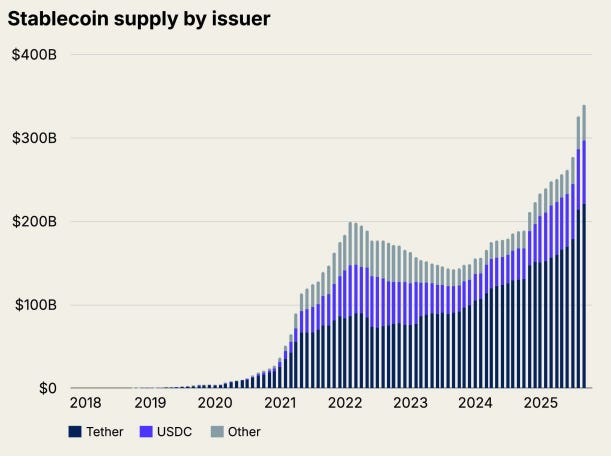
Source: a16z State of Crypto2
Mechanics
The mechanics of issuing a stablecoin follow these general steps:
Depositor sends $1 to the stablecoin issuer (Tether or Circle)
Issuer sends 1 token to the depositor, representing a claim on the $1
Issuer manages the $1 reserve
The depositor can transact with the token or redeem it for $1 at any time3
Transparency:
Circle:
Circle completed its IPO on June 5, 2025 and is a publicly traded company
Circle is audited by big four accounting firm Deloitte & Touche (D&T)
USDC reserves are fully disclosed weekly and attested to monthly by D&T
Circle is headquartered in New York
Tether:
Tether is a private company, headquartered in El Salvador
Despite holding $183.6B in assets, Tether has never agreed to an audit
USDT reserves are attested to quarterly by accounting firm BDO
Reserve Management:
Circle:
100% of reserves are held in cash & equivalents:
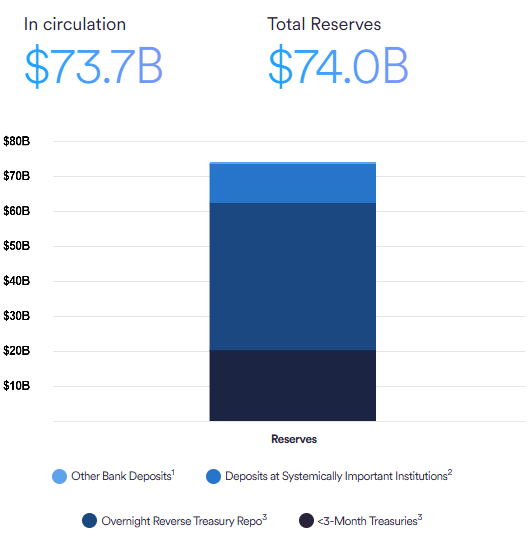
Tether:
76.3% of reserves (unaudited) are held in cash and equivalents
23.7% are held in gold (9%), secured loans (8.9%), Bitcoin (4.4%), and other (1.4%):

Why This Matters
Transparency:
While Tether reserves are attested quarterly, assurance is limited without an audit
Tether could move funds one day before quarter end and subsequently withdraw
From the most recent BDO attestation report:
“Our opinion is limited solely to the Financial Figures and Reserves Report and the corresponding total assets and total liabilities as of 31 December 2025. Activity prior to and after this time and date was not considered when testing the balances.”
Reserve Management:
Because Tether invested in gold and bitcoin which have appreciated, they claim to be sitting on excess reserves of $6.3B:
$192.9B in assets (deposits plus investment gains)
$186.5B in liabilities (USDT tokens issued)
If reserves decline by $6.3B, assets fall below liabilities
Excess reserves ($6.3B) divided by non-cash investments ($45.7B) = 13.8%
In other words, if the value of Tether’s gold, bitcoin, and other investments declines by just 14%, the dollar peg is not worth 1:1.
If the peg slips, this can cause a bank run where depositors trade out of or redeem USDT in exchange for dollars.
I am not the first to cite these concerns.
Response From Tether
Tether CEO Paolo Ardoino recently took to Twitter/x to defend the company:

This response concerns me:
Tether has never shared a balance sheet or agreed to an audit to substantiate this
Why would the CEO feel a need to respond and defend if properly managed
Conclusion
Tether is gambling with depositor money, Circle is not.
If Tether generates gains from their investments, depositors do not benefit since USDT is still pegged and redeemable at 1:1. If Tether suffers a loss, the peg may slip below 1:1. Zero upside with unlimited downside.
My conclusion is to use USDC (Circle’s stablecoin) not USDT, issued by Tether.
What’s The Trade
Let me be clear, I think the risk of a Tether insolvency and bank run is very low.
However, if it does happen, I want to have a plan.
If the peg slips in the future and Tether is forced to sell their Bitcoin or gold to meet redemptions, the liquidation would be a generational buying opportunity.
https://d2hguprl3w2sje.cloudfront.net/uploads/2025/10/State-of-Crypto-2025-a16z-crypto.pdf
https://d2hguprl3w2sje.cloudfront.net/uploads/2025/10/State-of-Crypto-2025-a16z-crypto.pdf
Simplified; restrictions require balance minimums and AML/KYC to redeem directly
Comments
Nothing yet. Say the first thing.
Sign in to join the conversation.