
Remember the first stop on the tour? The church on the left, the side room, the Tuesday-night handful. Good. Today we're going inside.
Last week I walked you past four places in your own town where ordinary people are quietly holding kids' lives together. I promised we'd come back and go through the doors one at a time. This is the first door, and I picked it on purpose, because what happens in this room is the single most misunderstood thing on the whole tour.
From the sidewalk, it looks like charity. A church helping a poor family. Casseroles and good intentions. You've seen that movie, and if that's all this was, I wouldn't be spending a whole article on it.
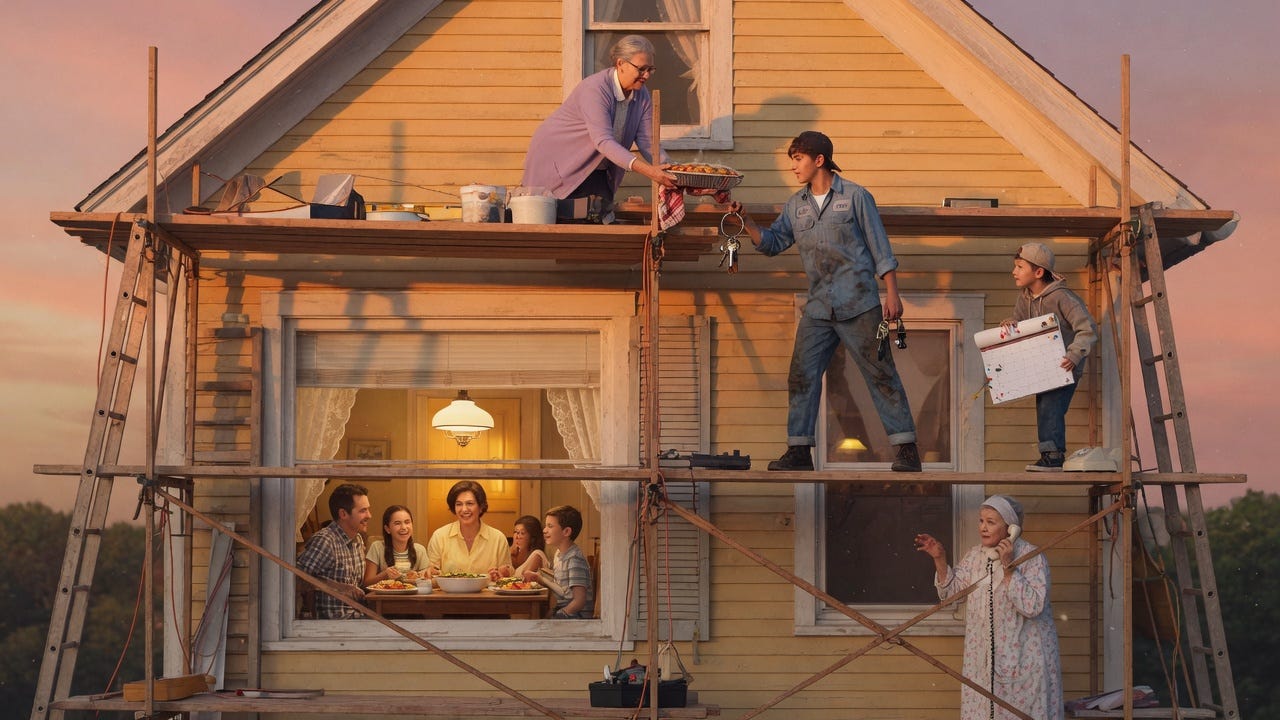
It's not charity. It's scaffolding.
Think about what scaffolding actually is for a minute. Nobody looks at scaffolding on a building and says "that's a nice gift." Scaffolding isn't a gift. It's structure: put up on purpose, attached at specific points, designed to hold weight for a season so that something can get built or repaired that could not stand on its own yet.
That's the idea behind what many churches call a care community: ordinary people deliberately building practical support around one family. You may hear people use words like wraparound for this kind of help, and in the everyday sense of the word, it fits. But it's worth being precise here, because formal Wraparound in child welfare and behavioral health is a specific thing: a structured, family-driven care-coordination process for children with complex needs, run through a defined planning model, often with a professional care coordinator at the table. That's not what this article is describing, and if you work in the system, you already flinched at the lowercase version.
What we're talking about today is the community side of the equation, the part the formal model itself calls natural supports: the people from a family's actual life and neighborhood who show up alongside the professionals. Here's the beautiful part. Formal Wraparound was built partly on the recognition that plans rarely hold without those people. The professionals have known for decades what this series keeps finding on every corner: the village is not decoration. The village is load-bearing.
So: a care community. Now let me show you the week.
What the circle actually does, week to week
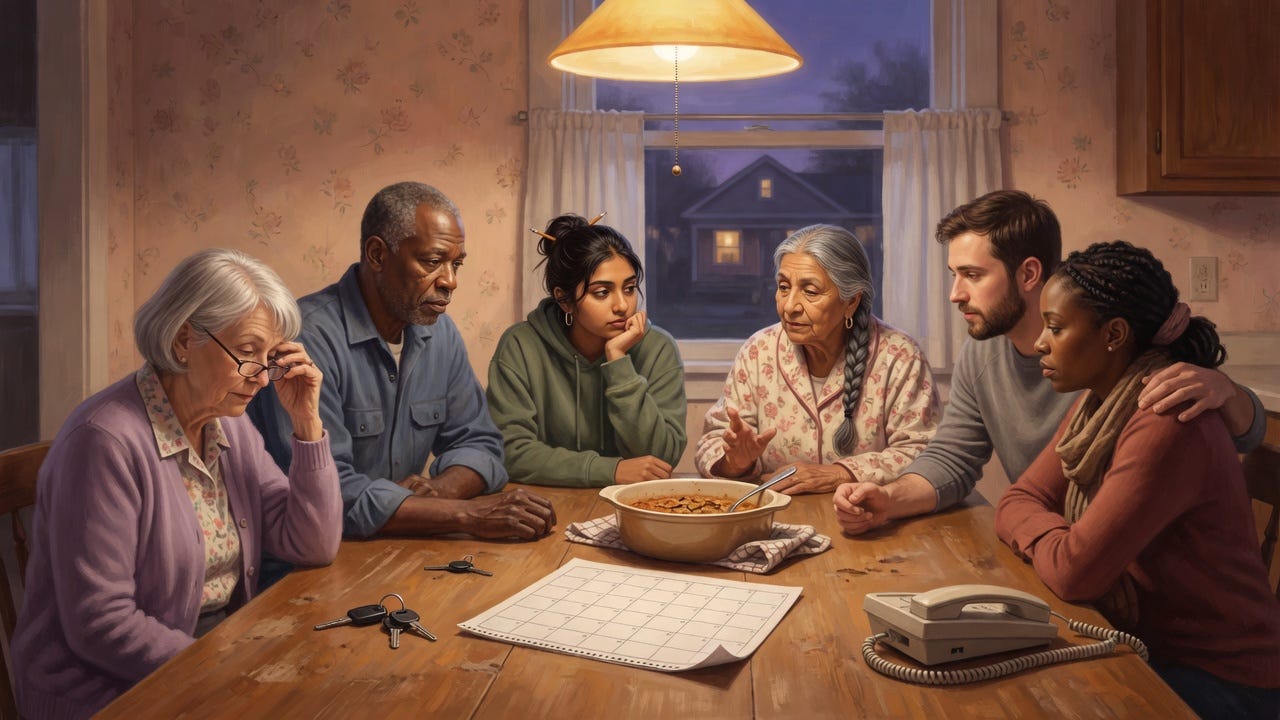
Here's a family, and I'm going to keep them generic on purpose, because the whole point of this series is that some version of them lives in every county in America. A mom and a dad, three kids, one income that just stopped. Or a grandmother who took in her grandkids overnight because the alternative was a stranger's house. Or a foster family on their fourth placement, running on love and fumes. The details vary. The physics don't: the family is carrying more weight than its structure can bear, and it is starting to buckle.
The old model, the one most of us grew up with, is that somebody notices, drops off a casserole and a gift card, feels rightly good about it, and goes home. One-time help for a 24/7 problem. It's kind. It's real. And it evaporates by Thursday.
A care community does something structurally different. A handful of people (usually four to eight, and no, they are not social workers; they're a retired teacher, a mechanic, a college kid, a grandmother) sit down and essentially divide the weight of one family among themselves, on a schedule. Each one bolts onto a specific point:
Somebody owns meals. Not "signs up when they can." Owns it. Knows that Tuesdays and Thursdays are the nights the wheels come off, and shows up on Tuesdays and Thursdays. One meal isn't insignificant. One meal that someone knows is coming every Tuesday becomes infrastructure.
Somebody owns rides. School pickup when the car dies. The appointment across town. The court date. If you have never been a family with three kids and zero working vehicles, it is hard to explain how many things collapse over a ride. A missed ride can become a missed shift. A missed shift becomes lost pay. A missed appointment creates another appointment. Another problem gets piled onto five existing ones. This person breaks that chain.
Somebody owns two planned hours with the kids. A standing block of time, set up the way the family wants it, and, for foster and kinship homes, the way their agency requires; some placements need approved caregivers, and a good circle asks first. What the parents do with those hours is their business: sleep, errands, a conversation they've been putting off, silence. Exhaustion is where marriages and placements start to crack. Two reliable hours a week pushes that point further away.
Somebody owns the phone call. Every week. Same day. "We haven't forgotten you." You can't budget for what that sentence does to a family that has been invisible for years.
And somebody owns the boundary: coordinating with the caseworker or the school or the counselor, so the team works alongside the professionals instead of around them. This matters enough that I want to say it twice. A care community is not a substitute for caseworkers, courts, counselors, or a formal Wraparound process where one exists. It's the structure that holds a family steady enough for that professional work to actually take. The professionals bring the plan. The circle brings the Tuesdays.
Notice what just happened. No single person on that team did anything heroic. A meal. A ride. Two hours. A phone call. Any one of them alone is a casserole: kind, and gone by Thursday. Bolted together on a schedule, they're load-bearing. That's the aha of this whole article, and I'm going to keep dragging you back to it every time we drift: the casserole was never the point. Reliability is what turns a casserole into infrastructure.
Why this works when bigger things don't
I told you on the tour: there is no off-switch on a child's hard life. The gap is 24 hours a day, 7 days a week, and institutions have operating hours. What a circle of neighbors has that no agency can put in a budget line is presence between appointments: somebody who knows the family on Tuesday nights, not just at the monthly check-in. Same principle again, wearing different clothes. Not the size of the help. The reliability of it. Agencies can know a case. A community can know a family. Those are not competing roles. We need both.
And there's a second thing, quieter and maybe bigger. A family in crisis is almost always a family that has become unknown, disconnected from the web of people who would have noticed sooner. The circle doesn't just deliver meals. It makes the family known again. Kids in that house now have four to eight adults who can name them, notice them, and vouch for them. Ask people who work with kids in the system what changes outcomes, and one answer comes up again and again: a consistent adult who shows up. A care community is that answer, multiplied, with a schedule.
Then, because it's scaffolding, it comes down the way scaffolding should: piece by piece, as the building can carry its own weight. Eventually the family doesn't need Tuesday dinner anymore. Dad's working again. Grandma has found her rhythm. The placement has settled. So the Tuesday meal ends, then the standing ride, one support at a time. That doesn't mean the relationships disappear. It means the family no longer needs those relationships to carry the same weight. The people who brought the meals are usually still around, because somewhere near month four the family stopped being a project and started being friends. What's left standing when the structure comes down isn't just the building. It's a family that is known, in a web of people who would notice next time before the buckling starts. That's not the scaffolding's afterglow. That's the finished construction.
Where this lives in your town
You'll find these teams most often in churches (that's the tour stop) because churches come with the two raw materials pre-assembled: a roomful of people who already gather weekly, and a habit of showing up for each other. Several national ministry networks exist to train and launch these teams; types, not names: this series works in every county, and I don't play favorites. But the model doesn't require a steeple. A neighborhood group can do this. A workplace can. Honestly, a determined book club could.
What it requires is smaller and harder than money: four to eight people willing to owe one family one specific thing on a schedule.
Your on-ramps
Ask the question at your own church. "Do we have a care community or family support team?" If yes: join at the level of one meal a month. That's a real seat, not a token one. If no: "Would we start one?" Sometimes the question is the seed.
Claim one spoke, not the wheel. Meals, rides, two planned hours, or the weekly call. Pick the one that fits the life you actually have. The schedule is the superpower. Small and reliable beats big and occasional.
If you're connected to a foster or kinship family already, even loosely, you can be a circle of one starting this week. Same four spokes. Pick one, put it on a repeating day, and make the commitment precise: "Every Thursday through the end of the school year, and then we'll talk about what's next." A named day and a named season a family can count on beats an open-ended promise, and it's a commitment you can actually keep.
If you work in the system (caseworker, teacher, counselor), you know which families are buckling, and that knowledge is not yours to hand to a volunteer team. What you can do is point in the other direction: know which care teams exist in your county, and tell the families about them. Offer the connection; let the family decide whether they want to be known. If they say yes, the introduction runs through your agency's referral channels, with the family's consent, not through a hallway conversation. And if your county runs formal Wraparound, you already know these circles are the natural supports that model keeps asking for.
If your town has no team at all, you found the vacancy, not the dead end. Ask your church, your county's foster-parent association, or a nearby congregation that has one how they started. You don't have to build it alone.
And when the phone gets heavy, here's this week's version of the script, tuned so that nobody's name gets traded without their say-so:
"Hi, I live here in town. I'm not looking to start anything big. I've got [a meal a week / a ride / two hours a month], and I can make it a standing thing. If there's a family your team is already walking with, I'd like to be one of the spokes."
Next stop on the tour: the folding tables behind the community center, and why a jar of peanut butter is a serious piece of infrastructure. Bring your kids to that one.
Subscribe — don't miss the next stop
New to the series? Start at the first stop: Let Me Be Your Tour Guide.
— Melody Jennings, Director, PMC Foundation
Project Milk Carton is a 501(c)(3) nonprofit dedicated to child welfare transparency and missing children awareness. Find your state's data at projectmilkcarton.org.
Comments
Nothing yet. Say the first thing.
Sign in to join the conversation.