
What Explorers often stop contributing first
The common misdiagnosis that can make disengagement worse
One early sign to watch for in each Explorer personality type
Inconsistent focus. Impatience with a slow process. Routine work finished quickly, but with less care than usual.
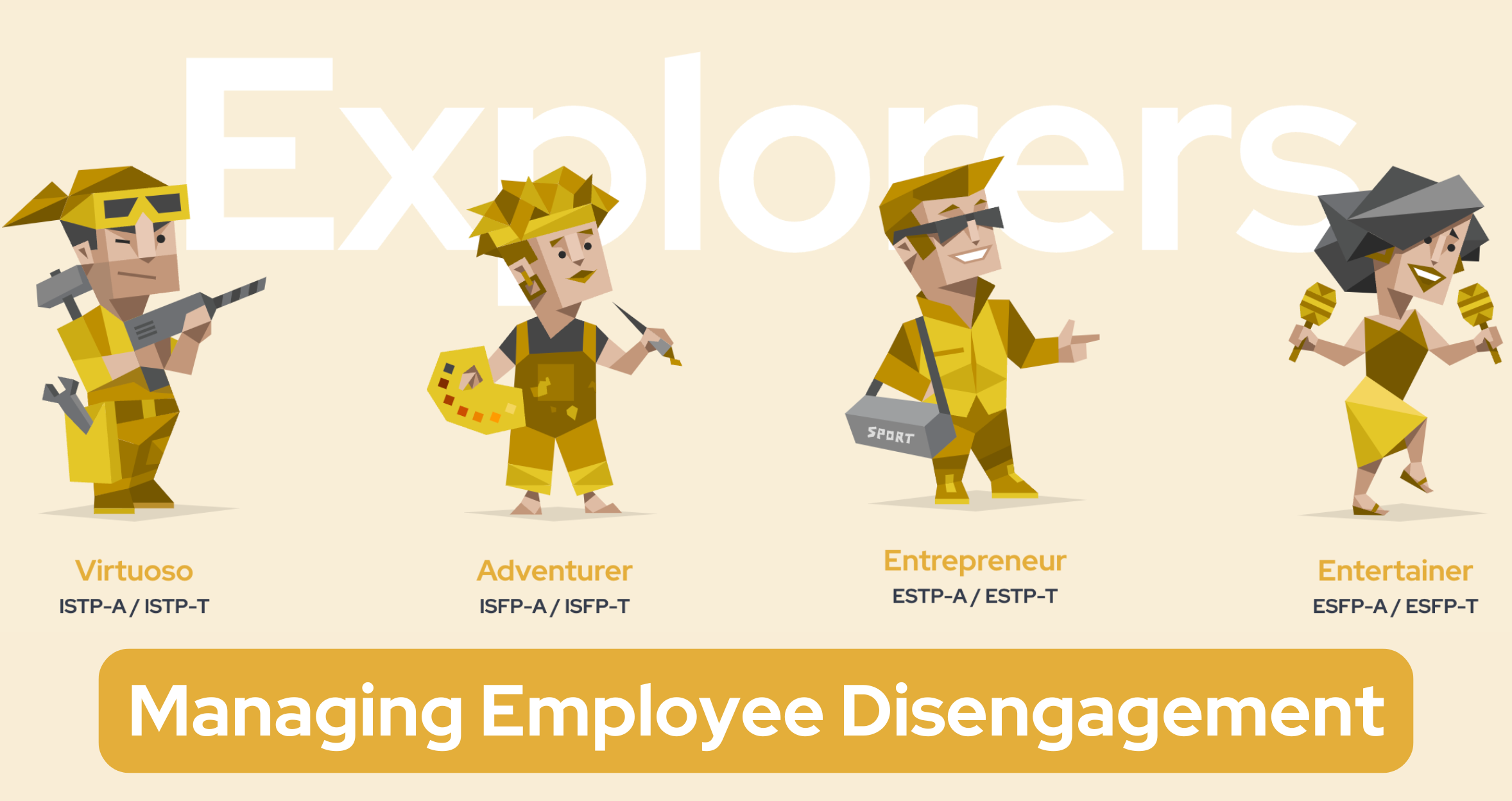
These behaviors can easily be read as attitude or discipline problems. But for Explorer personalities – ISTPs, ISFPs, ESTPs, and ESFPs – they may point to something else: a capable employee who no longer feels challenged, energized, or fully engaged by the work.
Over the past few weeks, we’ve explored how disengagement can look across the different personality Roles, beginning with Analysts, Diplomats, and Sentinels. Today, we’re closing the series with Explorers – a Role whose disengagement can easily be mistaken for inconsistency or impatience.
Explorers share the Observant and Prospecting personality traits – a combination that tends to show up at work as:
Learning by doing rather than by planning
Coming alive under variety, urgency, and high stakes
Acting quickly when something breaks
Finding workarounds instinctively, sometimes before being asked
Chafing at process that slows down the actual work
For more tips on how to recognize and work effectively with all Explorer personalities, check out our past Identifying Personalities at Work series.
If you’re wondering about your own type and whether you’re an Explorer, check out our Free Personality Test.
When Explorers disengage, they may continue showing up and completing their work. What often fades first is the extra energy and initiative they once brought beyond their assigned responsibilities:
The quick hand raised when something breaks
The instinct to make a tedious task faster or more effective
The momentum that helps everyone through a high-pressure stretch
For Explorers, boredom can be more than a passing annoyance. It can be a sign that the work is no longer providing enough variety, movement, or immediate challenge to hold their attention.
In our “Boredom” survey of more than 14,800 people, roughly nine in ten ISTPs said they feel bored often or very often. Explorers were also among the personality types most likely to say that novelty wearing off influences how quickly they lose interest – including 75% of ESTPs and 70% of ISTPs.
That does not mean boredom excuses careless work or missed responsibilities, of course. But it does mean that when an Explorer’s performance or initiative changes, leaders should look beyond discipline alone. A repetitive role may simply no longer be giving them enough to respond to, solve, or improve.
It’s all too easy for leaders to fall into a predictable pattern in the face of Explorer disengagement – an Explorer becomes restless, and that restlessness gets interpreted as irresponsibility. The response is more structure, tighter processes, and closer oversight.
But when the real issue is a lack of challenge or variety, adding more rules without changing the work itself may leave the employee feeling even less trusted and less engaged than before.
To be fair, boredom is not exclusive to Explorers. (ENTPs and INTPs report feeling it at similarly high rates, for example.) But what may look different is where an Explorer’s energy goes once boredom hits.
For Explorers, energy rarely disappears completely. Instead, it may shift toward a side project, the most hands-on part of the role, an urgent problem that needs solving, or something outside work that feels more immediate and rewarding. The employee still has plenty of energy. They are simply investing less of it in their job.
That shift is important to be aware of – and it can look a little different in each Explorer personality type.
Here is one subtle change to watch for in ISTPs, ISFPs, ESTPs, and ESFPs – and why it can be so easy to misread.
Comments
Nothing yet. Say the first thing.
Sign in to join the conversation.