
Part of today’s post is behind a paywall for my protection.
CW: This essay discusses pregnancy loss
—“Ma’am, you have to cover up to be in here.”
While the shoppers around me were in various states of uniform—shirts donning name-tags, PTs, and ACUs—I was on vacation and wearing considerably fewer layers. We had rented a little cabin steps from a fresh water lake on the local, and largely uninhabited, military base for my birthday and after a few hours of sun and swimming, I craved far unhealthier snacks than I had packed. I grabbed my maxi-wrap and off to the independently-run PX we went.
A few feet into the store I became engrossed by a rack of cheaply made tees with kitschy sayings on them. Things like: ‘I’ll be in my office’ overlaid on top of a tank and ‘proof of service: knee pain.’ I love a kitschy tee—those shirts absolutely no one needs but we’ve all owned at one point or another (if you’re a millennial, at least.) One of my favorite memories is shopping with the members of Andrew McMahon in the Wilderness before their 2013 Jax Beach show—they felt the venue called for neon shirts with the words ‘DON’T BRO ME IF YOU DON’T KNOW ME’ emboldened across the chest. So, naturally I honed in on the terrible colors and sparkle letters like some sort of low-standards barracuda. Only after pulling one from the rack to show my husband did I realize the entire store, which was unusually crowded, had frozen and was staring at me.

My husband’s sheepish nod directed my gaze to the older white woman behind the counter who was visibly flustered and gesticulating wildly. As I’m rendered hard of hearing when wearing polarized sunglasses, I lifted them and asked “excuse me?”
—“You are indecent and need to cover up!”
“Oh.”
I looked down at my cleavage and again said “oh!”—they weren’t staring at me, they were staring beyond me. They were staring at my boobs! As a woman with an A-cup, this was a novelty sensation. Never before had my breasts threatened the propriety of an entire establishment! I wedged myself behind my husband, adjusted my wrap dress to better conceal my commerce stopping cleavage and laughed out loud at the painful, yet all too common, irony that it was a woman who had turned my body into a public spectacle of sexualization, beckoning all present to participate.

Contrary to what androcentric anthologies imply, women were not missing from the literature of the medieval world. In fact, women were often at the center of the most widely circulated and translated texts of the time:
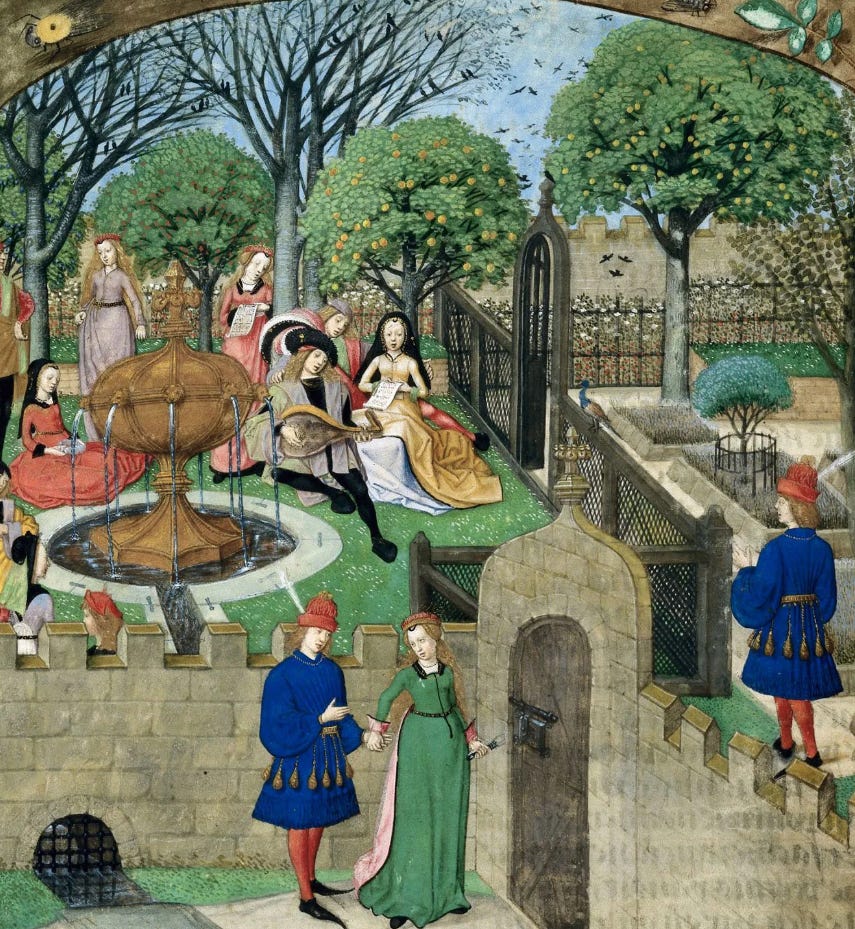
Portraiture of women adorned the walls within la Roman de la Rose; The Friend and The Jealous Husband speak of women both central to the story and outside the scope of the plot in equal measure. Women as an object to be acquired gives purpose to the very existence of the text itself, prominently represented in the titular (and titillating) imagery of the Rose.
Women were found among those seeking contrition from what lay interred within the walls of Canterbury with Chaucer giving them voice and representation in pilgrimage culture courtesy The Wife of Bath’s Prologue.
Without women, Matheolus would have naught to lament while Boccaccio’s de Mulieribus Claris would be a collection of blank pages.
Spanning the (roughly) thousand years that mark the European middle ages, women occupy significant space on the pages that defined each generations respective culture. Often, this gendered caricature was informed through the inherited woman—the woman as a vessel for moral teachings as realized and preserved by the church fathers and ancient orators before them. Even those years deemed ‘dark’ to us witness women’s near-constant presence within artifacts of cultural currency. As Christianity spread across Europe and down the generations, manifestations of law began to reflect the dominant group’s recycled beliefs which sought to strictly define women by their social and sexual relationship with men—virgin, wife, widow. Through cultural repetition and legal subjugation women became an absent center of their own lives, their own bodies, culturally valued only for their reproductive capacities in response to endless warring that threatened depopulation and empire collapse.
From scripture to sonnet, women were the absent center of a discussion they were conspicuously excluded from contributing to.
This would be the exact polemical access point that catalyzed a four-hundred-year-long debate known as la querelle des femmes in which most early feminist thought would evolve out of.


But what sort of culture is built out of such beliefs? surely not one of progress when thousand-year-old-thoughts are king and cultural currency.
In the dawn of the early-modern world a woman afforded the most possible privilege under patriarchy was divorced and discarded simply for the inability to give birth to a living son. Her successor would fare worse for the same fate. Both women—that is, Catherine of Aragon and Anne Boleyn—had successfully given birth to a healthy daughter each, but the culture they found themselves in was one of patriarchal preference and the sex of their full-term children coupled with their respective miscarriages cost them each dearly. As a princess of Europe, Catherine’s body was the property of Spain and therefore protected against Henry VIII in ways Anne, as his sovereign subject, was not. Catherine was shut-in for the sin of menopause while Anne was beheaded for that of miscarriage—both were seen as little more than instruments of state.
Because the wealthiest among us are too often the only ones with means to patron material culture in a world built on capital, social culture becomes skewed to afford, excuse, and protect privilege. In the case of Catherine and Anne, Catherine came to represent oppressive Catholicism in the face of English identity whereas Anne was a re-imagined Eve, tempting and monstrous. Of course, the experience of these two specific women can not be stretched to represent the experience of all women, but I highlight them in particular as their pregnancy outcomes determined the entire course of their respective lives.
When a culture’s only acceptable pregnancy outcome is that of the birth of a healthy baby boy regardless to what comes of the one giving birth, it is indicative of a value-system built out of hierarchy through oppression and a wanton disregard for humanity. When a culture’s only acceptable pregnancy outcome is birth without consideration to the welfare of the participating bodies, all become an absent center in service to the imposed and enforced social system(s.)
It would be easy to reach for the word ‘medieval’ when discussing a culture that positions women and girls as instruments of the state, but this practice is of the modern world, too. Women as an absent center looks like the Epstein files. Women as an absent center looks like trending trad-wife content. Women as an absent center looks like 412 pregnant people being charged with crimes related to pregnancy and pregnancy loss. None of this is medieval. This is (white supremacist capitalistic) patriarchy working as intended.
Comments
Nothing yet. Say the first thing.
Sign in to join the conversation.