

For the past few weeks, a recurring observation has emerged in Discover discussions: Google would be concentrating visibility on mainstream media giants, at the expense of smaller publishers and independent sites. Some tools show increasingly concentrated top 50s, with dwindling diversity.
Conversely, we’re observing increased diversity and extreme micro-targeting, even though the bulk of visibility remains concentrated on big whitelisted media. We’re seeing ultra-specialized e-commerce sites, local media, and most notably the massive arrival of Twitter and YouTube in French feeds since September-October 2025.
Both visions are true. Here’s why.
Two Discovers Coexist
Google Discover isn’t a single database. It’s actually an ultra-complex system designed to provide specific recommendations to carefully profiled user cohorts. A system that can operate in degraded, simplified mode when it’s not personalized.
So how do we explain this paradox?

The Generic Feed: The “Official” Discover
This is what you see if you check Discover on desktop, if you’re a new user, or if you don’t yet have a personalization history. It’s also what most scraping tools easily capture.
Characteristics:
Whitelist of major media to guarantee credibility
No spam visible at scale (since late September)
Resembles Google News, reassuring and “safe”
Easy to scrape, easy to analyze
But beware: this is NOT what real users see in their daily usage.
The Personalized Feed: The Real Discover
This is what you get on mobile, after a few weeks of use, once you’ve interacted with Google, maybe clicked a few “Follow” buttons, adjusted your interests in your Google account, and the algorithm has built your user embedding (see our article ”Smile, You’re being embedded”).
Characteristics:
Hyper-targeting via interests and multi-temporality user embeddings
Much richer than generic feeds
Social networks (Twitter, YouTube) increasingly present, including in France now
Ultra-targeted niche sites by topic
Hyper-local or hyper-specialized content
Invisible without massive data volume and personalized tracking.
Our Technical Advantage: Why We See What Others Miss
We’ve been working on this problem for over two years. Since Damien unveiled techniques to capture Discover feeds on desktop, a lot has changed. At Google, but also at our end.
We no longer capture desktop feeds. We capture real Discover feeds, the ones users have on their mobile. It’s a major technical challenge, but also one of sampling and representativeness of our profiles.
Our data isn’t perfect. Depending on the topic, we have clients telling us “It’s incredible, super representative, you capture everything as soon as I publish”, while for others, although we capture the biggest articles well, we can make errors in article reach. That’s normal, we’re constantly improving. We don’t claim to have perfect data: our data represents what our profiles see.
What we do see, however, when comparing with other services that publish their numbers, is the considerable difference in volume, number of cards, URLs and domains we see and analyze.
This technical advantage makes the difference:
20x superior volume compared to other tools on the market
Each article seen on average 26 times with us vs ~2 times elsewhere
This allows us to clearly differentiate blockbusters from regular articles, but also to capture weak signals that others miss
If you see each article an average of 2 times, you can hardly deduce anything precise. With us, with 26 views on average, we can distinguish real trends from statistical noise and draw attention to weak signals, though real and actionable.
Capturing generic feeds via desktop is easy. It’s like scraping Google News. But that’s not Discover.
Concrete Examples of Differentiation
X.com Enters the French Top 50
In October 2025, X.com made its entry into the top 50 most visible sites on Discover in France according to our data.
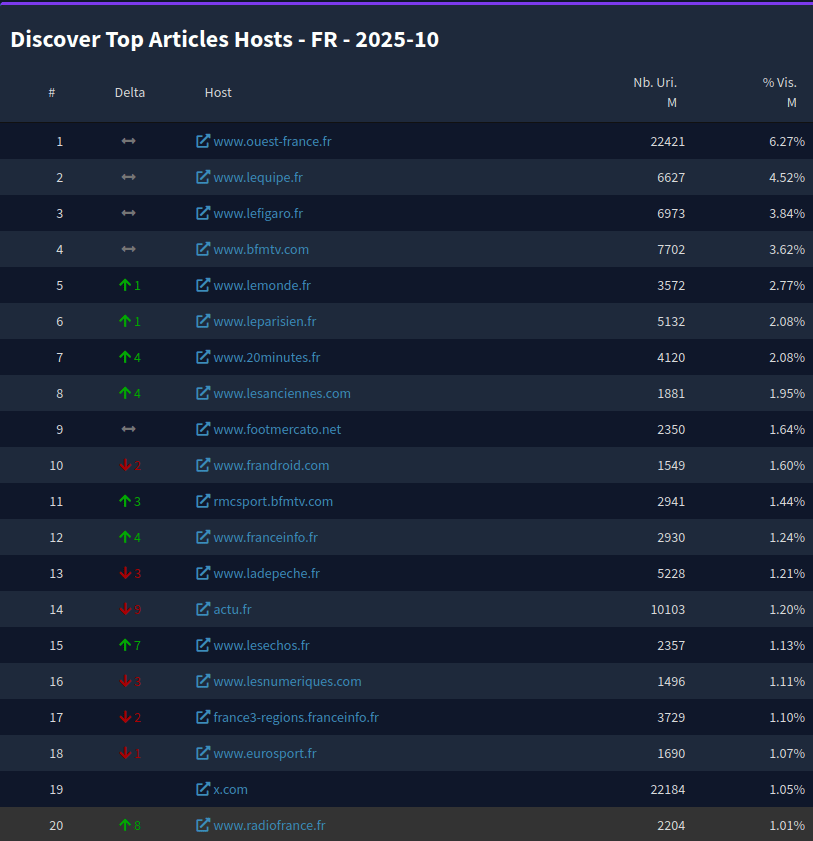
1% of visibility for the month, 20th position (with growth throughout the month: next month could be even more striking)
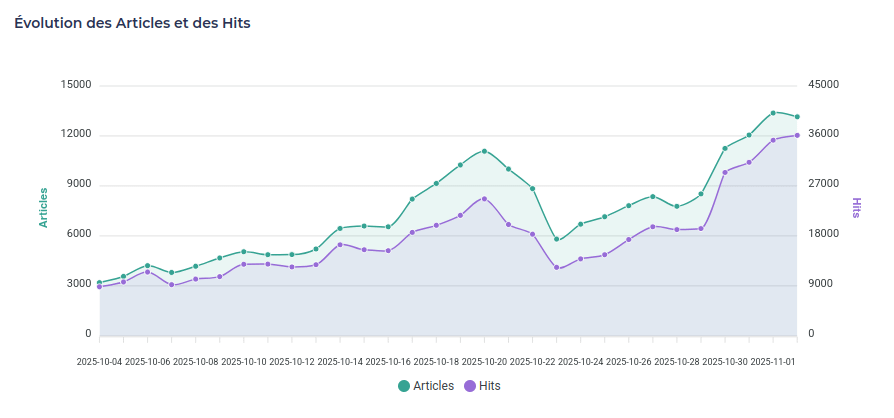
But beware: it’s not with viral tweets that get millions of views.
It’s with tens of thousands of ultra-targeted URLs, each presented to a highly qualified micro-audience. Each tweet = a very specific recommendation, not a blockbuster. It’s pure micro-targeting, invisible to tools that don’t have our capture volume.
22,184 French tweets, from 15,000 different Twitter profiles...
Almost as many as the 22,421 Ouest-France articles captured in October...
To compare with the 8,822 domains active on Discover the same month (4,959 if we only count article-type URLs)
Numbers you’ll find in your client area.
The Case of Local Media (Regional Press)
Some regional press publishers observe something both fascinating and worrying: they see themselves being “shut out” of international politics topics on generic feeds, while they continue to perform on personalized feeds for local content.
Again: targeting. A local media outlet, authority in its region, can no longer necessarily compete with Le Monde on international news.
Performance ratio comparison (number of views per article):
Le Monde: x20 ratio (major media, well present on generic feeds)
Twitter: only x2 (but with great URL diversity)
YouTube: x3, again, highly targeted and highly varied
Local press: x5 for francebleu, x6 for Ouest-France, x10 for actu.fr
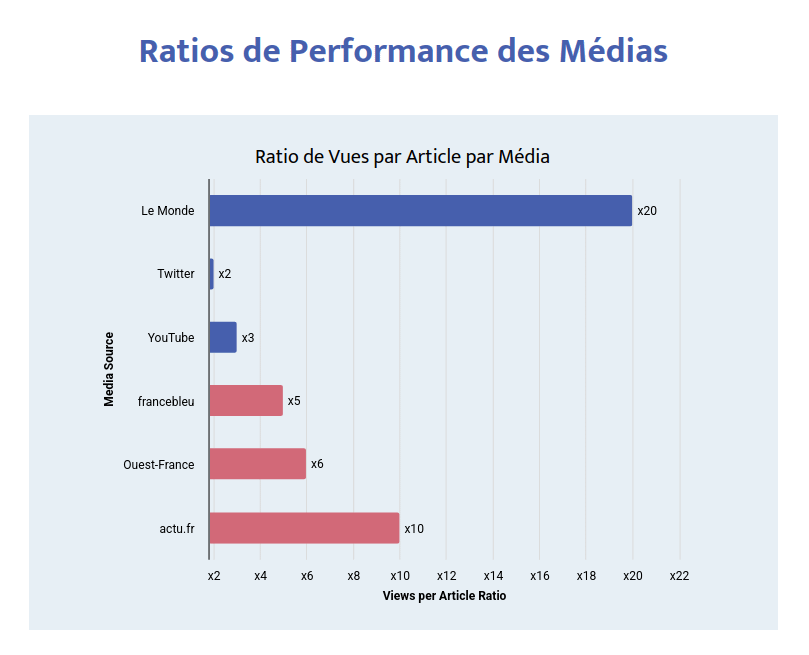
Local media lose on generic, but win on hyper-personalized. If you only look at generic feeds, you completely miss their real performance.
Profile Pages: Our Early Discovery
Three months ago, Damien discovered Google Profile pages. A new Google page that aggregates website + social networks + Follow button. Google confirmed later, deployment is underway.
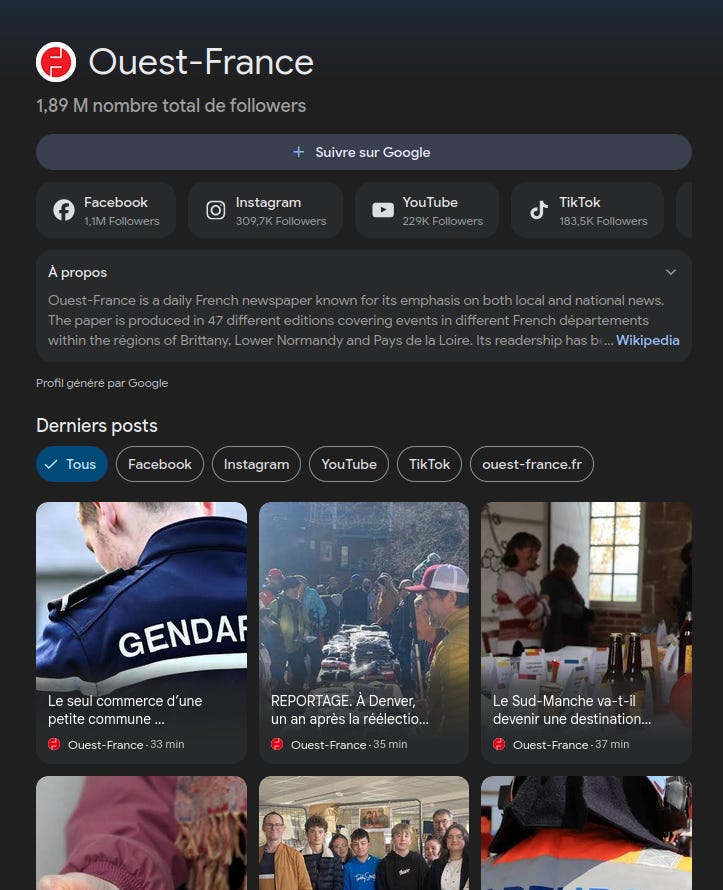
This discovery illustrates our ability to see changes before they become obvious. Thanks to our capture volume and R&D, we spot weak signals that announce major evolutions.
These profile pages are another sign that Google is steering its feeds toward personalization, allowing its users to “follow” an entity, a media outlet, a content creator. With, as a result, content and social network posts that will never surface in generic feeds.
These profile pages continue to evolve: proof of this, a fresh Google update, which made certain profile URLs non-functional. If you’re in this situation and your profile URL returns a 400 error, ask us for an updated link, we’ve aligned our systems accordingly.
The Ongoing Transition
We think Google is currently testing both models in parallel:
Short term: securing via whitelist (anti-spam, credibility)
Medium term: extreme personalization + social network ecosystem
The shift is progressive.
Before September 2025: Twitter “flickering” in Discover.
September 2025: We observe Twitter tests on about 10% of French accounts.
October 2025: Twitter presence on the majority of French Discover accounts.
Other social networks present on profile pages will likely follow.
Strategic Implications
For media and publishers:
Don’t rely solely on generic tools to analyze Discover
Understand that two different strategies exist depending on the targeted feed
Invest in personalization (Follow, Profile, social networks)
Prepare for the transition to hyper-personalization
For creators and e-commerce:
Micro-targeting is your friend
Ultra-qualified audiences are better than massive volumes
A multi-social-network strategy becomes essential
Take advantage of social networks arriving in feeds
For everyone:
Quality data = critical competitive advantage
Visibility disperses, but targets better
Fewer blockbusters, more recurrence on niches
What’s Coming: A Series of In-Depth Analyses
This introduction lays the groundwork. In the coming weeks, we’ll publish a series of articles exploring different angles!
Stay connected. Discover’s transformation is underway, and those who understand both faces of the system will be best positioned to adapt.
Thanks for reading 1492.Vision - English Version! Subscribe for free to receive new posts and support my work.
*This article is part of a series of in-depth analyses on the evolution of Google Discover. To stay updated, subscribe to our Substack.
Comments
Nothing yet. Say the first thing.
Sign in to join the conversation.