
If you publish at scale, this is no longer a side feature.
For months, we tracked this as a live product test: 54 U.S. publishers with extended profile controls inside Discover, out of a monitoring base of 47,000 publishers across 7 languages.
Now Google has officially documented Search profiles1, eligibility thresholds, and profile management rules.
So this post is not a generic reaction piece. It is a field-data update:
what we already measured before the announcement,
what Google has now confirmed in public docs,
and what publishers should operationalize next.
The strategic takeaway is the same, but now better grounded: this is turning into a real publisher visibility layer across Search and Discover, with direct implications for identity clarity, follow capture, and analytics.
We covered this in two previous Substack investigations, so here is the short version.
In 2025, we surfaced the profile pages on
profile.google.comand the Follow behavior in Discover.In 2026, we tracked a pilot cohort of 54 U.S. publishers with extended profile controls.
Across our monitoring base of 47,000 publishers and 7 languages, that advanced pilot access was initially U.S.-only.
In that 54-publisher cohort, we observed:
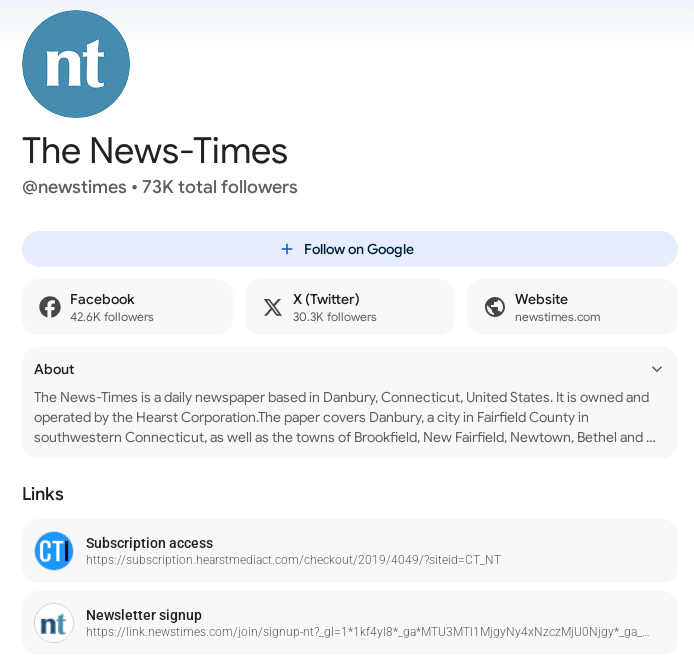
41/54 with a custom banner live.
31 publishers with at least one custom web link (65 links total).
Only 3/65 links with UTM parameters.
13 publishers with an active pinned post.
Heavy variance in adoption: capability available, execution inconsistent.
So the pattern was already clear before the announcement: Google was testing a publisher control layer inside Discover.
Now it is formalized.
Google’s public docs now clarify major points that used to be inferred from observation:
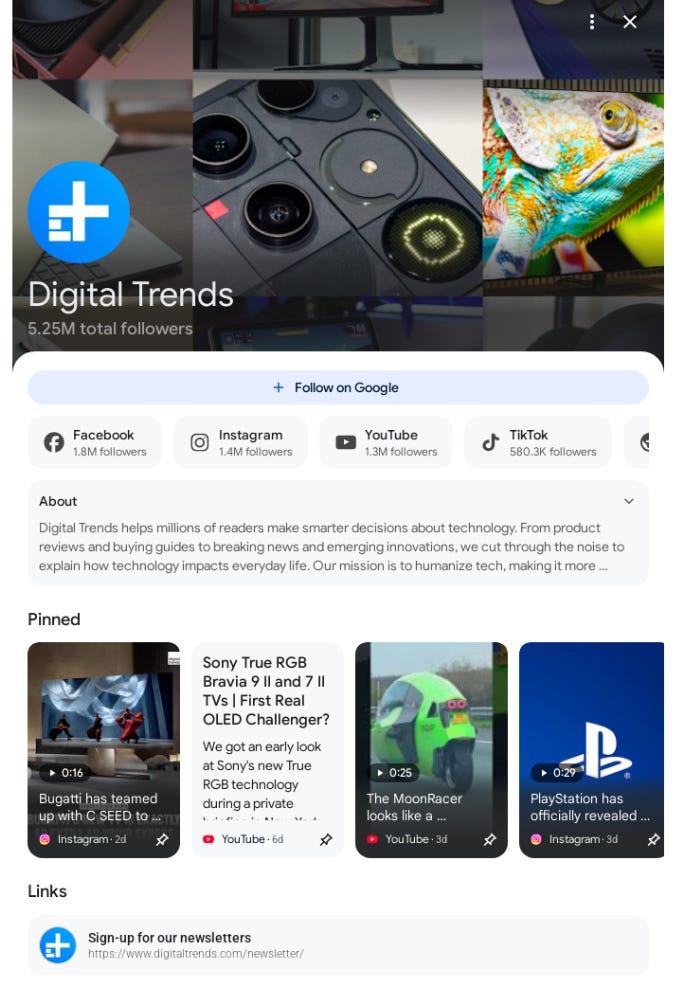
To create or claim in the current rollout, at least one linked platform must meet minimum audience thresholds:
YouTube: 100,000
Instagram: 100,000
X: 100,000
TikTok: 300,000
Note: For every rule, there are exceptions. We spotted profiles with less than the officially required audience.
Google’s help docs still mention U.S.-only availability in places, but field signals now suggest claim/create is opening beyond the U.S. pilot.
Our early extended-feature cohort (the 54) was U.S.-only. The product direction now looks global, even if rollout speed and feature parity may vary by market.
A Google Account can only claim one Search profile.
If your organization manages multiple brands or identities, each profile needs separate account architecture.
The profile handle is based on the most-followed linked platform account.
This is not primarily a branding preference layer, it is an audience-signal layer.
Immediate edits include things like reordering and certain layout/content controls.
Suggested changes to factual identity elements (name, bio, adding new platforms) may require review and stay pending.
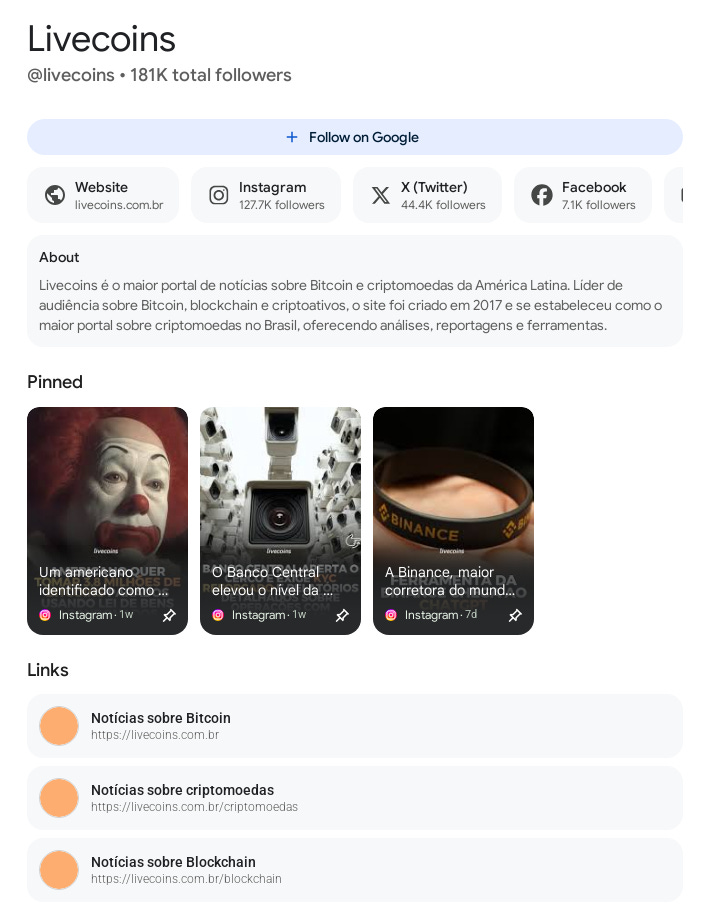
Every profile shows a prominent total follower number. It looks like a Google audience metric. It is not.
After digging into this across our monitoring base, the conclusion is clear:
The number displayed is not “followers on Google.”
It is an aggregate built from follower/subscriber counts across linked social accounts.
We would love to have a clean “Google followers” metric too. Publishers need it for growth tracking, sales narratives, and internal KPIs. But as of now, that count is neither exposed nor inferable. We checked hard.
A common reflex: take the total at the top, subtract the per-platform numbers shown in the carousel, and treat the remainder as “Google followers.”
That does not work.
Rounding compounds. Platform-level counts are often displayed in rounded or abbreviated form (
1.3M+,692K+). Subtracting rounded parts from a total produces fake precision.Hidden platforms are included in the total. The aggregate can include followers from social accounts that are not displayed on the profile UI. So the math is incomplete by design.
No reverse path in the data model. Nothing in the public profile surface gives you a standalone Google-follower field to isolate.
Bottom line: treat the headline number as a cross-platform social footprint indicator, not as Discover followership, not as Search audience, and not as a metric you can decompose reliably.
For analytics teams, this matters now:
Do not benchmark competitors using profile totals as “Google audience size.”
Do not build dashboards that infer Google follows from arithmetic on visible social counts.
Use Insights (where available), your own follow campaigns, and UTM instrumentation for anything you can actually measure.
If Google eventually exposes native follow counts per profile, we will report it. Until then, assume it is unavailable.
Search profiles are tightly connected to Knowledge Panels and entity understanding.
At minimum, this strengthens a hypothesis we have discussed for months: Google is not just ranking pages; it is organizing publishers as entities with cross-platform identity coherence.
For publishers, that means identity consistency is no longer a PR concern only. It is a distribution concern.
And it is already messy in the field: we regularly see publishers with a claimed site entity profile while Discover still surfaces a separate YouTube creator entity for the same brand (example thread).
Google states profile creation does not directly affect Search ranking.
That wording still matters:
Direct ranking promise: no.
Discover distribution effects via Follow behavior: yes, explicitly.
Indirect performance effects from stronger user affinity and repeated engagement: plausible.
The operational takeaway is simple: even without a direct ranking claim, this can materially affect visibility in personalized surfaces, depending on how Google surfaces the UI and how users actually use it.
No, Google has not announced a product called “Publisher Center 2.0.” But functionally, we are seeing similar building blocks reassembled in a more modern way:
Identity control
Audience capture through Follow
Surface-level merchandising via links and pinned content
Performance layer via Insights (beta)
Cross-surface coherence between Search and Discover
Add the direction of explicit personalization controls (for example “Tailor your feed” patterns), and the strategic intent looks increasingly coherent:
Keep users inside Google’s personalized content loop longer.
Improve source-level relevance with explicit follow signals.
Give publishers just enough control to optimize participation.
Build analytics and feedback loops around that behavior.
For publishers, this is both opportunity and risk:
Opportunity if your identity graph is clean and your profile strategy is intentional.
Risk if your brand is fragmented across accounts, entities, and unmanaged social mappings.
If you are eligible (audience thresholds + access in your market), treat this as a cross-functional project, not a solo SEO tweak.
Define all active brand entities (parent brand, local titles, vertical brands, personalities).
Map each entity to one owner Google Account strategy.
Decide ownership and escalation process before claiming profiles.
If this is messy internally, profile rollout will be messy externally.
Across our monitoring base, we keep finding the same structural issue: one brand, multiple Google entities, multiple profile URLs.
In our internal taxonomy, there are several profile families:
Entity profile (Knowledge Graph node): opened from a KG MID, content pulled from linked social accounts.
Creator profile (YouTube channel, social media creator): opened from channel identity, content pulled from that source.
Host profile : from the domain alone, when no dedicated entity exists yet.
They can coexist for the same media group. And they are not always merged.
A recent field case we documented (X Thread) shows the operational risk:
An editor successfully claimed a profile and got edit controls.
But the claimed profile mapped to the generic publisher/search entity (site + knowledge panel identity).
Meanwhile, the entity surfaced on Discover card headers for the same brand was often a separate YouTube creator entity.
Same publisher in the newsroom. Two profile URLs. Two content mixes.
We see this repeatedly, especially for publishers with strong YouTube footprints: Google will eventually merge entities (we got direct confirmation from Google), but today many YouTube-heavy publishers still have a dedicated creator entity path in Discover.
What this means in practice:
You can claim and optimize the wrong profile.
Follow behavior may attach to the Discover-visible entity, not the one you customized.
Banner, links, and pinned posts may live on a profile users rarely reach from Discover headers.
Before any customization sprint, run an entity map:
List every
profile.google.com/cp/...URL tied to your brand (site, YouTube channel, personalities).Identify which URL Discover actually uses on card headers (not just Search panels).
Prioritize claim/configuration on the distribution-facing entity first.
If you manage multiple identities, use separate Google Accounts as required by Google docs.
If two profiles should be one entity, escalate via Google profile support/feedback with evidence.
Then run the consistency layer:
Validate social ownership and naming consistency across platforms.
Audit
sameAsusage and structured data across your web properties. Double check wikidata.Check whether official accounts are correctly discoverable and attributable.
Your goal is not “one profile” by default. It is no ambiguity about which profile drives Discover distribution.
Be wary of generic tools that build “your profile url” based upon domain or entity: these are purely mechanical constructs that often have NO grounding into discover and may give unrelated profiles.
Once access is available:
Add a high-quality banner aligned with brand system.
Configure links as strategic destinations (not random leftovers).
Use pinned posts as editorial merchandising.
Write an “About” that explains value proposition, not generic boilerplate.
Most publishers still fail here.
Use UTM conventions for every profile link.
Separate profile-driven sessions from other social/referral buckets.
Track assisted conversions, newsletter signups, subscriptions, and return visits.
Compare performance of Follow-acquired audiences vs non-follow audiences.
Do not use the profile headline follower total as a Google audience KPI (see section above).
If you do not instrument this, you cannot optimize it.
For media groups with local/regional portfolios:
Standardize the technical baseline centrally.
Keep local brand expression in banner, pinned content, and links.
Define which fields are centrally governed vs locally editable.
Run quarterly audits for drift and broken mappings.
This is where large publisher groups can create real advantage.
It appears to be expanding beyond the initial U.S. pilot. Google documentation may still list U.S.-only in some pages, but claim/create is no longer effectively limited to U.S. publishers in what we currently observe
No direct ranking guarantee. But Follow behavior can increase Discover exposure.
No. One Google Account can claim one Search profile.
Not as a standard admin model today. Access is tied to the claiming account.
Not by default. Distinct identities generally require distinct profiles and account setup.
Yes. We regularly observe split entities (for example site/publisher entity vs YouTube creator entity) with separate profile URLs and separate Discover surfacing. Claim and optimize the entity users actually follow from Discover, not only the one visible in Search panels.
Not always. Some additions and factual edits can require Google review.
Up to 8 pinned items and up to 8 web links in current documented limits.
No. It is an aggregate of linked social follower/subscriber counts. Google-native follow count is not shown and cannot be reliably inferred by subtracting visible platform numbers (rounding + hidden linked accounts break the math).
Do not wait for “perfect parity” across countries. Start with the operational baseline:
Check whether your brand can claim/create now in your market.
Map all profile URLs for your brand and identify which one Discover uses on card headers.
Clean entity mappings and social consistency across those profiles.
Audit structured data (
sameAscan help a bit, but is not a silver bullet).Prepare banner assets and profile copy variants.
Define link architecture and UTM taxonomy before first edits go live.
Build ownership model for multi-brand profile operations.
Early movers still gain an adoption advantage, even where advanced features roll out unevenly.
Search profiles should not be treated as cosmetic profile pages. They are becoming a publisher identity layer inside Google’s distribution system.
For SEO and editorial teams, the strategic question is no longer “Should we care?” It is:
Are we operationally ready to manage identity, follow capture, and profile analytics as one system?
That is optimizing your publisher identity, and it starts now.
No posts
Comments
Nothing yet. Say the first thing.
Sign in to join the conversation.