
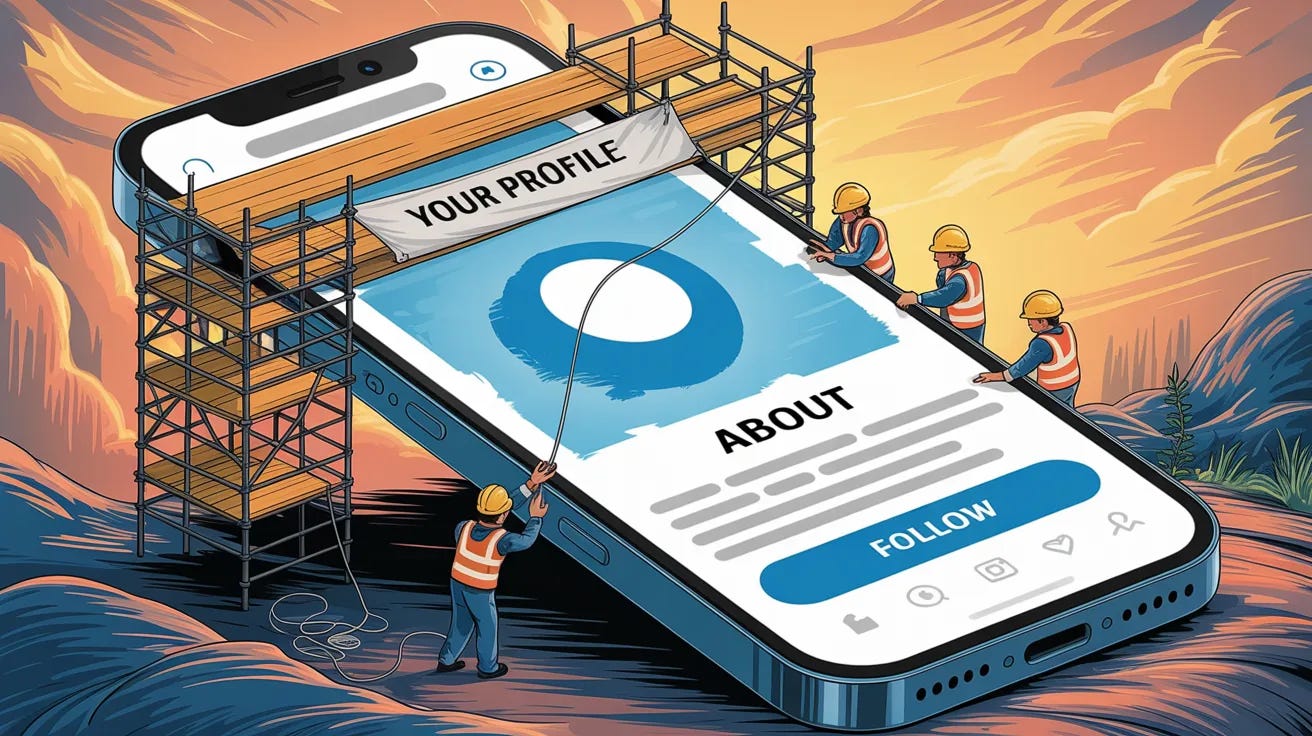
Last August, we wrote about our summer discovery: publisher profile pages on profile.google.com, a Follow button, social links, latest posts. We said there was more under the hood. We were right.
September 2025: Google tested a “Subscribe” button alongside Follow. We confirmed that following a publisher actually boosts their Discover feed presence. Not cosmetic anymore.
November 2025: Google published official documentation on publisher profiles. First public acknowledgment.
March 2026: Banners, Pinned posts (formerly “Featured Posts”), configurable Links, and custom ordering of social links and tabs appeared on select profiles. We launched our Profile Features Monitor: 47,000 publishers across 7 languages, scanned regularly.
April 2026: The “Profile generated by Google” label disappeared on some profiles, signaling a new “claimed” tier.
Out of 47K monitored publishers, 54 have access to enhanced features. All US-based. All English-language. The group skews heavily toward local news and community publishers.
Key findings from our cohort analysis:
Banners are universally professional. 41/54 uploaded one. Zero amateur designs. NY Post used a grid of 12 iconic front pages. WSJ went with a repeating wordmark.
Local TV stations are the power users. They configured 31 of 65 total links (avg 2.2 per station). National publishers averaged 0.6. The big names grabbed a banner and stopped.
Almost nobody tracks clicks. 3 out of 65 links have UTM parameters. Gothamist is the only one with a dedicated campaign tag (utm_campaign=discover-profile). The Inquirer recycled an Instagram campaign tag. Everyone else: zero tracking.
Hearst Connecticut is the corporate case study. 5 newspapers, identical configuration, same subscription checkout funnel. But each paper has its own unique banner. Centralized infrastructure, local identity.
The “About” text changes hands. On standard profiles, Google auto-generates the description (often from Wikipedia). On claimed profiles, 38 of 54 wrote their own. Local TV goes promotional (”Your trusted source for...”), nationals stay factual, Delish is the only one playing the mission card. When you get control of your profile, that’s your pitch on a Google page.
Nobody maxed out. Our composite adoption score (0 to 6) shows zero publishers at 6/6. Lifestyle brands score highest (mean 3.83), local TV follows (3.57), nationals lag (2.93).
Enhanced features are US-only today. Our monitoring across FR, DE, ES, IT, NL shows zero deployments outside English. But the profiles already exist for everyone.
Prepare now:
Design your banner. Square format, 512px+, professional quality. The bar is set.
Audit your JSON-LD
sameAs. That’s in part what populates the social links section.Plan UTM from day one. 95% of the cohort didn’t. Be the exception.
The full analysis (banner archetypes, tier patterns, sister-site coordination, visuals, adoption scores) is on 1492.vision.
You can also find coverage of this analysis on Abondance (in French) or in English on SearchEngineLand
We keep monitoring. The data is there when you need it.
Note: We feel compelled to remind everyone of basic copyright principles: These studies and articles are the product of our work and R&D. We welcome analyses based on our work and data as long as we are properly credited; we can provide custom data for specific analyses and articles. However, it is strictly prohibited to plagiarize and republish our content while removing credits and links, to resell our data in a third-party tool without prior authorization, or to integrate our content into a knowledge base, RAG, or any LLM-type system made available to the public that will regurgitate parts of this content out of context, with or without citation. When in doubt: just ask us.
No posts
Comments
Nothing yet. Say the first thing.
Sign in to join the conversation.