
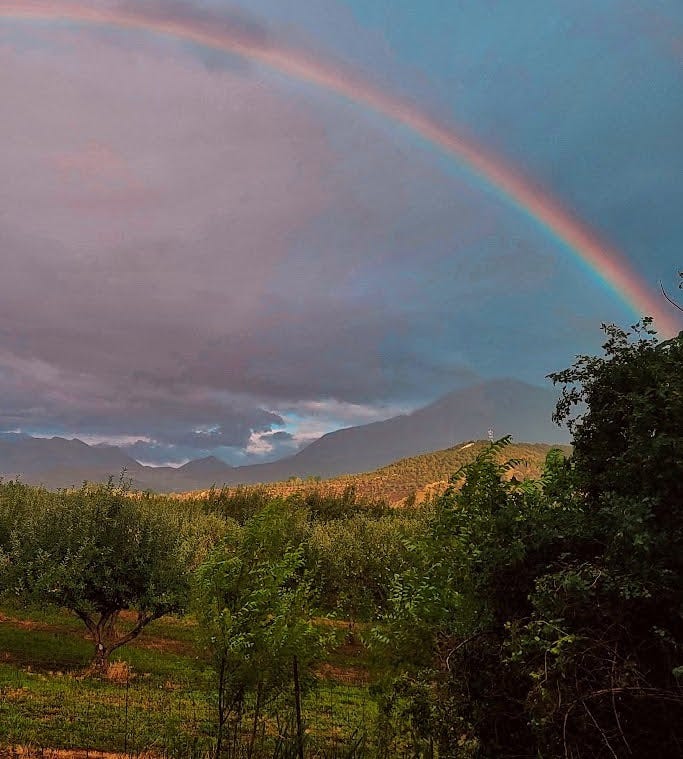
From my kitchen window I look at my backyard, across the North Fork River, and up at Cedar Hill, or “P Hill” as many know it locally, for the requisite P on its flank. It rises above the Town of Paonia and above the homestead of Sam Wade, town founder. The high school has since consolidated to Hotchkiss, ten miles down the road, to the chagrin of some old-timers, but the P remains. Change is hard. I am looking at the P, and across time.
Enos Hotchkiss was a partner with Sam Wade in settling the valley. Although you won’t hear it stated this way often, Enos was a scofflaw. In 1879 he was spying on the Ute inhabitants, a few years before he was allowed to be there, on land secured by Treaty, from the edge of what’s now Roger’s Mesa, above what is the current Town of Hotchkiss that bears his name.
Thanks for reading! Subscribe for free to receive new posts and support my work.
Although not known for agriculture, there were limited examples of cultivation by some Ute tribes, and in favorable locations. The North Fork was certainly the latter, which is confirmed by reports that Hotchkiss eagerly noted “a great golden field of late-season corn” that day in 1879, growing up river and across the valley - near a large Ute camp.
Perhaps near where his friend Sam Wade would locate his homestead, and establish Paonia, a few years later. Enos knew he had found a great location for his orchards, but it probably was not a random discovery. 100 years earlier Spanish friars Atanasio Domínguez and Silvestre Escalante had written about the valley’s great agricultural value on their way through trying to find a route from Sante Fe to West Coast missions, but making it only as far as Utah Lake, in 1776. Now their intelligence was about to bear fruit.
We stand on the shoulders of giants, the saying goes. And although they left their names here, agriculture in the North Fork Valley did not begin with Hotchkiss and Wade. By this account, they just took over what others had been successfully doing for perhaps hundreds of years.
Just down from the confluence of the North Fork with the main stem of the Gunnison River, the Eagle Rock Shelter - sitting on a bluff overlooking a broad sweep in the river - is one of the oldest archaeological sites in North America. Used for thousands of years, probably mostly as a summer and hunting camp, the second oldest yucca basket ever found (over 7,000 years old) is among the discoveries made there, some dating back almost 13,000 years.
Reports indicate evidence of corn at Eagle Rock from around 600 BCE, a period when early agricultural knowledge was spreading out of the current states of New Mexico and Arizona, and across and then beyond the U.S. Southwest.
The corn discovered at Eagle Rock carries genetic markers tracing back to Mesoamerica, representing not just early but sophisticated agriculture—the accumulated knowledge of agriculturalists spanning generations adapting cultivars, and of extensive trade among early people around the Southwest.
Right now I look out my kitchen window to where the Cedar Hill Cemetery sits on the sloping shoulder where the hill meets irrigated fields on Lamborn Mesa. Some of the town’s most famous names, the sons and daughters of settlers, the early town leaders, are marked on stones so they will not be forgotten. I have been told the final Ute camp was there as well, overlooking their home as it was taken away, before they were moved to reservation lands in Utah.
My home, once orchard housing, sits just above the main floodplain now planted in apples, cherries, and peaches, maybe where fields of maize were once cultivated. And just across the river, Cedar Hill, misnamed for the juniper, stands above the site of the Wade homestead.
There in 1881 Wade and Hotchkiss were hiding out, vulnerable on the low ground, from the hostility of those they were preparing to dispossess. A beautiful brick Victorian house today marks the shift from outlaw frontier to respectable settler town, with orchards stretching across fertile agricultural river bottom in all directions.
There is no doubt that Wade, Hotchkiss and settlers who followed, those first townspeople, farmers and orchardists, worked hard and with great skill to dig ditches and install infrastructure. My domestic water comes from their work, starting high above town in mountain springs, delivered by gravity: a hundred year old member-owned company; and my irrigation comes from the first ditch in the valley, completed by 1893, 12 miles long, surveyed by transect and dug by hand.
By the end of the 19th Century Delta County fruit was winning awards at the World Fair, indicating how quickly the industry was scaled up. Booming mining towns like Lake City, Crested Butte and Telluride were creating a high and immediate demand. New rails put in for the mines also allowed fruit to get to midwestern and eastern markets. For a time North Fork fruit was nationally renowned, and by the mid-20th Century the valley was filled with fruit trees.
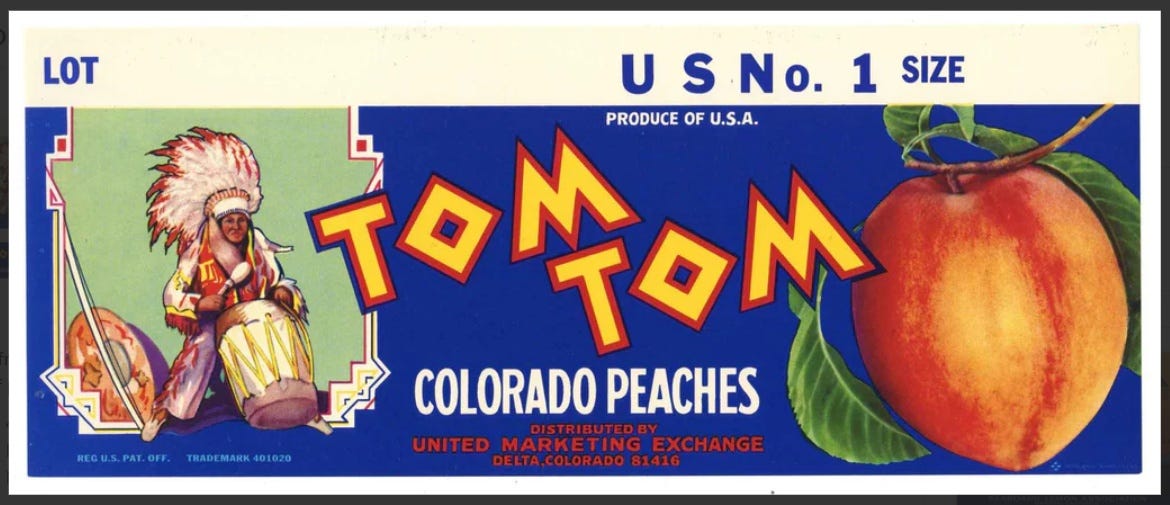
But the orchards were just replacing what human industry had already been cultivating for decades or millennia in the region. Hundreds of years before the era of Christ, corn–and farming–may have already been in the immediate vicinity.
In the Four Corners area corn arrived in the record over 4,200 years ago although the earliest direct evidence of corn cultivation in the state comes much later, around 400 BCE, from near what’s now McElmo Canyon.
Some of the earliest evidence of agriculture in western Colorado outside of the Four Corners area, was in the immediately adjacent Dolores River Basin, and by 1 CE it was being cultivated by Fremont people in northwestern Colorado.
Corn cobs from around 1,500 CE indicate that Ute tribes along the Dolores probably adopted or continued the practices established by those who had preceded them, and that Ute agriculture was nearby to the North Fork at least 300 years before Hotchkiss arrived.
So while no one knows how ancient the roots of agriculture are in Delta County, they likely stretch back into Time Immemorial. Long before Enos spied the fruits of another’s labor with the intent to make it his own, human effort was directing water and working soil to bring forth food.
Regarding agriculture in the North Fork Valley, our chapter is probably the briefest. Although the earliest chapters remain unknown, the Ute were likely the bridge between ancient knowledge and the fields Hotchkiss observed. Their practices likely incorporated techniques refined over thousands of years—knowledge that Hotchkiss also explicitly relied on to locate his fruit crops, and which European settlers would struggle to replicate despite technological advantages.
Governor Frederick Pitkin, whose name adorns Pitkin Mesa outside of Paonia, a nearby county, and other places around the state campaigned explicitly on Ute removal. He acknowledged that their lands contained “great mineral wealth” and the “finest agricultural and grazing” opportunities. The mining camps his policies served depended on the lands and the knowledge of the people those policies dispossessed.
As mining was booming in the San Juans and the Elk Mountains, treaty lands promised to the Ute tribes were creating an impediment to economic expansion. The solution was dispossession disguised as retaliation and the 1879 Meeker Incident provided the pretext. Newspapers screamed about ‘the Meeker Massacre,’ but the story was simpler: mining camps needed food, and Ute lands were inconveniently productive on the very lands miners coveted.
Businessmen like Hotchkiss and Wade saw opportunity, as the calls for removal grew louder. They were trespassing to scout out where to take advantage of it, before they were supposed to be there.
Honoring founders, forebears and ancestors means more than just recalling their memory—it means recognizing that the relationship from centuries of people to this place offers lessons we still rely on. The knowledge that was already here including where and when to plant, how to read the weather, how to work with rather than against the land’s rhythms—is knowledge that remains critical today.
We stand on the shoulders of giants. We even have the place names. Sam Wade Road, the Town of Hotchkiss, Pitkin Mesa. But being honest we would admit that they showed up after agriculture had already likely been long established and a fabric of the human landscape. It certainly was elsewhere in the region. Settlers like Enos and Sam took it and made it their own.
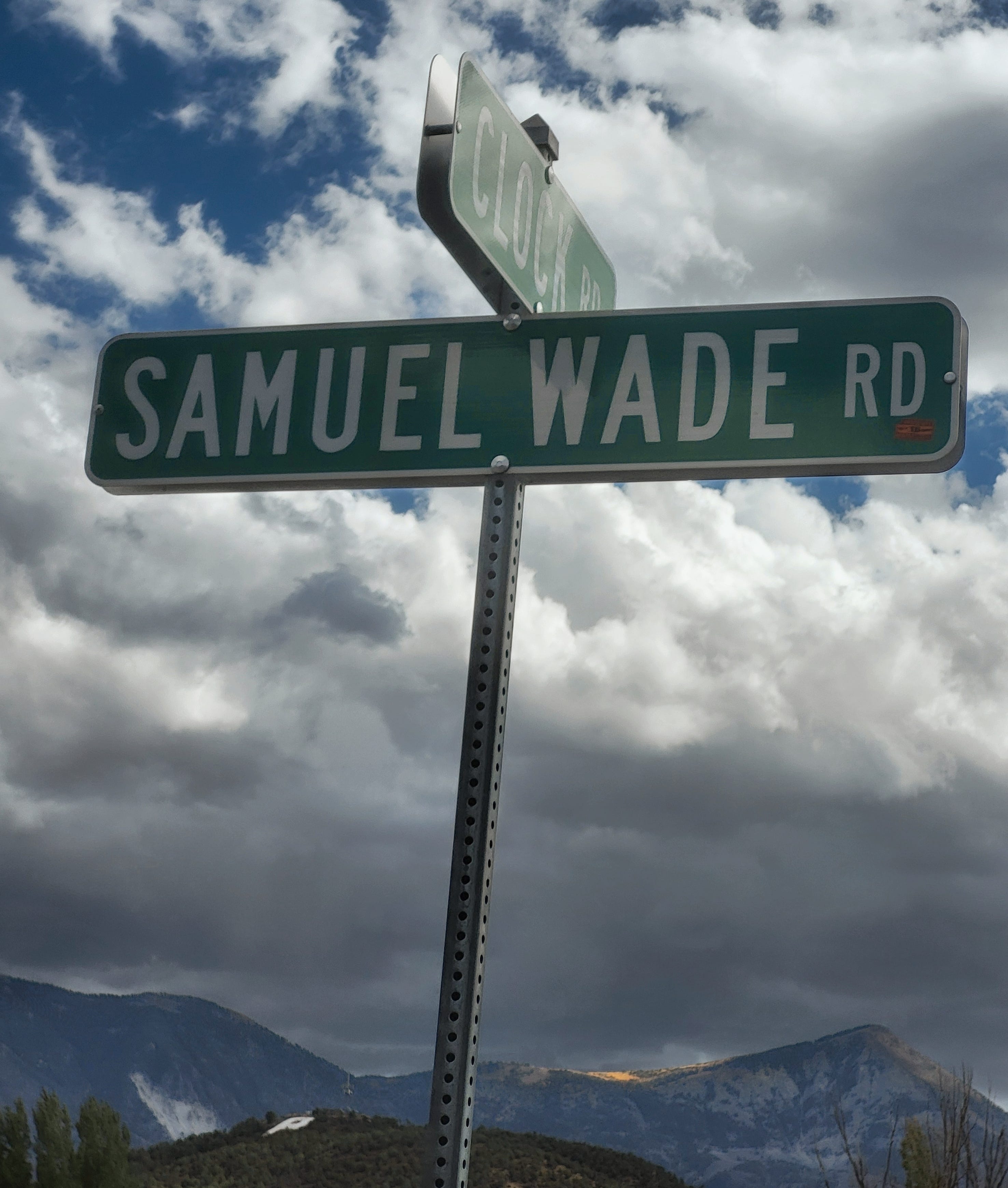
While we cannot stop change we can avoid erasure. But whose erasure we guard against, and what we put in its place suggests a wound still unhealed. I do wonder what we owe to memories and how to address past harms. The land, the community, those dispossessed have their memories too. The high school is gone from Paonia, the P remains on the misnamed Cedar Hill.
Maybe the first step is being a witness, realizing that the giants’ shoulders we stand on don’t all have names memorialized as geography. Maybe a start is to not forget those who toiled and belonged here humbly, across generations, to this place–who had their knowledge, land and the fruits of their labor taken away–but who showed us how we can live here, even if we often neglect to remember it that way.
I imagine those people sometimes, centuries of families who lived here. Perhaps they sat where I do now in my backyard, looking on as their neighbors worked the fields that ran down to the banks of the river with the same juniper clad hillside rising behind. They were probably grateful in the fall when they had a good harvest, and worried in summer when the lands and streams dried up, wondering when the monsoons would arrive. Today I look out my window and wonder the same. I want to let them know we still share that, across those years.
Thanks for reading! Subscribe for free to receive new posts and support my work.
Comments
Nothing yet. Say the first thing.
Sign in to join the conversation.