
It was a tree you noticed–and noted. I had been climbing a small slope; it sat on a shoulder of sorts, seeming to welcome me. I stood by it to look, with its trunk and markings. I have walked a lot in the woods, there is always something new to see.
It was a day when fall had paused and it was summer again. The air was warm, and the sun was hot with just one inconsequential cloud in the sky. But the smell of autumn and the crunch of fallen leaves was in my senses as I split off the trail and decided to hike up onto a ridge and over a small saddle to loop back around to the start. The days were getting shorter.
I had already been walking a while, lost a bit in thought, looking at some dark spruce on a rocky steep aspect, a few hundred yards away, on the mountain now visible though the bare aspen. Then the old tree, apart a bit from its kin, caught my attention.
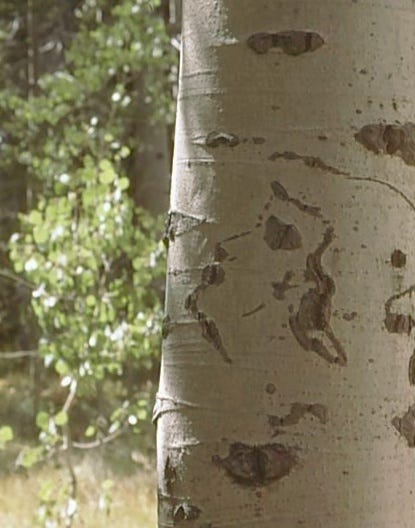
With the knots and gnarls aspen have, like eyes looking out. And what were glyphs, grown in now so they looked both swollen from and folded into the trunk. A lonely sheepherder leaving a sylph of sorts, in the wood — proof that others had stood here.
A little further on I crested, the valley beyond was nondescript and the horizon was mostly filled with the same long high ridge, with dark timber up high and aspen and brush and brown grass below. It was beautiful in the western Colorado way — distinct and ubiquitous.
Following a small draw down, opening up to a flat where the first thing I notice is a single large print in some dried mud where water had washed though, during the monsoon I suppose. It looks like a lion print, no claw marks.
I would have liked to see a wolf print, but it would be harder to identify. I can find my way around, but I am a casual naturalist. I take out my phone, grab a picture and move on. I wonder if it’s watching me, sizing me up like a cat does.
Soon I am near the bottom of the draw, still looking up at the high slope. On its flank I notice the signs of a spring: growth still lush in fall and lots of vegetation. Barely a wash but a stand of small mountain cottonwoods gathered at the place where the water must linger longest. I consider hiking up to explore, but again do not and turn toward the car.
But I am not yet where I thought I should be. This isn’t unusual in a walk. It is really pretty normal. There is always some unseen hill or ledge, maybe a false peak. Some particular thing, feature, event, obstacle that is hard to predict without being on the landscape. Still I note it.
Near the top of an intervening hill, at the edge of a little meadow, a small aspen grove holds a treasure that catches my eye. They look like morels.
I move up past old aspen, now separated from the younger part of the grove, thinking about roots. The fungal networks and the aspen clone itself, a vast communication system under my feet. I look up at a few last golden leaves yet to fall, and watch one detach and drift toward the ground.
The mountain rises behind the forest, bare aspen bendy and pale, golden canopy mostly on the ground. The spruce up high also reaches down into the edges of the aspen, and I see an encroachment lower than the others, moving in.
I bend down and carefully slice a couple mushrooms to take with me. I am pretty sure they are morels, but mushrooms take a certain confidence that I am not feeling. I get up, over the saddle to head back around to the car.
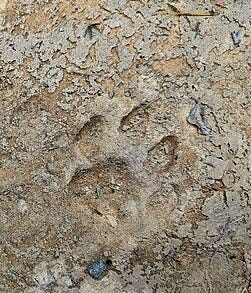
More lion activity, in a scoured patch, another track. It is later now, the sense of it watching me is a little more acute. I only brought snacks. I have a filter straw but not a lot of water. I have warm clothes. I could bivouac. I chase those thoughts away.
Soon I come around a bend, still following a slight hunter or game trail and my boot squishes for a minute on the darkening path. I note the presence of water. There is a spring nearby. I take out my phone to drop a pin. I don’t like to do that when I do this. But I may need to get back here.
I head up yet another hill, they seem to get longer but I know it’s because my hike has, more than intended, and I am feeling less and not more certain now. An aspen grove is a single organism that can live for thousands of years, sending up new shoots as old trunks perish, growing as one. But they do decline and die. That is marked sometimes through a forest succession as spruce moves in and replaces it.
A stand of dark in the midst of aspen, any time of year, but especially now, is a good landmark. I am looking up at some spruce now as I come to the top and see a tree you notice. It wasn’t only the eyes looking at me from the tree. The crude shepherd glyph reminded me that someone had stood here before.
That day stayed with me. I walk in circles. I find myself back at places I thought I had already moved past, learning new things and old lessons in new ways. Paths circle back, things show up again with new or old wisdom.
In Taoist thought, ‘the ten thousand things’ refers to the infinite particular manifestations of the underlying pattern - the fundamental unity expressing itself in each specific form. A tree, a track, a storm, a season. Each one a doorway.
That’s what 10 Thousand Things explores: places where small moments uncover big ideas. These essays are grounded in close observation - a walk, a landscape, something noticed - and they follow paths that lead through philosophy, history, ecology, archaeology.
We circle and go deeper. We often return to where we started, but see it differently.
Some pieces are free. Paid subscribers get more frequent essays and join the deeper wandering — the questions I keep circling, the patterns that reveal themselves again and again. If you find yourself walking similar paths, wonder what the deeper patterns might reveal, or if you’re curious where close attention might lead, join me.
No posts
Comments
Nothing yet. Say the first thing.
Sign in to join the conversation.