
This is a short English version of this Slovenian original.
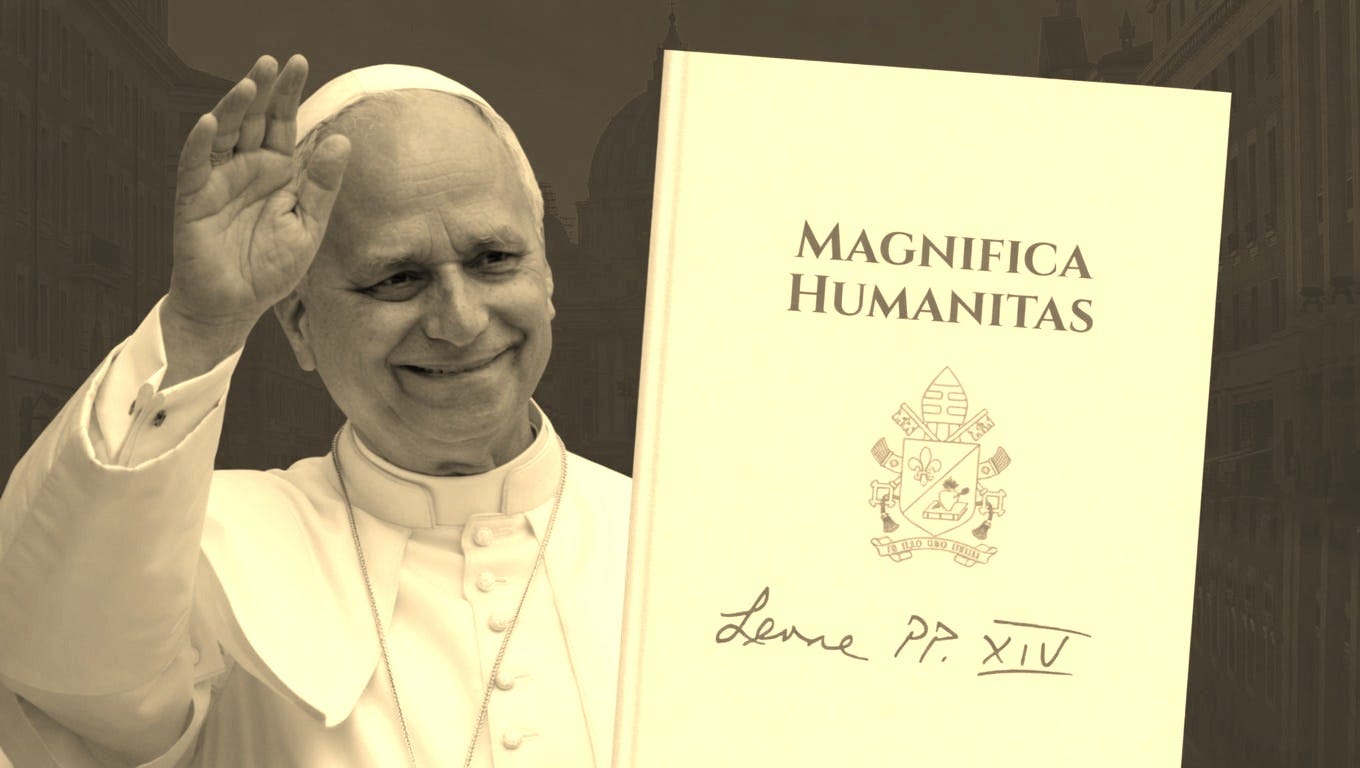
Pope Leo XIV has done something no one else has managed: assembled the most complete inventory of concerns about artificial intelligence, grounded it in a coherent moral tradition, and addressed it to the whole of humanity. Magnifica Humanitas is a serious document. It deserves a serious response, which means praise where praise is due, and questions where questions are unavoidable.
At 43,000 words, the encyclical is longer than Mill’s On Liberty, four times longer than Rerum Novarum. The timing is right. Artificial intelligence is not just another technology. It is larger than the computer, larger than the internet. It strikes at the very definition of homo sapiens, the thinking human. That a pope has chosen this moment to do what Leo XIII did for the industrial revolution is exactly what the moment calls for.
The catalog of worries is exhaustive and real: algorithmic bias, disinformation, digital addiction, autonomous weapons, concentration of power, environmental cost, geopolitical arms races. The encyclical grounds all of it in the social teaching of the Church: human dignity, the common good, subsidiarity, solidarity. It neither panics nor naively cheers. It insists that the question is not whether to accept the technology, but what kind of civilization we want to build with it. That is the right question.
The encyclical opens with two biblical images. The Tower of Babel as a warning of centralized power, one language, one plan, one ambition — ending in collapse. Nehemiah’s Jerusalem as the model: each family rebuilding its own section of the wall, responsibility distributed, community restored.
It is a beautiful parable. The problem is that the encyclical’s own prescriptions sit uneasily within it. Babel, after all, was built by something resembling a global organization with a unified vision and top-down coordination. And with the ambition of the builders to feel magnificent!
When the document then calls for stronger international governance, expanded multilateral institutions, and coordinated global oversight of AI, one has to ask: which parable does that resemble? Nehemiah did not build a unified system. He organized a community where each family took responsibility for its own portion. Today, that looks less like the UN and more like dozens of competing technology companies, each building their own model, each accountable to their own users and markets.
The encyclical deploys the Babel metaphor against concentrated private power. But the logic of the metaphor does not stop there.
This is a disappointment. The list of concerns such as surveillance capitalism, filter bubbles, job displacement, killer drones etc. is one that politicians, academics, and NGOs have been compiling for years. Nobody had assembled it so completely or positioned them so firmly against the dignity of the person. But the Pope is not chair of some European Commission’s high level group. The specifically papal contribution should be something no secular committee can provide: a deep metaphysical account of what the human person actually is.
The encyclical spends considerable energy demonstrating that AI lacks conscience, compassion, and moral judgment, arguing from physical, material grounds that a secular reader might accept. Good. But the believing reader expects a simpler and more radical answer. The machine has no soul. That word, with everything it carries - imago Dei, covenant, redemption - appears at the edges of the document rather than at its center. Faith retreats to the final paragraphs, offered as a source of strength for those who want to do good in a technological world. That is not nothing. But it is not enough.
The encyclical warns repeatedly about the concentration of AI power in the hands of a small number of private companies. This is true to an extent. But the largest and most immediate threats to human dignity from artificial intelligence do not come from Apple or OpenAI. They come from states, states that have subordinated the technology to surveillance, censorship, social scoring, and political manipulation. China is not a tech company. It does not compete for customers, competes for control.
A document concerned with the dignity of the person and the freedom of communities should have said this clearly. The question is not only how to constrain private power. It is how to constrain all concentrated power, corporate or governmental, and why competitive, pluralistic, decentralized structures offer more protection to the individual than any global coordination mechanism, however well-intentioned.
The title deserves scrutiny too. Magnifica Humanitas - the magnificence of humanity. Does Scripture actually speak of humanity’s collective magnificence? The biblical anthropology is almost always singular. God calls Abraham, Moses, the prophets, the apostles. He saves persons, not abstractions. It is humanity as a collective that built the Tower of Babel. It is the crowd - humanity assembled - that shouted “crucify him”.
If magnificence belongs anywhere in the biblical tradition, it belongs to the person created in God’s image, not to the multitudes celebrating its reason. One senses in the title a kind of reassurance: a bolstering of human self-confidence at the moment when machines are catching up with us cognitively. That is understandable. But is also not far from pride and vanity.
Copernicus displaced us from the center of the universe. Darwin returned us to the animal kingdom. Freud showed we are not masters of our own will. Each time, the establishment denied the findings. Each time, the correct response turned out to be: so what, that is not what is essential about us.
Now artificial intelligence is eroding the last fortress: the human monopoly on intelligence. The encyclical gestures at this challenge but does not meet it. The answer it needs to give, the answer that only the Vatican can give, is not that AI, for now(!) falls short of human cognition in various ways. It is that being a human person means something that no expansion of computational power can touch. Not because we are the smartest things in creation, but because we are the things in whom God chose to dwell.
That would have been a papal encyclical.
Magnifica Humanitas is the right document at the right moment, written with care, grounded in a tradition that has earned its authority over centuries. It is more complete than anything produced by Brussels, Geneva, or Silicon Valley. But the Church’s advantage over all of them is not a better checklist. It is a metaphysics.
The Gospel of John opens with, “In the beginning was the Word, and the Word was with God”. We now have machines that are extraordinarily good with words - more fluent, more tireless, more encyclopedic than any human. If words were all there were, we would already be outmatched. But the point of John’s Gospel is precisely that the Word became flesh. Not data. Not language. Flesh - particular, mortal, ensouled. That is the difference that matters. That is what no language model, however large, will ever be.
The encyclical too often argues like a concerned NGO and too rarely like an institution that believes this. The soul is the answer. It should have been the beginning.
Thanks for reading Too Old to Tik Tok, too Young to Die! This post is public so feel free to share it.
No posts
Comments
Nothing yet. Say the first thing.
Sign in to join the conversation.