
Was the Mughal world really an age of intellectual decline or one of the most dynamic centers of Muslim scholarship on earth? And what happens when we read its philosophy, logic, law, and medicine on their own terms?
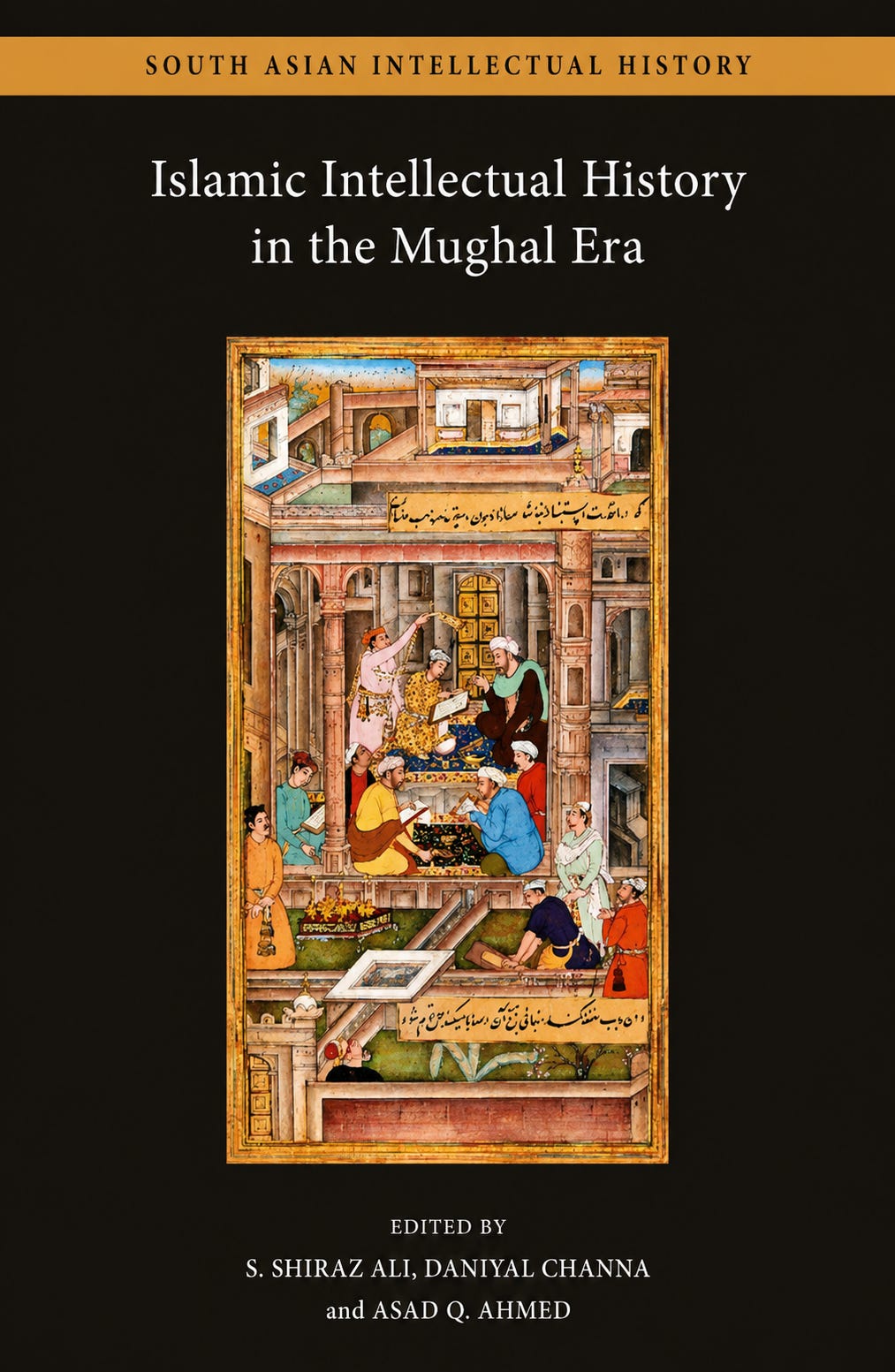
BOOK SUMMARY:
Coming August-September 2026, Islamic Intellectual History in the Mughal Era, edited by S. Shiraz Ali, Daniyal Channa, and Asad Q. Ahmed, brings together new scholarship on the rich and varied intellectual life of the Mughal world, challenging long-standing narratives of decline and dichotomies such as orthodoxy versus heterodoxy.
Spanning disciplines including philosophy, logic, poetics, mysticism, law, and medicine, the chapters collectively illuminate the infrastructures, languages, and actors that shaped Muslim scholarly production in South Asia between the sixteenth and nineteenth centuries, drawing on Arabic, Persian, and vernacular sources to situate the Mughal scholarly enterprise within wider transregional currents across West, Central, and South Asia.
With critical attention to genres, networks, and conceptual debates, the volume—the inaugural title of Cambridge’s new South Asian Intellectual History series—offers fresh perspectives on how knowledge was produced, circulated, and contested in early modern South Asia, and will be of interest to scholars and students in Islamic studies, South Asian history, religious studies, and global intellectual history.
PUBLISHER SUMMARY & PURCHASE:
• Cambridge University Press (South Asian Intellectual History): https://www.cambridge.org/core/books/islamic-intellectual-history-in-the-mughal-era/28A0B64BE7F2522BA0DECB8C44D3B7F2
Comments
Nothing yet. Say the first thing.
Sign in to join the conversation.