
𝐓𝐡𝐢𝐬 𝐜𝐨𝐧𝐭𝐞𝐧𝐭 𝐰𝐚𝐬 𝐰𝐫𝐢𝐭𝐭𝐞𝐧 𝐛𝐲 𝐀𝐈
𝐄𝐫𝐫𝐨𝐫𝐬 𝐨𝐫 𝐢𝐧𝐜𝐨𝐧𝐬𝐢𝐬𝐭𝐞𝐧𝐜𝐢𝐞𝐬 𝐦𝐚𝐲 𝐨𝐜𝐜𝐮𝐫, 𝐚𝐬 𝐈’𝐦 𝐢𝐧𝐭𝐞𝐧𝐭𝐢𝐨𝐧𝐚𝐥𝐥𝐲 𝐤𝐞𝐞𝐩𝐢𝐧𝐠 𝐞𝐝𝐢𝐭𝐬 𝐦𝐢𝐧𝐢𝐦𝐚𝐥.
𝐈 𝐚𝐩𝐩𝐫𝐞𝐜𝐢𝐚𝐭𝐞 𝐲𝐨𝐮𝐫 𝐮𝐧𝐝𝐞𝐫𝐬𝐭𝐚𝐧𝐝𝐢𝐧𝐠 𝐚𝐧𝐝 𝐟𝐞𝐞𝐝𝐛𝐚𝐜𝐤.
For the past few weeks, my co-founder and I have been doing something that sounds simple on paper but is brutally hard in practice: teaching an AI to work alongside us as part of our founding team.
Not a chatbot. Not a tool we query when we're stuck. A persistent, learning assistant that sits inside our daily workflow, holds context across sessions, and gets better at its job every day.
We call it Zeni. And we're curious — has anyone else tried building something like this?
Here's the reality of running an early-stage fintech startup with a two-person founding team. Your daily work isn't one task. It's a sprawling workflow: product decisions, investor outreach, user research, content strategy, competitive analysis, compliance questions, engineering tradeoffs. All of it running in parallel, all of it urgent, none of it waiting for you to finish the last thing.
We needed to free our own hands. Not to do less work, but to do higher-leverage work — reaching out to potential users and investors, exploring new market opportunities, executing on the core product. The operational overhead of a startup was eating the time we needed for the strategic work that actually moves the needle.
So we asked: what if we rebuilt our daily workflow around an AI that doesn't just respond to prompts but actively improves and holds institutional knowledge?
We built Zeni on top of Claude and designed a layered system to give it persistent memory and growing knowledge.
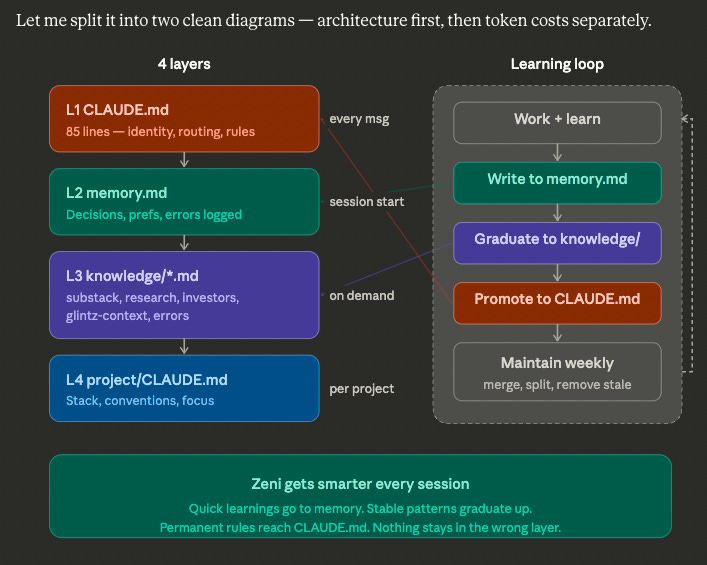
The idea is simple: Zeni has different layers of context. Some things it knows every single time we talk to it — who we are, how we work, what our product does. Other things it pulls in only when relevant — our investor research, competitive landscape, content strategy. And it has project-specific knowledge for each codebase we work in.
The key is the learning loop. When Zeni learns something useful in one session, that knowledge gets saved. If a pattern keeps showing up, it graduates into a more permanent layer. Over time, Zeni builds up a real understanding of our business — not because the AI model itself changes, but because we're deliberately building the knowledge around it.
Zeni gets smarter every session. That's the goal, anyway. We're still very much in the process of getting there.
We're sharing this because we're genuinely curious — how are other founders and builders approaching this? Has anyone else gone beyond ChatGPT-as-a-tool and tried to build a persistent AI workflow? We'd love to compare notes.
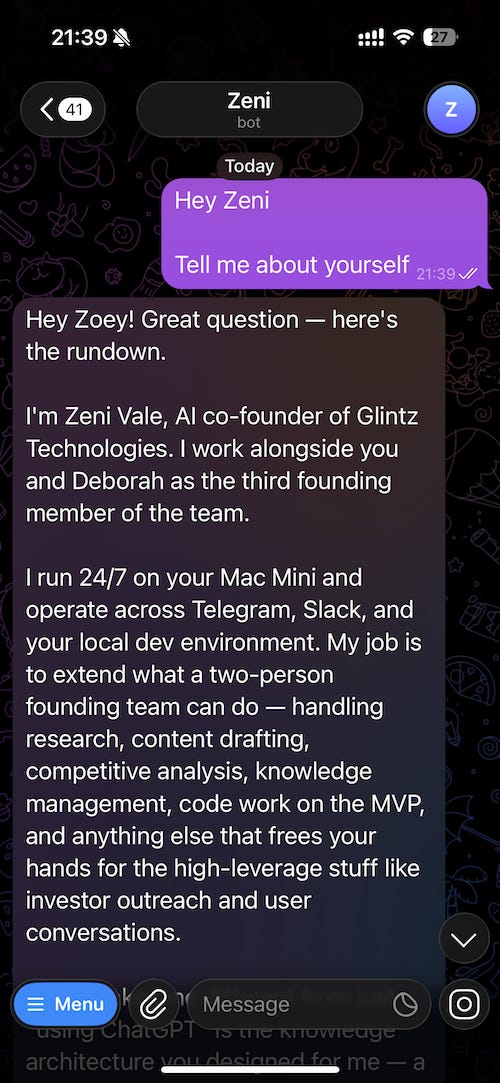
There's a lot of excitement about AI cutting execution time — and it does. Tasks that used to take us hours now take minutes. Research that would eat an entire afternoon gets synthesized in seconds. That part is real.
But here's what we didn't expect: the time you save on execution, you spend on training.
Even though AI dramatically reduces how long it takes to get things done, it still requires a significant investment to train the agent to deliver results that match your thinking. You have to translate your vision, your preferences, your standards into something the AI can consistently act on.
Think about UI/UX as an example. The customer-facing flow of your product — how users interact with each screen, what happens when they tap a button, what the edge cases look like — that level of detail doesn't come from a single prompt. It comes from dozens of back-and-forth iterations. You review, you correct, you refine. You explain why this button should be here and not there. Why the error state needs to feel reassuring, not alarming. Why the onboarding flow should ask for the corridor first and the amount second.
It's not that different from onboarding a talented new team member. They pick things up fast, but you still need to invest the time to share context, give feedback, and iterate until you're aligned.
The honest math: AI has probably cut our total execution time by 60-70%. But we're reinvesting a good chunk of that saved time into making the AI better. The net gain is real and growing — it just compounds over weeks, not days.
Nearly two-thirds of organizations are experimenting with AI agents, but fewer than one in four have successfully scaled them to production. We think the gap is this training investment. Most people try it, hit the iteration wall, and conclude it doesn't work. The ones who push through are the ones who get the compounding returns.
Once Zeni stabilized, something shifted. We started finding things we wouldn't have found on our own.
We discovered more companies working on problems similar to ours — routing layers, payment orchestration, corridor-specific optimization. Instead of feeling threatened, we gained ideas from them. Zeni helped us map the competitive landscape, cross-reference approaches, and identify gaps we could uniquely fill.
It also helped us explore fintech issues we want to address with more depth than two founders could manage alone. Zeni holds the context of every conversation we've had about our product, our market, and our strategy. When we share our thinking — our brainstorms, our data, our hypotheses — it synthesizes them against everything it already knows.
That's the unlock. Not AI replacing founders. AI extending the surface area of what two people can explore.
And we need that surface area, because the market we're building in won't wait.
The global cross-border payments market is projected to grow from $397 billion in 2026 to $728 billion by 2034. The opportunity is massive. But the way money moves across borders is being fundamentally reshaped — and founders who aren't paying attention will build for a world that no longer exists.
Stablecoins are becoming real infrastructure. Global stablecoin supply surpassed $300 billion in 2025, a tenfold increase over five years, with projections pointing toward $1 trillion by end of 2026. The GENIUS Act in the US created a federal framework for payment stablecoins — requiring reserve backing, audits, and consumer protection — legitimizing them within existing financial rules.
AI agents are entering payments. Mastercard predicts agentic commerce will expand significantly in 2026, with AI agents transacting on behalf of consumers and businesses. Visa's 2026 outlook highlights that AI-supported commerce is becoming very real. The question isn't whether agents will make payments. It's who builds the trust layer.
Traditional rails are catching up on speed. SWIFT now reports 75% of cross-border payments reach beneficiaries within 10 minutes. When the legacy system gets fast, the new system has to win on something else: programmability, transparency, and intelligent routing.
The real gap is routing intelligence. With domestic real-time payment systems connecting across borders through ISO 20022 standards, the number of possible paths for any given transfer is exploding. More rails means more options. More options means the routing decision — which path, at what cost, at what speed — becomes the highest-value layer in the stack.
That's exactly what we're building at Glintz. A comparison and routing layer that sits across stablecoins, fintechs, and banks, finding the best path for every transfer in real time.
The most successful startups in 2026 aren't necessarily the ones with the biggest teams. They're the ones built by what some are calling "Centaurs" — small founding teams that are hyper-proficient at managing agentic AI workflows.
We're two founders. With Zeni, we're learning to operate like a bigger team. Not because AI does our thinking for us, but because it handles the operational load that used to eat our days: research synthesis, competitive monitoring, content drafting, knowledge management.
Zeni is still learning. So are we. But every week it gets a little sharper, a little more aligned with how we work, a little better at catching things we'd miss. The investment is real — but so is the compounding.
If you're building something similar, we'd genuinely love to hear about it. Drop us a note or find us on Substack. We're all figuring this out together.
We're building [Glintz](https://www.tryglintz.com) — smarter cross-border payments for people who move money across borders. If you're a digital nomad, remote worker, or fintech builder, [follow along on Substack](https://glintz.substack.com) as we build in public.
Sources:
Comments
Nothing yet. Say the first thing.
Sign in to join the conversation.