
It’s Saturday afternoon in Bangkok.
Your landlord just pinged you. Rent’s due Monday. You need to move $1,000 from your US account to Thai baht today.
You open the app you always use. It was the cheapest option when you checked on Thursday. You trust it. You type the amount, hit send, close the app.
What you didn’t see:
Between Friday close and Saturday morning, that same provider quietly widened its exchange rate markup from 0.15% to 1.01%.
Your landlord receives THB 31,651 instead of THB 31,955.
That’s THB 305 less (~$9.50) vanished into a wider spread. Not because the baht moved. The mid-market rate barely shifted overnight. The provider just decided weekends cost more.
We know this because we watched it happen in real time.
At Glintz, we pull daily rate snapshots from 20+ providers across 6 corridors. We log every fee layer (deposit, FX markup, withdrawal, network) and rank by what the recipient actually gets after everything is deducted.
Last weekend (April 17 to 19), we compared Friday’s numbers against Saturday and Sunday.
The results were not subtle.
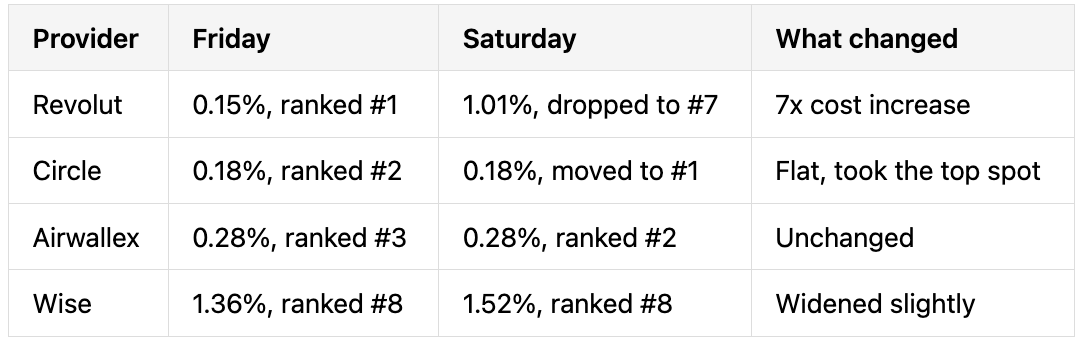
The cheapest option on Friday became the 7th cheapest on Saturday.
If you’d picked “the best app” on Thursday and trusted it through the weekend, you’d have overpaid without ever knowing.
Same corridor type, same pattern:
Revolut: 0.04% → 0.40% (a 10x increase, dropped from #1 to #4)
Circle: 0.18% → 0.18% (unchanged)
Airwallex: 0.28% → 0.28% (unchanged)
The providers using traditional forex rails shifted. The ones using stablecoin or fixed-rate infrastructure didn’t.
CAD → SGD (Canada to Singapore) barely moved. Circle held #1 at 0.18% across all three days. Revolut went from 0.34% to 0.30%, actually getting slightly cheaper. Top 5 rankings stayed almost identical Friday through Sunday.
GBP → EUR flipped the other direction entirely:
Revolut improved, going from 0.34% (ranked #4 Friday) to 0.09% (ranked #1 Saturday)
Circle slid from #1 to #2
On this corridor, sending on Saturday was actually better.
There’s no universal “weekends are worse” rule.
Some corridors get more expensive. Some get cheaper. Some don’t move at all. The pattern is inconsistent, and that’s exactly what makes it dangerous. Your assumptions from one corridor don’t transfer to another.
→ Check your corridor here:
On top of the spread changes, entire payment rails disappeared on Saturday.
Every credit card option (1.30% deposit fee on weekdays) was gone from the rankings Saturday and Sunday, across all US, Canadian, and UK corridors.
Two invisible variables at once:
Your provider costs more on weekends
Your payment method might not exist on weekends
Most people send money internationally a few times a year. Weekend rate changes are rounding errors for them.
But if you’re living abroad, earning in one currency and spending in another, these transfers are part of your monthly rhythm. And weekends are exactly when life forces your hand.
The Saturday landlord
Your Chiang Mai landlord doesn’t care about forex market hours. Rent’s due, you need to send, and you’re not going to wait until Monday to save nine dollars.
Except multiply that by 12 months. That’s over $100/year quietly lost to weekend spreads on a single corridor. For someone managing rent, health insurance, and a phone plan across two countries, that’s real money.
The Friday-night contractor invoice
Your developer in Jakarta finishes a sprint and sends an invoice Friday evening your time. You want to pay fast because that’s how you keep good people around. You process it Saturday morning.
On USD → IDR that weekend:
Cheapest provider on Friday: 0.04% (less than $1 in fees)
Same provider on Saturday: 0.40% (~$8 in fees on a $2,000 invoice)
Do that every other week for a year and it compounds into hundreds.
The “I’ll do it this weekend” trap
You’ve been meaning to send money home for a week. Saturday morning you finally sit down with coffee and get it done.
Same app. Same corridor. Same amount. Everything looks the same.
But the cost structure underneath has shifted since Tuesday. No banner, no warning, no “rates are higher today.” You just get less on the other end and don’t realize it unless you’re actively comparing.
None of these people did anything wrong. Same provider, same amount, same steps. The only thing that changed was the calendar.
Forex markets close at 5pm ET on Friday and reopen Sunday evening.
During that window, there’s no live interbank rate for providers to anchor their pricing to. So they estimate. Some add a small buffer on top of Friday’s closing rate. Others add a large one. They’re hedging the risk that rates might move before Monday, and passing that cost to you.
How much they add varies wildly:
Revolut: jumped 7x on USD → THB
Circle (stablecoin route via USDC): didn’t change at all, because it doesn’t rely on the interbank market
Wise, Airwallex, SingX: shifted by different amounts on different corridors
There’s no standardized “weekend fee” across the industry. Every provider sets its own rules. And none of them tell you the rules changed.
The core problem isn’t that weekend rates are always bad. (On GBP → EUR, Revolut actually gave the best rate of the whole weekend on Saturday.)
It’s that the landscape reshuffles every 24 hours, and unless you’re checking multiple providers at the moment you send, you’re flying blind.
The comparison engine we have today is phase 1.
It pulls real-time fee and rate data from 53 providers across 111 corridors, breaks down every fee layer, and ranks by what your recipient actually receives. If a provider widens its weekend spread, the ranking reflects that in real time.
You don’t have to memorize which providers are good on which days or on which corridors.
But comparing is still just the starting point.
The long-term vision: you shouldn’t have to compare at all.
Open Glintz. Type the amount. Tap send. The routing engine picks the cheapest, fastest path for that exact moment, on that exact corridor, on that exact day. If it’s Saturday and the usual best option has a wider spread, the engine reroutes automatically.
One tap, done.
That’s the product we’re building toward: top up, compare, send. Today you can compare. We’re raising to build the rest.
→ Check your corridor here:
We’re two co-founders building Glintz, a cross-border money platform for people who live borderless. If you send money internationally and want to stop guessing, we’re building this for you.
Have a corridor you want us to track? Reply to this email, we read everything.
Comments
Nothing yet. Say the first thing.
Sign in to join the conversation.