
All week I’ve watched an hour of extreme hiking videos before falling asleep. I don’t know how they ended up on my algo, likely the result of last week’s obsession, which was “Holy shit, a bear!” videos. The Go Pro camera footage of fearless, quippy white people walking up Angel’s Landing in Zion National Park is mezmerising. I think I enjoy watching them the same way I like The Pitt. This type of hike is my biggest fear. I hate heights. I wrote this story in Granta about my relationship to hiking during an agoraphobic flare in Joshua Tree. It ended up being the title story in my collection Wild Failure.
I have mostly recovered from the type of OCD where you obsess about losing control and jumping off high surfaces. (I did this by moving to an island by myself and ensuring I must drive over a bridge a dozen times per month.) But there exists no willpower or CBT strong enough for me to ever scale a cliff. I cannot imagine being able to clip a caribeener onto a chain on a vertical rock, relying only on my own physical and mental health to get to the other side, knowing I will have to do it again in reverse. I easily make jokes about these people not having enough actual danger in their lives so they must create it for themselves to feel anything. But underneath those derisive quips? Simple envy. How free you must be to be able to walk across a thin, rocky bridge with mile long drops on either side? How does it feel to trust yourself, and the flukey nature of the universe, that much? How invincible you must be, teach me to be like you!
I think it’s important to know what your narrator or TV show character is afraid of. If you’re stuck in a story, ask yourself what is their biggest source of shame? Their regrets? What could they encounter that would be almost unbearable? There’s the cliche/wisdom in screenwriting that you have to chase your character up a tree and throw things at them. What are the stakes, where is the tension? Sometimes I write three whole drafts of a novel before I realize that the tension is in my mind, obvious to me, and not on the page. I get really caught up in pretty sentences for too many pages. But sometimes I give a character in a script too many obvious problems or stakes, and not enough moments of contemplation, subtlety, time to grow and change.
I’ve made the mistake of giving my narrators the same fears in every novel, even if the plot and timeline, their ages and backstories, are wildly differently. But I’m not sure if it’s a mistake or just the way artists work. Are we artists to wrestle with this unbearable feelings? I notice other writers doing it too, how their characters grow older but stay similarly preoccupied with the same unanswerable questions. I’ve been listening to all of Ben Lerner’s novels on audiobook even though I’ve read them all in print, and I’m noticing how the narrators all fear the same things, they have similar sources of rage, existential and social discomfort, the same preoccupations with masculinity. Of course authorial geneology is impossible to avoid. It made me think about the poet Tony Hoagland’s observation that every writer has an irresolvable obsession. I’ve written about this a lot, probably mentioned it in this substack many times, but I find it helpful. I used to say that all of my novels are about anxiety, no matter the story and invented stakes. (Or I suppose, as Vivian Gornick writes so well, no matter the situation, the story remains the same.) But what I want to know 13 books in, is how it might shift. Should I write a story about someone who could scale a cliff? Could I make it believable?
For a while I was really into writing from the point of view of someone I could never be. A romance novel about someone like me would be dreadful, I find most cis men unbearable to be around. It was fun to embody someone who could have crushes on not one but two. And now my new novel is narrated by a butch. I’ve written many femmes narrators, all of my novels except for one feature a femme POV, because I’m a queer femme primilarly romantically interested in butches or those on the masc spectrum. Switching it up is really interesting, having to look through her eyes at the femmes I’ve often spotlit in previous works.
Does it help you to think about what your characters fear? If you’re stuck lately, try freewriting a list of things they are afraid of, situations where they’d potentially lose it. What does it say about their window of tolerance, their past traumas, how they can access bravery or abandon themselves?
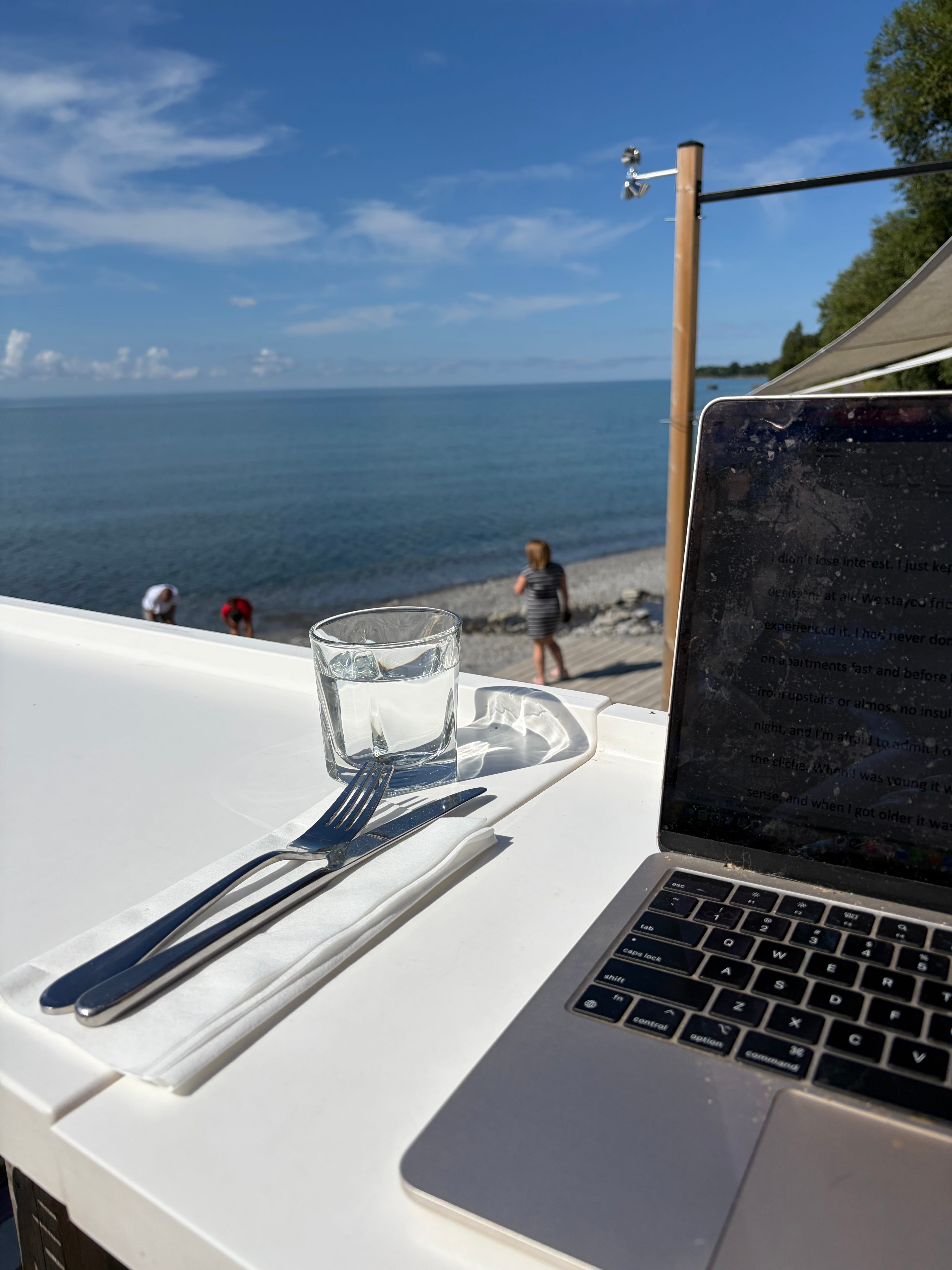
My view as I write this at the Drake Devonshire patio
No posts
Comments
Nothing yet. Say the first thing.
Sign in to join the conversation.