
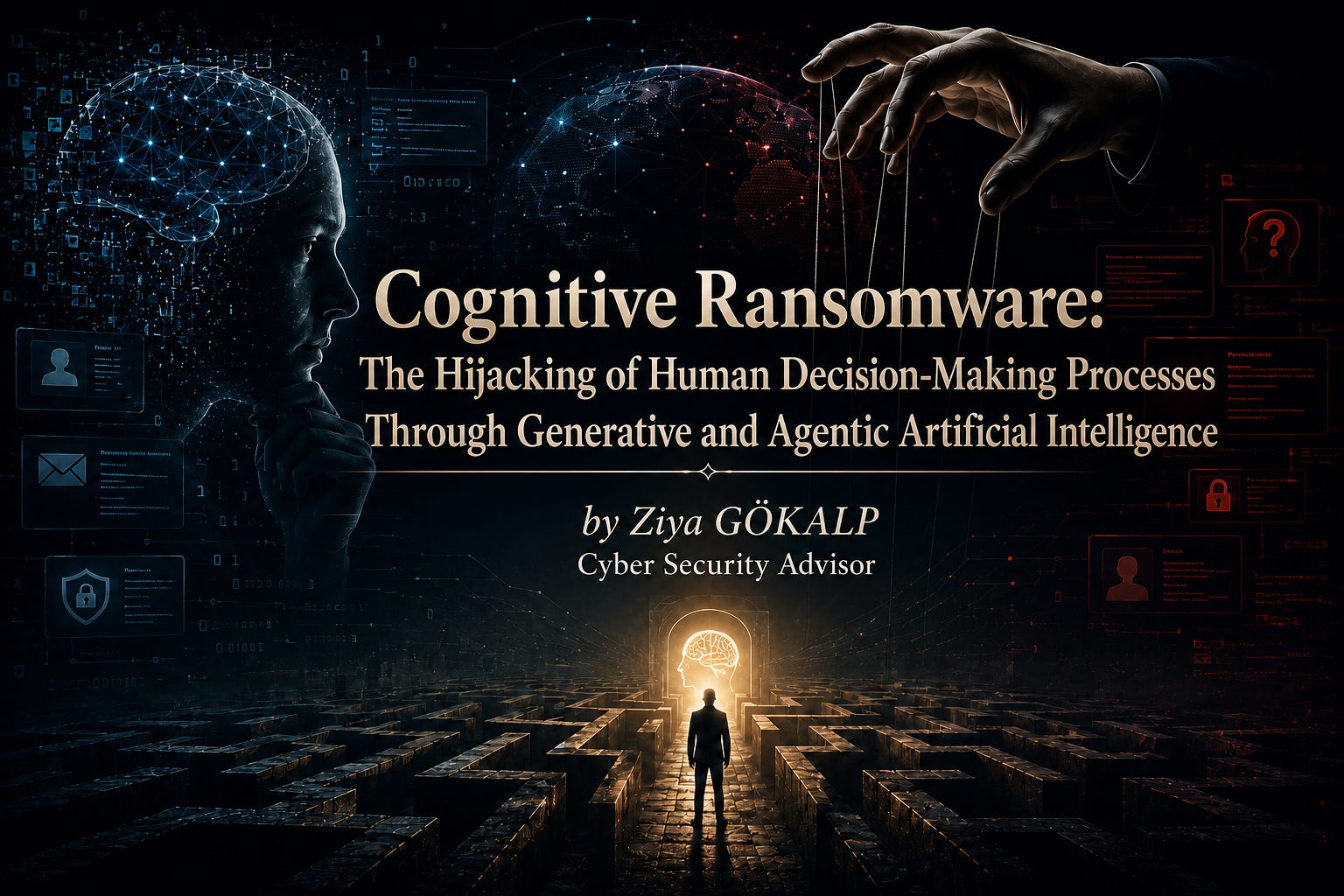
For many years, the field of cybersecurity has approached cyberattacks primarily from a technical perspective.
Vulnerabilities were sought within software, attacks were analyzed through network traffic, and defense mechanisms were designed largely to protect systems. Firewalls became more sophisticated, antivirus solutions were widely deployed, authentication mechanisms were strengthened, and organizations invested heavily in building more resilient infrastructures.
Despite these efforts, cyberattacks have not only persisted but have also become increasingly sophisticated and impactful with each passing year.
This evolution has revealed a fundamental reality: an organization’s most valuable asset is not merely its data. Equally important are the people who interpret that data, make decisions based on it, and ultimately determine the organization’s response.
Modern ransomware provides one of the clearest examples of this phenomenon.
At first glance, the apparent target of a ransomware attack is the organization’s data. Files are encrypted, access to critical systems is denied, and payment is demanded in exchange for the decryption key.
However, when the psychological dimension of such attacks is examined, a very different picture emerges.
Two organizations exposed to the same ransomware attack may respond in entirely different ways. One may choose to pay the ransom, while the other refuses. Some recover and resume operations within days, whereas others remain unable to function for weeks. Even when the technical conditions are nearly identical, the decisions made are fundamentally different.
The difference does not lie in the encryption algorithm itself. The decisive factor is the psychological pressure imposed on people. Fear of prolonged downtime, concerns over losing customer trust, financial losses, reputational damage, and the uncertainty surrounding the incident ultimately determine the true impact of the attack.
In other words, ransomware does not merely encrypt data, it also places human decision-making under pressure.
This leads to a fundamental question.
Must an attacker actually encrypt files to create the same psychological effect?
Put differently, if an attacker can directly influence the target’s decisions, is technical encryption still necessary?
This question has become increasingly relevant in light of the remarkable advances in generative artificial intelligence over the past few years.
The rapid advancement of large language models (LLMs), voice cloning technologies, deepfakes, and synthetic digital identities has provided threat actors with an unprecedented set of capabilities, enabling them to target not only computer systems but also human cognition and behavior.
Today, an individual’s writing style can be convincingly replicated, their voice can be synthesized with near-perfect realism, and entirely fictitious personas can be transformed into credible digital identities.
In such an environment, the focus of cyberattacks naturally shifts from technical systems to the cognitive processes of human beings.
The concept of Cognitive Ransomware presented in this article is proposed as a conceptual framework for understanding and explaining this transformation. It describes a new class of cyber threats in which the primary objective is not to encrypt data, but to manipulate, coerce, and ultimately seize control of human decision-making processes.
It should be emphasized that Cognitive Ransomware, as discussed in this article, does not represent a formally recognized category of malware. Instead, it is proposed as a conceptual framework for understanding how AI-enabled manipulation techniques may evolve into a new class of cyber threats in the future.
In conventional ransomware attacks, the attacker denies the victim access to their data. In the Cognitive Ransomwareparadigm, however, the primary target is the human cognitive process.
The objective is to narrow an individual’s range of perceived choices by exploiting fear, trust, perceived authority, time pressure, or social relationships.
As a result, although the victim may appear technically free to choose, they are psychologically guided toward making only the decision desired by the attacker.
This perspective highlights that cybersecurity is no longer solely about protecting information systems. Even the most advanced firewall cannot analyze an executive’s fears, and no intrusion detection system can recognize when an employee’s trust is being systematically exploited.
As technical defenses continue to improve, the transformation of human behavior into a primary attack surface demands a fundamental redefinition of cybersecurity itself.
At this point, it is reasonable to pose a critical question: Which is easier to compromise a system, or to alter the decisions of the person who operates it?
If the latter becomes less costly, faster, and more difficult to detect, the hostages of future ransomware attacks will no longer be files or data, but human judgment itself.
It is precisely at this point that the true encryption will no longer occur within computers, it will take place in the human mind.
Cyberattacks are often assumed to require sophisticated malware, zero-day vulnerabilities, or highly advanced exploitation tools to succeed.
However, numerous incidents in recent years have demonstrated that the most decisive factor in the success of a cyberattack is not technology, it is the human being. The reason is straightforward. Computers operate according to predefined rules, whereas humans make decisions based on their perceptions, experiences, emotions, and the circumstances in which they find themselves.
This distinction elevates humans from being merely users of information systems to becoming the most critical link in the attack chain.
As discussed earlier, technical systems generally behave in predictable ways because they follow deterministic rules. Human behavior, by contrast, can vary significantly, even when individuals are confronted with the same situation.
A decision made under intense stress is often very different from one made in a calm and controlled environment. Likewise, factors such as time pressure, perceived authority, fear, trust, and social pressure can lead individuals to make decisions they would not ordinarily make under normal circumstances.
This is precisely why cybercriminals have invested heavily in social engineering techniques for decades.
While bypassing a firewall requires technical expertise, deceiving a human being often requires nothing more than understanding how that person thinks. Consequently, successful cyberattacks exploit not only vulnerabilities in technical systems but also weaknesses in human decision-making.
The human brain is required to make thousands of decisions every day. Because it is impossible to analyze each decision in depth, it relies on mental shortcuts known in cognitive psychology as heuristics.
These cognitive mechanisms make everyday decision-making more efficient, but they also create vulnerabilities that can be exploited through manipulation.
An official-looking logo can instantly create a sense of trust. Instructions that appear to come from a senior executive may be executed without question. A task presented as urgent can cause routine verification procedures to be bypassed. Likewise, information perceived to be accepted by the majority is often adopted with little critical evaluation.
None of these outcomes result from technical vulnerabilities. Rather, they arise from predictable characteristics of human cognition characteristics that have become increasingly valuable targets for cyber adversaries.
All of these behaviors stem from the natural functioning of the human brain and should not, in themselves, be regarded as security weaknesses.
Precisely for this reason, modern cyberattacks increasingly focus not on bypassing technical security controls, but on exploiting these inherent decision-making mechanisms to their advantage.
In most cases, the attacker’s objective is not to compromise the victim’s computer. Rather, it is to induce the victim to voluntarily perform a specific action.
Clicking on a malicious link, approving a fraudulent payment request, disclosing sensitive credentials, or temporarily disabling security controls may appear to be technically simple actions. Yet these seemingly ordinary decisions often represent the critical point at which a cyberattack succeeds.
This phenomenon becomes even more pronounced in organizational environments. Employees who process hundreds of emails each day, move continuously between meetings, and simultaneously manage multiple operational decisions naturally operate under significant cognitive load.
In an environment where attention is constantly fragmented, it is impractical to verify every instruction in detail. This is precisely the working dynamic that threat actors seek to exploit. Security vulnerabilities, therefore, exist not only in software but also within organizational processes and human behavior.
Another characteristic that distinguishes humans from technical systems is their ability to establish relationships based on trust.
Trust is an indispensable element of organizational life. Organizations thrive through collaboration, managers delegate authority to their teams, and employees routinely act on the assumption that their colleagues, supervisors, and business partners are operating in good faith.
This assumption is what makes modern organizations function effectively, yet it also creates opportunities for malicious exploitation. By targeting trust rather than technical systems, an attacker can often achieve the same objective at a fraction of the cost and with far greater efficiency.
In many cases, compromising a trusted relationship is significantly easier than compromising a well-protected information system.
For this reason, today’s attack surface extends far beyond servers, endpoints, mobile devices, and cloud infrastructures. The people who make decisions have become security assets just as critical as the systems themselves.
This is particularly evident in critical infrastructure, financial institutions, energy facilities, healthcare organizations, and industrial control systems, where a single erroneous decision can have consequences far more severe than a technical vulnerability.
An approval granted at the wrong moment, an instruction accepted without verification, or sensitive information shared with someone mistakenly perceived as trustworthy can result in losses amounting to millions of dollars or even consequences that directly affect physical safety.
At this point, the key issue is not to characterize humans as the weakest link in the security chain. Such a perspective is incomplete. Humans can also represent its strongest line of defense. However, this requires recognizing that people are not merely operators of information systems but are themselves a critical attack surface that must be actively protected.
This recognition forms the conceptual foundation of Cognitive Ransomware.
If the attacker’s objective is to influence human decision-making, the attack has already moved beyond the boundaries of traditional social engineering. The goal is no longer simply to persuade a victim to perform a single action, but to systematically narrow the individual’s perceived choices until a particular decision becomes virtually inevitable.
The technological force that makes this transformation possible is, above all, Artificial Intelligence (AI).
For the first time, Artificial Intelligence provides threat actors with the capability to analyze millions of individuals simultaneously, craft highly personalized attack scenarios for each target, and automate cognitive manipulation at an unprecedented scale.
Throughout the history of cybersecurity, advances in technology have consistently reshaped the methods used by cyber adversaries. The widespread adoption of the Internet gave rise to network-based attacks, the proliferation of mobile devices introduced mobile malware, and the evolution of cloud computing created an entirely new class of threats targeting cloud infrastructures.
Today, a similar transformation is being driven by Artificial Intelligence (AI).
Unlike previous technological shifts, however, AI is not merely introducing another attack tool. It is fundamentally redefining how cyberattacks are planned, prepared, and executed.
In the past, a successful social engineering campaign relied heavily on human effort. Attackers had to research their targets, understand the structure of the organization, develop a convincing pretext capable of establishing trust, and wait for the right opportunity. This process often took weeks or even months, and the same preparation had to be repeated for every new target. As a result, the scale of such operations was constrained by the attacker’s available human resources.
Generative AI is fundamentally changing this equation.
With the emergence of large language models (LLMs), natural language processing (NLP) systems, and autonomous AI agents, many tasks that previously required extensive manual effort can now be performed automatically.
Information about a target can now be gathered from open sources, analyzed, and used to identify the most effective communication style and generate highly tailored attack scenarios, all within a fraction of the time previously required.
As a result, the attacker’s greatest advantage is no longer technical expertise alone, but the ability to collect, interpret, and operationalize vast amounts of information.
The foundation of this transformation lies in Open-Source Intelligence (OSINT).
Today, individuals and organizations unknowingly leave behind vast amounts of digital footprints. Social media activity, professional networking platforms, corporate websites, conference presentations, press releases, job postings, and publicly available documents can collectively provide a remarkably detailed profile of a target.
Artificial Intelligence does not merely collect this information; it also analyzes the relationships among disparate data points, transforming them into coherent and actionable intelligence.
For example, by examining an organization’s publicly available information, AI can identify which teams collaborate closely, who holds the greatest influence in decision-making processes, which executives maintain the highest public visibility, and what communication style is commonly adopted within the organization.
Similarly, at the individual level, AI-driven analysis can reveal a person’s professional interests, work habits, preferred terminology, and communication style.
None of this information is inherently harmful. However, when aggregated, correlated, and analyzed effectively, it enables the creation of highly convincing and context-specific attack scenarios.
One of the most significant capabilities introduced by Artificial Intelligence is its unprecedented capacity for personalization.
In the past, phishing campaigns typically relied on sending the same message to thousands of recipients. Today, however, AI makes it possible to generate unique content for every individual target.
Even two employees within the same organization may receive messages that differ entirely in language, technical terminology, tone, and attack scenario. This is possible because Artificial Intelligence can analyze and model each individual as a distinct behavioral profile.
This level of personalization is not limited to written communication.
Recent advances in voice synthesis and AI-generated imagery have fundamentally challenged the reliability of digital communications.
Using only a few minutes of recorded speech, it is now possible to replicate an individual’s voice, speaking style, and vocal inflections with remarkable accuracy. Likewise, advanced image and video generation systems can produce highly realistic videos that are increasingly difficult to distinguish from authentic recordings. As a result, technologies that were once considered reliable means of visual or auditory verification can no longer be assumed to be trustworthy.
More importantly, these technologies do not operate in isolation. Within a single attack campaign, Open-Source Intelligence (OSINT), Large Language Models (LLMs), voice cloning, AI-generated imagery, and automated content generation systems can be seamlessly integrated.
Rather than simply sending a fraudulent email, an attacker can orchestrate a sophisticated, multi-layered manipulation campaign tailored specifically to an individual target.
This transformation has also dramatically expanded the scale of cyberattacks. In the past, complex social engineering operations were typically reserved for high-value individuals or specific organizations because of the considerable human effort they required. With Artificial Intelligence, however, the same techniques can now be deployed efficiently across vastly larger target populations.
In other words, highly personalized attacks are no longer economically viable only against senior executives, they have become scalable and cost-effective even when directed at ordinary employees.
Another significant advantage provided by Artificial Intelligence is persistence.
In traditional cyberattacks, communication between the attacker and the target was typically brief and transactional. AI-powered systems, by contrast, can sustain coherent and context-aware interactions for weeks or even months, retain memory of previous conversations, and continuously refine their scenarios as new information becomes available.
This capability makes attacks that rely on establishing trust significantly more effective.
The transformation taking place, however, extends far beyond making cyberattacks more convincing.
The most profound change, however, is that cyberattacks are becoming dynamic rather than static. Artificial Intelligence can analyze every response from the target and adapt its next move accordingly.
Instead of following a fixed attack script, AI-driven systems can continuously refine their strategy based on the target’s behavior, making the manipulation process increasingly adaptive, personalized, and effective over time.
If the target becomes suspicious, the communication style can be adjusted, alternative communication channels can be employed, or additional elements of verification can be introduced. Consequently, the attack ceases to be a one-time attempt and instead evolves into a continuously adaptive process that responds to the target’s behavior in real time.
It is at this point that Cognitive Ransomware begins to diverge from traditional social engineering.
The objective is no longer merely to establish trust or persuade the target to perform a single action. Rather, the goal is to gradually shape the target’s decision-making process, systematically narrow the range of perceived alternatives, and ultimately lead the individual to regard a predetermined decision as a natural and self-directed choice.
Artificial Intelligence serves as the primary enabler of this transformation, accelerating, scaling, and continuously optimizing every stage of the manipulation process.
A review of the history of cybersecurity reveals a consistent pattern: attackers have always targeted the weakest point in the defense.
Early cyberattacks primarily exploited technical vulnerabilities. Over time, however, their focus expanded to financial systems, enterprise networks, and critical infrastructure. As defensive technologies evolved, attackers adapted their methods, recognizing that overcoming technical barriers was not always the most efficient path to success.
In many cases, influencing the decisions of the people operating a system proved easier than compromising the system itself.
Today, Generative AI, Large Language Models (LLMs), voice cloning technologies, and synthetic digital identities are taking this evolution to an entirely new level. The success of cyberattacks no longer depends solely on software vulnerabilities or the sophistication of malicious code. Intelligence gathering, target profiling, trust-building, and persuasion can now be automated to a remarkable degree, making human-centric attacks both more scalable and significantly more convincing.
The concept of Cognitive Ransomware presented in this article should not be interpreted as a newly identified category of malware within the current cybersecurity literature. Rather, it is proposed as a conceptual framework for understanding the emerging class of AI-enabled threats that seek to manipulate human cognition rather than compromise information systems directly.
The central argument advanced in this article is that future cyberattacks may rely less on technical encryption and increasingly on cognitive manipulation.
In other words, the objective may shift from rendering data inaccessible to influencing an individual’s decision-making process and psychologically constraining the range of perceived choices.
It is important to emphasize that not every social engineering attack or AI-enabled fraud should be classified as Cognitive Ransomware.
Nevertheless, current trends indicate that cyberattacks are becoming increasingly personalized, leveraging trusted relationships and placing human behavior at the center of their operational strategy.
From this perspective, Cognitive Ransomware provides a valuable conceptual lens through which emerging threats can be examined before they become widespread.
This evolution also calls for a fundamental reassessment of organizational cybersecurity strategies.
Building resilient infrastructures, maintaining secure and up-to-date systems, and protecting networks will remain indispensable. However, these technical safeguards alone will no longer be sufficient.
Equally critical are employees’ critical thinking skills, verification habits, levels of digital awareness, and the resilience of organizational decision-making processes. Together, these human-centric capabilities are becoming integral components of modern cybersecurity.
Ultimately, the defining characteristic of future cyberattacks may be that they target not only information systems, but also the people who make decisions on behalf of those systems.
For decades, cybersecurity has been primarily understood as the discipline of protecting data. Today, however, that definition is expanding.
What must be protected is no longer information alone, but also the human capacity to interpret that information, evaluate it critically, and make informed decisions based upon it.
Consequently, the cybersecurity strategies of the coming years will need to integrate traditional technical controls with cognitive resilience as complementary pillars of defense.
The greatest cyber threat of the future may not be malware that encrypts our computers. Instead, it may be systems capable of influencing our decisions without encrypting a single file.
And if one day we believe we are making decisions freely, while every available option has already been invisibly shaped on our behalf, then what has been held hostage will not be our data, but our freedom to decide.
Important Note:
The term “Cognitive Ransomware”, as presented in this article, does not refer to an officially recognized attack category or malware classification within the current cybersecurity literature. Rather, it is a conceptual framework proposed by the author to describe a plausible future threat model, drawing upon recent advances in Generative AI, Agentic AI, social engineering, cognitive psychology, and decision-making manipulation.
Accordingly, the analyses and conclusions presented throughout this article should be understood as a forward-looking analytical perspective grounded in current technological trends, established research, and emerging threat patterns, rather than as a description of an existing or formally recognized class of cyberattacks.
Ziya GÖKALP
Cyber Security Leader & Advisor
MSc.IT, SSCP®, ECSA, CEH, ITIL, CEA, CIRS™,
MPM®, OCOE, OOSE, Certified ISO/IEC 27001 LA,
CompTIA Project+ Professional, CIW Security Analyst,
Certified Cyber Threat Intelligence Analyst,
Certified Information Security Executive™,
Senior Certified Leadership Practitioner.
Anthropic. (2024). Claude 3 model card.
https://www.anthropic.com
Cialdini, R. B. (2021). Influence: The psychology of persuasion (Rev. ed.). Harper Business.
Kahneman, D. (2011). Thinking, fast and slow. Farrar, Straus and Giroux.
National Institute of Standards and Technology. (2024). Artificial Intelligence Risk Management Framework (AI RMF 1.0) (NIST AI 100-1). U.S. Department of Commerce. https://www.nist.gov/itl/ai-risk-management-framework
OpenAI. (2025). GPT-4.1 system card.
https://openai.com
OWASP Foundation. (2023). OWASP Top 10 for Large Language Model Applications.
https://owasp.org
Verizon. (2026). 2026 Data Breach Investigations Report (DBIR).https://www.verizon.com/business/resources/reports/dbir/
No posts
Comments
Nothing yet. Say the first thing.
Sign in to join the conversation.