
So a few weeks ago Alex Taylor & Kate Parfet invited to a “talking circle.” I love them both, so I decided to go, even if I had no clue what a circle was. Were we all gonna braid our hair? Cry together? Burn exes’ photos ? I’m picturing wine, women, soft lighting, someone having an emotional breakdown. I said yes before I even read the subject line.
The subject line was perimenopause.
And listen, I had a moment. A small, deeply unflattering moment (aka breakdown) where I thought: wait, why am I being invited to this? Is this a thing my friends know about me that I don’t? I’m basically a teen mom, how am I getting invited to anything perimenopause-related? did someone look at me recently and go, “you know who needs to be in the perimenopause room? Victoria.” am I… giving perimenopause??
Anyway, I went. And I havent shut up about it ever since.

A doctor said this in the first five minutes, and I have not recovered.
Menopause is the single day you hit twelve months with no period. That’s it. That’s the whole event. The day before is perimenopause, the day after is post-menopause, and the thing we’ve all been dreading like it’s a ten-year storm system is technically a 24-hour anniversary you don’t even find out you’ve had until it’s already a year behind you.
The ten-year storm system has a different name: It’s perimenopause. It can run four to ten years, and roughly 90% of women get symptoms during it.
I’m 43. Math was happening. Math was happening fast.
I want to be so clear about why I (a person who reads, who has a phone, an early adopter of ai + who has been a woman her entire life) did not know I might already be in the early innings of this:
Because the symptoms they told us about are not the real symptoms.
We were all handed the same two-item starter pack as teenagers: hot flashes, and your period stops. Cool. Filed it under “Problem For Future Me, approx age 51.” So that’s what I’ve been scanning for. Am I on fire? No. Do I still get my period? Yes. Case closed, not my problem, let’s move on.
Except the doctor read out the actual early list, and it was less “hot flash” and more “every single thing I have privately blamed on being tired, online, and ‘just stressed’ for three years”:
Fatigue , the kind where you sleep eight hours and wake up like you fought someone. Sleep that breaks at 3am for no reason. Anxiety that shows up without an appointment. Brain fog ( so much brain fog). Walking into a room and forgetting the room. The word, you know the word, it’s right there, it’s a normal word, you’ve said it ten thousand times , gone. Mood swings, rage with a hair-trigger, joint aches, migraines, weight that shifts when nothing else did, libido doing interpretive dance, hair thinning, skin going rogue.
I sat there going through it like a quiz I was failing in real time. Oh. Oh no. That’s not a personality. That’s a symptom.
The kicker: this can start in your mid-to-late thirties, often years before your period does anything weird. So you can be fully, regularly menstruating and already be in it. The one sign we were all told to watch for shows up basically last.
It’s a psyop. A loving, accidental, multigenerational psyop.
And can we talk about when this shows up. Because as if millennials didn’t have it bad enough. We had our kids later, which means we’re deep in the loud, sleepless, someone-is-always-touching-me years at the exact same moment our own parents are getting old enough to need us too. So we’re the filling in the sandwich, caretaking in both directions — while also surviving a second Trump term, doomscrolling three wars, watching AI come for our jobs, and trying to afford eggs/strawberries.
And NOW, on top of all of it, my own hormones have decided to stage a full walkout. Cool, perfect, truly love that for us.
Then someone said the number. $26.6 billion. That’s what menopause and its lead-up costs the US economy every year, and a huge chunk of it is women cutting their hours, turning down the promotion, or leaving work entirely because they feel like they’re losing their minds and nobody — including their doctor — connected the dots. One in eight women aged 45–60 reports a real hit to their work because of it. Stanford found women who finally go get help see their earnings drop about 10% in the years after.
So let me get this straight. Half the population goes through a totally normal biological transition that has a name and a treatment. It tanks our sleep, our focus, our confidence, and apparently our paychecks. And somehow the response has been to let us decide we’re just bad at being people now.
We weren’t failing. We were uninformed. Those are extremely different things, and the gap between them is, conservatively, twenty-six billion dollars.
And it doesn’t stop at your paycheck. When the Family Law Menopause Project surveyed around a thousand women, 73% said menopause played a role in their marriage ending. Women already file roughly 70% of divorces, and the single most common age to do it — 45 to 55 — is this exact window. The internet has a name for it now: the menodivorce.
But the part I can’t stop thinking about is why. The researchers are pretty consistent: menopause doesn’t usually end a good marriage (duh), it ends your ability to keep pretending about a bad one. You don’t change. Your tolerance does. The same fog and rage and 3am ceiling-staring that make you doubt yourself at work also make it impossible to keep absorbing a partner who’s been coasting on your patience for fifteen years.
So the “crazy midlife woman who blew up her perfectly nice marriage” is, a lot of the time, a very tired woman who finally ran out of the hormones that were subsidizing everyone else’s comfort.
** the product that has actually helped my marriage during this romantic time
You are not imagining it. You are not too young. You do not have to wait until your period stops to ask for help.
If something feels off, you’re allowed to walk into a doctor’s office and say the magic sentence: “Something has changed and I don’t feel like myself — could this be related to perimenopause?” Be specific. Not “I think my hormones are off.” Say “I’m exhausted, I’m not sleeping, I’m gaining weight and nothing’s changed.” And if they pat your head and send you home — and they might, because this is wildly under-researched and routinely dismissed — get a second opinion, preferably from a middle-aged woman doctor. The good ones treat your story as data, because during perimenopause your story is often more accurate than a single blood test.
I walked in terrified the invite meant something about me. I walked out realizing nobody had ever handed me the basic information.
Important Note: if you want an actual human to walk you through the whole thing before you ever get to a doctor’s office , my friend Celia Chen health optimization coach, is the person to find. I just took her perimenopause course and it’s genuinely been so helpful in understanding my body.
I genuinely don’t know yet. I have a doctor’s appointment, a list of questions, and a new, faintly unhinged enthusiasm for the word “estradiol.”
But I made you something, because the second I started describing this to friends, every single one of them went still and then said “wait… me too?“
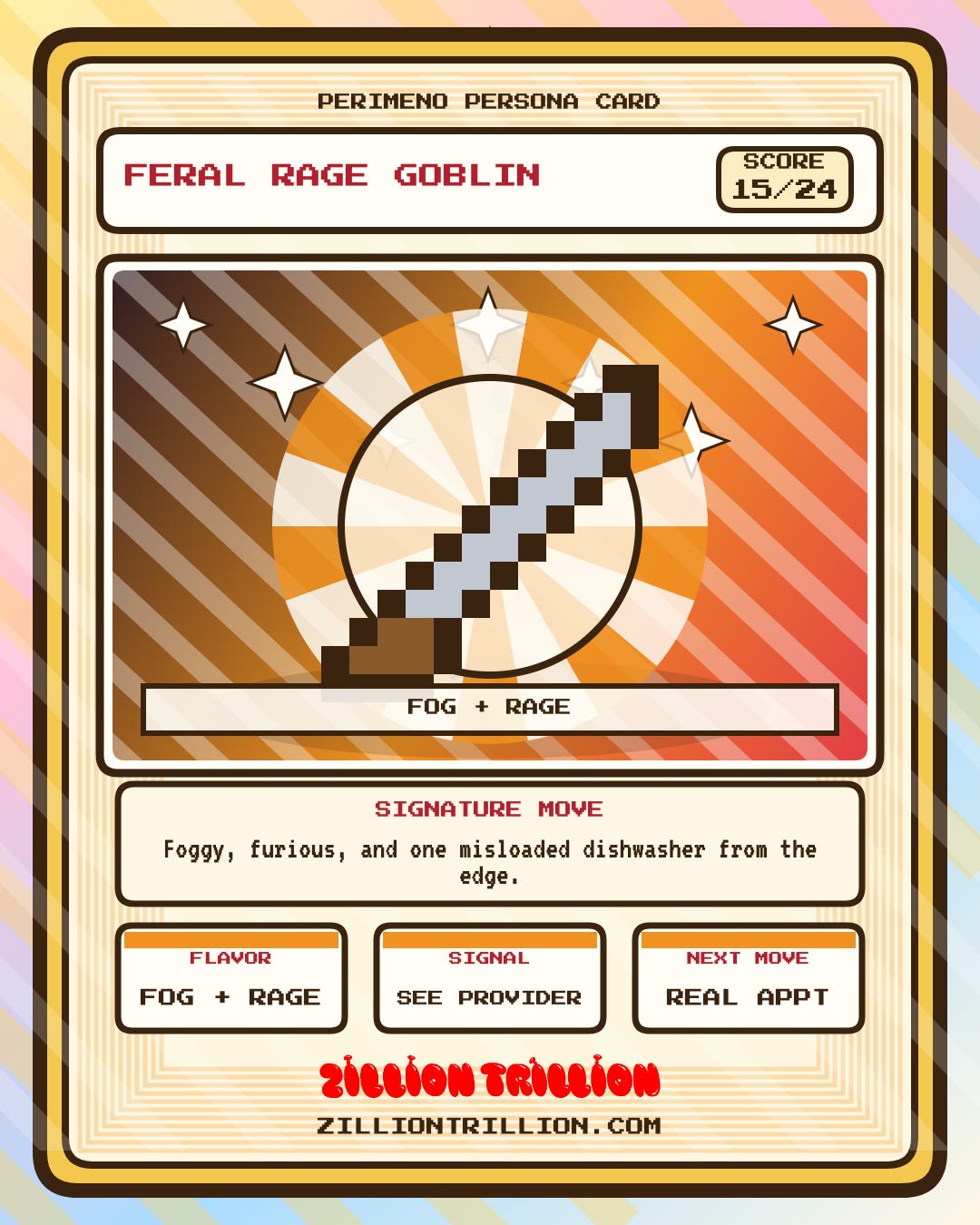
It’s a little quiz. It’s called Am I Crazy or Is It Perimenopause? It is not medical advice, it will not diagnose you, and it is slightly funnier than it has any right to be. It just walks you through the sneaky stuff and tells you whether it might be time to make the appointment.
Take it. Send it to the friend you immediately thought of while reading this. And if you land in the “welcome to the circle, babe” tier, know that you’re in an extremely good, extremely large, extremely tired room.
[QUIZ — Am I Crazy or Is It Perimenopause?]
Ps: Show me yours, and I will show you mine?
Hi, its me, im a teen mom going through perimopause, its me.
Besos,
Victoria
Not medical advice, obviously — I’m a girl with a Substack, not your doctor. If any of this hit a nerve, the move is a real conversation with a provider who actually knows perimenopause care. The circle that started all this was hosted by Perelel and Gloria’s Foundation, with facts from Dr. Sarah de la Torre, MD.
No posts
Comments
Nothing yet. Say the first thing.
Sign in to join the conversation.