
Hey, before we get to today’s newsletter, here’s a quick update.
Our aim at Zerodha Varsity is to make financial education simple and accessible. Apart from writing these newsletters, we also conduct free bootcamps, workshops, and online sessions across topics such as stock markets, trading, macroeconomics, and personal finance.
If you haven’t explored them yet, you can check out our online sessions here and upcoming events here.
Imagine if, every year, petrol prices stayed constant, onions cost the same, and milk prices didn’t rise at all.
A world with 0% price rise sounds like a dream.
But central banks don’t chase this dream of zero inflation. Instead, they chase a world where there’s a little bit of inflation each year.
So here’s what I want to talk about today — what’s the holy grail for inflation?
Because since 2016, India has followed something called Flexible Inflation Targeting, or FIT. What it means is that the Reserve Bank of India (RBI) has an inflation target it has to get right — 4%, with room to drift 2% on either side.
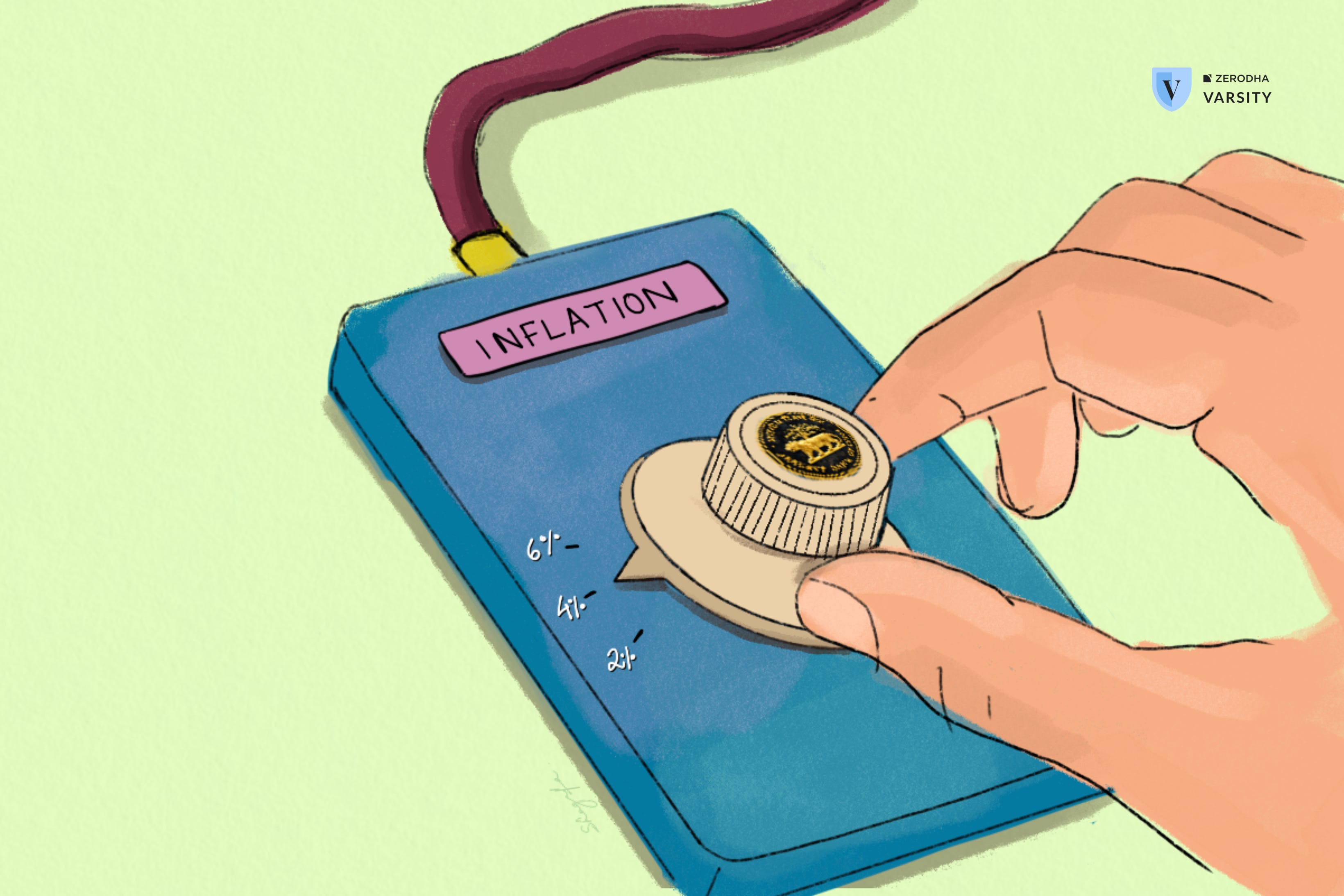
And every five years, the government and the RBI sit down and decide whether we should keep the number or change it. The last time they reviewed it was in March 2026 and looks like they’re happy. Because we’re keeping the 4%, +/- 2% target. At least till March 2031.
But the question is — why 4%? Why not 0%?
Also, has India’s FIT actually worked?
Let’s get into it.
On the face of it, a 0% inflation target sounds like the obviously correct one. Isn’t a central bank’s primary job to protect the value of your money? So shouldn’t “no rise in prices, ever” be the gold standard?
Well, no.
And that has a lot to do with something else that central bankers are worried about — a fall in prices, or deflation.
See, if you know your washing machine will be cheaper next year, why buy it today? You wait. Everyone waits. Demand dries up. Companies, staring at falling sales, cut production and lay off workers. Now people have even less money to spend, so they wait even longer to buy anything. Prices fall further. Repeat.
Economists call this a deflationary spiral, and once it gets going, it’s hard to stop. Japan spent the better part of three decades stuck in something close to this.
Also, there’s the monetary lever angle.
If a central bank has to fight an economic slowdown or a recession, they resort to tweaking interest rates to make the economy do its bidding. They cut rates to make borrowing cheaper and get people to spend money.
But interest rates can’t theoretically go below zero (yes, it has happened in the past where you would have paid interest for depositing money in a bank rather than earning it, but that’s only a desperate measure). Economists call this the “zero lower bound”. Because people can always hoard physical cash (which earns 0%), banks cannot force interest rates into the negative territory without causing mayhem.
And if a central bank targets 0% inflation (subsequently near-zero interest rates too), it’s constantly flirting with the edge of that lower bound, leaving itself almost no room to cut rates when a recession hits.
A little bit of positive inflation is a safety buffer.
Then there’s a nerdier point about wages and employment that a group of economists — Akerlof, Dickens and Perry — made in the 1990s.
The tl;dr version of the paper (pdf) is that when a company or an industry faces declining demand, the quick economic fix might be to cut wages. Say by 3% so everyone stays employed. But employers also know cutting pay destroys morale and leads to top talent quitting. And hence, what economists call “downward nominal wage rigidity” comes into play here.
This simply means that it’s tough to reduce nominal wages (wages not adjusted for inflation).
Now think about what could happen at 0% inflation.
If overall inflation is 0%, a company that needs to reduce its labour costs by 3% has only one option and that is to lay people off. They cannot reduce nominal pay and the wage stays artificially high. This could also increase permanent unemployment.
But if an economy has 3% inflation, the company keeps nominal pay constant. The real wage drops by 3% and thus, the labour costs are reduced without any layoffs.
Ergo, unemployment doesn’t shoot up.
And that is why and how the consensus that built up globally, across almost every major central bank, is that a low, positive, and stable rate of inflation beats zero (0) inflation
Let’s rewind to 2013.
Inflation in India was ugly and hovering around 9-10%. Household inflation expectations, essentially what ordinary people believed prices would do, had shot up and stayed up. The currency was under pressure.
It was messy.
So the RBI, which was headed by Raghuram Rajan then, decided to fix India’s monetary policy framework. They set up a committee and tasked it with figuring out what could be done.
Sidenote: This committee was also called the Urjit Patel Committee. Urjit Patel would later succeed Rajan as the RBI Governor in 2016.
And in that report (pdf), the committee actually ran the numbers to figure out what India’s “right” inflation number should be.
First, they estimated the level of inflation above which growth actually starts getting hurt. That threshold came out to about 6.2%.
Second, they looked back at the mid-2000s (2003-04 to 2006-07), a period when India’s economy was running close to its full potential, neither overheating nor underperforming, and found that inflation during that “just right” period averaged around 4%.
So that set the tone — 4% as a starting point, 6% as the ceiling.
Also, you should know that advanced economies like the US, UK, and the Eurozone typically treat 1-3% inflation as their version of price stability. But emerging economies, from Eastern Europe to Latin America, have historically found that a 4-5% range is what corresponds to genuine price stability for them. This isn’t arbitrary. Emerging economies are still catching up in productivity, they have larger informal sectors, and their price data itself is patchier and gets revised more. A slightly higher target gives you breathing room against that kind of statistical noise.
There’s also India’s specific inflation basket to consider. Food and fuel used to make up ~50% of India’s CPI basket — categories that are hostage to a bad monsoon, a spike in global crude, or a poor harvest, none of which the RBI’s interest rate decisions have much control over. Setting the target too tight, too close to zero, means the RBI would be constantly “failing” its own mandate over things it can’t influence, purely due to one bad monsoon season.
That’s also why there’s a band and not just a single number. The +/-2% cushion exists specifically to absorb these kinds of supply shocks without the RBI needing to panic-react every single quarter.
Here’s where we need to be careful, because this is exactly the kind of question where it’s tempting to look at a “before” and “after” chart and declare victory.
Because the facts on the “before and after” are quite exciting. Average inflation was around 8% in the decade before FIT was adopted. Since 2016, it has averaged ~4.8%. Inflation volatility has come down.
Also, economists Barry Eichengreen, Poonam Gupta, and Rishabh Choudhary, ran the numbers for the World Bank (pdf) and found that, statistically, actual inflation now has a noticeably smaller effect on shaping people’s future inflation expectations than it used to. In plain English: when prices spike today, people are less likely to assume prices will keep spiking tomorrow. That’s the textbook definition of an “anchor” doing its job.caption...
They say,
Evidence points to improved outcomes: inflation is lower and less volatile; inflation expectations are better anchored; and the transmission of monetary policy is more effective.
But correlation isn’t causation. Which means just because inflation has tempered down since the adoption of FIT, we cannot quite declare it the sole reason for that.
And that’s where an RBI bulletin from July 2025 adds nuance.
Rather than claiming total victory. It found that FIT has genuinely helped anchor expectations, but it was one ingredient among several. Timely government interventions, like export bans on certain foods or cuts to import duties, and a broader period of moderating global prices, worked alongside the monetary framework, not despite it.
So where does that leave us?
Not with a clean, one-line verdict, and if anyone gives you one, be suspicious. The honest answer is: FIT appears to have done real, measurable work in anchoring expectations and improving policy credibility, but it operated inside a decade that was also unusually kind on the oil-price and global-inflation front.
Both things can be true at once.
PS: Did you know that New Zealand was the first country to implement inflation targeting (IT) in 1990? Today, 48 countries have IT as their monetary policy framework.
This newsletter is written by Nithin Sasikumar
Do read, “Ways to buy gold and silver in India” in our Second Order newsletter.
For any feedback or topic suggestions, write to us at varsity@zerodha.com

No posts
Comments
Nothing yet. Say the first thing.
Sign in to join the conversation.