
Most engineers choose orchestration tools like they’re picking a side in a debate.
“Airflow is legacy!”
“Dagster is the future!”
“Prefect is so clean!”
But you’re not here for debate. You’re here to ship pipelines, learn fast, and get hired.
So let’s get real:
Which tool should you pick — for your project, for your portfolio, or for your resume?
This guide won’t compare every feature.
It’ll show you how to think like a system builder, not a tool fangirl.
Use Airflow when:
You’re applying to big tech or mature data teams
You want to show you understand orchestration, retries, and scheduling
You need strong scheduling and visibility (UI, logs, retries)
Why it works for your resume:
“Familiar with industry-standard orchestration using Airflow, including DAG design, sensors, retry logic, and alerting.”
Why it’s great for teaching yourself the fundamentals:
Airflow makes you learn how pipelines actually run: tasks, triggers, failures, dependencies. It exposes orchestration in raw form.
Where it’s weaker:
Not great for data scientists or notebooks
Heavier to deploy without Docker
Harder to reason about with dynamic workflows
Use Prefect when:
You’re building a lightweight project
You don’t want to mess with Airflow configs
You like writing clean Python with decorators
Why it works for solo projects:
It’s Pythonic and elegant
Easy to get up and running
Great docs, fast dev feedback loop
Why it works for data science/analytics engineers:
You can orchestrate model training, dbt, API tasks quickly
You don’t need to explain DAGs to non-engineers
Where it shines on a resume:
“Used Prefect to orchestrate model training and dbt transformations in a low-latency ML workflow.”
Where it’s weaker:
Less recognized by recruiters
Smaller community
Not ideal for heavy-duty, multi-team orchestration
Use Dagster when:
You care about type safety, IO contracts, and observability
You want to model your data pipeline like software
You’re building a data platform, not just a DAG
What makes Dagster interesting:
Built-in concepts like assets, software-defined pipelines
First-class support for data lineage and testing
Powerful for collaborative teams that want engineer-level visibility
On your resume:
“Designed asset-aware DAGs in Dagster to enforce data lineage, retry logic, and schema-aware contracts.”
Where Dagster may not be right:
Overkill for simple projects
Less intuitive for beginners
Still evolving rapidly — may have rough edges
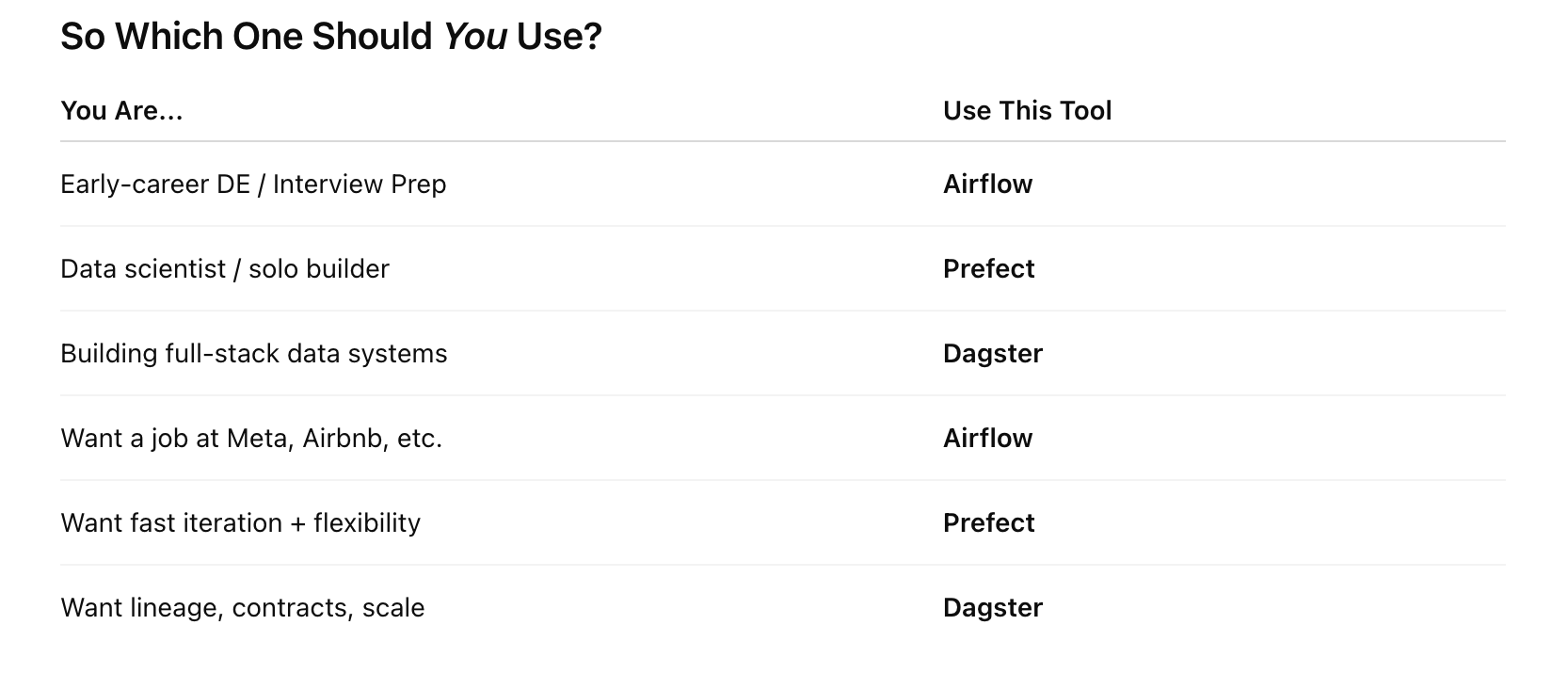
If you picked...You’re signaling...Airflow“I understand production-scale systems.”Prefect“I move fast and iterate cleanly in Python.”Dagster“I think in contracts, lineage, and scale.”
There is no “best” tool — only the one that aligns with:
The story you want to tell
The type of work you want to do
The types of teams you want to join
The tool you use reflects how you frame problems.
Interviewers aren’t just looking at which orchestrator you picked — they’re evaluating whether your mental model matches the role.
Use Airflow if you want to tell a story about scale, resilience, and legacy integration
Use Prefect if you want to show you’re experiment-driven, lean, and fast-moving
Use Dagster if you want to prove you're a system thinker who designs for complexity and traceability
This is less about syntax, more about signal. Make your choice reflect your intended audience.
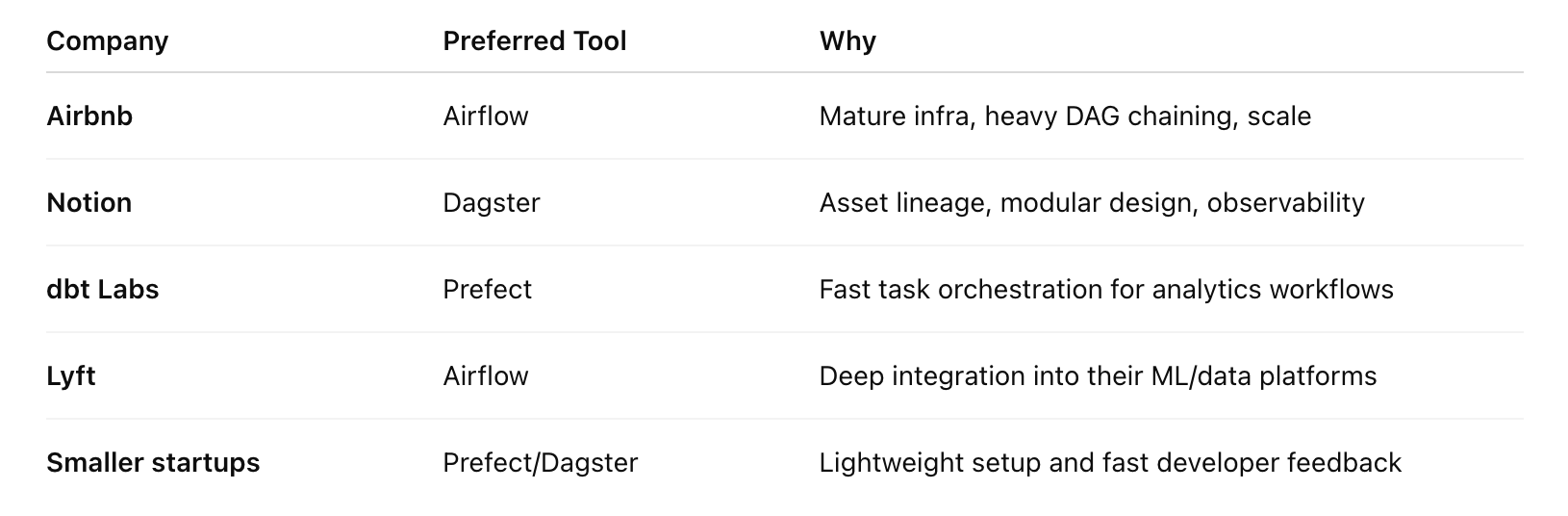
If you're applying somewhere — match your project tool with what that company runs in production (or wants to).
Don’t write:
“Used Airflow for DAG orchestration.”
Write:
“Designed idempotent, retry-aware data pipelines using Airflow for scalable ETL orchestration across S3, Spark, and Snowflake — with SLA tracking and alerting.”
Or:
“Built fast, modular Prefect flows to orchestrate data science pipelines with resume-to-dashboard visibility in under 15 minutes per run.”
Or:
“Architected lineage-aware pipelines using Dagster assets and config mapping to reduce failure recovery time by 80% across multiple data teams.”
The tool isn’t the flex. The system design behind it is.
If I’m hiring:
Airflow tells me you’ve worked with mature pipelines and understand operational burden.
Prefect tells me you can build fast, are probably solo or hybrid (data + product), and can ship.
Dagster tells me you write pipelines like software — clean, testable, typed — and are comfortable with architecture decisions.
If you’re junior? Pick one and go deep.
If you’re senior? Know when to choose which — and explain it.
Don’t just pick the tool that’s hyped.
Pick the one that matches how you want to think and explain your work.
What you build is one thing.
How you talk about it is what gets you hired.
Comments
Nothing yet. Say the first thing.
Sign in to join the conversation.