
Last weekend in Bangalore was special. On a Sunday that captured the onset of yet another unusually hot Indian summer, I asked a room of people hosted by Antara, to draw their family tree.
In the freewheeling conversation that followed, I felt the opening up of a space that allowed for each person to bring to life the shape their family holds in the silent geography of their mind - who stands where, who shows up stronger, who is forgotten or has been quietly erased.
As I looked through the drawings of each person, I noticed the diversity and similarities in each. Parents who have swapped their locations, a child “stepping up” to bridge the differences between parents, a forgotten sibling, transgenerational patterns handed over from grandparents to parents to the current generation - both gifts and traumas.
As I began to read these trees aloud with each person, something shifted in the room. A sense of astonishment. Of recognition. The kind that rises when a pattern you have spent a decade unsuccessfully explaining to a therapist reveals itself in a single image.
This is the territory of Kuṭumbam - a unique offering I’ve designed, integrating my learnings from the fields of Family Constellation with the Somatic Experiencing method, Yogic Depth Psychology, and Flow Game.
In Tamil, kudi means “house” and inbam means “happiness.” Together, kudumbam becomes “the happiness of the house.” In Sanskrit, kutum derives from the older root tantri — “to support, to nourish, to increase.” Embedded in the word itself is an understanding the modern nuclear family has quietly lost: a family is not a container for individuals. It is a weaving. A field whose health depends on the continuous flow of support, nourishment, and belonging across generations.
In the Mahābhārata, kuṭumba appears in the moments where duty, love, conflict, inheritance, and belonging tangle into each other. This is the Indian intuition of family: not a sentimental unit, but a relational ecosystem — ancestors, kin, unborn descendants, and everyone’s unresolved business, all weaving the same cloth.
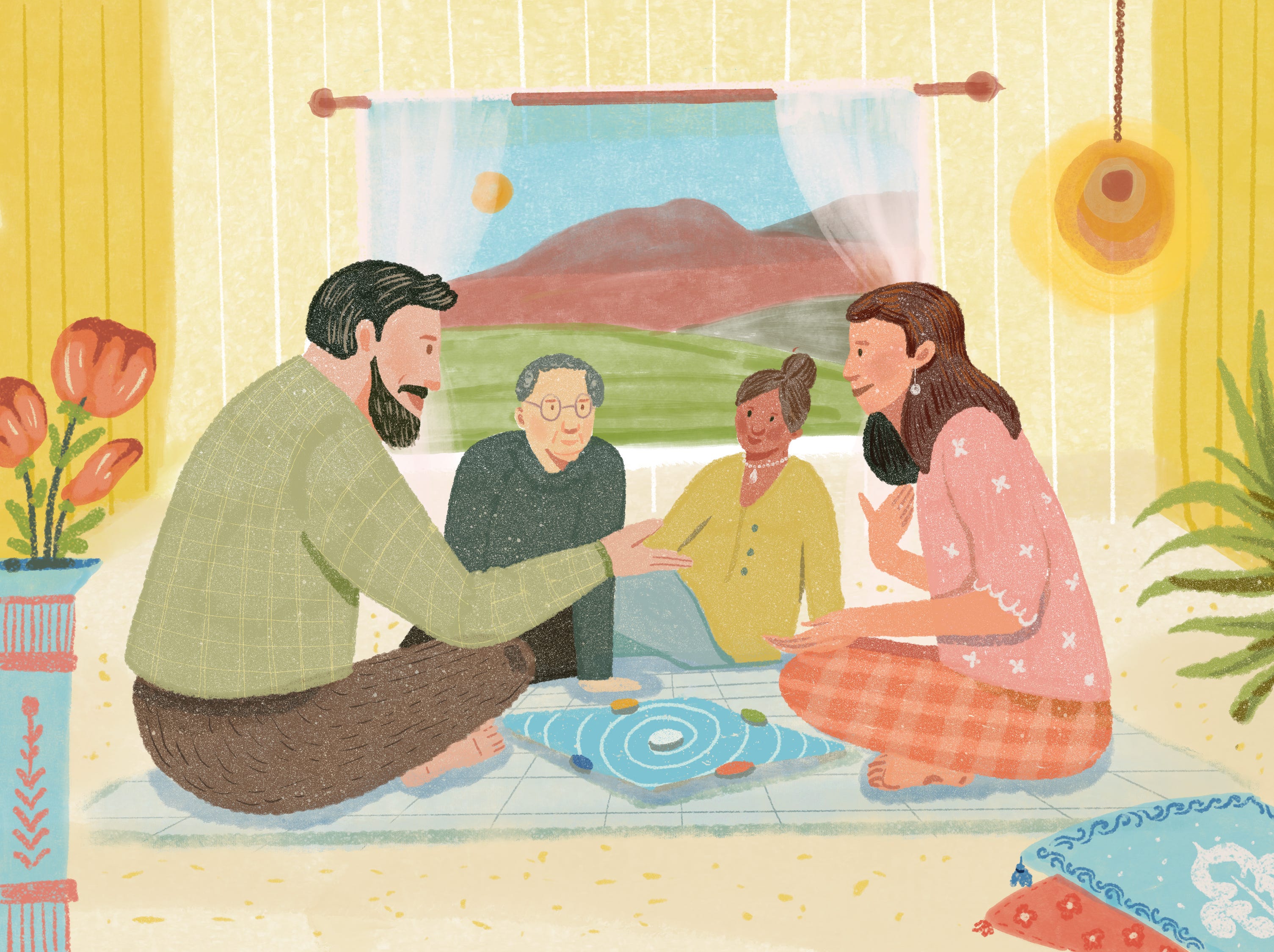
Family as a relational ecosystem is a universal concept conceptualised in varying forms across different indigenous cultures around the world.
The Lakota (Sioux) people of South Dakota (USA) have a profound phrase regarding the family system, viz., Mitákuye Oyás’iŋ, which literally translates as “all my relations.” It is at once a prayer and a worldview that captures the total interconnectedness of existence. It acknowledges that humans exist not in isolation, but in interconnectedness with even plants, animals, stones, and the stars. In this view, human beings are not “above” nature. We, the “Two-Leggeds” are the brothers and sisters of the “Four-Leggeds”, the “Wingeds”, and the “Green Nations” (plants).
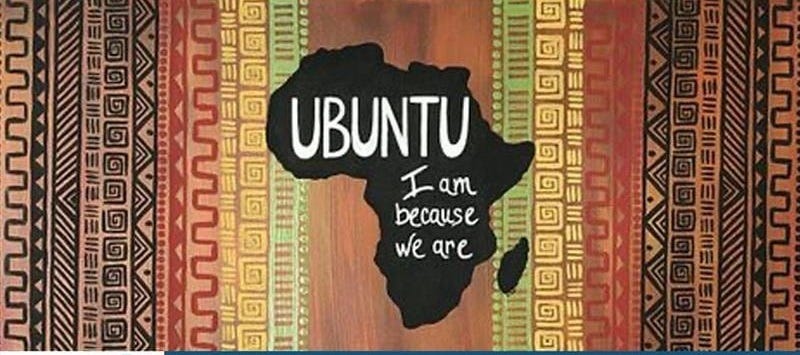
The Zulu and Xhosa peoples of South Africa have a single word in the Nguni Bantu philosophy: Ubuntu — “I am because we are.” This idea is often summarised through the following Zulu proverb.
“Umuntu ngumuntu ngabantu.” - Zulu Proverb
“A person is a person through other people.”
In everyday practice, Ubuntu finds expression through ukuhlonipha (respect). This includes:
Hospitality: A core expectation that strangers should be welcomed and cared for.
Shared child rearing: The belief that “it takes a village” to raise a child.
Vulnerability support: A specific responsibility to look after the most vulnerable members of the community.
Each generation can potentially inherit both trans-generational gifts and traumas. And the weaving of this relational ecosystem can fray. Threads can break upstream and keep breaking for generations before anyone notices.
Reweaving that cloth is the quest of Kuṭumbam.
Originally, I designed Kuṭumbam for families to come together with parents and children, and perhaps even grandparents, to sit in the same room, look at the same patterns, and take responsibility for their part in weaving together the existing family dynamics.
However, the Bangalore weekend was different. The people who gathered did not belong to the same families. They came as individuals, each curious to discover patterns that they may have inherited and perhaps been re-enacting in their own lives unconsciously.
There is something quietly radical about strangers doing family work together. In Indian thought, family is not merely blood; it is sambandha — relationship, resonance, the binding of one thing to another. When one participant sees their grandmother clearly for the first time in a circle of witnesses, something reorients in everyone present. The field remembers together.
This is akin to the idea embedded in the image of Sankofa found in the Akan tribe of Ghana. Sankofa is a Twi word that literally means “go back and get it”. It is a concept that is captured in an Akan proverb that translates to, “It is not taboo to return and fetch what has been forgotten.” What one person retrieves, the whole circle can feel.
We like to believe we begin at our own birth. Research, unsentimentally, disagrees.
Rachel Yehuda’s studies on children of Holocaust survivors revealed altered cortisol patterns, which are the body’s stress signature, transmitted through epigenetic markers, not stories. The children carried the signal of a trauma they had never experienced.
Anne Ancelin Schützenberger, mapping her patients’ genosociograms, kept finding uncanny repetitions: accidents on the same date, illnesses at the same age, estrangements in the same generational slot.
Bert Hellinger, watching families enact their dynamics in constellation after constellation, articulated what traditional societies have always known: there is an unseen order of love in a family system, and when it is disturbed, the disturbance travels.
Mark Wolynn put it plainly in his book, “It Didn’t Start With You”. He asserts that much of what we claim as “my anxiety,” “my compulsion,” “my pattern in love” did not originate with us. In fact, we are carrying it forward, faithfully, for someone in our family system who could not put it down.
The Indian tradition has always named three primordial debts, i.e., the ṛṇa-traya, in one’s life. These are:
pitṛ-ṛṇa (the debt to ancestors),
deva-ṛṇa (the debt to the sacred), and
ṛṣi-ṛṇa (the debt to teachers).
The householder’s life is, in part, the work of tending these debts gracefully without getting shackled by them. One must learn to let the inheritance move through, rather than stagnate in, one’s own life.
As I reviewed the family tree of one of the participants, they saw clearly how the flow of love from the mother’s side had been interrupted somewhere upstream. And there, in the same family tree, was the shape of the relationship with their current partner — the same interruption, quietly re-enacted. The pattern was not a flaw. It was a form of misplaced loyalty. Love was moving in the only way it knew how, repeating what had never been named so that the family might, finally, one day name it. Seeing this in a single image did more than years of talking around it could. Naming it aloud was the first act of reweaving.
Another participant sat upright and spoke of a shift difficult to hold in ordinary language. When she could actively receive and not merely tolerate, not merely acknowledge, the gift of life from her father and the gift of love from her mother, she felt them present. Not as memory. Not as imagination. Present. In the room with her, in the here and now.
This is the moment Hellinger described as the restoration of an order of love: the child takes, at last, what only the parents can give, and the parents — however flawed, however incomplete — are permitted to have given it.
The Haudenosaunee (the “People of the Longhouse”) of the north-eastern USA and Canada, teach the Seven Generations principle: every significant decision that one takes should be weighed against its impact on seven generations ahead. But there is an inverse truth to this, too. We are the seventh generation of someone’s prayer, and also of someone’s wound. To receive our parents’ gifts fully is to honour the seven generations standing behind us. Most of them gave what they had, even when what they had was incomplete.
If I learn to receive fully from my parents, I can then return what does not belong to me.
Kuṭumbam works through four interwoven modalities, each earning its place by doing what the others cannot.
Family Constellation reveals the hidden architecture — the places someone has been excluded, the unmourned loss, the ancestor whose fate is being unconsciously carried by a descendant who never met them.
The Flow Game creates a container of deep questions and intuitive play. It is the opposite of advice. It is a structure in which the right question, asked at the right moment, does more than a hundred interpretations.
Yogic Depth Psychology returns the work to the Indian frame of the Puruṣārthās — dharma, artha, kāma, mokṣa. The householder, in this tradition, is not a lesser spiritual aspirant than the renunciate. Family life is the very field of self-realisation, not a distraction from it.
Somatic Experiencing attends to what the body is still carrying. Much of what gets inherited lives at a pre-verbal stage, difficult to articulate through language. Body remembers these as the tremor, the held breath, and the collapsed chest that was never ours to begin with. These are released only when the body is gently invited to finish what a previous generation could not.
The individuals who came to Bangalore left with something hard to name and harder to lose. It was neither a cure nor a resolution. It was the beauty and hope that come with owning up to one’s own reality and restoring the sense of belonging in one’s own family. This sets the stage for transforming the personal, familial, and professional spaces in one’s life.
A family field is not rewoven by heroic acts. It is rewoven by small, accurate gestures. By seeing the grandmother you never met. By acknowledging the sibling who did not live. By letting your father give you what he actually has to give, instead of grieving what he does not. By allowing love to move in the direction love naturally moves — from the earlier to the later, from the larger to the smaller, from what was to what is becoming.
A family is not a thing you have. It is a field you weave, every day, with the threads you choose to pick up and the ones you choose, consciously, to set down.
This is the quest. Not to escape the family, but to reweave it.
And to discover, often with astonishment, that it has been waiting — patiently, across generations — to be rewoven by us.
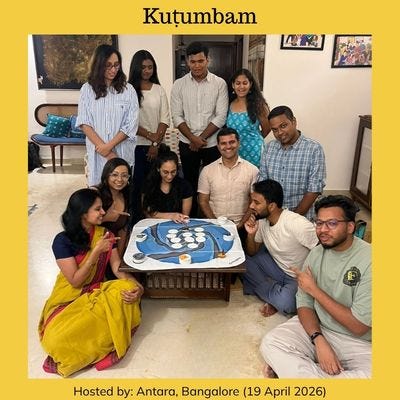
P.S.: If you wish to request Kuṭumbam exploration for your family, please submit your request here.
Comments
Nothing yet. Say the first thing.
Sign in to join the conversation.