
0:00
-23:19
This is the 3rd and final part of the 3-part Fintech Series. You may read part 1 and 2 below.
Moneyview: Mann Hai To Money Hai!
·
Jul 10
Mann Hai to Money Hai! It is Moneyview’s tagline. I think this is so well thought off. Kind of a marketing genius if you ask me. Hence, I borrowed it for the title of the blog.
OnEMI Tech [Kissht] An EMI factory
·
Jul 17
![OnEMI Tech [Kissht] An EMI factory](https://substackcdn.com/image/fetch/$s_!QCMN!,w_1300,h_650,c_fill,f_auto,q_auto:good,fl_progressive:steep,g_auto/https%3A%2F%2Fsubstack-post-media.s3.amazonaws.com%2Fpublic%2Fimages%2Fa9b54ca9-8498-4fb2-a05b-18e0b70dacfb_500x500.jpeg)
If you have straightaway landed on this page, you should realize that it is Part-2 of a 3-part fintech blog series. And you should ideally read Part 1 first. Here’s the link below.
Fibe- An Introduction
Fibe is the consumer-facing brand. Social Worth Technologies Limited is the IPO-bound parent company. EarlySalary Services Private Limited is the group’s RBI-registered NBFC subsidiary. The business operated under the EarlySalary brand before rebranding itself as Fibe in 2022. The company does not have an identifiable promoter under the DRHP classification, although Akshay Mehrotra and Ashish Sohan Goyal are its founders and continue to lead the business. The IPO comprises a fresh issue of up to ₹750 crore and an OFS by institutional shareholders. It filed its DRHP last month. And I must confess that what you will read ahead is just my raw thoughts based on my reading of the DRHP and a few searches and questions I asked on ChatGPT. The larger motive of writing this fintech series is to get a sense of how the organized credit in India is fast-evolving. Also, in this process, I wish to prepare myself to learn, unlearn, and relearn some of the rules of lending and investing. So let’s begin.
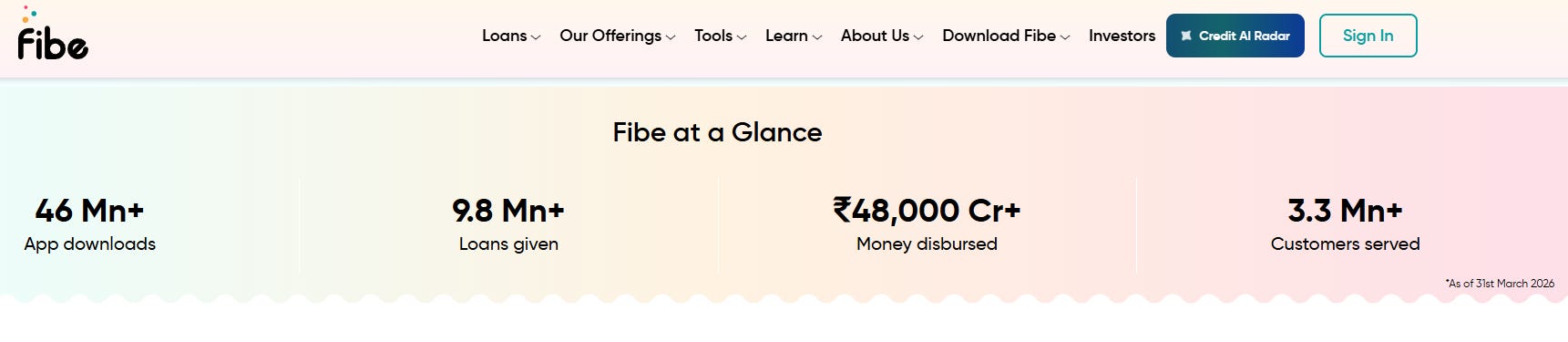
Fibe is best understood as a technology-led consumer-finance platform that began with salary advances, evolved into digital personal lending, and is now building a differentiated embedded-finance business around specific life expenses.
The central idea behind Fibe is different from Moneyview and Kissht. Moneyview is primarily a large direct-to-consumer credit and data platform. Kissht combines direct lending with an offline merchant and collections network. Fibe is trying to embed credit inside the expenditure itself, medical treatment, education, insurance premiums, travel, e-commerce purchases and rooftop solar. That is what Fibe calls Purpose-Driven Financing, or PDF. More on PDF later.
Fibe acquires borrowers directly through its app and indirectly through merchants or platforms, evaluates them using proprietary technology and data, lends through its NBFC or co-lending partners, services and collects the loans, and earns interest, fees, commission and guarantee-related income. The company therefore has four overlapping identities:
A digital personal-loan platform
An embedded checkout-finance platform
An NBFC-led lender
A co-lending and risk-sharing platform
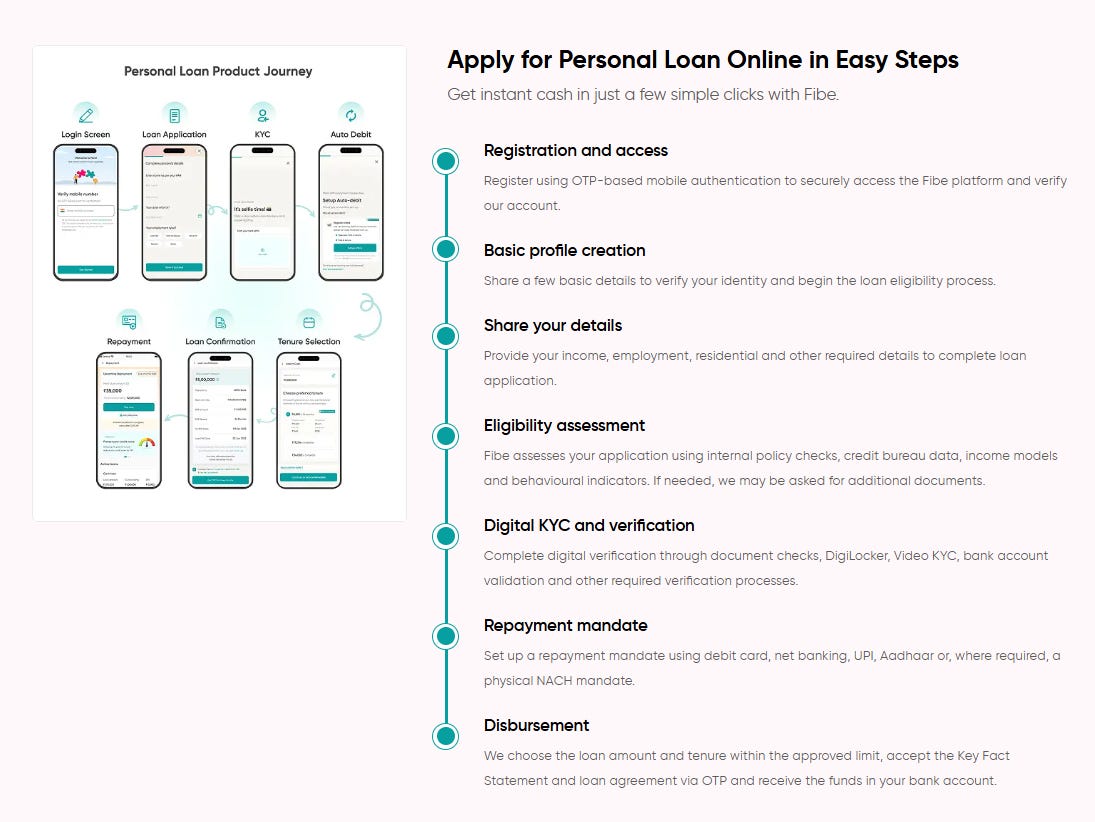
Evolution Over Six Phases
Phase 1: Salary before pay-day proposition [2015-17]
Fibe began with a narrow but clearly identifiable problem. Young salaried employees often had regular income but limited savings, low credit-card penetration and occasional cash-flow gaps before payday. Traditional banks were generally not designed to process very small, urgent loans economically. EarlySalary offered a digital alternative: small amount; short duration; quick decision; minimal paperwork; and fully app-based disbursal. The original proposition was closer to a salary advance than a conventional multi-year personal loan.
Phase 2: From Salary Advance to Personal Lending [2017-2020]
Once the company accumulated more customer and repayment data, it could offer higher loan amounts; longer tenures; repeat loans; credit for purposes beyond salary shortfalls. The NBFC subsidiary became strategically important because the group could earn interest directly and control its credit policy rather than only source borrowers for other lenders. The CashCare acquisition added merchant-led checkout finance, planting the seed for the company’s later embedded-finance strategy.
Phase-3: Credit Cycle Learning & Borrower Migration [2020-22]
Covid exposed the fragility of relying excessively on young, short-tenure unsecured borrowers. The company’s subsequent strategy appears to have focused on stronger credit scores; more stable salaried and professional borrowers; more contextual loan purposes; longer tenures; improved portfolio monitoring; and greater lending-partner diversification. This period appears to have shaped Fibe’s current emphasis on asset quality and purpose-based underwriting.
Phase-4: Rebrand and Purpose Driven Finance [2022-24]
The 2022 rebrand from EarlySalary to Fibe was more than cosmetic. “EarlySalary” described the original product but constrained the brand to salary advances. “Fibe” allowed the company to address a broader range of life events like medical treatment; education; insurance; travel; e-commerce; or even solar installation. The company’s distribution model consequently shifted from simply convincing consumers to download a loan app toward embedding finance where the spending decision was already occurring.
Phase-5: Multiproduct Consumer Finance Ecosystem [2023-25]
Fibe, in this phase, added numberless credit cards; loans against mutual funds; fixed deposits; insurance distribution; credit-report services; and gift vouchers. These products were meant to increase customer engagement and cross-selling. However, the economic centre remained lending, and nearly the entire portfolio remained unsecured.
Phase 6: Scale, Institutionalization, & IPO [2025-2026]
By FY26, Fibe has become one of India’s larger digital consumer lenders, with the following:
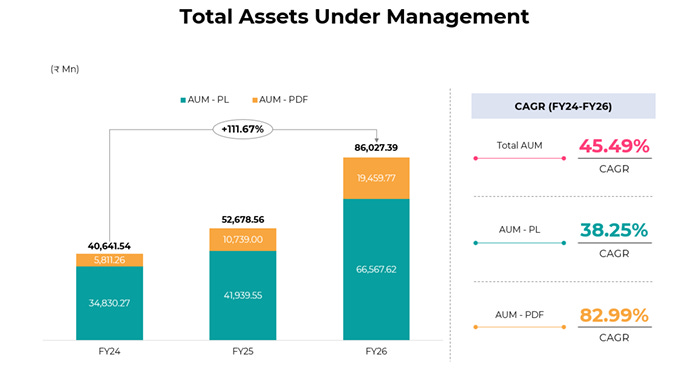
Total AUM of approximately ₹8,603 crore
Personal loans and purpose-driven financing as the core verticals
More than 27,500 variables used across underwriting
A hybrid own-book and partner-funded structure
An expanding institutional investor base
Profitability
A proposed ₹750 crore fresh issue.
The group is now moving from startup governance to public-market institutionalisation. The business has therefore moved from Salary-gap finance to General digital personal loans to Purpose-specific embedded financing and finally toward a broader consumer financial-services ecosystem.
Products
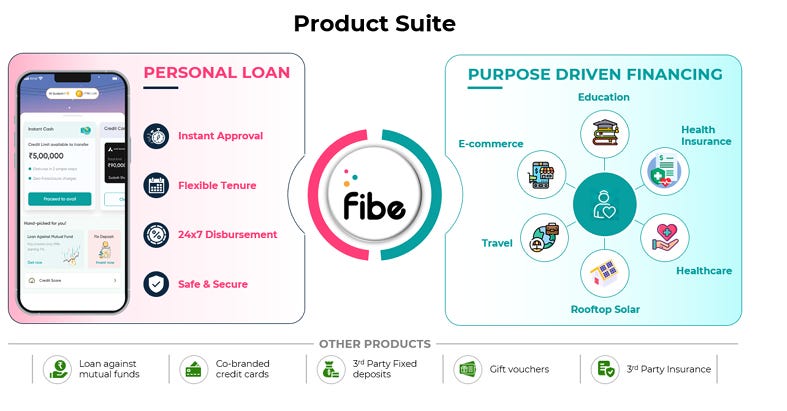
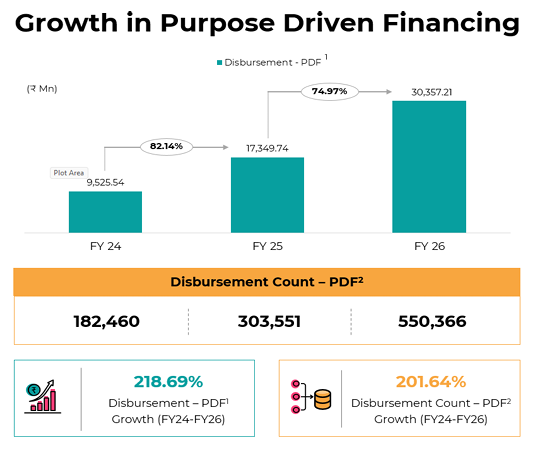
There are basically two types of products. Personal Loans and Purpose Driven Finance [PDF]. Personal loans remain the largest product. It represented approximately 77% of total AUM in FY26. These are digitally originated unsecured loans used for a variety of planned and unplanned expenses. PDF is the distinctive growth vertical. The PDF portfolio grew at an 82.99% CAGR between FY24 and FY26 and reached 22.62% of total AUM by March 2026. The FY26 average ticket size was approximately ₹55,158, with an average tenure of about 13 months. PDF currently includes: education finance; healthcare finance; insurance-premium finance; travel finance; e-commerce finance; and rooftop-solar finance.
Fibe also distributes or facilitates like loans against mutual funds; co-branded credit cards; third-party insurance; third-party fixed deposits; credit-information reports; and gift vouchers. These help build engagement and cross-selling, but the economic centre remains lending.
A Deep Dive on Purpose Driven Finance: Opportunities and Challenges
A normal personal loan begins with the customer asking: “How much money can I borrow?” Purpose-driven finance begins with the customer asking: “How can I pay for this medical treatment, educational course, insurance premium or solar installation?” Fibe is integrated with the relevant merchant, hospital, school, edtech platform, insurer, travel platform or e-commerce partner. The typical process looks like this. The customer selects a product or service. The merchant offers Fibe financing at checkout. The customer enters Fibe’s digital application journey. Fibe verifies identity, income, bureau history, device and behavioural data. Fibe approves or rejects the application. The merchant receives payment. The customer repays Fibe or the lending partner in instalments.
The key difference is that Fibe knows more than just the borrower. It knows what is being financed; the merchant providing it; the amount; the category; the location; the service duration; and the transaction context. This provides additional underwriting information.
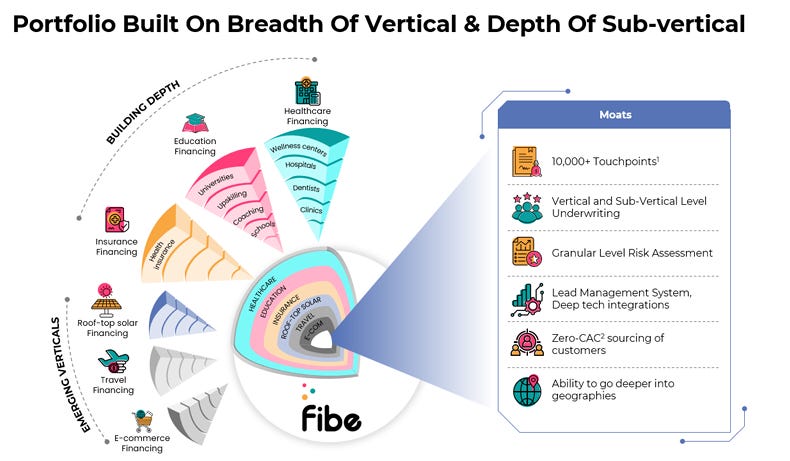
For example, a medical procedure is different from cosmetic treatment; an offline coaching institute is different from a distance-learning course; a branded healthcare chain may behave differently from a small independent clinic; or an insurance-premium loan may behave differently from a vacation loan. Fibe says its PDF credit policies are segmented by geography, merchant category, borrower segment, delivery method and the underlying product or service.
The Opportunity
The borrower is financing a known requirement rather than taking unrestricted cash. The merchant relationship can help verify that an actual transaction exists. The lender can study loan performance by hospital; educational institution; merchant; product category; geography; treatment type; course type; ticket size; and tenure. Also, all new PDF customers in FY26 were acquired at what Fibe calls “zero-CAC”. This means no direct incremental marketing or lead-generation expense was incurred at the point of origination because the customer arrived through the merchant or partner journey. It does not mean that the channel has no cost: technology, integrations, merchant management, employees and overheads remain. PDF loans, as per Fibe, can create a deeper customer relationship than the original short-term salary-advance product.
The Challenge
Purpose-linked does not mean secured.If a borrower defaults after completing a course or medical treatment, Fibe generally cannot repossess the education or reverse the surgery. Therefore, PDF still has unsecured-credit risk. Other risks include merchant fraud; fabricated invoices; inflated transaction values; collusion between merchant and borrower; cancelled services after disbursal; poor-quality institutions; weak student outcomes; medical treatment disputes; concentration in large partners; and reputational harm from unsuitable financing. PDF may improve the information around lending, but it does not remove borrower-default risk.
Rest of the business model of Fibe is almost similar to what is there in Moneylife and Kissht in regards to customer onboarding, on-book and off-book lending, focus on repeat borrowers and customer stickiness, DLG & financial guarantees.
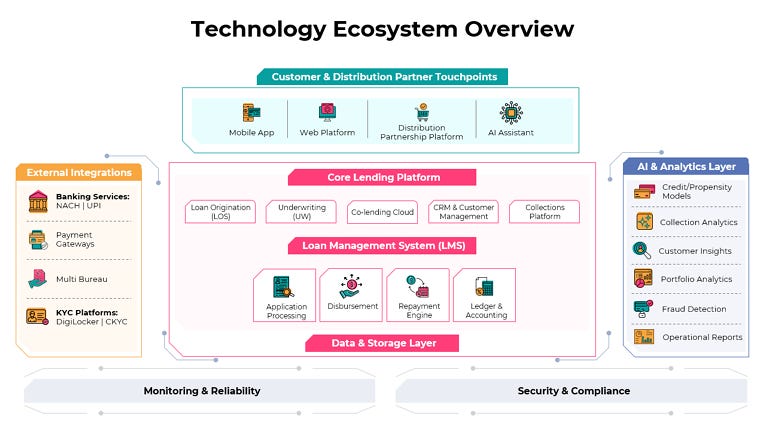
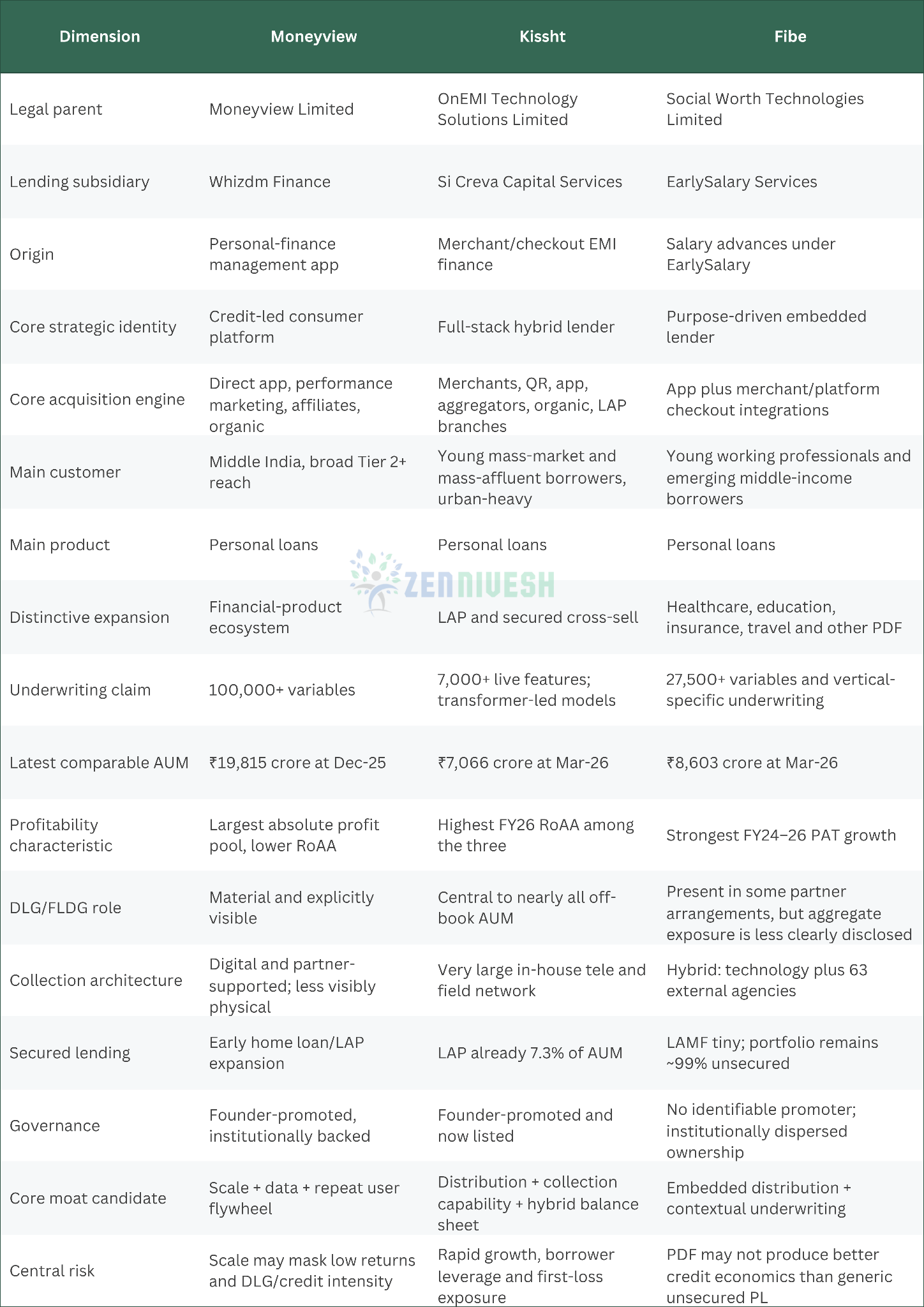
Now, it is a good idea to compare and contrast each of these three businesses.
Comparative Study: Moneyview Vs Kisht Vs Fibe
Moneyview, Kissht and Fibe may all look like digital lenders, but they are building three different lending architectures. Moneyview is the largest and most platform-like, with a huge direct-to-consumer user base, broad lender network and ambitions to become a wider financial-services ecosystem, though its lower return on average AUM raises questions about how efficiently scale converts into shareholder returns. Kissht is the most operationally integrated lender, combining merchant-led and digital sourcing, a roughly balanced on-book and off-book model, extensive in-house collections and a growing secured LAP portfolio. Its FY26 performance was the strongest evidence of execution, with rapid AUM growth, improving asset quality and the highest current RoAA, but nearly complete FLDG coverage of off-book loans and meaningful borrower loan stacking create substantial cycle risk. Fibe is the most strategically differentiated, having evolved from salary advances into purpose-driven embedded finance across healthcare, education, insurance, travel, e-commerce and solar. Its model potentially offers stronger customer intent, transaction context and lower direct acquisition costs, but the portfolio remains almost entirely unsecured and it is not yet proven that purpose-linked loans generate structurally better lifetime credit economics than ordinary personal loans. Moneyview’s potential moat is scale, data and direct customer ownership; Kissht’s is distribution, underwriting and collection control; Fibe’s is embedded partnerships and vertical-specific underwriting. Moneyview is the strongest on absolute scale, Kissht on current operating returns and full-stack execution, and Fibe on differentiation and optionality. All three are migrating toward better-quality borrowers, longer tenures, lower yields and deeper customer relationships, which should improve credit quality but also increases funding, duration and competitive risks. None is truly asset-light, because DLG, FLDG and financial guarantees return credit exposure to the platform even when loans are funded by partners. Their reported NPAs and collection efficiencies are also not directly comparable because definitions, write-off policies and on-book/off-book mixes differ. The real winner will not necessarily be the company with the most users, variables or fastest AUM growth, but the one that delivers the lowest all-in lifetime credit loss and the highest sustainable return on capital through a difficult lending cycle.
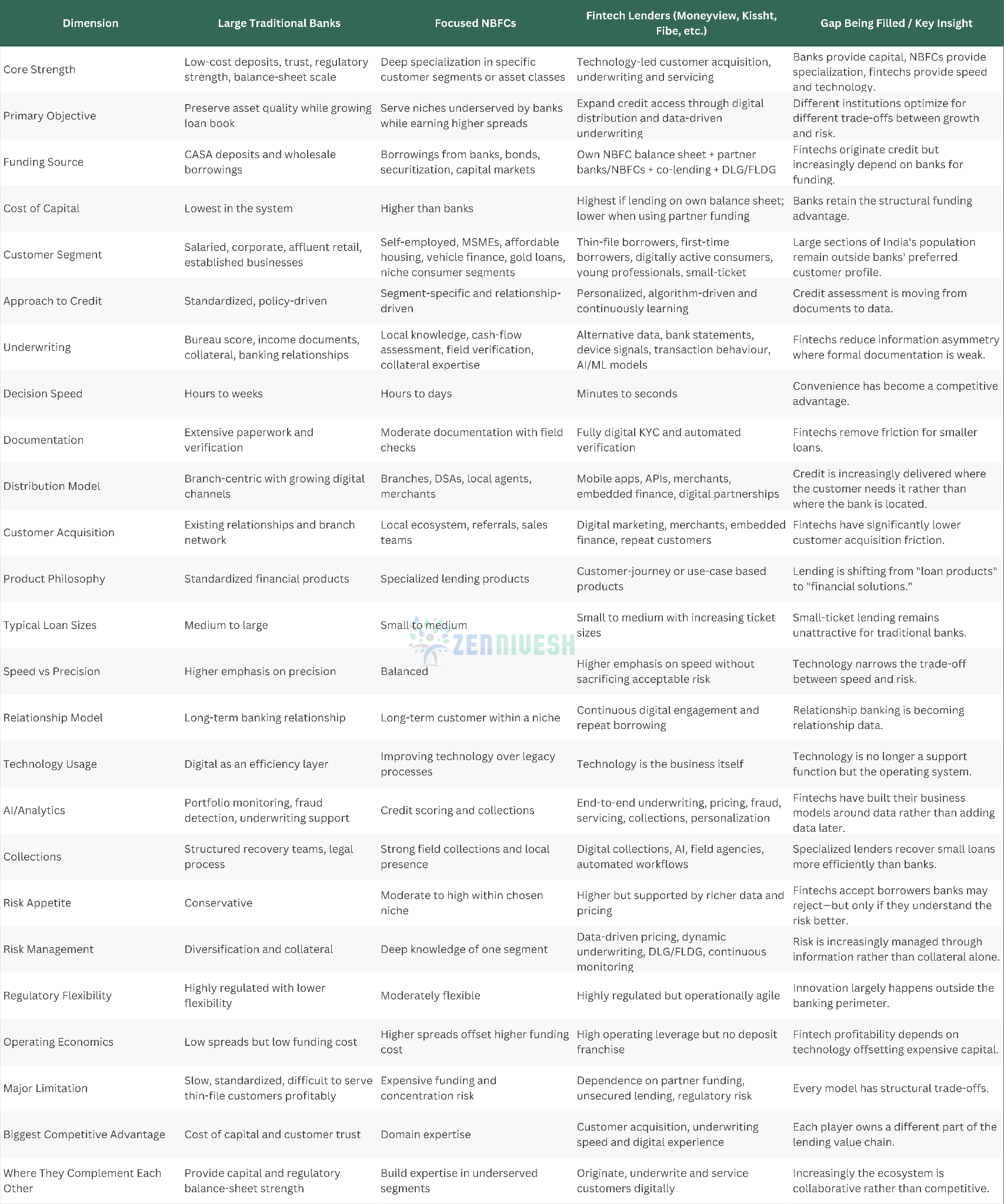
Expanding the lending Canvas
Large traditional banks in India are strongest at serving salaried, formally employed and higher-credit-quality customers through low-cost deposits, established underwriting, large branch networks and trusted brands, but their systems are generally optimized for larger, standardized loans rather than millions of small, urgent and highly customized credit requirements. Fintech lenders such as Moneyview, Kissht and Fibe attack this gap through instant digital onboarding, alternative-data underwriting, automated decisioning and products designed around specific customer journeys rather than conventional bank categories. Moneyview focuses on finding and evaluating borrowers directly at scale, Kissht combines digital acquisition with merchants and physical collections, while Fibe increasingly embeds credit within healthcare, education, insurance, travel and other purchase journeys. Focused NBFCs occupy the middle ground: they may lack banks’ deposit franchises, but they understand particular borrower segments, industries, geographies or collateral types far more deeply and can design products that conventional banks often find too operationally intensive. The visible gap in organized lending is therefore not simply the absence of money, but the absence of appropriately designed credit for self-employed borrowers, informal-income households, first-time borrowers, small merchants and customers requiring relatively small loans quickly. Traditional banks often struggle to assess irregular income, local business cash flows and borrowers with thin credit histories because standardized bureau scores and documents do not fully capture their repayment capacity. Fintechs fill this information gap using transaction data, device behaviour, banking flows, merchant context and repayment history, while specialized NBFCs supplement data with field verification, local relationships and physical collections. Another gap lies in distribution: banks expect customers to approach a branch or existing digital channel, whereas fintechs and NBFCs place financing at the merchant counter, hospital, school, app checkout or small-business location where the need actually arises. They also serve loan sizes that may be too small for banks to process profitably through traditional infrastructure, but large enough to be meaningful for the borrower. However, fintechs and NBFCs do not replace banks; they increasingly depend on banks for funding, co-lending and balance-sheet capacity, while banks rely on them for customer acquisition, underwriting technology, servicing and collections. The resulting system is becoming complementary: banks provide low-cost capital and regulatory strength, while focused lenders provide specialization, speed and last-mile execution. The risk is that faster access can encourage over-borrowing, loan stacking and weak collection practices, particularly when growth incentives outrun underwriting discipline. The long-term winners will be those that fill genuine credit-access gaps without merely shifting risky borrowers outside the traditional banking system.
Negative Capability & Closing Thoughts
Here I come back to where I started this blog. To get a sense of how the organized credit in India is fast-evolving. Also, in this process, I wish to prepare myself to learn, unlearn, and relearn some of the rules of lending and investing. So, let us take a step back from lending and investing and go to a completely different field. Literature. Do you know about John Keats? When I was in the seventh or eighth grade in school, I was introduced to one of his finest works as a chapter in English Literature. It was La Belle Dame sans Merci, a narrative ballad written by John Keats in 1819. Don’t worry, I am not going to recite that here. Keats mentioned something very deep and interesting which I think is very relevant here.
John Keats coined this term, negative capability, in a letter to his brothers George and Thomas (December 21, 1817).
“Several things dove tailed in my mind, and at once it struck me what quality went to form a Man of Achievement, especially in Literature, and which Shakespeare possessed so enormously—I mean Negative Capability, that is when man is capable of being in uncertainties, Mysteries, doubts, without any irritable reaching after fact and reason.”
In another letter, Keats again praises Shakespeare. This time to Richard Woodhouse (27 October 1818).
“As to the poetical Character itself... it is not itself—it has no self—it is everything and nothing... It enjoys light and shade; it lives in gusto, be it foul or fair, high or low, rich or poor, mean or elevated. It has as much delight in conceiving an Iago as an Imogen. What shocks the virtuous philosopher delights the chameleon Poet... A Poet has no Identity—he is continually in for—and filling some other Body.”
Perhaps the biggest lesson from studying these three fintech companies for me is just this. We often approach businesses like what John Keats called the “virtuous philosopher.”A quick to divide the world into good and bad, safe and risky, right and wrong. Banks naturally fall into the first bucket. They are conservative, deposit-funded, highly regulated and familiar. NBFCs and fintechs fall into the second. They are newer, faster, more leveraged, more experimental and therefore easier to dismiss as inherently risky. But investing demands a different temperament. Keats admired Shakespeare because he possessed what he called Negative Capability. The ability to inhabit opposing truths without rushing to judgment. He described the ideal poet as having “as much delight in conceiving an Iago as an Imogen,” becoming each character without moral prejudice. As investors, I sometimes wonder if we should aspire to the same mindset. We should understand a bank with the empathy of a banker, an NBFC with the instincts of a lender and a fintech with the curiosity of a technologist, before deciding whether the economics justify the risks. The objective is not to become advocates for any business model, but to understand each one on its own terms. The best thing probably, much like Keats’ chameleon poet, is to suspend judgment long enough to see the world through the eyes of every participant before deciding where the odds truly lie.
Thanks for reading!SEBI RIA Disclosure: No Holding, No Recommendation
P.S. This brings an end to our 3-part fintech blog series. Know more about Zen Nivesh and our origin story here.
Comments
Nothing yet. Say the first thing.
Sign in to join the conversation.