
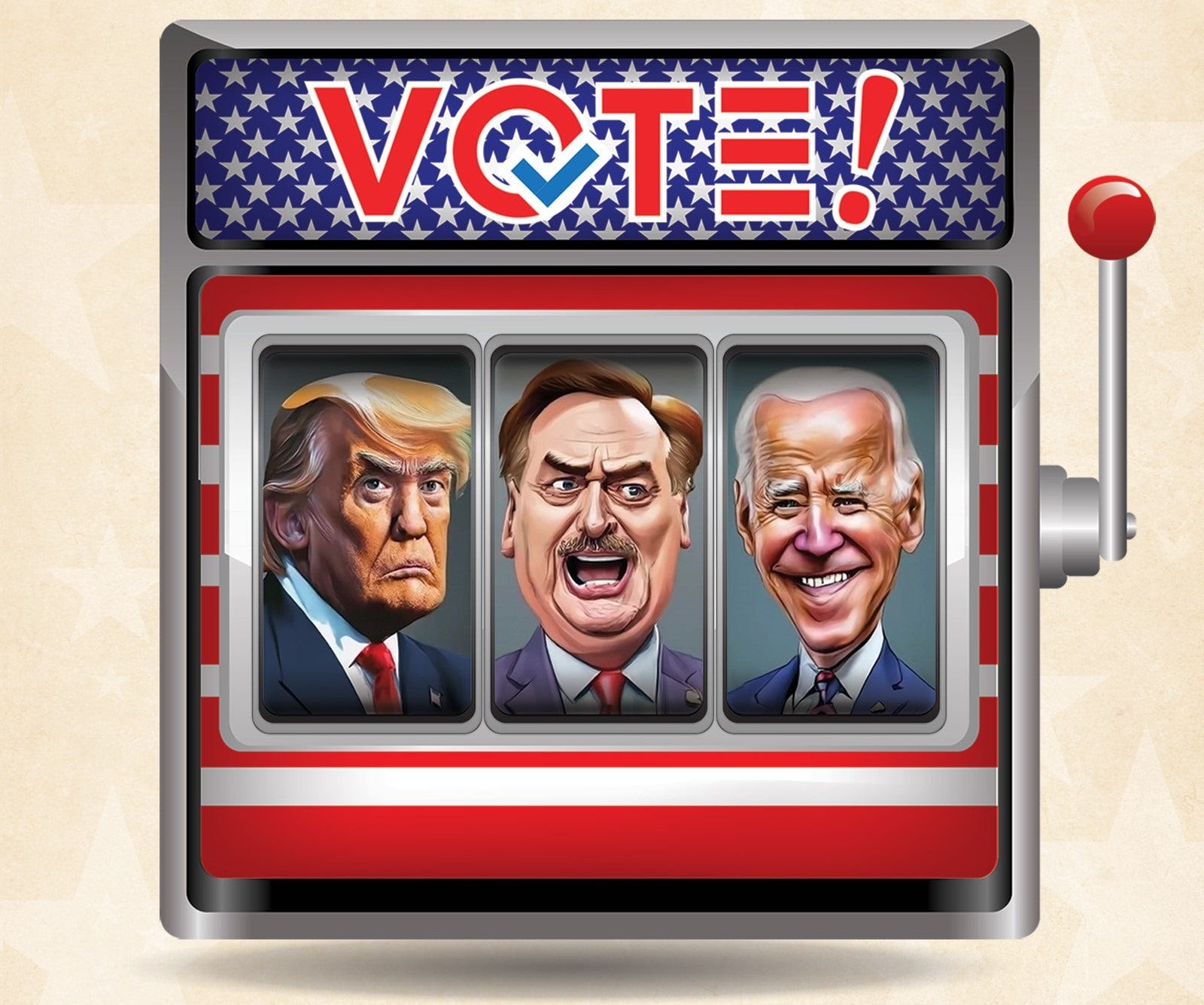
The facts so far… In the summer of 2021, MyPillow CEO Mike Lindell held a cyber symposium in Sioux Falls, South Dakota, to show the world that he had proof that the voting machines for 2020 presidential election had been hacked by China to throw the election to Joe Biden from the real winner Donald Trump. He invited world renowned experts in data analysis and offered $5 million to anyone who could prove him wrong. I attended, proved him wrong, and submitted my report.
When he refused to acknowledge my proof, I took him to arbitration as required by the agreement he wrote and required all the experts at the symposium to sign. The Federal Arbitration Act was enacted by Congress in 1925. Its purpose is to provide a shorter, less expensive alternative to the legal system, in which cases can grind on for years. There are tradeoffs. With the legal system, judges are assigned randomly without either party’s input. In arbitration, the parties get to select arbitrators, typically retired judges or lawyers who are not only familiar with the laws relating to the case but also often with backgrounds in the kind of issues of the particular dispute. For my arbitration against Lindell, we all agreed on three judges who were familiar with contract law and had experience with high tech and data analysis.
As you probably know, on April 19, 2023, I won that arbitration unanimously. Then, as my lawyers and I had expected, and as he had threatened, Lindell went to federal court to try to overturn the arbitration decision. On February 21, 2024, the federal court judge noted that while he may disagree with the arbitrators’ decision, he had no authority to overturn a binding arbitration. That was the correct decision. In fact, there are only four valid reasons that allow a court to overturn an arbitration, all stated explicitly in the arbitration act:
1. Fraud or corruption. For example, witnesses lied under oath.
2. Evident partiality. For example, one of the arbitrators was related to one of the parties or held stock in a company affected by the arbitration.
3. Arbitrator misconduct. For example, the arbitrators would not allow evidence to be heard or was biased against one party.
4. Arbitrators exceeded their authority. For example, the arbitrator ignored the terms of the contract.
There is a fifth alleged reason that is not actually in the law;
5. Manifest disregard. Arbitrators knowingly ignored the law. Different jurisdictions within the federal courts disagree on whether this is truly grounds for overturning an arbitration decision and have asked the Supreme Court for clarification.
It is widely understood that an arbitration award cannot be overturned because the arbitrator got the law wrong, got the facts wrong, the decision seems unfair, or a court would have ruled differently.
Lindell claimed the latter disputed reason, manifest disregard, and also the fourth reason, that the arbitrators had exceeded their authority, when he went to the Federal Appeals Court. There, three judges listened to 15 minutes of arguments by lawyers from both parties.
Lindell’s argument was that I had only proved that his election data wasn’t packet data, but that I hadn’t proved it wasn’t some other kind of election data. The Prove Mike Wrong Contest agreement said I had to prove with 100% certainty that the data was not related to the election. The agreement said nothing about packet data. Therefore, according to Lindell, the arbitration judges had “exceeded their power” because they had read “data related to the election” as packet data and only packet data. This was a restrictive reading that narrowed the agreement to a condition that was not explicitly in the agreement and thus their decision must be overturned. At least that’s what he claimed.
But that’s not actually the situation. I had shown that the data was not any kind of known data format. Lindell and his lawyers had argued before the arbitration that the term “data related to the election” could be any kind of data. One of Lindell’s witnesses, Doug Frank, claimed that data can be “reflective of November 2020 election data” simply by someone calling it related. He wrote the following:
To illustrate this difficulty, one might attempt to prove that the short phrase, “My shirt is blue.” is not related to the election. For all we know, my shirt is blue today because I used blue dye to color it for my patriotic participation in the election. But the only information provided to you is the short phrase. Without more information, it is impossible to prove that the short phrase is not related to the election.
This was obviously a ridiculous interpretation, so by the time of the actual arbitration, Lindell’s team explicitly stated that they had given me network packet data, a very specific kind of data related to the election. In fact, at the arbitration, under oath, here are direct quotes referring to packet data and packet captures, which are recordings of the packet data.
Lindell: “Now, there’s a -- when I just said that there now, if you heard what I said, if you listen to the words, it says packet captures are like having a movie of the whole election. That’s what this data is.”
Lindell: “For me, when I talk packet capture, that’s a stream of the data.”
Lindell: “When [the people who sold me the data] explained to me what that -- it’s a stream of data, and they just use the phrase ‘packet captures.’”
Brian Glasser (my attorney): “So the electronic newspaper movie you’re talking about is the packet capture movie we talked about in your examination with me at the beginning when you were telling the world about how these Internet packets had been captured and couldn’t be altered. That’s what [the man who sold you the data] captured, the Internet traffic, right?”
Lindell: “That shows the time -- that it came from the 2020 election, this stream of data. Absolutely.”
Brian Glasser: “Did you guarantee the data that you were going to show the contestants would be packet capture format?”
Lindell: “I’m not a cyber guy. It was data that shows that that camera is from the 2020 election. When I used -- like you say -- like we just talked, I’m not a cyber guy. I don’t understand. If you said, ‘Is this a packet capture? Is this’ -- to me, you’re capturing data. And that’s what they called it. They call that data packet capture, I guess.”
Doug Frank (Lindell’s witness): “So imagine a program that collects massive amounts of data. And, of course, those are PCAPs. That’s packet captures. So it collects all these data. And we have a massive amount of it… So Mike’s objective in the symposium was to give the data to people in a way they could examine it and confirm it’s from the 2020 election. That was his point.”
Alec Beck (Lindell’s attorney): “When you say, ‘captured,’ somehow just somebody went out and got it on the Internet? Is that what we’re talking about?
Frank: “Well, let’s talk about that. There’s no such -- I mean, there’s -- as every cyber person understands, everything on the Internet is in packets. So when you capture it, it’s a packet capture.”
Frank: “Mike is not a cyber guy. And he knows they started out as PCAPs, so he’s just referring to all of that kind of in a slang way as being PCAPs [packet captures]. And he’s right. It originates as PCAPs. It must because that’s the way the Internet works.”
Doug Gould (Lindell’s expert witness): “I believe, after -- after the symposium was brought to my attention, I understood that Mr. Lindell stated there were 37 terabytes of packet captures.”
Beck: “[You testified that] ‘The contestants were all told in the experts’ breakout room that the program... was used to decrypt raw encrypted data related to the packet capture data.’ Did I read that correctly?”
Gould: “You did.”
Glasser: “When you came to the symposium, you personally expected to see authentic packet captured data, correct?”
Gould: “I had hoped to, yes.”
Glasser: “That’s why you brought the big array of storage devices so that you could actually download the authentic packet captured data that Mr. Lindell had promised the world he was going to deliver, correct?”
Gould: “Yes.”
Glasser: “Of the authentic real-time captured packet captures from the election. That’s what -- in fact, that’s what Lindell said in this chair yesterday and repeated he had promised, right?”
Gould: “Yep.”
In fact, all parties had agreed that the election data referred to in the arbitration agreement was packet data, but in his pleading before the appeals court, suddenly it was not packet data, some other unspecified kind of data, and I had not proved was not related to the election.
And yet that’s exactly what the judges decided when they overturned the arbitration ruling:
From the four corners of the Challenge contract as defined by the Official Rules, there is no way to read “information related to the November 2020 election” as meaning only information that is “PCAP [packet] data.” The [arbitration] panel thus did more than construe an ambiguous contract term. Adding a form-of-data requirement imposed a new obligation upon LMC, effectively “amending the [contract].” Keebler, 80 F.3d at 288. Fair or not, agreed-to contract terms may not be modified by the panel or by this court. On this record, “[t]he conclusion is inescapable that the panel simply imposed its own conception of sound policy.”
However, under contract law, if the contract said “doohickeys” and both parties agreed that “doohickeys” means packet data, then no judge can assert his opinion that it doesn’t. Thus, contrary to what these judges stated, the arbitrators did not exceed their authority by ignoring the terms of the contract.
But let’s say that the data was not required to be packet data according to the terms of the agreement. What was the data? I showed that the data, after being translated from one format to a different format, fell into four categories, something that was not challenged by Lindell, his witnesses, or his expert witness. There were data files that consisted of generic diagrams of voting systems. There were data files that consisted of a long table in a Microsoft Word document with seemingly random Internet Protocol addresses followed by the number 7. There was data that consisted of a Word document containing a long list of random characters and symbols. And there was a long spreadsheet consisting of things like names of cities in the U.S. and around the world, as well as names and addresses of international internet providers including Amazon, AT&T, Charter Communications, Google LLC, Mark Twain Rural Telephone Co., Reynolds Media, and China Unicom. It also included the names Biden and Trump. Lindell’s witness admitted under oath that he was aware that some person unknown to him had added information to this spreadsheet after he had initially received it.
In an ending that reminds me of a Perry Mason moment or the ending of the movie A Few Good Men, under Brian Glasser’s intense questioning, Lindell’s expert witness Doug Gould admitted under oath that most of that information in these documents could not have come from packets but also that he could see no relationship to the 2020 election. And yet three federal judges determined that arbitrary data could somehow be related to the 2020 election in a way that neither I nor Lindell’s own people could explain.
Furthermore, the arbitrators were aware that unambiguous terms cannot be interpreted by going outside of the contract to define those terms. They explicitly stated this in their decision:
The intent of the parties is determined from the plain language of the written contract, so long as the agreement is clear and unambiguous.
“Words or phrases found in a contract should not be interpreted out of context, but rather by a process of synthesis in which the words and phrases are given a meaning in accordance with the obvious purpose of the contract as a whole.”
Both parties contend that the rules are unambiguous, and no [external] evidence is required for contract interpretation.
…
As noted above, Mr. Lindell and his cyber-expert witnesses admitted that data to be provided from the election was to be in the form of packet data or PCAP data. This is important, as Mr. Lindell explained, because such data can be examined by experts based on time stamps, addresses and other information from the packet to determine whether it was genuine.
The arbitrators were clearly aware of this Minnesota law and thus did not show manifest disregard by knowingly ignoring the law.
Rather, what happened is that three federal judges disagreed with the arbitrators or simply sympathized with Lindell and found a way outside the law to overturn the decision.
My lawyers and I decided to take this ruling to the U.S. Supreme Court because of its significance. Courts in various jurisdictions have disagreed on the meaning of “manifest disregard” and whether it is an allowable reason for overturning an arbitration. Six circuit courts and three state supreme courts have decided that manifest disregard remains a valid basis for overturning an arbitration while three circuit courts and two state supreme courts have decided that it does not. The Fourth Circuit recently stated, “the question of whether the manifest disregard theory [is legitimate] has caused an entrenched circuit split” and “the Supreme Court or Congress will have to resolve the issue.”
On January 9 of this year, the Supreme Court refused to hear my case. What this means is that arbitration is no longer a viable option in any legal matter. Rather than making a resolution of disagreements simpler, faster, and less expensive than litigation, it now does the opposite. If a party doesn’t like an arbitrator’s ruling, she can simply go to court and have it overturned by this vague concept of manifest disregard. If a party wants to wage a war of attrition against another party, simply go to arbitration, which is now guaranteed to last much longer than litigation and cost much more.
Mike Lindell now has two significant accomplishments to his name. He has thrown the voting system into disarray and distrust by falsely claiming that voting machines are tainted and that voting does not work, and he has single-handedly destroyed the arbitration system in America.
Please share this Good Intentions Newsletter so that others may learn from it.

Bob Zeidman is the creator of the field of software forensics and the founder of several successful high-tech Silicon Valley firms including Zeidman Consulting and Software Analysis and Forensic Engineering. He is the author of textbooks on engineering and intellectual property as well as award-winning screenplays and novels. His latest book is Election Hacks, the true story of how he challenged his own beliefs about voting machine hacking in the 2020 presidential election and made international news.
Comments
Nothing yet. Say the first thing.
Sign in to join the conversation.