

You can submit your own Feminist Advice question here. If you have previously submitted a question and would like to provide an update, please do so here.
What do you think of Professor Jennie Young and her Burned Haystack dating method? I love her group, but it was also big and at times overwhelming, and the method was hard to learn. Do you think it’s worth committing the time?
I chose this question primarily because it affords me the opportunity to address some other things I always seek opportunities to address in my work, so I’m going to talk about those before I get to the meat of the question.
I’ve publicly collaborated with Dr. Young several times, and I consider her a friend and colleague. It always surprises me when people seek to introduce me to her work or ask me if I think her work is worthwhile. This, to me, speaks to how much social media algorithms control our lives and thoughts.
Because if you’ve been reading my work for any period of time, you’ve definitely seen work that talks about Dr. Young! But if you view my work based only on what you see in your social feeds, a lot of my work is being suppressed. I’m consistently surprised to learn how many people don’t know I have a podcast, for example, or that I have a book coming out next year.
I don’t fault anyone for this, but I do encourage people to notice what social media shows you and doesn’t show you. Please try to actively seek out the work you like by clicking on their links, website, and more, so that what you consume isn’t solely dictated by amoral tech bros.
One of the most frustrating aspects of being a feminist in the public eye is how, in so many ways, it replicates the misogyny of motherhood: No matter what you do or say, it’s wrong, someone thinks you deserve to die for it, and there is literally no path you can take that won’t cause a large number of people to hate you. I’ve been stunned by how little it takes to get my readers to deem me a monster.
So I am always reluctant to publicly criticize another feminist. That’s because in feminism, we tend to repeat the same toxic patterns as the larger culture. We treat every disagreement as a moral threat. We lose the ability to talk through disagreements. We focus on winning instead of understanding. We demand consensus instead of solidarity. And we expect everyone we like or admire to think exactly like us on every issue.
When I get questions about what I think about a particular public feminist, I worry that it’s a test—of me, or of them, or both. We shouldn’t be doing feminism that way. You should be reading widely, learning from feminists you disagree with about some things, because everyone should disagree with you about at least something.
On to your question:
I think Jennie Young is an absolute genius, who has done the painstaking work of helping women understand what is wrong with men’s standard communication, and why generally men tend to be so bad at communicating. You should absolutely buy her book (side note: buying feminist books is crucial to ensuring they continue to exist; publishers determine what and whom to publish based on the success of past similar works).
But I have two core disagreements with her—neither of which is a reason to not read her book. Feminists can and should disagree, and publicly discussing these differences can help us build a stronger movement.
First, I think Jennie greatly over-estimates how many women can find a “needle” in the haystack. I believe that the statistics show that the overwhelming majority of men are going to be terrible partners, and that a significant number (perhaps even the majority) are going to be abusive in some significant way.
So even if you are lucky enough to find a good man, however you define that, you will very likely endanger your life in your search. Dating is dangerous. We can’t pretend that the abuse women experience as a routine part of dating is trivial. I don’t think Jennie treats it as trivial by any means, but I do think she underestimates how much danger dating really leads to.
Second, Jennie’s rhetorical discourse analysis is brilliant in its ability to bring apparently hidden patterns to light. But I think its real brilliance is something else entirely: It empowers women to critically analyze men, to trust their instincts, and to ditch a man at the first sign of trouble. Jennie is helping women move past the impulse to give every bad man a chance and the benefit of the doubt.
I do not think her method is magic, nor that it is revealing something which, in a healthy society, wouldn’t otherwise be obvious. Instead, she’s just teaching women to notice the very obvious misogyny in the way men talk to them. For instance, you don’t have to know about “I’m the prize” (a common rhetorical tactic) to know that a man who depicts himself as great and women as inferior is dangerous. The same is true of test-and-apologize. A man who behaves poorly in an initial interaction is a bad man; we shouldn’t need a guide to tell us this.
I am very glad we have that guide. I am very glad Jennie has devoted so much time and study to sussing out and identifying these patterns so that more women will recognize them. But I think the fact that we need the guide speaks to a broader problem:
Women do not trust themselves. They’ve been taught to over-value men, which means they miss obvious red flags. They pursue men who offer them little or nothing. They blame themselves for abuse and violence. They believe the sunk cost fallacy, and continue to invest in relationships that have already harmed them, because they don’t want to “give up.”
None of these behaviors are women’s fault. Patriarchy socializes us from birth to accept less than we deserve. That’s because patriarchy works best when it is invisible or even seems consensual. I appreciate Dr. Young working overtime to get women to notice what is often invisible. That doesn’t mean her method is magic, nor that we should pretend the misogyny is anything other than obvious.
I also worry about whether the method alone is enough. I see in my own work that women who intellectually understand feminism, who see relationships as oppressive, who want better, will still make terrible relationship decisions, including while knowing they are making terrible relationship decisions. That’s because patriarchy gets in early and deep, and our need to please and center men is difficult to overcome.
We have to pull out the roots of the problem rather than just snipping the top off of the ugly weed. Until we do, though, I love Jennie for doing everything she can to prune the weeds as we build consciousness, strength, and hopefully, a world where we don’t have to analyze men’s messages to detect misogyny.
Why do men expect women to bear the full cognitive load of communication?
·
June 12, 2025

One of my favorite Facebook reels features a nurse taking over after the night shift, seeking to get information from her male colleague. His answers are incomplete, confusing, disorganized, and filled with bias. He decides his female patient is horny, makes plans with a male patient, and his sole report about another is, “She good.”
Liberating Motherhood Podcast
Jennie Young: Dating More Safely in a Patriarchy
·
Apr 1
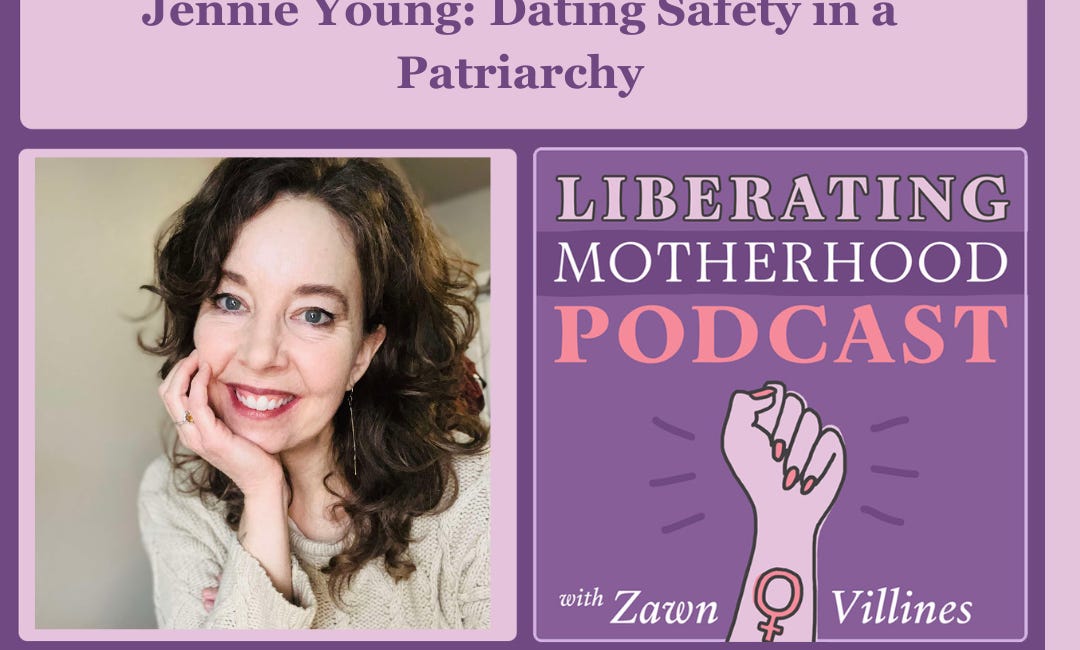
Patriarchy destroys relationships, and it has turned dating into a nightmare. Jennie Young is fighting back with her Burned Haystack method, and now the method is a book. Through her work, Jennie endeavors to teach women to detect red flags before they become obvious, and to thwart abuse before it happens. Dating is the most dangerous thing most of us d…
Comments
Nothing yet. Say the first thing.
Sign in to join the conversation.