
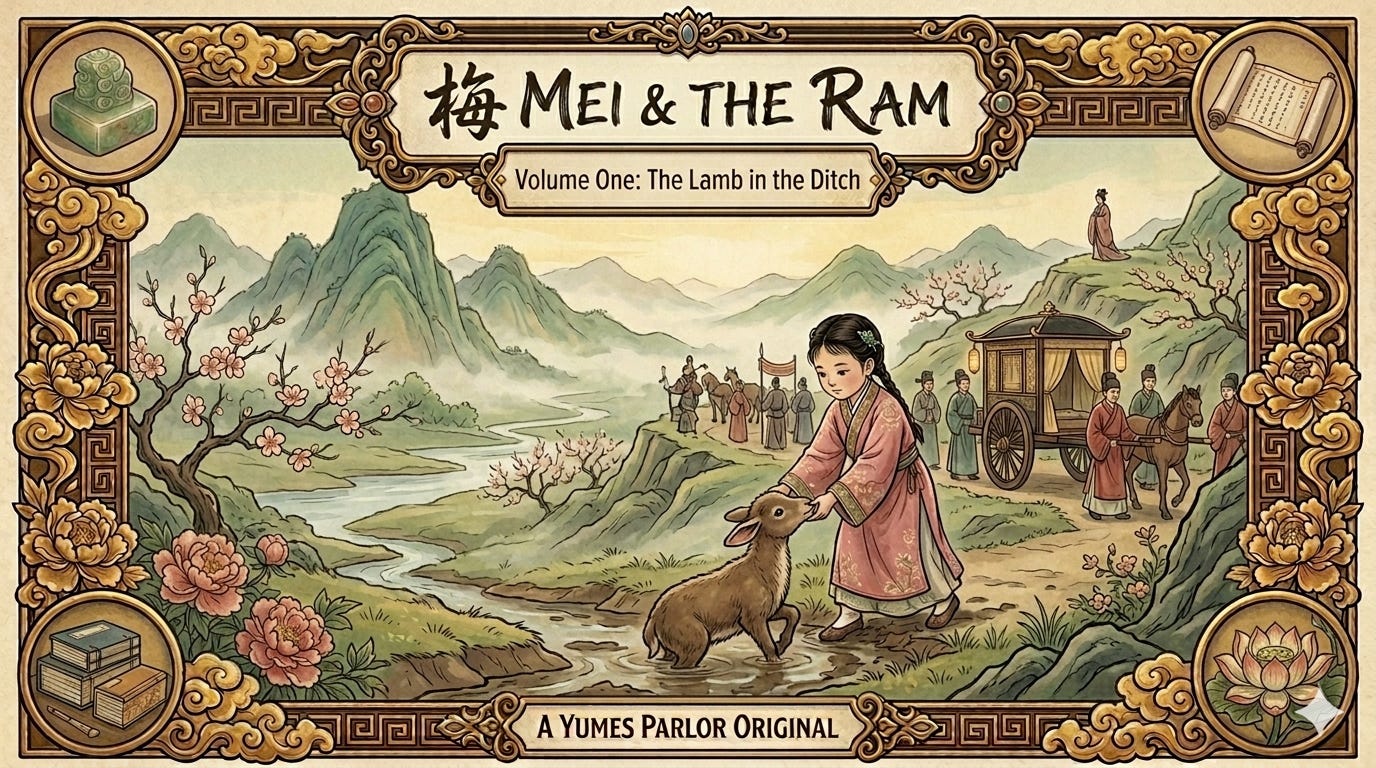
Mei & the Ram
Volume One: The Lamb in the Ditch
Season One
Remastered
A Yumes Parlor Original
A note from the Emperor:
I am the Son of Heaven, master of ten thousand affairs, and I have held court with kings and envoys and the most formidable minds of the age. I have dictated poetry. I composed a commentary on The Art of War at the age of nineteen. My calligraphy has been framed and mounted in nine provinces.
I am writing this account of my daughter and her ram. I cannot explain it except to say that some things demand to be recorded, and I am the only one paying close enough attention.
It began in spring.
Part One: The Imperial Tour
The annual spring tour was my idea, as most things are. The procession winds through the outer districts — a display of imperial presence, a reminder that the Tang court is not merely a collection of buildings but a living thing that moves through the world and takes note of it.
I had planned this particular tour with more than the usual care. The previous year's harvest reports from the western prefectures had been inconsistent in ways I did not like — not disastrous, but uneven, the kind of unevenness that either means nothing or means the beginning of something a wise ruler ought to notice early. I wanted to see the fields myself, from the road, rather than trust the figures alone. A minister's report can be accurate and still fail to tell you what a farmer's face tells you when he watches your carriage pass.
My daughter Mei had been on every tour since she was four. She rode in the third carriage, with Nanny Jia and three silk cushions and a lacquered box of sweet bean cakes she was not supposed to touch until the afternoon stop, and which she invariably touched before the first hour was out.
She was six years old in the spring I am writing about. Small for her age, though she would object to my saying so. Her hair was braided down her back with a jade pin at the end, and she sat with the formal posture of a child who has been told to sit up straight and has decided, on this occasion, to comply.
I rode in the lead carriage, as protocol required, close enough to hear the general commotion of the column but far enough that the particulars of my daughter's carriage — her small negotiations with Nanny Jia over the bean cakes, her habit of narrating the passing scenery to no one in particular — reached me only as a pleasant, indistinct murmur beneath the sound of hooves and wheels on packed earth. I had grown used to this distance. I did not yet understand how thoroughly it was about to close.
We had been traveling for perhaps four hours when the procession slowed.
A messenger ran up along the column. There was a sound ahead — faint, carried on the warm spring air, coming from somewhere in the tall grass at the edge of the road. Most of the court did not hear it. I heard it.
Mei had already opened her carriage door.
Part Two: The Ditch
"There's something crying," she said, before anyone could stop her.
Nanny Jia said "Mei, get back in the —" but Mei was already out of the carriage and walking toward the sound with the focused, unhurried confidence of a child who has decided that what she is doing is correct and is simply waiting for the adults to catch up to this understanding.
I stepped down from the imperial carriage. An empress does not step down from her carriage on a roadside in the outer districts; this was, I believe, the expression on my head minister's face as I walked past him. Minister Kang — a man who has never in his career been caught without a considered opinion on any subject — said nothing at all, which I took, correctly, as his most considered opinion of the entire tour, and one he would maintain, wisely, for the remainder of the journey.
The sound was coming from a ditch along the north side of the road — a shallow cut in the earth where spring rains had run off, filled now with mud and new grass. In the grass, half-submerged in mud, was a lamb.
It was not a lamb I recognized. The ears were enormous — arched and swept back, the ears of a creature built for listening to great open spaces. The coat was brown and thick and currently matted with mud. The legs were folded under it at strange angles, too thin for the oversized body, trembling.
Thirty paces away, in the taller grass, was what remained of the mother. The hunters had been through this morning. They had not, apparently, noticed the lamb.
Mei stood at the edge of the ditch and looked down at the small creature for a long moment.
"It's cold," she said.
"Mei." I came to stand beside her. "That is not a domestic animal."
"I know."
"We cannot —"
"He's going to die if we don't take him."
There was a pause. The lamb made a sound — small, not exactly a bleat, something more fundamental than that, the sound of a creature that does not yet know how to explain what has happened to it.
Mei looked up at me. She was six years old. She had mud on her slippers already.
"Please," she said.
I looked at the lamb. I looked at my daughter. I have faced more difficult negotiations.
"You will care for it yourself," I said. "Entirely. Every feeding, every bath, every complication."
"Yes."
"If it survives."
"He'll survive."
She was already climbing into the ditch.
A Note on the Argali (Ovis ammon)
The Argali is the largest wild sheep in the world, native to the high steppes and mountain ranges of Central Asia — Mongolia, Tibet, the Pamirs. An adult Argali ram can weigh as much as three hundred jin and stand nearly as tall as a man at the shoulder, with curved horns that can span the length of a man's arm.
Argali lambs are born in spring, in the high country. They are rarely seen by humans. That one should appear in a roadside ditch in the Tang lowlands — alive, alone — was unusual enough that even Old Chen, who had worked in the imperial stables for thirty years, had never seen one.
The Tang emperor's court records do not mention this incident. Certain events are too small for official record, and certain events are too large.
Part Three: The Column Waits
I should record, for the sake of an honest account, what happened to the rest of the procession while my daughter climbed into a roadside ditch and I stood at its edge doing nothing whatsoever to stop her.
An imperial column of that size does not simply pause. It ripples to a halt from front to back over the course of several minutes, each section arriving at stillness slightly after the one before it, so that for a short while the tail of the procession continued advancing while the head had already gone entirely quiet, a small chaos of confused riders and stalled carts that would, I am told, be discussed among the household staff for weeks afterward. Riders came forward to inquire. Officials exchanged glances that I did not need to see to understand. Minister Kang, recovering some fraction of his composure, suggested — carefully, diplomatically, in the manner of a man who has learned exactly how much candor an emperor will tolerate before growing irritated — that perhaps a stable hand might be sent for, rather than requiring the Emperor and the Princess to remain roadside themselves.
"The stable hand is not here," I said. "We are."
Minister Kang did not press the point further. This, too, I noted, was his most considered opinion of the tour, and I confess I found myself, that afternoon, rather more amused by his careful diplomatic silence than the situation strictly warranted.
Nanny Jia had by this time descended from the third carriage herself, moving with rather more haste than her usual dignified pace, and stood at the ditch's edge wringing her hands in a manner I had not seen from her since Mei's infancy, when a fever had kept the entire nursery awake for three nights running and left even Nanny Jia, ordinarily unshakeable, visibly rattled by the end of it.
"Your Majesty," she said, to me, quietly. "She will ruin her slippers."
"She has already ruined her slippers," I observed.
"She will ruin considerably more than her slippers before this is finished," Nanny Jia said, with the particular grim certainty of a woman who had raised this child from infancy and had long since stopped being surprised by her, only occasionally still being alarmed.
Part Four: The Carriage Home
She lifted him out of the ditch herself. He was heavier than she expected — she nearly fell twice — and he smelled of mud and lanolin and something sharp that was probably fear, and he struggled once and then went still in her arms in the way that small animals sometimes do when they have decided that struggling is no longer the most practical option.
Mei climbed back onto the road with the lamb held against her chest and her jade hair pin at a significant angle and mud from her collar to her knees. She looked at Nanny Jia with an expression of complete calm.
"He needs warm milk," she said. "And somewhere dry. And his legs need looking at." She said each item plainly, as though reciting a list she had already composed in her head somewhere between the ditch and the road.
Nanny Jia closed her eyes briefly. Opened them. Said: "I'll send for the stable physician."
"Thank you, Nanny Jia."
"You're going to ruin those silk cushions."
"Yes."
"I'll send for new ones as well."
The lamb rode in the third carriage for the rest of the day, wrapped in Mei's outer robe, pressed against her side, occasionally making the small fundamental sound, occasionally falling silent. I rode alongside for a portion of that afternoon rather than resuming my place at the head of the column, an irregularity I permitted myself on the grounds that an emperor who has just watched his daughter climb into a ditch has, I think, earned the right to a small irregularity of his own.
I watched her through the carriage's open curtain. She did not speak to the lamb the way children speak to toys — no cooing, no performance for an audience. She spoke to it the way one speaks to a person who is frightened and needs plain, steady information. "You're safe now. We're almost there. I'm not going to drop you." I do not know where a six-year-old learns to speak this way to a dying animal. I have wondered about it many times since, and I have not arrived at a satisfying answer beyond the plain fact of who she is, and who, I suspect, she had always been waiting for the occasion to become.
By the time we reached the palace gates, Mei had decided on a name.
"Bo," she told me, when I came to see how they had arrived. "It means wave. Something that rolls forward and cannot be stopped."
I looked at the lamb, who was looking up from the ruins of the silk cushions with eyes the color of pale gold — wide, horizontal, steady. Something in those eyes already suggested that the name was appropriate.
"A wave is also something that is difficult to reason with," I observed.
"Yes," Mei said. "That too."
Part Five: Old Chen
I have not yet introduced, in this account, the man who would come to matter as much to this story as nearly anyone in it, and I think the record deserves a proper introduction here, at the moment he first entered it.
Old Chen had served in the imperial stables for thirty years by the spring I am describing — a broad, weathered man of few words and exact judgment, trusted with the health of every horse in the imperial service and, by extension, with a great many decisions that lesser men might have deferred upward rather than make themselves. He was summoned to the stable that evening, along with the physician, to assess what exactly had been brought into his domain.
Old Chen arrived, took one look at the lamb in the prepared pen, and was silent for a considerably longer moment than his usual manner allowed, the silence stretching long enough that Mei began to look uncertain for the first time since the ditch.
"That is not a lamb," he said, finally.
"He is a very young lamb," Mei said, with the particular firmness she used when she suspected an adult was about to say something inconvenient.
"He is an Argali," Old Chen said. "Wild stock. Mountain stock. I have worked these stables thirty years and I have never once had one brought to me." He crouched beside the pen, studying the animal's proportions with the same careful attention he gave every horse under his charge — the legs, the shoulders, the set of the eyes. "This animal was not built for a palace stable, Your Highness. He was built for country you and I will never see."
"He's here now," Mei said. "The country he was built for isn't."
Old Chen looked at her for a long moment. Then, unexpectedly, he almost smiled — a rare enough occurrence, I would learn over the following years, that Mei herself would come to treat it as a small private victory whenever she managed to produce one. "No," he agreed. "It isn't." He stood, brushing straw from his knees. "I'll show you how to feed him properly. Warm milk isn't enough on its own — he'll need it thickened, and slowly, or his stomach won't take it." He paused at the pen gate. "And I'll want to be consulted before any further decisions are made about him. Not asked permission. Consulted. There's a difference, and I expect you already understand it."
"I understand it," Mei said.
I noted, watching this exchange, that Old Chen had just secured for himself a role in my daughter's life that would prove, in the years that followed, considerably larger than either of them could have anticipated on that first evening.
Part Six: The Physician's Report
The stable physician — a careful, soft-spoken man named Dr. Lin, more accustomed to horses' colic and the occasional injured hunting dog than to wild mountain stock — examined the lamb's legs by lantern light while Mei held the small trembling body as steady as she could manage.
"The legs are not broken," he said, after a thorough examination that Mei watched with an intensity that made even the physician glance up at her more than once. "Strained, perhaps, from however long he was struggling in that ditch. Some bruising along the left foreleg. He is cold, and he is hungry, and he has clearly been separated from his mother for some hours before you found him. But he is, by every measure I can take tonight, a fundamentally sound animal."
"Will he survive?" Mei asked, and I noted that her voice, for the first time since the ditch, carried something less than complete certainty.
Dr. Lin considered the question with the seriousness it deserved rather than offering false comfort. "The first three days will tell us more than I can tell you tonight," he said. "Wild lambs separated this young from their mothers do not always take to hand-feeding. Some refuse it entirely, out of some instinct we don't fully understand, and there is little a physician can do against an animal's own will to give up." He looked at Mei directly, his tone gentling somewhat, as though he had only just registered how young the girl in front of him truly was. "But I will say this: an animal fought for as hard as this one has been fought for tonight has better odds than most. Whatever else happens, he has not been abandoned twice in one day. That counts for something, even in a lamb."
Mei absorbed this with the particular stillness I had already begun to notice in her — not the stillness of a child failing to understand, but the stillness of a child understanding completely and choosing to hold the understanding quietly rather than perform a reaction to it.
Part Seven: The Promise
That night, after the stable physician had assessed Bo's legs as "uninjured but in need of rest," and after Mei had overseen his first feeding herself under Old Chen's careful instruction, and after Nanny Jia had removed three ruined silk cushions and one ruined outer robe and added them to the growing catalog of Mei's effects that were casualties of her enthusiasms —
Mei sat alone with Bo in the clean straw of the small stable pen they had prepared for him.
Bo was asleep, or nearly. His breathing had slowed from the rapid frightened breaths of the afternoon to something steadier. His legs, folded under him in the straw, had stopped trembling.
Mei sat with her back against the wooden pen wall and her knees pulled up and her braids coming undone, and she looked at him for a long time.
"You're mine now," she said, quietly, to the sleeping lamb. "I'm going to do everything myself. Just like I said."
Bo made a small sound, the edges of sleep.
Outside, the spring night moved over the palace rooftops. Somewhere in the inner court, I was supposed to be reviewing dispatches from the western frontier. I was, instead, standing in the shadow outside the stable door, listening to my daughter make a promise to a lamb.
I did not interrupt.
Some things must be allowed to begin without a witness.
I wrote about it later. I have been writing about it ever since.
Part Eight: What I Told the Council
I will close this first volume with a small administrative footnote, offered partly for the historical record and partly because I find I still find it privately amusing, some years distant from the events it describes.
The following morning, my council convened for the regular review of the spring tour's findings — the harvest figures, the district reports, the small matters of provincial governance that constitute the actual substance of most imperial business, whatever the poets prefer to write about instead. Minister Kang, ever thorough, inquired whether the delay on the road the previous day ought to be formally noted in the tour's official record, and if so, under what heading.
I considered the question for a moment. "Note it," I said, "under unscheduled acquisitions."
Minister Kang, to his very great credit, wrote this down without so much as a raised eyebrow, and the official record of that spring's tour contains, to this day, a single terse line reading: One (1) unscheduled acquisition, roadside, outer district, disposition: retained. I have always considered it among the more accurate lines in the entire imperial archive, whatever it lacks in ceremony.
Part Nine: The First Week
I have compressed, in the preceding parts, what was in truth a considerably more eventful first week than a single evening's account might suggest, and I think the record is better served by a fuller telling of it, even at the cost of some of the tidiness a shorter account affords.
The second night was the difficult one. Dr. Lin had warned us, correctly, that the first three days would tell us more than any single evening could, and the second night very nearly told us the wrong thing. Bo refused the milk entirely — turned his head from it, twice, with a stubbornness that seemed, for a small trembling creature not yet a full day removed from a roadside ditch, remarkably well developed for an animal that young. Mei sat with him through most of that night, and I confess I did not sleep well myself, occupying the hours with dispatches I did not truly read and a private, unspoken concern I did not share with anyone, least of all my daughter.
It was Old Chen, summoned again well past a reasonable hour, who solved the difficulty — not through any dramatic intervention, but through a small, practical observation that I have thought about many times since as an early lesson in the particular kind of attention this animal would require for the whole of his life, a lesson that would, in time, extend well beyond stable matters into something considerably larger.
"He won't take it from a bowl," Old Chen said, examining the untouched milk with a critical eye that missed nothing, as it never did in matters of this kind. "Wild lambs don't feed from a bowl. They feed from beneath, at an angle, pressed close against the mother's flank. Try your hand instead. Cup it, let him find it himself, keep it low and close to your body the way a ewe would stand."
Mei did exactly this, and within moments Bo was feeding — awkwardly, inefficiently, milk running down her wrist and sleeve in a manner that would become, over the following weeks, a familiar and entirely unremarkable state of affairs — but feeding nonetheless. I watched my daughter kneel in the straw with warm milk running down her arm and an expression of fierce, focused relief on her face, and I understood, I think, for the first time, that this was not going to be a passing enthusiasm of the kind children develop and abandon within a season. Something had actually been decided that night in the ditch, and it had been decided completely, in the particular irreversible way that only the truest decisions ever are.
By the fourth day, Bo was feeding readily, his legs bearing weight again, his trembling entirely gone. By the end of the first week, he had discovered that the stable's second gate, if leaned upon with sufficient persistence, would eventually yield, and had wandered as far as the kitchen garden before a considerably alarmed under-cook discovered him investigating the spring cabbages with the same focused, thorough attention he would one day bring to an entire imperial library. This was, I am given to understand by those who witnessed the years that followed, merely the first of what would become an extensive and varied catalogue of similar incidents, though none of us knew it yet.
Part Ten: Nanny Jia's Ledger
I would be leaving an important character in this account somewhat underserved if I did not give fuller record to Nanny Jia's particular contribution to those early weeks, which extended well beyond her initial dismay at the state of the silk cushions.
Nanny Jia had raised Mei from infancy, in the practical sense that matters more than any court title — she had been present for every fever, every tantrum, every small triumph of the nursery years, and she brought to the arrival of an Argali lamb in her charge's life the same unshakeable competence she brought to everything else, once her initial alarm had settled into something more useful.
Within the first week, she had begun what she referred to, with a dry humor I did not fully appreciate until some months later, as "the ledger" — a private accounting, kept in a small bound book she carried in her sleeve, of every item damaged, ruined, or otherwise sacrificed to Bo's presence in the household. The three silk cushions and the outer robe were the first entries. They would not be the last, though I will leave the fuller catalogue for later volumes of this account, as it grew considerably before the year was out.
"Why do you keep it?" I asked her once, having noticed her making an entry after a minor incident involving a chewed slipper.
"Because someday, Your Majesty," she said, without looking up from the ledger, "someone is going to ask what it cost to raise that girl and her ram properly, and I intend to have an honest answer ready, down to the last ruined cushion." She closed the book and tucked it back into her sleeve. "It costs a great deal. It is also, I will say once and not repeat, entirely worth it, though I would ask you not to tell her I said so. She is difficult enough to manage when she believes she has full support, and considerably harder still when she knows it beyond any doubt."
I did not tell Mei. I am telling the historical record instead, which I judge safe enough at this remove.
Part Eleven: What the Kitchen Staff Observed
I have relied, in compiling this account, on a great many sources beyond my own direct observation, and I think it worth noting, before I close this first volume, one small report that reached me through the kitchen staff some weeks after Bo's arrival, because I believe it captures something true about the shape of what was beginning, something that would only become clearer to me as the seasons and the volumes accumulated.
The head cook, an efficient and generally unflappable woman named Auntie Song, reported to Nanny Jia — who reported, in turn, to me, this being the general chain by which small palace intelligence traveled in those days — that the Princess had taken to visiting the kitchens each morning before her lessons, not to request treats for Bo, as one might expect, but to ask Auntie Song detailed questions about what young livestock generally ate, how their diet ought to change as they grew, and whether the kitchen's stores contained anything that might supplement what Old Chen was already providing, arriving each morning with a small folded list of questions she had apparently composed the night before.
"She wants to understand it properly," Auntie Song reportedly said, with some evident admiration. "Most children her age want to feed an animal because it's fun to watch it eat. She wants to feed him right because she's decided that's her job now, and she takes her jobs seriously."
I found, reading this report, that I recognized something of myself in the description, and something considerably better than myself as well. I had approached the business of governing an empire, in my own youth, with a similar determination to understand things properly rather than simply perform the appearance of understanding them. I had not expected to see the same instinct emerge, so early and so completely, in a six-year-old girl kneeling in stable straw with milk on her sleeve. I do not think I had fully understood, before that spring, what kind of daughter I actually had. I would spend a great many volumes after this one continuing to find out, and I confess I have never once regretted the length of that particular education, however unexpected its beginning.
— THE END —
A Yumes Parlor Original
No posts
Comments
Nothing yet. Say the first thing.
Sign in to join the conversation.