
I’ve been playing the Pixel Remaster of Final Fantasy III (1990) lately, and rather ironically, it’s put me in the mind of Final Fantasy VI (1994), which was originally called Final Fantasy III in the West). Playing through the different, early Final Fantasy games has been fun, but it has also been enlightening. It’s not just the presence of chocobos, Cid, and summoned monsters that is carried between the games of the series; there are also themes that begin, often very early in the series, and are built upon as the series grows. This is the case with Cyan, samurai, dark knights, and dark swords, which is what I’ll be writing about below.
As a note, though, I’ll be discussing Cyan’s entire story here. If you haven’t, and you want to save some of the surprises, then maybe save this article for a later date. There are also light spoilers for the other games in the Final Fantasy series.
What does it mean to make a game series? Back in the late 90s, after Final Fantasy VII was released, Western gamers were looking for more stories from that world. Square, however, had moved on, and continued its tradition of creating new worlds for each of its Final Fantasy games. I think that part of the distaste many Western gamers have for Final Fantasy VIII is that it wasn’t Final Fantasy VII-2. Western gamers wanted to dig more deeply into the stories of Cloud, Tifa, Shinra, Sephiroth, and the history of the world, not move on to something completely new.
Square has continued this design philosophy with most of its Final Fantasy games, only releasing direct sequels a handful of times (nor have these turned out to be great games, either). This is a conscious design choice. Square could easily have done what Xenosaga and Xenoblade creator Monolithsoft did and create a story over three different games, or what Konami did with the Suikoden series, creating multiple games in the same game world and sharing certain characters and locations. Square, instead, chose to create new worlds, though not necessarily from scratch. If you lifted up the hood of the Final Fantasy genre, you would see that the engine wasn’t fit together by a game world or characters or a developing battle system but by themes.
Think about the theme of the wasteland, a term I’m borrowing from Western myth and legend but that is helpful here. A wasteland is a part of the world that has been drained of its natural or spiritual energy, usually through some single act of anger, hatred, sin, or malice. Trees lose their leaves and their bark becomes dry and cracked. Grass withers. Rivers and lakes dry up. Only rock and the hard soil remains. And again, importantly, this is not just a natural disaster but a spiritual one as well.
The second half of Final Fantasy VI and all of Final Fantasy VII feature such wastelands, and they have come about through the direct action (Kefka) or as an unintended consequence (Shinra) of certain characters. Final Fantasy VIII has its own wasteland: the Moon, where monsters and a powerful sorcerer are kept prisoner. What does it mean to use a wasteland as a prison?
A wasteland can be more than a desecrated land. In Final Fantasy X, the world of Spira has a joyful, blue, watery tone, but the people are living in fear of Sin. This is a sort of spiritual or emotional wasteland (think of the scene where Yuna dances at the funeral). In Final Fantasy XIII, Pulse is a wasteland of safety, though it is shown to be simply a fully natural world, mostly untouched by humanity (and therefore a wasteland of civilization, not of nature). Finally, Final Fantasy XVI returns to the idea of a physical and natural wasteland, pinning the fault on Ultima, the game’s antagonists.
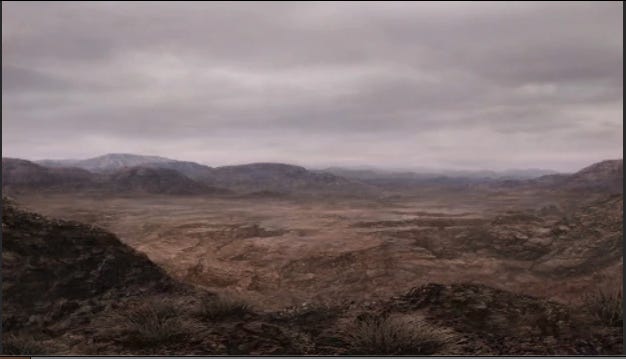
Images of wasteland come up time and again, but Square doesn’t just give the same wasteland over and again; the developers build on this theme by asking various questions. In FFVI, a megalomaniac destroys the world, but what will happen to Terra when things are made right again? FFVII asks the question of how we heal the wasteland when we are using nature to support the very way we live, and the last scene of the game suggests that civilization may not actually survive this loss of resource. FFX wonders what needs to be sacrificed in order to revive the land, and FFXIII surprises us by suggesting that what we in our comfortable lives think of as a wasteland could very well be the natural state of the world (and which can go on living without our intervention). Each game takes the wasteland and looks at the topic differently, and in discussing one, new lights can be shown on others. Putting them in the same “Final Fantasy” box forces them to converse with one another, so that Terra and Aeris and Yuna and Lightning can all comment on the wasteland in their own way and be set to talking to one another.
This is how Final Fantasy games talk to one another and to their players.
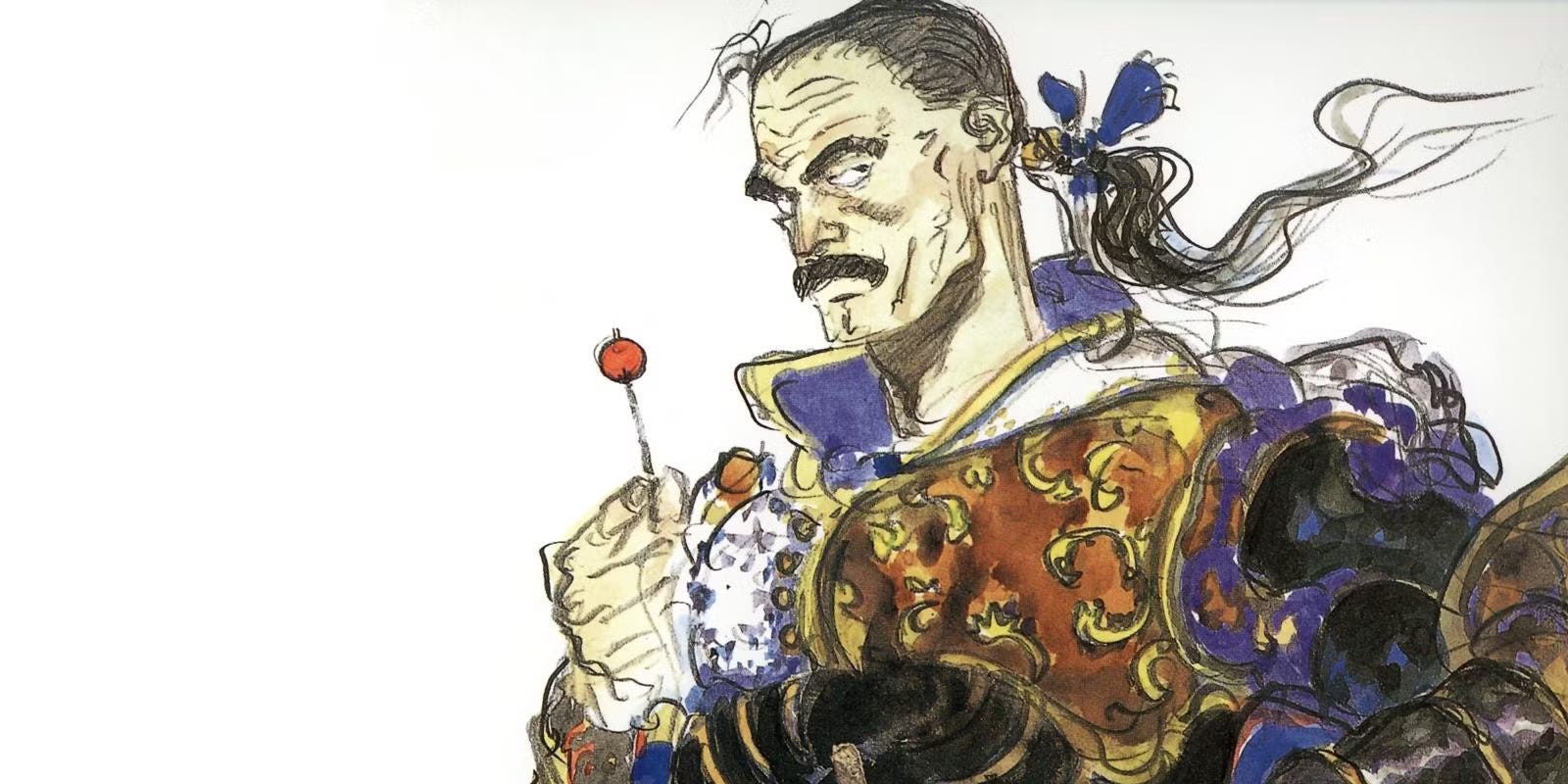
This sort of conversation is happening with Cyan in Final Fantasy VI; or, rather, Cyan is in the middle of this kind of conversation. Each character in VI is a representation of a job class: Mog is a dancer, Locke is a thief, Sabin is a monk. Cyan is the party’s samurai. His character is bound by honor and loyalty, both to his king and to his family. He uses special weapons that no one else in the game can use, and his special ability focuses on patience leading to stronger attacks. The samurai class is from the fifth game, which focuses on stunning or stopping enemies, doing hefty damage, and throwing gil for even more damage. Cyan continues the tradition of being a physical-based character who can deal decent damage and whose ability (Sword Tech or Bushido) can, in one form, stop opponents.
Of interest here, however, is Cyan’s weapon: the katana. While samurai used them in FFV, they are assigned to Dark Knights in FFIII. There isn’t much lore when it comes to character classes in FFIII, but one NPC in Falgabard, a town of dark knights, says the following:
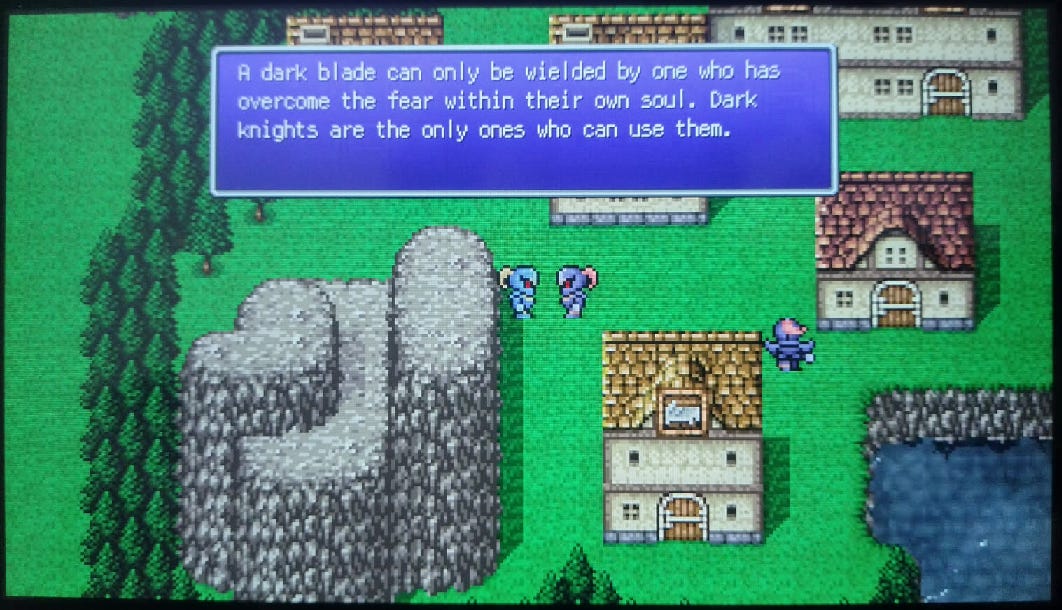
There’s nothing in the game that requires a character to actually overcome fear in order to be a dark knight, but the lore is a possible explanation for why the class has a lower defense stat than other physical-based class. Whatever the case, these dark blades (the katana) is a possible link between the dark knight class and the representation of the samurai class, Cyan. Does the series build on this idea of defeating one’s own fears as a dark knight or a samurai.
Of course, there is Cecil from Final Fantasy IV, the quintessential dark knight. Cecil overcomes his sense of guilt and suffering on Mt. Ordeals, facing his shadow in battle and becoming a Paladin. This scene is one of the key moments of the game, and it sets Cecil, and his quest, in a completely new direction. His quest against Golbez couldn’t be completely with his sin and guilt weighing so heavily on him, nor could he get closer to Rose, who obviously has feelings for him. So much is holding him back. When he becomes a Paladin, he faces himself and can find redemption.
In general, once this transformation is complete, the game moves on. Cecil doesn’t harp on his transformation for too long, and after the initial surprise he receives from some characters, he continues forward unwaveringly. But that’s Cecil. He needs to lead his companions into battle and confront other realities, particularly those concerning his family and the deaths (and supposed deaths) of some of those close to him.
Cyan, however, is not Cecil. Cyan is constantly mired in his past. The tragedy of the death of his king, wife, and child haunt him (sometimes literally) all throughout the game. He sees his wife and child depart on the phantom train for whatever afterlife exists in the world of FFVI. He stands on the platform as the train pulls away and the game makes the player wait and watch him looking down sadly. Is he crying? Is he making sense of anything? Is he merely bearing the weight of his loss? For a character with such a noble personality, Cyan certain experiences and feels a lot during the first half of the game.
In the second half, Cyan seems to overcome his grief in writing letters to Lola, and while he finally admits to her that he was the one, not her boyfriend, writing the letters, there is a sense that he would continue writing them if he could. He is doing what is right, not necessarily what he wants.
This may seem like a fair end to Cyan’s grief, but his story continues in his dreams. Here he confronts various scenes from his past, from the Phantom Train to riding Magitek armor, and eventually is set upon by Wrexsoul, who only appears in battle when one of the party members dies. When he finally wakes up, Cyan is able to put the past behind him or at least integrate his sense of loss and grief with his desire to continue moving forward with his companions. It’s no surprise that, here, he finds the esper Alexander, the representation of holy strength, in Doma’s throne room.
In all this, Cyan continues to face his fears, just as the dark knight is supposed to have done in FFIII. The difference between Cyan and Cecil, though, is that Cyan is continuously facing his fear. Cecil overcomes his fear, but Cyan’s fears and griefs haunt him continually throughout the game. Cecil faces his shadow on Mt. Ordeals, while Cyan lives with his shadow. I personally think this makes Cyan a much more compelling character than Cecil, but whatever the case, both characters represent the dark knight’s character to overcome what afflicts them.
There’s a bit more here that Square is doing with katana and dark knights. In the same town in FFIII as before, an NPC says the following.
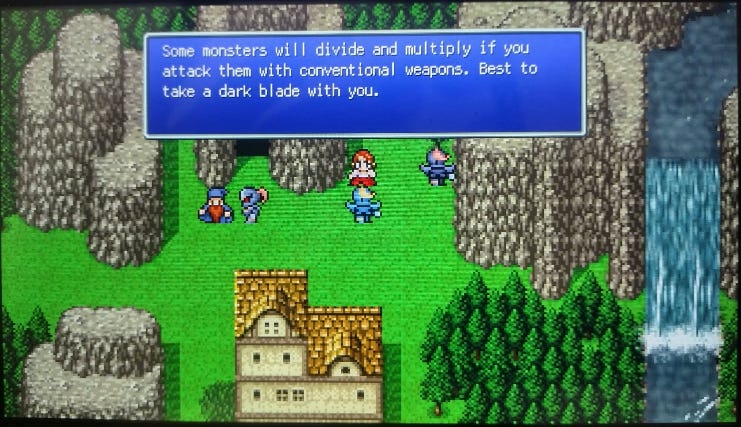
This is one of the game’s gimmicks, something that the early Final Fantasy games are known for. In FFIII, certain bosses can only be beaten by using certain classes: you really need a scholar to defeat Hein and four dragoon to defeat Garuda. Two of the game’s dungeons, the Cave of the Ancients and the Cave of Shadows, have enemies that multiply when hit with any weapon except the katana or dark blade. Thus, make a party with at least two dark knights and head in. Otherwise, you can’t complete the dungeon.
This theme continues in FFIV with Cecil, who is literally cloven in two as the dark knight and the paladin. Cecil faces a mirror that shows his true self, both as a shadow and as his inner sense of justice, and only by wielding the holy blade can the two be made one.
Cyan is a bit more interesting. We see Cyan’s whole life destroyed just a short time after we meet him: his king and family are poisoned. On the train platform in the Phantom Forest, he is split from his family. In the World of Ruin, he writes to Lola as her boyfriend, even though he isn’t. Cyan’s final journey is in a dream world that is both like and unlike the worlds through which we’ve traveled with him. FFVI sets up multiple doubles for Cyan again and again, never truly reconciling them but each of them another step towards healing. If dark blades stop enemies from splitting in FFIII, and a dark knight becomes his true reflection as a paladin in FFIV, then Cyan in FFVI shows that balancing two opposites - grief and a stiff upper lip, loyalty and failure, dream and reality, truth and lies - leads to the healing of grief. Cyan is a character who continues to seek balance in opposites. And in doing so, he finds peace.
Final Fantasy as a series of course continues after its sixth entry. Auron in Final Fantasy X is the next samurai, and he certainly has a dual reality in the game world. Clive in Final Fantasy XVI goes through similar grief as Cyan in the loss of his brother, and he eventually overcomes that grief through accepting that the hooded man is in fact himself and by joining with Joshua to become an Ifrit-Phoenix hybrid. Final Fantasy continues to tell the story of the splitting and rejoining of noble and stalwart characters who are a tad bit old fashioned compared to those around them. So as the series changes, Final Fantasy continues to spin new stories on themes established twenty to thirty years ago, and the stories continue to inspire us and to heal us as well.
No posts
Comments
Nothing yet. Say the first thing.
Sign in to join the conversation.