
On February 3rd, Anthropic dropped eleven open-source plugins for its Claude Cowork platform on GitHub with an accompanying blog post that rattled markets, hitting SaaS businesses hardest. By the close of business, $285 billion in SaaS market cap had been wiped out.
But this didn’t feel like a logical market correction that gave careful consideration to the discount rate and terminal value of software companies. It felt like a narrative-driven SaaSpocalypse.
Then on February 22nd a popular finance Substack by Citrini Research published “The 2028 Global Intelligence Crisis”. This creative writing exercise imagines a world where companies deploy AI to cut labour costs, reinvest the savings in more AI, which cuts more labour, which depresses wages and consumer demand. Citrini branded this “a negative feedback loop with no natural brake.”
It sparked fresh market jitters. Datadog, CrowdStrike and Zscaler each plunged more than 9%. IBM fell 13% — its worst single day since 2000. American Express, KKR and Blackstone, all name-checked in the post, also took a hit. DoorDash dropped 6.6% after Citrini labelled it a “poster child” for companies that “monetise interpersonal friction” — the argument being that AI agents would help drivers and customers navigate food delivery at drastically lower cost, rendering the intermediary redundant.
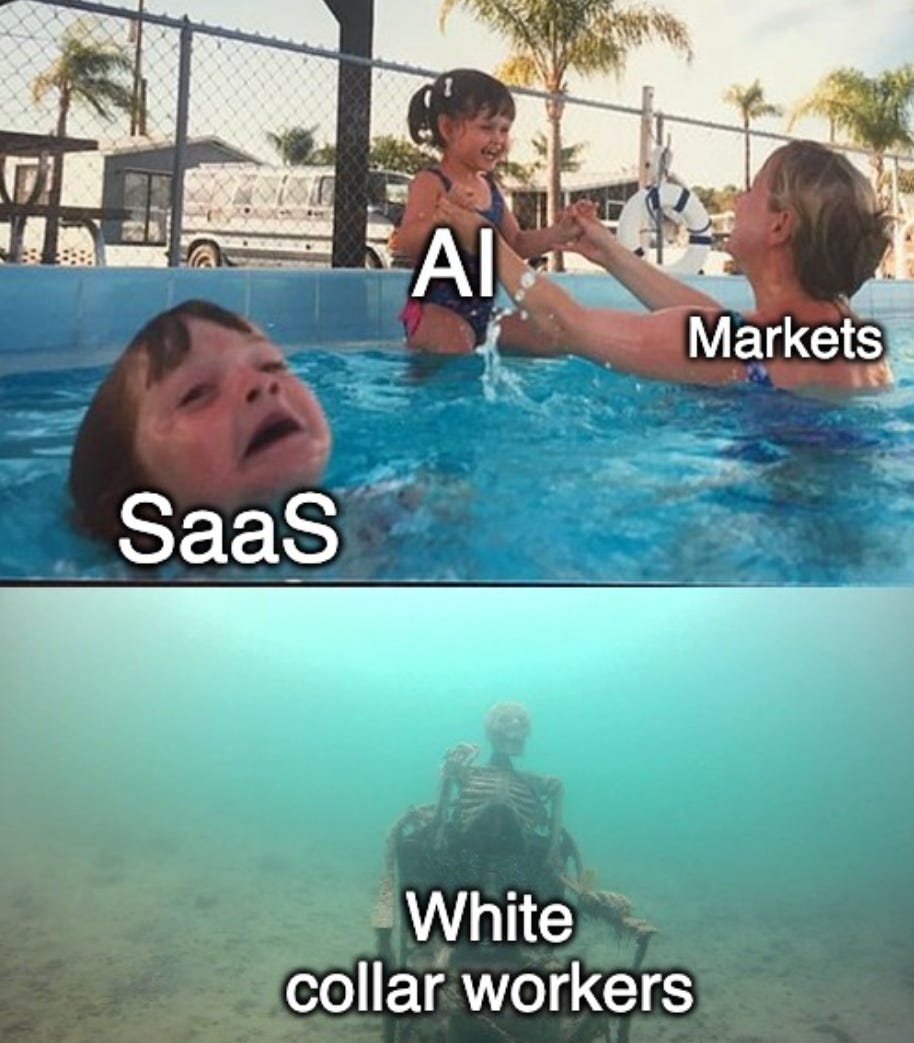
It feels like social media sensationalism has crossed over into real life, stoking fear at every level: macroeconomic (which economies will win, and which will be left behind), social (will the proceeds of AI riches be fairly distributed, if at all), industry (does my sector survive the shake-out?) and individual (which knowledge workers will still have a job in five years’ time?).
These fears explain why yet another essay — this time by Matt Shumer, called Something Big Is Happening — garnered 85 million views on X. His viral moment combined impeccable timing, credibility in the “AI commentary community” and a reassuring self-help framing. Which is exactly what many of us anxious souls needed to hear.
Shumer says:
I’m not writing this to make you feel helpless. I’m writing this because I think the single biggest advantage you can have right now is simply being early. Early to understand it. Early to use it. Early to adapt.
He names our fears to validate our anxiety, and then like any good self-help guide, reminds us that we have agency. Board the AI express, or be stranded on the platform with the luddites.
These competing narratives seem confusing and contradictory because we think in a very linear, extrapolative way about the future of jobs and industries.
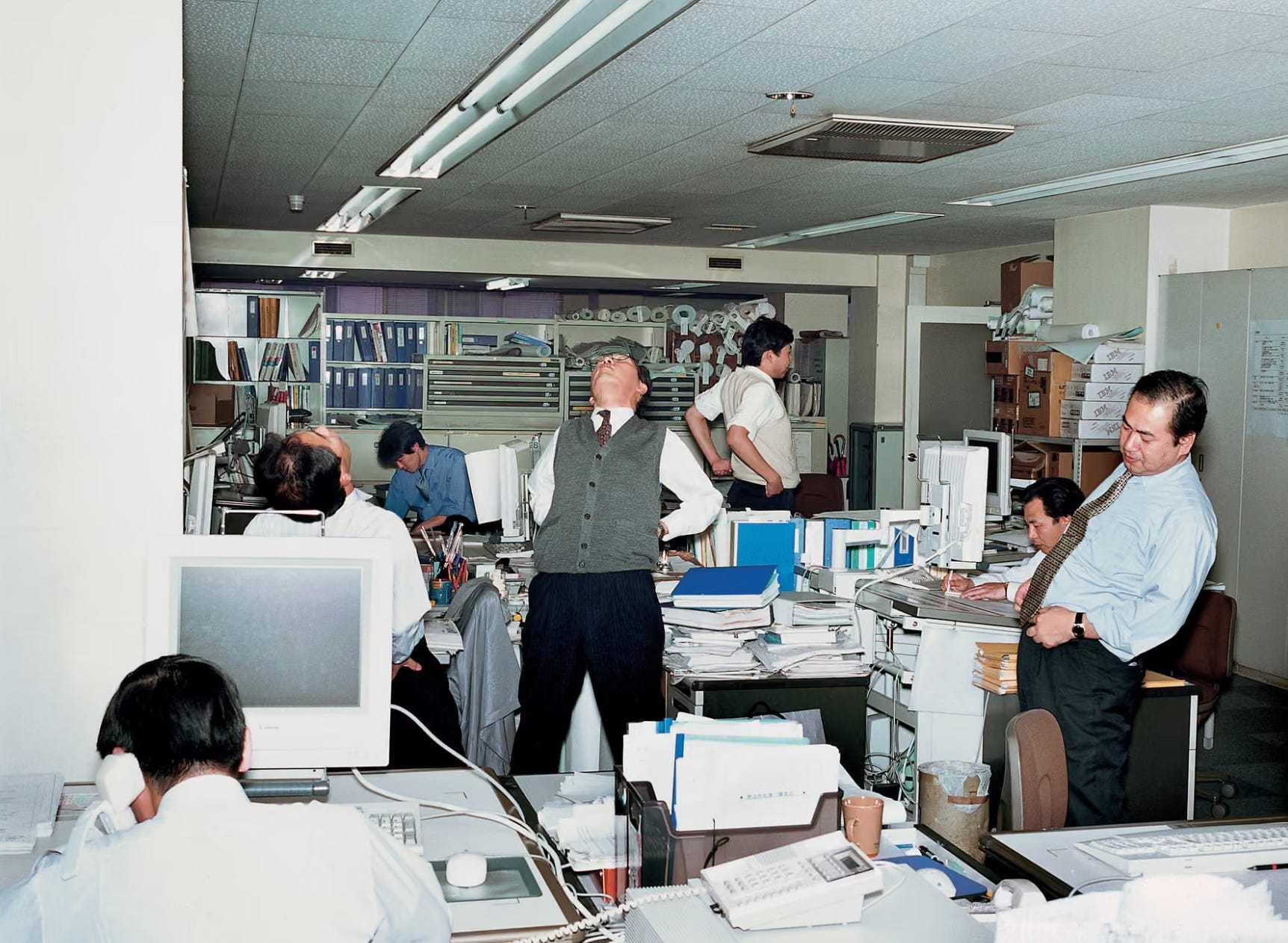
Yes a lot of old-world white-collar professions will be radically augmented, or completely replaced, by AI — think financial analysts, entry-level lawyers and consultants, customer support teams and so forth, but new professions will be born to solve new problems.
The only snag — and this is my bit of narrative speculation — is that the total number of knowledge jobs worldwide is likely to shrink. New roles will emerge, but probably not enough to absorb everyone displaced.
The more pertinent question, if we could all stop hyperventilating for a moment is not how many jobs disappear but how we reskill millions of workers. Skilled trades, care work and pedagogic professions face massive shortages. The societies that figure out how to turn surplus PR managers into kindergarten teachers, wealth managers who underperform the market into heat pump installers, and the people who spend their working hours on LinkedIn hawking their bullshit AI playbooks into palliative care assistants — will be better places to live.
There is, of course, a competing narrative filling a void of uncertainty. And it surmises that transformative technological change almost always arrives later than we envisage. As Richard Waters of the FT says:
the transition to a new, AI-centric computing platform may cause some upheaval but is far from the existential crisis that the market is pricing in. Companies are wary about uprooting software systems that hold their most important corporate data or embed their core work processes.
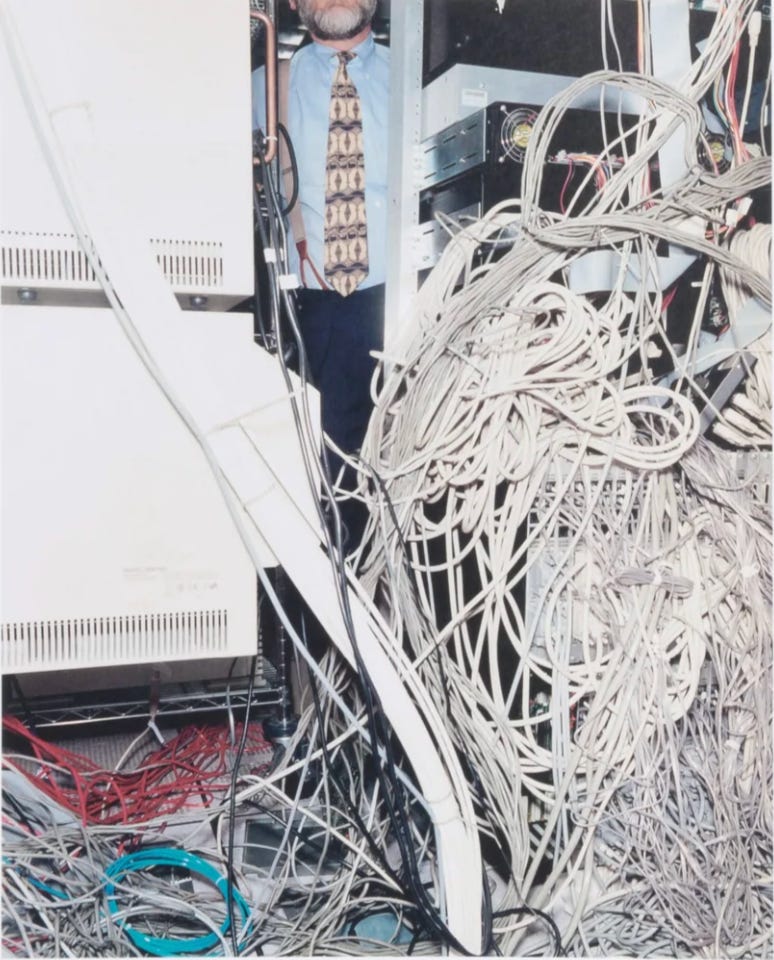
Existing systems of record, including human brains, are still valuable infrastructure, and not as easily ripped out and replaced as some would have us believe. CIOs and CTOs are also not, on the whole, reckless people who will deploy AI and let it run wild without guardrails, so implementation is phased and therefore slower. Laws and regulations, corporate culture, professional norms — and above all, the sheer human resistance to change — also remain as formidable counterforces to “AI eating the world”.
Dario Amodei’s roadmap for AI is key to understanding obsolescence. Across two long essays — “Machines of Loving Grace” (October 2024) and “The Adolescence of Technology” (January 2026) — plus numerous speeches and interviews, a few things are worth drawing out.
He thinks that within one to five years, AI could eliminate half of all entry-level white-collar jobs, pushing unemployment into the 10 to 20 per cent range. He speaks of AI as “a country of geniuses in a datacentre” — fifty million Nobel laureates, the finest domain experts that never lived, available to you as a co-pilot at any moment. Exhilarating, until you consider if these geniuses are really going to wait patiently for their inferior human master to write another bad prompt?
On the coding side, he predicted that 90 per cent of all code would be AI-written by the end of 2025 — which proved true of Anthropic itself, though industry-wide the figure is somewhere between 25 and 40 per cent. Which tells us something important: a founder surrounded by other founders, building AI inside their own bubble, is living in an accelerated reality. A canary in the coalmine? Perhaps.
But where there is a deafening silence, is on society’s ability to carry this transformation without widespread misery and collapse. In conversation with Ross Douthat of the New York Times (which I recommend listening to in full), Amodei talks of:
a “time of plenty,” government coffers filled to the brim, 20% year-on-year GDP growth and the promise that we can “take all these wonders” and ensure “everyone benefits from them.”
Given the massively growing economic inequality we are already witnessing, and the visible disinterest of the super-rich in philanthropy or social progressivism, Amodei’s vision reads less like a forecast and more like a founder’s prayer that this will somehow all turn out to be ok.
So it’s on this macro issue that my anxiety peaks. Getting onboard with Schumer’s vision, by comparison, is more tangible and anxiety alleviating.
I spent last night running scripts in Claude Cowork to build a go-to-market sales motion for an early-stage startup — turning Ideal Customer Profiles into a target account database, buyer personas and contact lists from paid data APIs, and then scored the circa 5000 rows of data by fit. Tomorrow I’ll generate the outbound sequences, content plan and all the other assets required, and will sharpen the copy.
Until a couple of years ago this would have taken between 4-6 weeks at 20x the cost. Yesterday it took three hours, with half a day of fine-tuning today before sharing with my client. We should have a 95% operational workflow in place within a week.
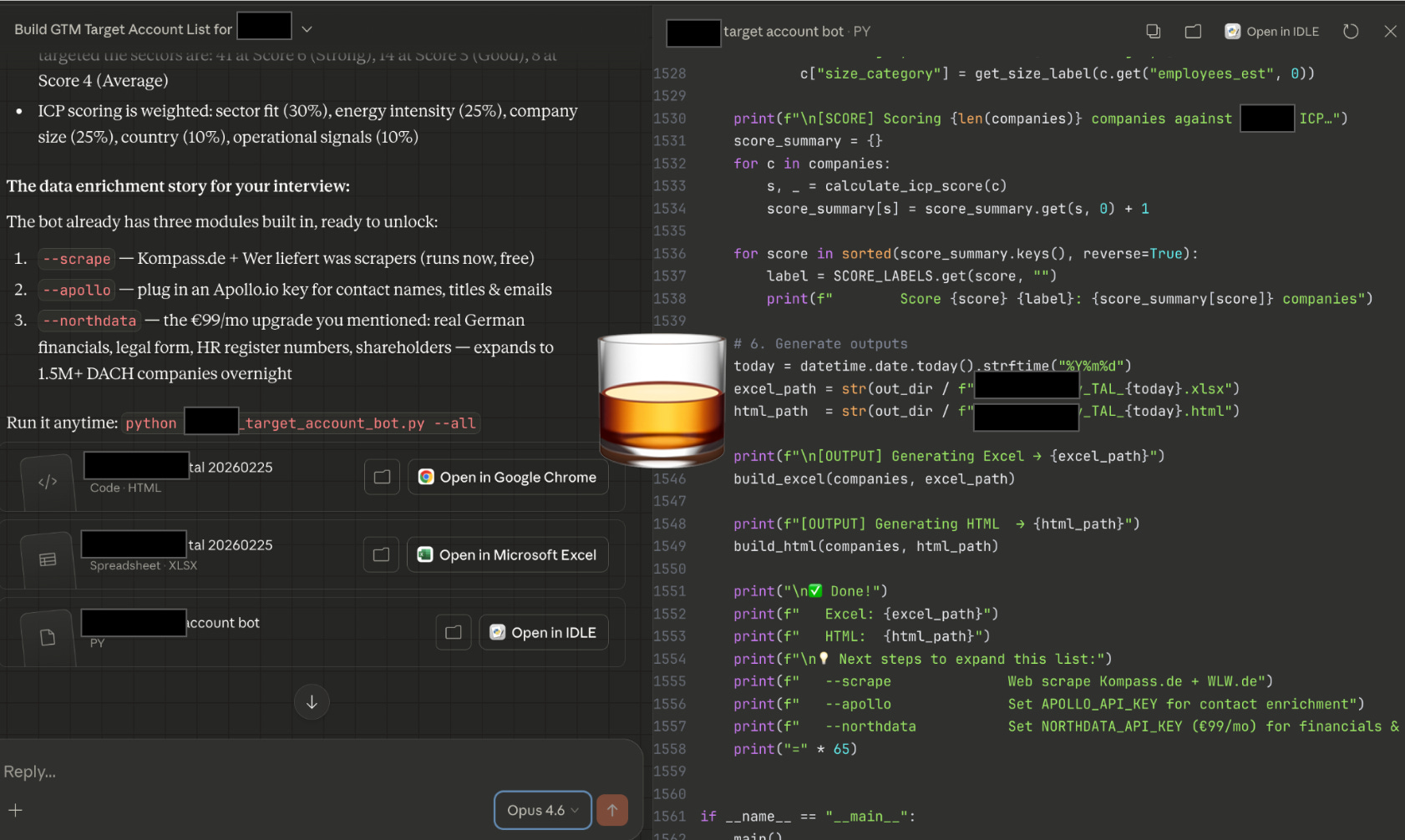
Upon comprehending that, I had to pour myself a whisky, not out of self-congratulation, but because if the rate of progress continues, I won’t be doing this work in 24 months’ time, because anyone will be able to.
But I don’t mourn the past for a moment. When I think back to how I used to have to first source, then piece together data sources, write multiple formulas in Excel before uploading everything into Salesforce — a piece of SaaS so catastrophically bad it has measurably shortened my life — a cold shiver runs down my spine.
Pouring a second whisky (YOLO), I then thought back to my time as a graduate consultant at EY — the 10pm finishes, the benchmarking reports I built that nobody acted on, the reformatted PowerPoint decks, the obnoxious Director hell-bent on making Partner, keeping everyone in the office late to “demonstrate value to the client”. That world could soon also be gone, and good riddance when it is.
Which is why I find myself in alignment with Shumer’s central argument: knowledge workers do have agency. The tools exist, and once you actually sit down with them — not just dabble with a prompt here and there, but really use them — their value is mind-blowing.
AI has jolted us into self learning at an accelerated speed, and is pulling us out of our comfort zone to the point where we might be doing things every day that genuinely scare us — tasks we’ve never attempted before, capabilities we’ve haven’t called in a long time.

This is a new condition of modern knowledge work. Do we now live in a more Darwinian world than before? Yes, probably. The theory of natural selection is often overused, but adapt or get left behind feels true here.
The fear of becoming obsolete is, in the end, a fear of being replaced, becoming redundant, being put out to pasture. But the etymology of the word — from obsoletus in Latin — means something subtly different: growing old through disuse.
Many of us are feeling out of breath. Every other month, another significant leap forward arrives giving us new possibilities that didn’t exist before. Our adaptation muscles are being asked to work harder, for longer, than feels sustainable. Which is, if you think about it, a training problem more than a technology problem. The lesson is about building endurance and — just as importantly — the judgment to pace yourself, so you don’t blow up in the first mile of what looks increasingly like an ultramarathon of skills acquisition.
The other lesson is simpler: filter out the speculative noise. The narrative scenarios will keep coming. The market will keep overreacting. The self-help industrial complex will keep trying to sell you stuff, and not much of it will be that useful. In the meantime, we can just work the problems closer to hand. After all, we all have a genius in a data centre sat next to us now.
No posts
Comments
Nothing yet. Say the first thing.
Sign in to join the conversation.