
This is mistake a lot of people make - I’ve done it too, more than once. I want to make a digital product, have a lot to share, want to help people. Start the outline for how to achieve result x in z time frame. Get it started. Then remember all the OTHER bits that would be useful for my client so start adding more modules and bits and pieces in. Before I know, I’m making a twenty-module course, the comprehensive system, the thing that finally captures everything I know.
It feels like the responsible choice, doesn’t it? If you’re going to charge someone money, so surely it should be for something substantial.
The scope keeps growing, because there’s always one more thing worth including, one more chapter that ties it all together, one more ‘but I should really also cover..’ But before anything gets finished, the overwhelm sets in, momentum - which was never infinite to begin with - runs out and nothing (in my case at least) gets done. It’s too much. And also, who has time to study 20 module course if they just want to fix one problem? Not many people, including myself. The 3 last digital products I’ve bought myself have all been small and solved one small problem for me.
So the instinct to go big or go home is backwards. Not just for your first digital product, for most of them. A finished, small, imperfect product will teach you more in a weekend than a perfect plan teaches you in a year, because a finished product actually gets seen by real people. And real people can tell you whole lot of things a plan never can, like what they wanted, what confused them, what they’d have paid more for.
Test your product by asking yourself a few simple questions. If it’s your first ever, it should solve one problem for one specific person. It does not need to fix anyone’s whole business or a whole big topic, and you do not even need to include most of what you know about the topic - just pick one problem to solve, and you are done. Sounds obvious written down like that, but it’s so easy to slip to the ‘I’ll include this one more thing’. Here’s how to stress-test an idea before it gets carried away:
Can you say what it does in one sentence, no “and” in it?
Could you actually finish it, or most of it, in a weekend, not a quarter?
Would one specific person - someone you could name right now, pay for it today?
If you answered no to any of those, your idea isn’t wrong. It’s just not specific enough or doesnd’t solve a problem people want to pay for. Start small and expand it later.
Why does feel like a better idea to go big? I don’t think this is about anyone’s ambition. Most people I talk to who keep expanding their first idea aren’t trying to make something impressive- they’re avoiding the moment the small, finished thing goes out into the world and someone actually sees it. It is also harder to make a very well refined product than cover everything just in case. Takes more thinking and cutting back.
Bigger also feels safer, because it postpones the scary bit of having to go to the world with your product. The visibility anxiety. But waiting doesn’t make the scary bit smaller. Doing it once, on a small scale, does - because you find out the thing you were dreading mostly didn’t happen.
You’re also not starting from nothing here. Whatever you did before, whatever you have been doing and getting good at over years you never thought of as “content” - that’s your raw material. This isn’t about becoming someone new but about pointing what you already know at one small, sellable thing.
Write down the one problem you are solving, for the one person, in one sentence ideally
Ask three people who fit that description whether they’d pay for a fix to that exact problem. Not ‘what do you think of my idea’ - just an yes or no
Set a deadline that isn’t ‘when it’s ready’. You need a date on the calendar. Something external, because internal deadlines are too movable
That third one is the reason I made the thing I’m about to tell you about. If you missed the post where I shared where digital products fit next to paid newsletters and the other ways to make money from what you know- you can find it here.
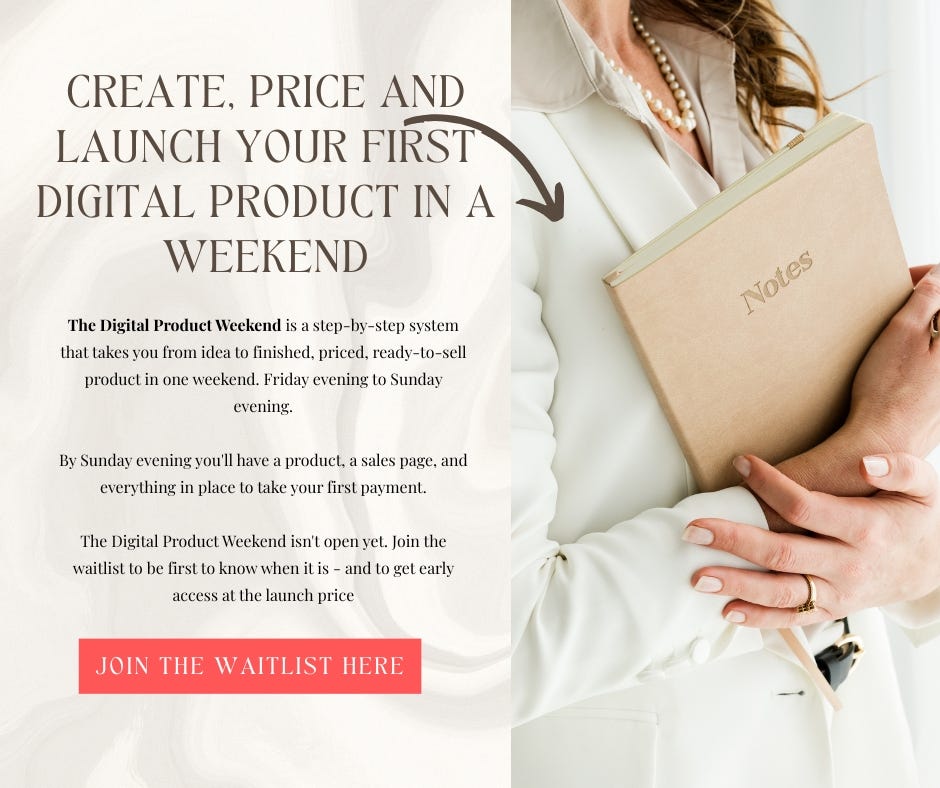
🎯 The Digital Product Weekend is opening its waitlist
I put together a system - Friday evening to Sunday night - that takes you from idea to finished, sellable product. Not a course you work through eventually. A weekend where most decisions are already made for you, so the only thing left is the doing. I'm currently finalising the content, and it's shaping up to be the most hands-on thing I've made yet - super focussed and includes just the exact steps to get you from idea to finished product. You don’t even need a product idea yet, either. Finding one is part of the weekend.
Join the waitlist before launch and you’ll get £100 off when doors open. No commitment now, just first access and the discount locked in.
If this is useful to you, the best thing you can do is reply and tell me your one-sentence idea or drop it in the comments below - your emails and messages often shapes what I write next!
More on this next week, including how to pick which type of product to make first if you’ve got more than one idea competing for the spot.
Susanna
📷 One more thing
If you want more of this in between newsletters, follow Your Second Act on Instagram for the half-formed ideas and the stuff that never makes it into a newsletter. It's the closest thing to watching over my shoulder - come say hello.
This went out to everyone on the free list. Paid subscribers get the deeper working sessions and the full build-alongs - if that’s useful to you, you can upgrade any time.
No posts
Comments
Nothing yet. Say the first thing.
Sign in to join the conversation.