
Welcome back, Class.
So, last edition we focused on the foundations of your money: payslips, budgets, debt, credit scores, emergency funds. I totally understand if it was a tad boring, the point is that it’s boring which is exactly why so many of us disengage with it until we find ourselves in a desperate situation and wish we paid attention.
If you snoozed or skipped the last session, you owe it to yourself to give it a little more time.
Today we are doing the slightly more interesting bit: how your money actually grows.
This is the lesson most people genuinely never get. Forty years of compulsory engagement with the financial system, and we were sent into it knowing more about Henry VIII’s wives than about pensions. Whoever decided that was the right curriculum, I would like a word (no hate to history class, it was actually one of my favourites and is still important, but so is learning about pensions).
A note before we start, because a lot of you are reading from outside the UK now and I do not want anyone bouncing thinking this is not for them. Most of what I write below is UK-specific because that is the system I actually understand. But the concepts are the same. Where it matters, I have put the closest equivalent for the US, Australia, and Canada as well so you can match it to your own system as you read.
By the end of this edition, you will understand:
Compound interest, properly. Why time can matter more than amount.
The full UK ISA system (and what it maps onto if you are not in the UK).
Pensions, properly. Workplace, State, and the self-managed kind.
Investing in plain English. What you are actually buying when you buy a stock or a fund.
The order in which to approach your money.
I am not a financial advisor. I work in the financial industry and have spent a lot of time educating myself on all of this, but nothing in this guide is personal financial advice. This is financial education so you can make informed decisions for yourself or know when to seek proper advice from someone qualified to give it.
All UK figures are current for the 2026/27 UK tax year. International figures are the most current I could verify. The rules can change.
Investments can fall in value as well as rise. Past performance is not a guarantee of future returns. The bits of this guide that talk about historical stock market returns are based on long-run data.
Right! Class is in session.
Compound interest is the single most powerful force in personal finance. People nod at it like they understand it and then make decisions that show they do not.
Compound interest is interest earned on the interest you have already earned. Your money grows on a curve, not a line. The longer you leave it, the more it earns, and the more there is to earn on, and the steeper the curve gets. By the end of a long time horizon, the curve looks almost vertical.
Here is the example that might actually seem quite shocking at just how fabulous compound interest is - depending on how you look at it.
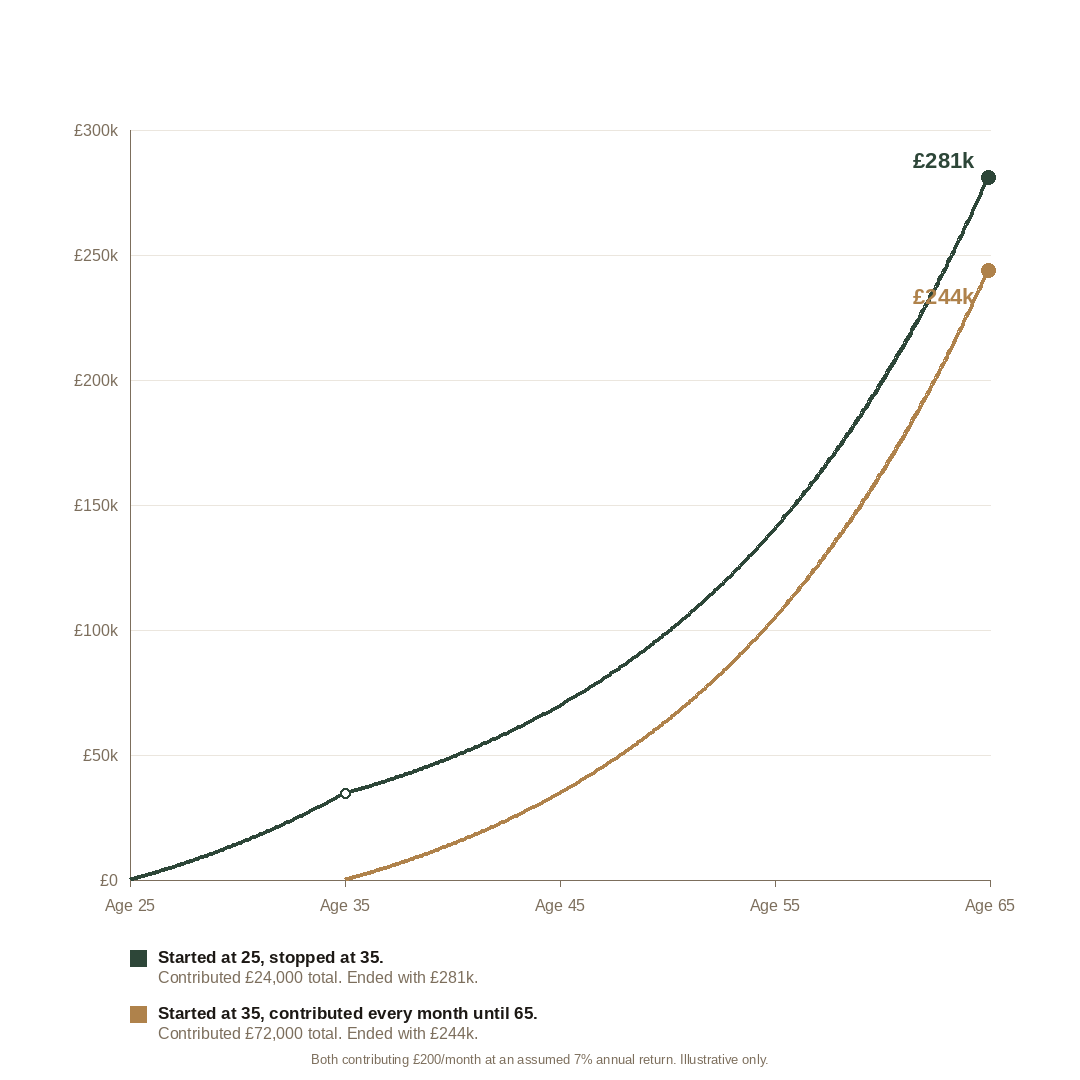
Two people, both putting £200 a month into an investment account, both earning a long-run average return of 7% a year. (This is roughly the long-term historical return on a globally diversified equity fund. The MSCI World Index has averaged around 7% per year since 1970. Past performance is not guaranteed and forward-looking returns may be lower. But we use past returns to understand how a fund has performed and could perform).
Person A starts at 25 and stops at 35. They contribute £24,000 over ten years and then never add another penny.
Person B starts at 35 and contributes £200 a month every month until they are 65. They contribute £72,000 over thirty years.
By the time both are 65, Person A, who contributed a third of what Person B did, ends up with around £281,000. Person B ends up with around £244,000.
Person A is £37,000 richer despite having put in £48,000 less, because they had ten extra years of their money compounding before they stopped.
Time is doing more work than money in this equation. The most expensive thing about not investing in your twenties is not the money you fail to put in. It is the years of compounding you fail to start.
This is why every personal finance person on the internet keeps banging on about starting early. We are not nagging, we are showing you the maths.
If you are reading this and thinking I am 38 and I have not started, I have already lost, you have not. You still have the rest of your life to compound. The lesson of the maths is not “you missed the boat.” The lesson is “the boat is leaving every minute, get on it now rather than next year.” *
This week’s homework
Sit with the example above for a minute. Properly. Not “I’ll think about this later.” Now. The point of this lesson is for the maths to stop being theoretical.
Find a compound interest calculator (I recommend this one). Plug in your own numbers.
Decide on one number, even a small one, that you can put away every month from now on. £25, £50, £100. Whatever does not panic you. The number is less important than the habit.
*I know that can make you feel like you need to jump on investing, but please ensure you have an emergency fund first. Pick up my free guide here to learn more about this. THIS is the first step before investing.
Everything else in this guide is for paid subscribers. I keep the free essays free because I want them to be widely shared, and the paid content paywalled because that's what makes it possible for me to keep writing the way I do, properly, with research and time. If you've found Lesson 1 worth your time, the next four lessons cover ISAs, pensions, investing, and the order you should approach your money. Subscribing unlocks the rest of this guide, the rest of the paid archive, and Part 3 about how to retire early when it lands next week. A paid subscription also means you get access to tools I create for a fraction of the price, or even for free.
Comments
Nothing yet. Say the first thing.
Sign in to join the conversation.