
Our kids are headed back to school, and in California, more will get there on e-bikes than ever before. Our state leads the nation in e-bike uptake, with over 96,000 e-bikes purchased in 2025.
For public health, the e-bike boom is a healthy trend. But the question of how to protect young riders is still up in the air, and is a matter of public debate. Here’s how I’m making sense of it all.
Yes—but with a ray of hope I’ll describe later. With increased e-bike use we’re seeing more e-bike related injuries. In 2018 California Highway Patrol logged just two e-bike crashes, compared to 1,506 in 2024. Hospitals across the state are seeing more e-bike injuries, including Rady Children’s Health in Orange County.
Policy scramble: Here’s the challenge. E-bikes really hit the market around the start of the pandemic, before regulation, safety standards, or basic data collection could keep up. The past four or so years have seen a rush to catch up on two fronts—measuring the problem, and legislating around it. I’ve had a front row seat to both of those issues.
An e-bike microcosm for the state. Marin County, where I was health officer, ended up in the middle of that scramble. Even by California standards, our community adopted e-bikes early, making us a canary in the e-bike coal mine.
In 2023, I remember the first signal came from our ED doctors, who were seeing people in bike crashes with injuries they’d expect from motorcycle accidents—pelvis and femur fractures, internal organ damage.
To really understand the local problem, Marin Public Health built a bicycle safety dashboard, pulling live ambulance data to track crashes by bike type, age, and outcome. We weren’t collecting data for long before a pattern emerged. In fall 2024, after 50 days of tracking 911 responses, we found that school-aged kids aged 10-19 had a 5 times higher rate of e-bike accidents than any other age group. We were shocked, and issued a local public health
The extra risk young people face has defined the e-bike problem in California. The immediate response has understandably been a call for solutions. But, when we look more closely, the picture gets complicated. “E-bike” is a catch-all for several different vehicles—and it matters which we’re talking about when we consider policy.
Here are the classes of e-bikes sold in California, and their main features. From Class 1 to e-motos they get further from a regular pedal bike in look, function, and power.
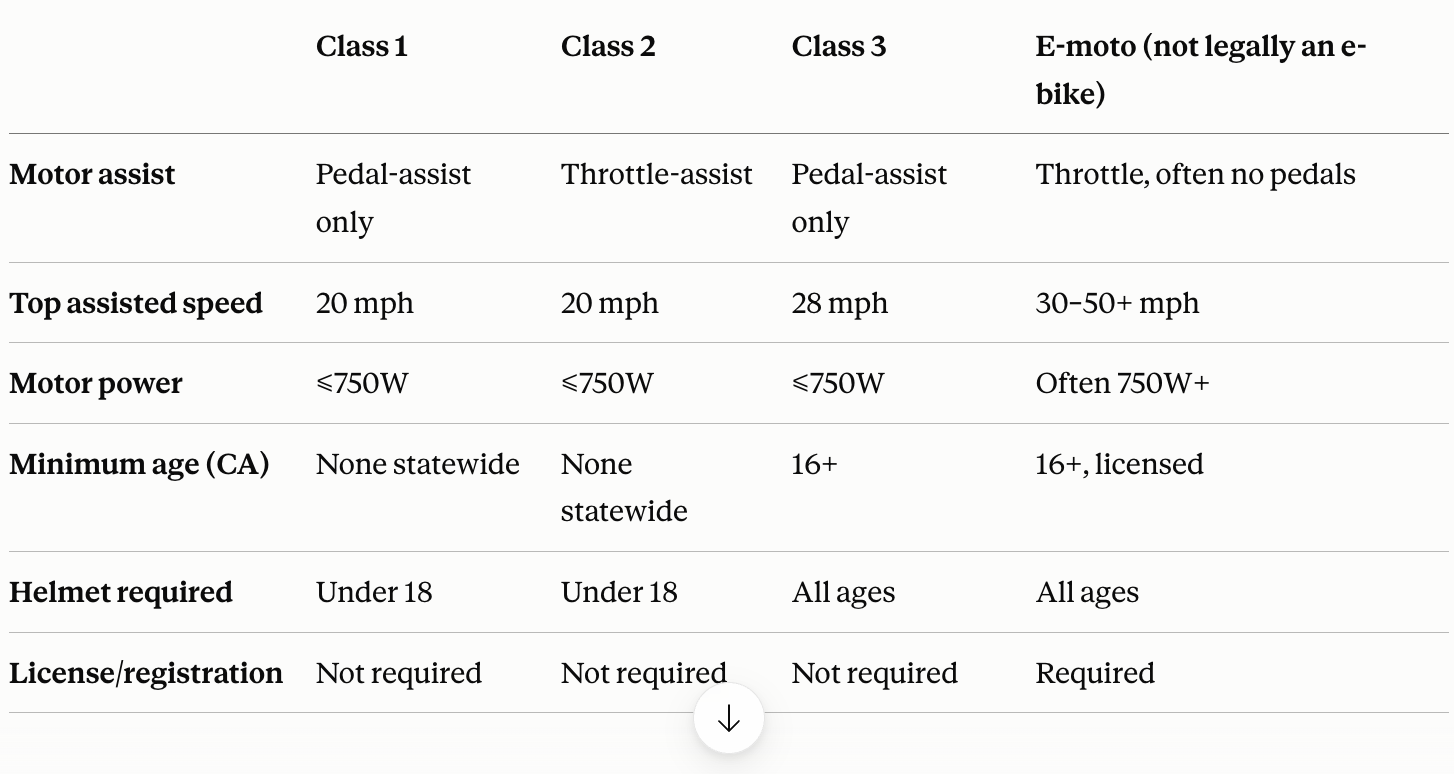
Early e-bike policy results in California. Ultimately Marin became a “laboratory” to assess the impact of a policy solution, as a one-county pilot. In 2024 state Assembly Bill 1778 authorized Marin to limit e-bike use for riders under 16 to Class 1 e-bikes—the pedal style e-bikes most like an ordinary bicycle—and bar them from Class 2 throttle models. (Class 3 and e-motos were already illegal for people under age 16.) This was the state’s first law to place new age restrictions on e-bike use.
Results at one year. AB 1778 went into effect in July 2025, so we just got the first year’s results last week. Preliminary data are promising: the youth e-bike injury rate dropped from 16 to 12 per 10,000 county residents in the year after the ordinance took effect. It’s not proof of a sustained trend, but it’s a real signal. Helmet use among accident victims also increased from 77% to 90% during the same interval.
It’s hard to tease out the factors behind declining e-bike accidents in Marin but the Mineta Transportation Institute 2025 report offers some insights. They found that e-motos—illegal, over-powered devices—are a key driver of California’s e-bike safety problem.
A 2024 count of e-bikes parked at Marin and San Mateo County middle schools found that nearly 9 in 10 were illegal e-bikes or e-motos. Decreasing e-moto use under AB 1778 could help explain a reduction in 911-level e-bike accidents, because they are heavier, faster, and more risky.
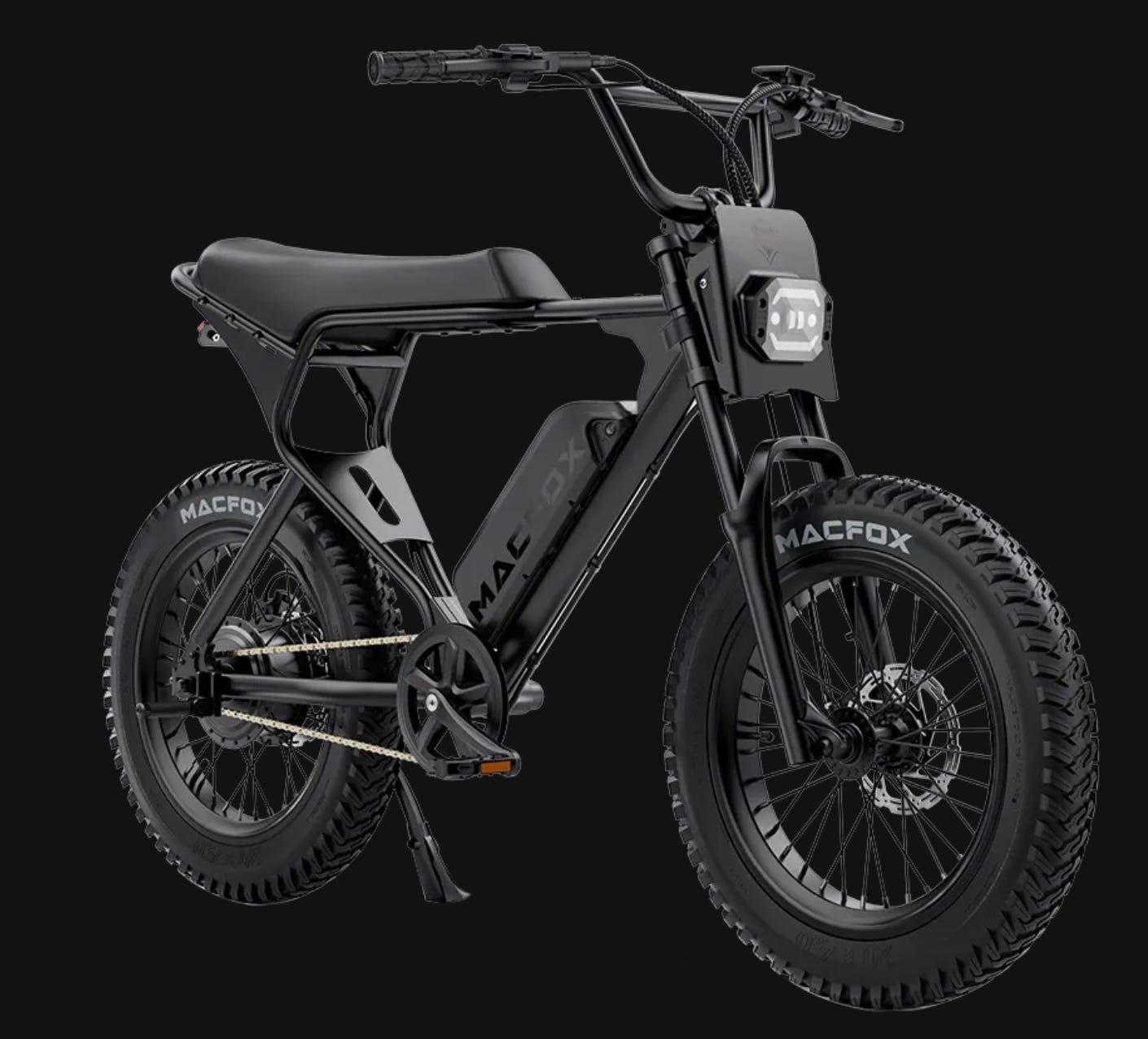
E-motos aren’t bikes at all. Most have no pedals and have top speeds of 30-50+ mph, putting them closer to a motorcycle than anything a kid should be riding to school. Legally, an e-moto rider needs to be 16 with a valid license, registration, and insurance. But almost none of that gets enforced, and e-motos are sold, gifted, and ridden as if they’re just a faster bike. They read as e-bikes, and are popular with middle schoolers.
Typical e-moto
Speed matters. Injuries that happen above 20 mph—the ceiling for Class 1 e-bikes—are far more severe than those below it: a study of 15,121 pediatric e-bike injury patients found that half of higher speed accidents involve head, neck, or facial trauma versus 29% for slower crashes, and internal organ injuries occur at more than double the rate. At 30 to 50+ mph, e-motos routinely travel way above the threshold where injury severity doubles. The same study found 79.7% of e-bike accidents involved a male rider.
Gaining focus. We’re seeing a picture emerge, a risk profile, for common e-bike accident scenarios in California. This lends focus to our policy direction. Limiting access to e-motos, encouraging Class 1 e-bikes, enforcing helmet laws, and providing education on rules of the road will go a long way. And making sure our boys are paying special attention.
Here are some tips for families considering an e-bike:
Get informed. Parents and teens should take time to understand the different classes of e-bikes and the laws in their community. And remember e-motos are unsafe and illegal for anyone under age 16.
Consider taking a class. Many law enforcement agencies in California now offer hands-on e-bike safety courses specifically for teens. The California Highway Patrol has a great on line training.
Wear a helmet. A properly fitted and buckled helmet is one of the best ways to reduce the risk of head injury.
Think about age. Most pediatric groups agree that children under 12 should not be riding e-bikes due to speed, size, and handling challenges.
Do not modify e-bikes. Altering an e-bike can increase speed to unsafe levels and change how it is classified under the law.
Choose your route. Stick to physically protected bike lanes when possible, especially for beginners. Painted lanes on busy streets require more experience, and sidewalks aren't a safer alternative.
Sidebar: It’s not just about the bike. A safe ride to school depends on more than being on the right bike— we need safe routes, drivers who can share the road, help at key intersections, and a community that’s supportive. That’s culture change, and it takes time.
As e-bike use grows, the state’s Climate Action Plan for Transportation Infrastructure directs more than $5 billion a year to climate and safety goals, with safe bicycle and pedestrian networks as a priority.
Grassroots efforts like Safe Routes to School gives parents, schools, and local law enforcement a place to come together, share what they’re seeing, and push for the changes their community needs.
The path toward safer e-bike use for young people in California is getting clearer as we learn more about what’s driving accidents, who’s most impacted, and which policy solutions might work. It’s been rewarding to be part of that learning. We still have along way to go.
If I have any concerns about framing e-bike injuries as a public health crisis, it’s the shadow it may cast on biking itself. Getting more of us on bikes is a major public health win.
None of this is an argument against e-bikes. They’re cheaper than a car, way better for a kid’s health than a back seat, fun, and better for the environment.
As we get back to school, the message is still to try to get on a bike— in the right class, on friendly streets, at the right age, with a helmet. At least make sure it’s not actually a motorcycle.
Love,
Matt
P.S. Here are some popular California e-bike routes for longer rides. Maybe I’ll see you out there!
San Francisco Bay Trail: 500+ miles, Class 1 & 2 allowed on most sections.
American River Bike Trail: 32 miles, commonly Class 1 only.
The Strand (LA): 22-mile beach path, Class 1 & 2 (check specific city segments).
San Diego Bayshore Bikeway: 24 miles, most sections allow all classes.
Angels Camp/Arnold Trail: 12-mile rail-trail, local rules apply.
In case you missed it: Read my piece on wildfire smoke in this week’s YLE National.
Dr. Matt Willis is the author of Your Local Epidemiologist in California. A California native, he’s served as a primary care physician, CDC epidemiologist, and public health officer for Marin County, where he guided the pandemic response. He lives in Marin with his family and their dogs, Teddy and Ramona.
Comments
Nothing yet. Say the first thing.
Sign in to join the conversation.