
This post discusses suicide, self-harm, homicide, and severe postpartum mental illness. Please proceed with care. If you or someone you know is in immediate danger, call 911 or the 988 Suicide & Crisis Lifeline. Pregnant and postpartum people can also call or text the National Maternal Mental Health Hotline at 1-833-TLC-MAMA (1-833-852-6262) for free, confidential support 24/7.
Lindsay Clancy is on trial for killing her three small children. A jury will determine whether she was criminally responsible for her actions. But there is clearly another trial this country desperately needs to undergo: one of our postpartum (or, shall we say, entire) health system in the U.S.
As this trial unfolds, it’s clear that the even the most informed, most motivated patient cannot navigate a system this fragmented, underfunded, and unowned. It’s not designed to provide new mothers, and especially those experiencing serious mental illness, with continuous, coordinated care. And until we build a system that actually does, preventable crises and unthinkable tragedies will continue.
There are so many failures here we lost count, so I called Nikki Sapiro Vinckier—OBGYN PA-C and reproductive health educator—to help us walk through four that are on display, very loudly, here.
Some narratives within the case and in the general public surrounding this case continue to treat functioning and postpartum psychosis as mutually exclusive: if Clancy could run errands and hold it together in front of others, she must have been fine.
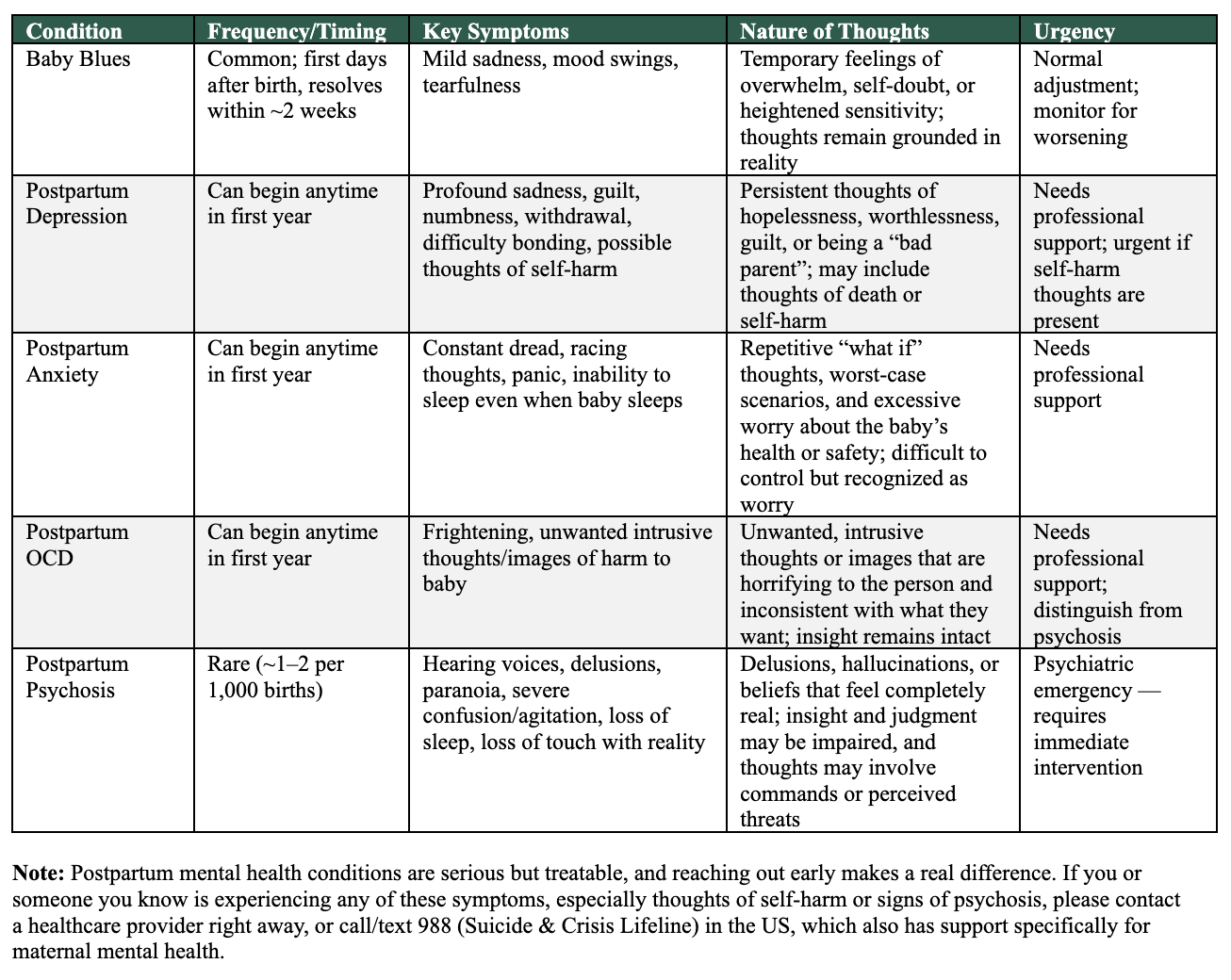
Postpartum psychosis, what Clancey had, is a psychiatric emergency. But it’s not the emergency people usually picture in their minds, like a heart attack. A mother can move from disorganized and incoherent to composed within the same day. Some women have arrived at appointments looking put-together while privately losing touch with reality: hearing voices, experiencing delusions or paranoia, or losing sleep beyond what’s required for caregiving, with judgment eroding.
Different types of “postpartum mental illness” look very different and require very different levels of care. While postpartum mental illness is talked about more now than in previous generations, the information voids are stark:
In the U.S., 70% of women say they wish they had known more about postpartum mental health before giving birth, with the number even higher among women of color.
A U.K. survey found that only 6% of pregnant women are given any information about postpartum psychosis at their antenatal classes, despite the condition affecting roughly the same number of families as Down syndrome does each year.
Clancy, a labor-and-delivery nurse, repeatedly sought help: a day program for postpartum depression, disclosed self-harm thoughts, inpatient care just 19 days before her children’s deaths, and ongoing psychiatric appointments, including one the day before. She was prescribed 13 psychiatric medications by multiple providers across settings.
Who was responsible for seeing the whole picture?
Our fragmented health system means that one doctor rarely knows what another doctor is doing or has done. No information is shared, including prescriptions, so a patient’s full picture is often lost. And because of this, people fall through the cracks.
In the U.S., all the responsibility lies on the patient. In other words, a mother is expected to recognize and monitor her own psychiatric state while sleep-deprived, still physically healing, and keeping a newborn alive. This is often when she is least able to carry the responsibility.
Postpartum psychosis is a psychiatric emergency with well-documented clinical evidence behind it, yet it still has no formal diagnosis of its own. It’s classified under other disorders using a “with peripartum onset” specifier, and without a diagnostic standard, there’s no screening tool either. In practice, postpartum care in the U.S. often amounts to a ten-question mental health screening, one that isn’t even universally required, leaving a condition this severe easy to misread or miss entirely.
This massive gap reflects how little research investment is directed toward women’s health as a whole. In fiscal year 2023, NIH categorized approximately $4.6 billion as funding for research on women’s health, roughly one-tenth of its nearly $45 billion biomedical research budget. And even that figure understates the problem: a Nature analysis found that conditions disproportionately affecting women, including migraine, endometriosis, and anxiety disorders, receive far less funding relative to the burden they cause. And female-dominant diseases are underfunded more severely than male-dominant ones are.
There are countless cracks in our postpartum care system that Clancy did not have to face. For so many other families, the surrounding landscape is even more fractured, believe it or not:
No paid maternity leave
Insurance coverage gaps, including limits on how long someone remains covered after giving birth
Medicaid cuts and hospital closures expanding maternity care deserts
A severe shortage of perinatal mental health specialists
Racial bias that leaves Black and Brown mothers less likely to be heard, believed, or adequately treated
Barriers in transportation, childcare, costs, language, and paid leave that make accessing care nearly impossible
Layered over every one of these failures is another: when the system breaks down, there is no clear line of accountability. It becomes a constant game of punting responsibility to someone else.
Real postpartum care doesn’t look like this. Mothers need multiple postpartum check-ins, urgent access to perinatal mental healthcare, communication between every clinician prescribing medication, and one provider responsible for coordinating the whole picture. This isn’t dramatic to expect. Many other countries have different versions of this:
The Netherlands sends a trained maternity nurse to the home daily for the first 8 to 10 days, covered by standard insurance.
The U.K. hands off care from midwife to health visitor to GP, with checkpoints at 10 to 14 days and 6 to 8 weeks, plus, since 2020, a separate mental health check for the mother.
The WHO recommends four postnatal contacts in six weeks.
We also need to normalize how common perinatal mood and anxiety disorders are. Depression, anxiety, rage, intrusive thoughts, and difficulty bonding don’t make someone a bad or dangerous parent. Removing the shame makes people more likely to name what they’re experiencing and ask for help before a crisis.
Many often call our postpartum health care system “broken,” but that suggests it was once built to work. The trial cannot answer the larger question of how a labor-and-delivery nurse repeatedly sought psychiatric help and still reached this point.
If we continue treating cases like this as isolated, unimaginable tragedies—without confronting the fragmented, underfunded postpartum system surrounding them—we leave the same conditions in place for the next mother and the next family.
Love, YLE and NSV
P.S. If you know somebody who is experiencing postpartum anxiety and depression, here’s where you can refer them to: https://postpartum.net/
Nikki Sapiro Vinckier, PA-C, is an OB/GYN Physician Assistant, author of We Deserve More, reproductive health advocate, and founder of Take Back Trust—a national platform offering tools and education to help people navigate reproductive care. With over a decade of clinical experience and a fast-growing digital presence, she works at the intersection of medicine, media, and movement.
Your Local Epidemiologist (YLE) comprises a team of experts, ranging from physicians to immunologists to epidemiologists to nutritionists, working together with one goal: to “translate” ever-evolving public health science so that people are well-equipped to make evidence-based decisions. The YLE suite of newsletters reaches over 475,000 people across more than 132 countries. This newsletter is free to everyone, thanks to the generous support of fellow YLE community members. To support the effort, subscribe or upgrade below:
Comments
Nothing yet. Say the first thing.
Sign in to join the conversation.