
This is a companion piece to last week’s post How to be an ARTIST when you’re taking a TRIP
A lot of you already go out into the world and draw—and if that’s you, you probably have a good idea of what art supplies to pack in your rucksack before you head on out the door … so you might just skim this post and look at the pictures.
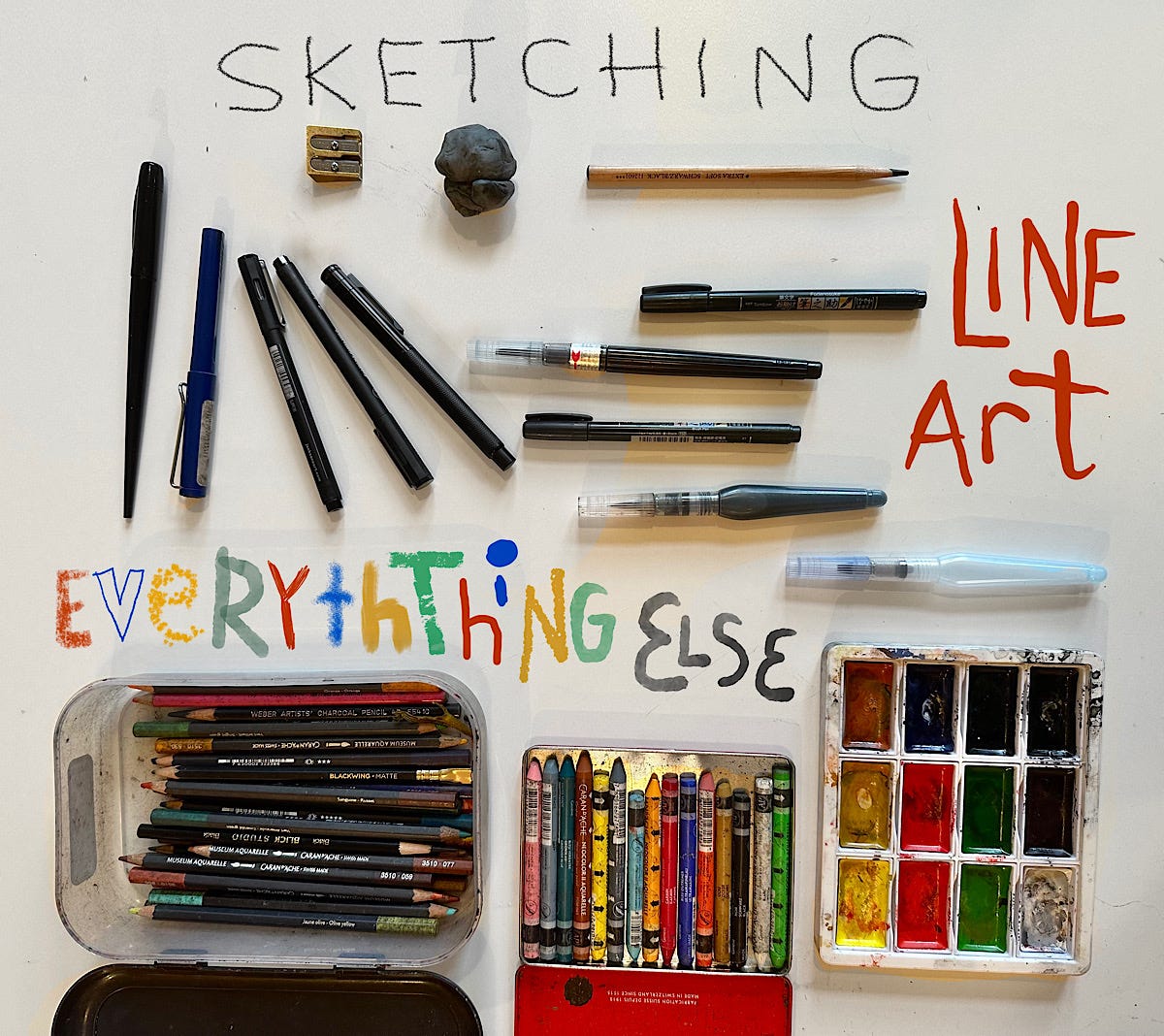
But if you’re like me, and you just started (or haven’t started yet) it might take a whole bunch of annoying trial and error to figure out what works. So I wrote this post and drew this picture (below) to give you a system. It’s a system that will help you skip some of that trial and error and get a head start on this drawing-out-in-the-world thing.
I think of making art away from home in three phases:
Sketching.
Line Art.
Everything Else.
And I’ve got special tools for each one of these phases.
The interesting thing is that every artist has their own unique relationship to each one of these phases: Sketching, Line Art. And Everything Else.
For instance, you might revel in all three, or concentrate on two or possibly even just focus on one. The trick for you is to know which of these phases you care most about so you can select what type of tools will work for YOU.
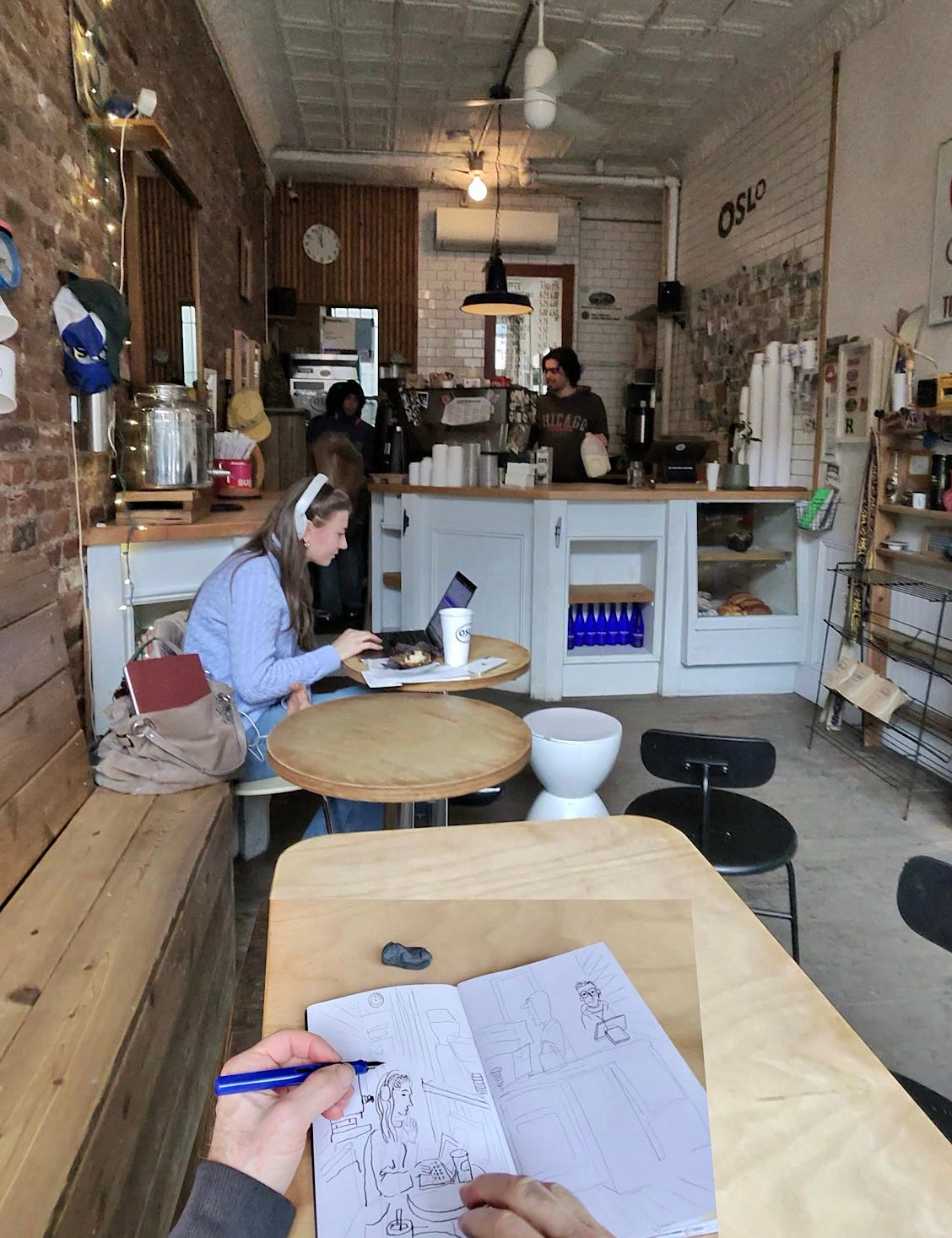
When I’m out making art IRL, I worry less about getting a perfect sketch down on the page and I think more about jumping right in and making the art. That’s why my sketching tools are nothing but a Pitt oil based pencil (I love the way it can be used not just for line but for deep rich shading) a sharpener to keep my Pitt pointed and a kneaded eraser to clean up my mistakes. FYI think of your eraser as the analog version of Command+z, a way to UNDO your mistakes.
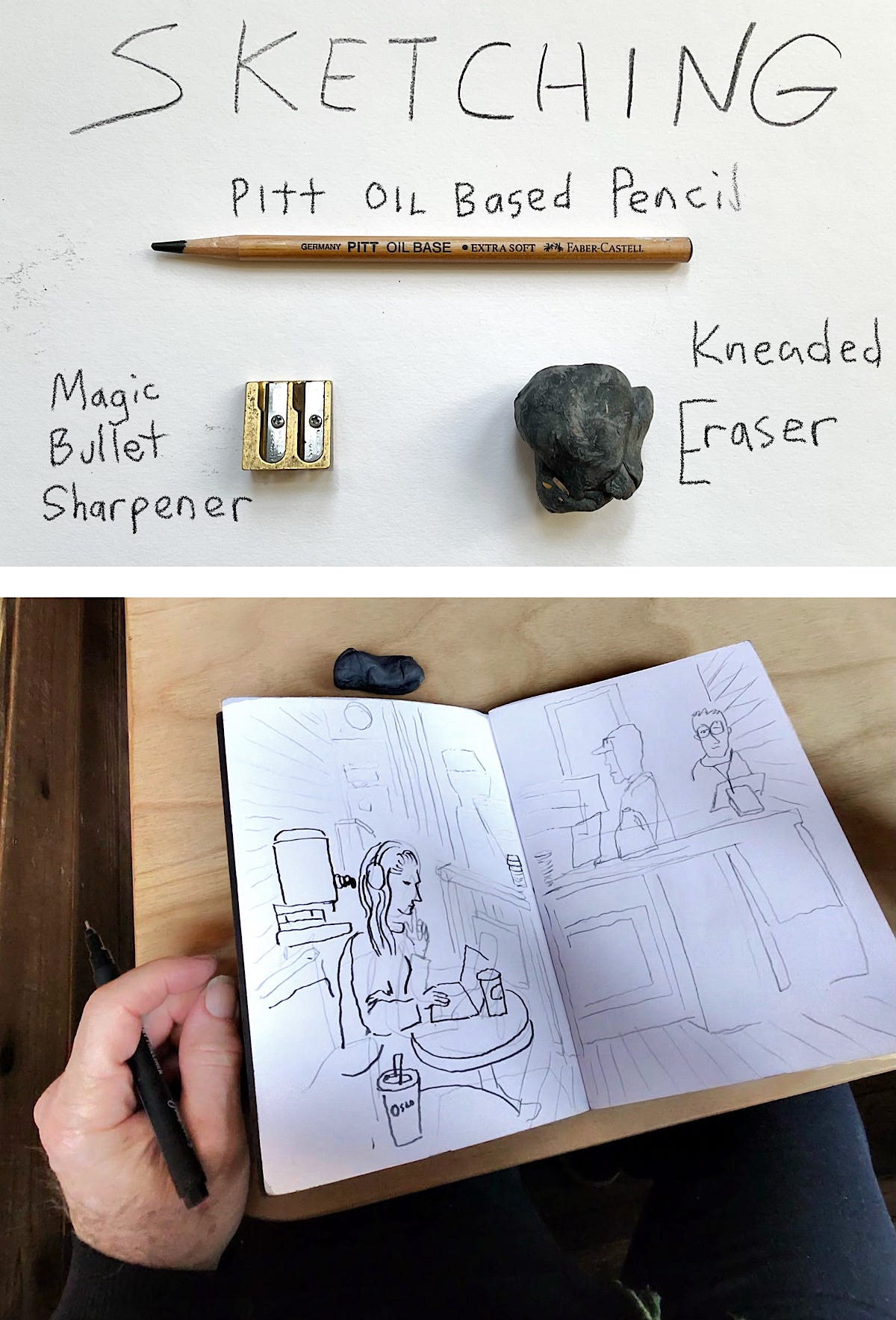
Now that we see the beginning of my process, let’s talk about you.
You might be like me, a mostly quick-sketcher, in which case you can just pick a couple of your favorite pencils and a command+z eraser.
But if for you, the sketch is important — either because you spend a lot of time on your sketch before committing or because sketching IS your art — you might want a larger variety of sketching tools. Those might include charcoal sticks, a blending stump, a mechanical pencil for thin lines — a 2H pencil for preliminary lines and a 6B for darker shading and so on, but of course that’s for you to decide.
Take me. After my typically hurried sketching phase I love to jump in and draw lines and more lines and more lines. I love lines and I love variation in my lines so I want to be able to make a gazillion types of lines—from thick to thin and from precise to loose— which is why I have a lot of pens and brushes in my art kit. The cool thing is that pens and brushes don’t take up a lot of space.
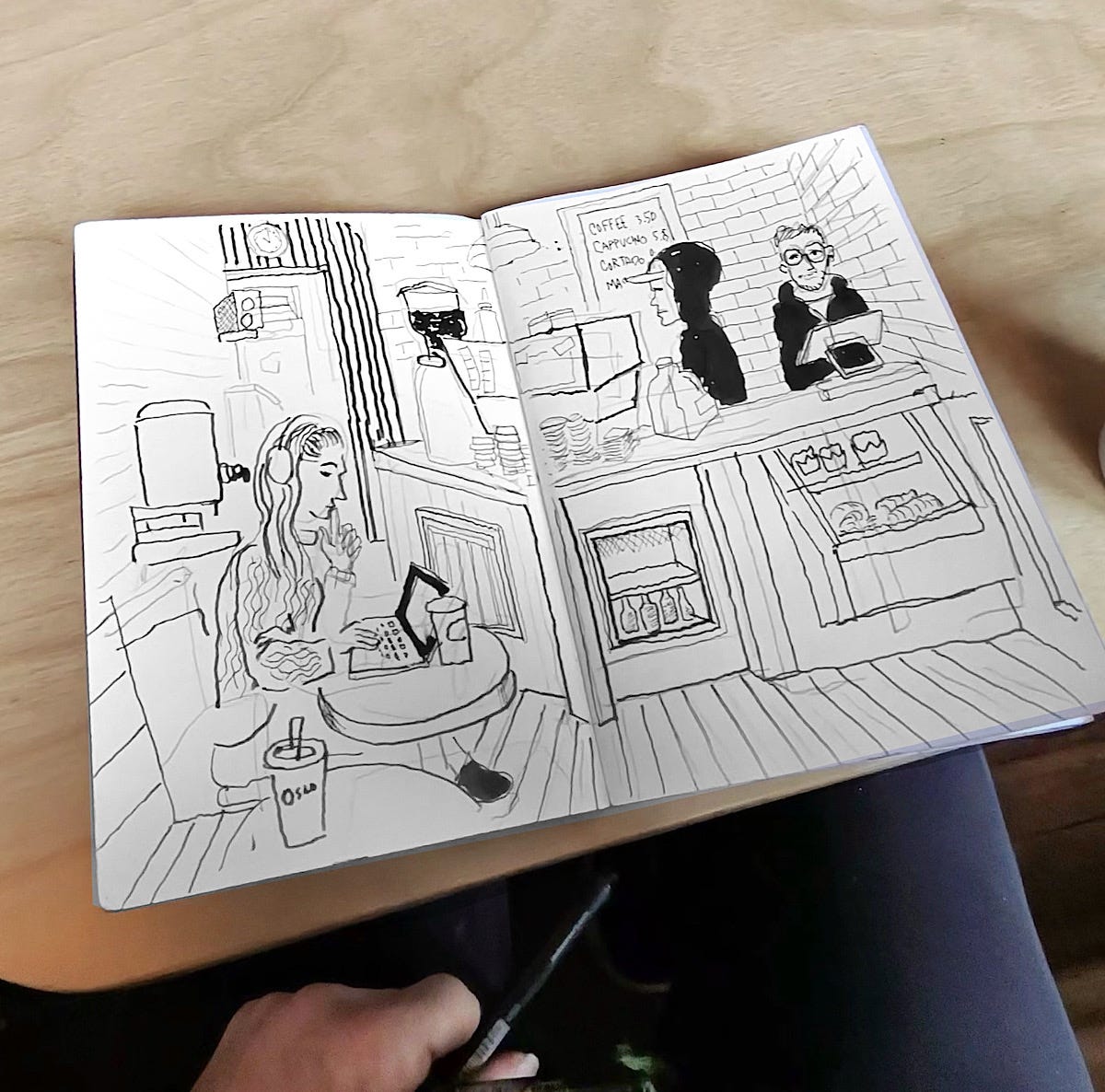
I have three type of line art pens and brushes in my art kit.
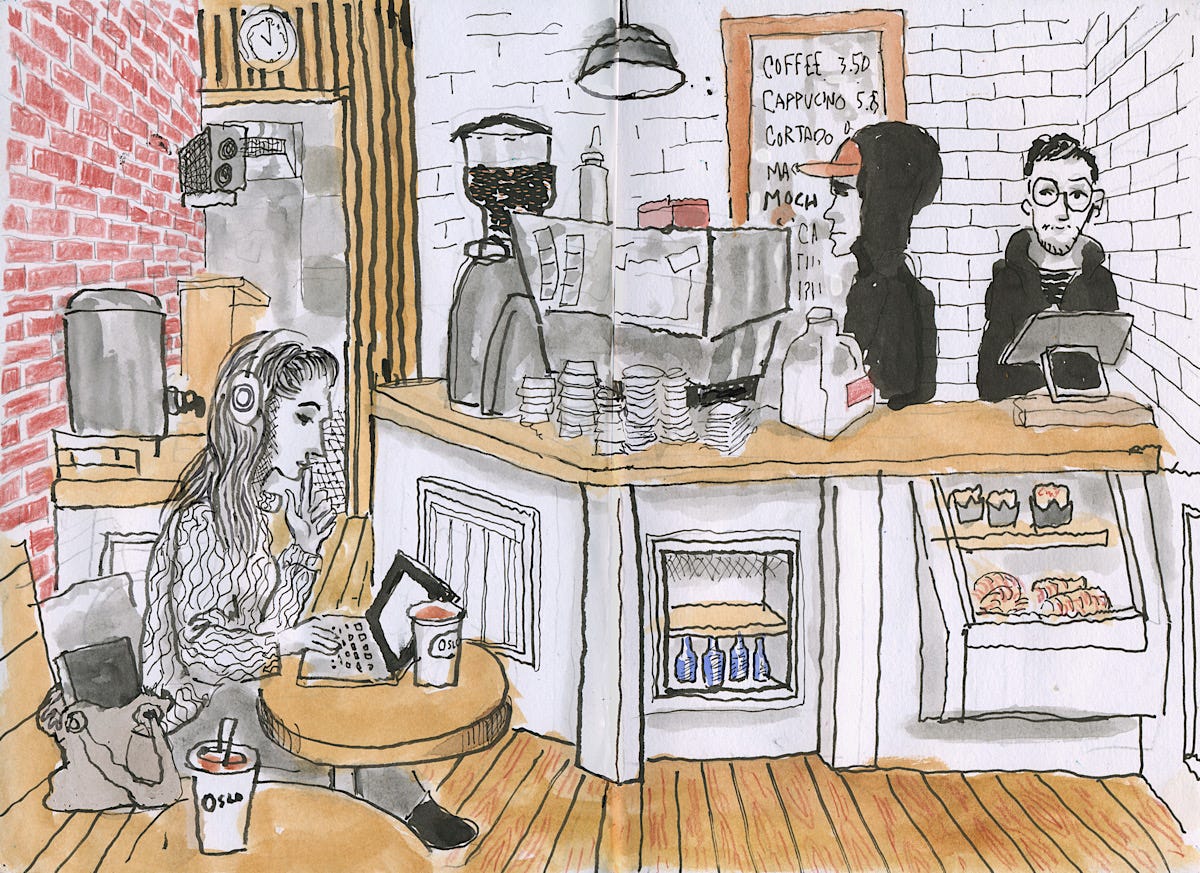
Fixed width pens: Sometimes you want a consistent width line to create a rhythmic visual pattern. It might be the big fat lines I used on the woodwork or the little bitty lines I used for the coffee cup lids in front of the espresso machine
Variable width pens and brushes: There’s something so expressive and alive about a line that varies from thick to thin which is why I used it on the woman on her computer.
Solid Black Brushes: If I have a lot of line work in my drawing I always try to relieve it with patches of black so I have brush pens that I use to fill in solid blacks with a bit of style. I used them here on the hoodies on the two guys behind the counter and the computer.
Down below I’ll get specific with some of the pens and brush pens I use, but of course they are just a guide. See additional notes in the caption.
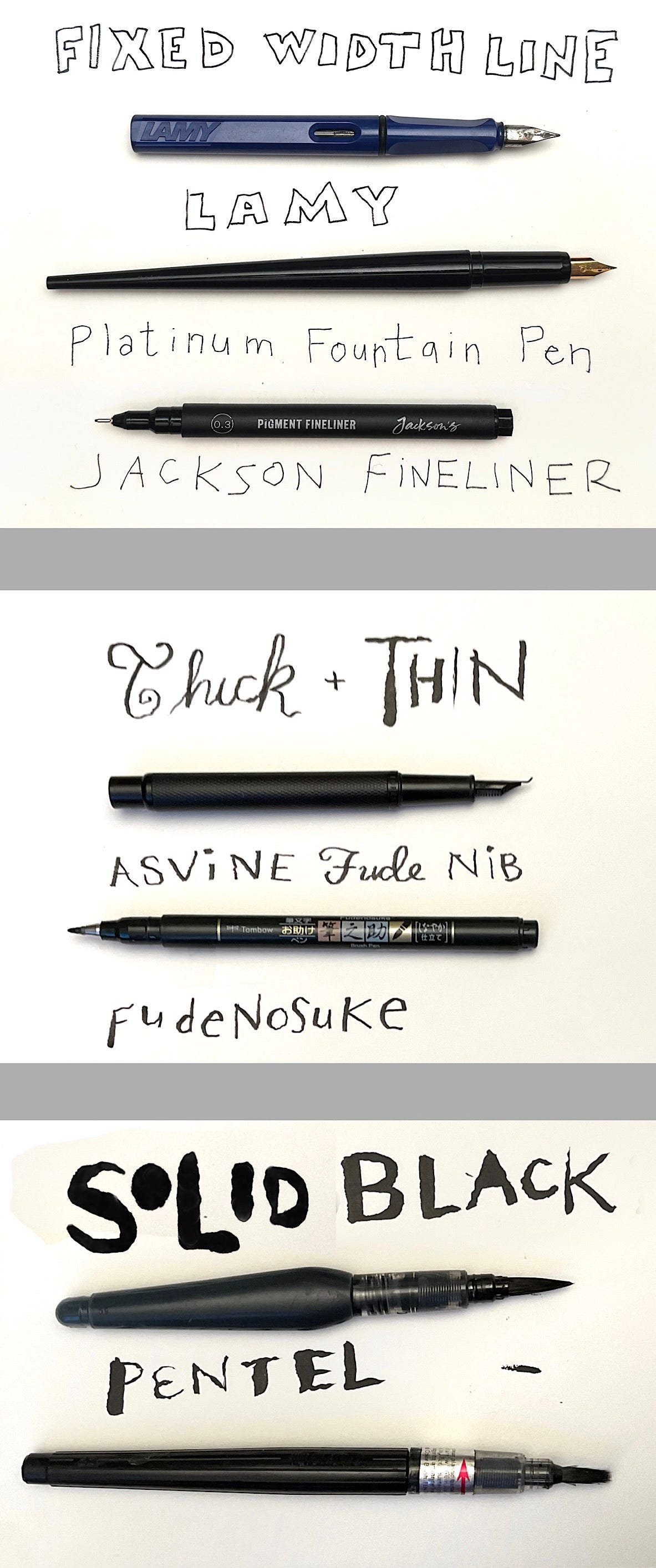
One last note on pens and brushes. If you’re using wet media on top of your line art and you don’t want your lines to run, use waterproof inks. In other words, if you buy a pen find out if its ink is waterproof or water soluble. I repurposed my LAMY pen with a cartridge to use the ink of my choice and I took apart that that Pentel Pigment Ink Brush to fill it with waterproof ink. (It was a pain but I love that brush). Top waterproof inks for fountain pens are Platinum Carbon Black and Sailor Kiwa-Guro. [PS: I learned a lot about these pen choices from Jabari and Samantha Dion Baker PPS: I learned a lot from them because when I saw work of theirs that I liked I asked them about the tools they used. Dear Substacker, don't be afraid to ask questions!]
Ok. Enough about my pens and brushes. Now let’s talk about you and your line art. If you love lines, like I do, you probably have your own set of favorite pens and brushes and of course, you could experiment with some of mine too. If on the other hand you are more of a pencil person or a painter or a water colorist or whatever, you might prefer to keep it simple with just a couple of pens.
The next phase of art is about everything else — paints, watercolors, colored pencils, crayons, pastels, markers, etc. These are the freest and most expressive art tools and mediums with the maximum range of effects that you use to add color, lighting, shading, patterns and textures to your art.
Sometimes I just draw line art and — bang! — I’m done. And sometimes I use watercolor or pencils or whatever to add color, texture, patterns, shading and more. To be truthful when I start drawing an image, sometimes I’m not sure what I’m going to do, so to be safe I usually bring my Everything Else tools with me.
With the drawing I did in the cafe OSLO, I didn’t get too fancy as far as Everything Else tools. I photographed the drawing in stages so you could see my progress.
TOP: I used water colors (yellow ochre and burnt sienna mixture) on all the woodwork to unify the drawing. MIDDLE: I used a wash of black to add shadows and reflections. BOTTOM: I used a colored pencil to indicate the bricks on the left and to add a few details like the wood grain in the floor and the croissants in the display case.
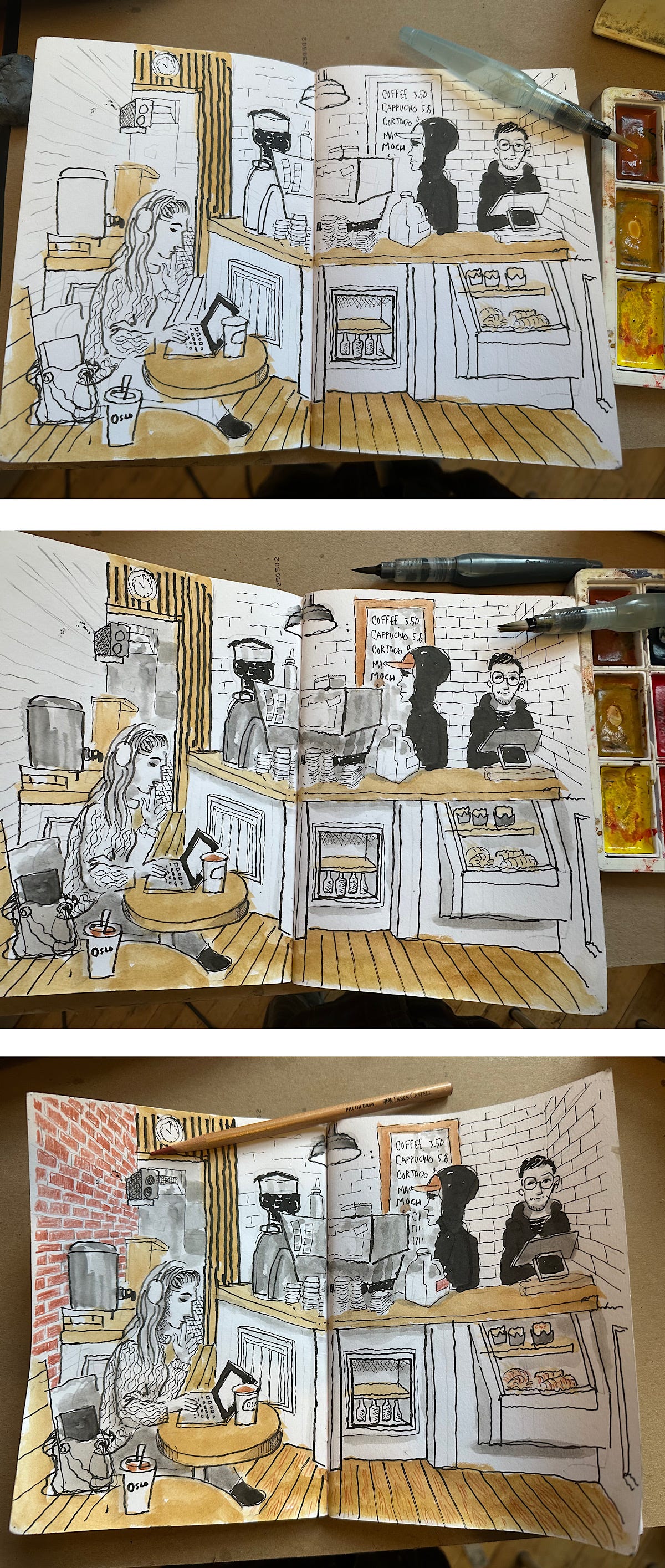
And that was it!
There are a million Everything Else tools so I can’t cover them all, but I can get specific with the tools I use. Just like with the sketching tools and the line art tools these are just a guide. Surely you will choose your own favorites. [See additional notes in the caption.]
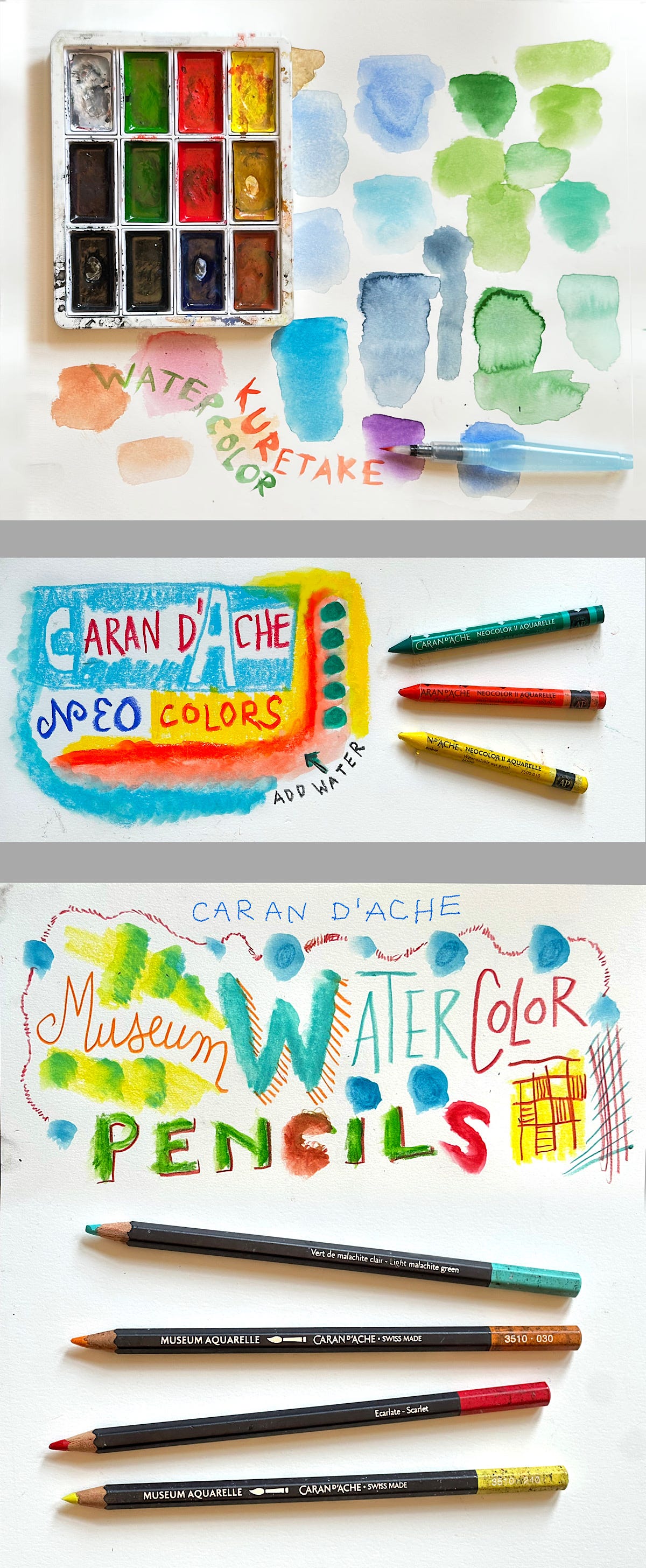
I tend to fall in and out of love with my Everything Else tools — adding some new ones in and rotating some old ones out — because it’s nice to change them up every once in a while. And of course I don’t use everything in every drawing.
My kit is just my kit. So, what about you? If you are a straight sketcher or mostly a line artist you might not even use any of these Everything Else tools. But if you want to use them, just pick the ones that you like (gouache, pastel or whatever) that are also relatively portable and then see what happens.
Wouldn’t it be great if you could always travel with a donkey named ‘Vincent Van Donk’ who you could load up with saddle bags stuffed full with all your art supplies?
I don’t know about you but I don’t own a donkey so I have to carry all my own art supplies in my bag.
A draw-the-world artist has two pain points: “This bag is too heavy,” and “Now that I see those geese on the riverbank I wish I had brought my Goose-turd Green pastel stick with me.”
You get what I’m saying?
How much is too much? And how much is too little? You’ll have to figure that out for yourself. I have a modular set up so if I know I’m only doing line art for instance, I might leave my Everything Else stuff behind.
Comment away if there’s anything that you want to know … or if you would like to share what cool tools are in your kit.
And that’s the end of this rather longish post my friends.
I hope this was useful to you and …
Good luck with your ART KIT!
Josh
A note to everyone: I’ve been doing this Substack for almost a year, giving away almost everything for free. I wish I could do that forever because I’m more or less an anarchist, so I’ll continue sharing most stuff for free while also adding some super special features for paid subscribers… such as a art goodness bonus article I’ll post in a few days for those curious about what SKETCHBOOKS I use on the road and how I choose them.
#Drawing
#Sketching
Comments
Nothing yet. Say the first thing.
Sign in to join the conversation.