
I am pleased to announce that Jerusalem Letters will begin carrying essays on public affairs by friends who are involved in various aspects of my work. The first guest essay is by Gita Hazani-Melchior, a well-known columnist on the Israeli political right who is also my colleague at the Herzl Institute in Jerusalem. This essay, translated from the Hebrew, was first published in Olam Katan on July 24, 2026. —Ed.
Although the United States has resumed military action against Iran, and Israel may well join forces with the Americans again, the waves of anger and criticism—together with feelings of betrayal—that have flooded Israeli public discourse over the administration’s bewildering policy reversal on Iran have not abated. Many Israelis continue to feel that our national interests and our honor have been abandoned, and that our country has been thoroughly humiliated.
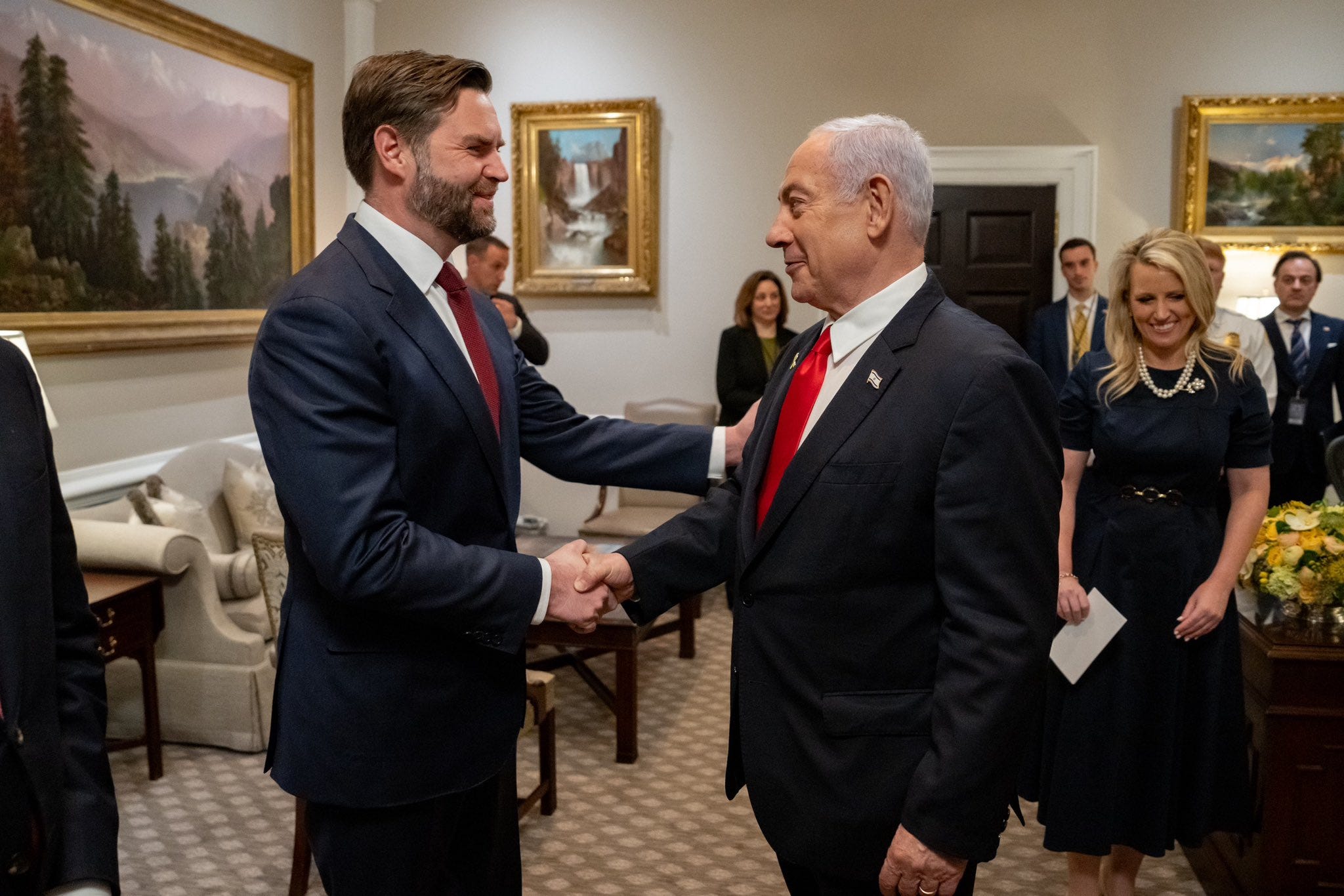
Vice President J.D. Vance, already identified more than any other figure in the administration with a foreign policy perceived as diminishing and humiliating both Israel and the United States, has drawn even more fire in recent days following his controversial interview on Joe Rogan’s podcast on July 15, 2026. His responses to the host’s speculative, provocative questions about the war, foreign affairs, and conspiracy theories surrounding the Epstein files were interpreted by conservative leaders and commentators in Israel as evidence of anti-Semitism and of the erosion of the familiar, comfortable paradigm that long governed U.S.-Israel relations.
Yet that paradigm itself has for a very long time been one of childish dependence on the United States—one in which American presidents and high-ranking officials would shower us with eloquent declarations of their love and support for Israel’s right to exist, while at the same time systematically curtailing Israeli settlement growth and arms supplies, even as they advocated for the idea of a Palestinian state directly from the White House lawn.
For this reason, I would like to challenge the harsh interpretations that have been given to Vance’s rhetoric, and offer an alternative reading of both the substance of his remarks and the broader political context underlying them.
VANCE IS OFFERING ISRAEL A MORE MATURE ALLIANCE
In my view, the Republican administration is offering Israel a more mature, independent relationship than the dependency to which we have grown accustomed—one that could grant us greater freedom to conduct our own foreign policy in accordance with our genuine national interests, rather than those of foreign powers. Even if this newfound independence leads to future diplomatic clashes, and Mother America changes her mind and tries to bring her child back home, I suspect she will find that there is no way back. The new rules of the game will be those governing relations between two responsible adults, not between a mother and her infant.
As for the substance of Vance’s answers to Rogan, it is essential to note, first, that the interviewer framed his questions in an extraordinarily conspiratorial manner, clearly seeking to trap the Vice President into endorsing views well outside of the political mainstream. Yet the vice president responded with both sophistication and restraint. Second, a careful examination of Vance’s arguments on the show reveals a healthy commitment to political realism. He openly acknowledged that countries such as Israel, Russia and Qatar attempt to influence American foreign policy. Do we need to begin listing the names of pro-Israel lobbying organizations? Implicitly, Vance was admitting that states behave toward the United States exactly as the United States itself does in seeking to influence the policies of other nations. At the same time, he made clear that Israel—not Russia or Qatar—is America’s close ally. In measured, rational tones, he observed that allies sometimes have overlapping interests and sometimes conflicting ones.
Vance’s remarks about Jeffrey Epstein amounted to a remarkable exercise in media maneuvering, which ultimately worked to the benefit of Prime Minister Netanyahu and the Israeli nationalist camp. Any attempt to claim otherwise reflects, at best, contempt for journalistic integrity; and at worst, a deliberate falsehood.
WHAT IS VANCE TRYING TO ACHIEVE?
Now I would like to invite readers to consider the real political story that explains both the phenomenon of J.D. Vance and the broader policy shift we are seeing within the administration. For some reason, we have been reluctant to acknowledge the decisive role this political story has played in shaping the Republican administration’s evolving approach to our region.
The Trump administration is facing two critical elections—the midterms in November of this year, and the next presidential election two years later—that will determine not only the future of the Republican Party but also, in many respects, the future of the Western world, and indeed, the future of Israel. Victory in these elections is genuinely critical. However, a Republican victory is impossible without the support of the party’s electoral base, which is skeptical of ongoing American warfare in the Mideast. The administration therefore finds itself engaged in a Sisyphean effort to balance domestic political constraints with the demands of its international alliances—a balance that is needed to win the confidence of the American electorate.
The electorate in question has come of age in America over the past forty years, an era in which the Bible was removed from the American public-school curriculum. As a result, it feels little natural affinity for Israel’s security concerns, and at this moment also opposes war with Iran. Polls indicate that this electorate has grown increasingly disillusioned, believing that Trump has abandoned his campaign promises to make America great again, strengthen the economy, improve Americans’ living standards, and avoid becoming entangled in “unnecessary wars” overseas that threaten the very achievements his administration had made in these areas before the war. Its members now watch with growing frustration as the United States becomes increasingly drawn into action over the Strait of Hormuz, while the administration’s promise of “America First” seems to them to be slipping away.
Thus, an administration that recognizes the importance of defeating Iran no less than Israel does, and genuinely identifies with that objective, nevertheless finds itself caught in a direct collision between America’s domestic interests and its external interests, which are those it shares with its “model ally,” Israel.
Trump and Vance’s decision to prioritize domestic interests in order to win the elections is both understandable and logical. While Israel and the United States undoubtedly share strategic interests, we must also acknowledge that those interests do not always fully align. Recognizing this truth in no way diminishes the genuine achievements of the strategic partnership forged during the war with Iran. This is not an act of betrayal, but rather a rare moment in which the interests of the two allies really do clash, and in two different ways: There is a real tension between the domestic political constraints in each of the two countries, and their is a tension between our different international commitments. Yet these tensions come after an extended period of exceptionally close strategic coordination between America and Israel.
Guided by the principle of political realism, the administration has also chosen to keep the shared enemies of both the United States and Israel close. If Trump appears enraptured by Erdoğan’s neo-Ottoman ambitions or by the Qataris’ lavish gift-giving, this is merely an illusion. If Trump truly trusted the Qataris’ friendly offering a new luxury jet to replace the old Air Force One, why would the administration now have to invest nearly $300 million to “upgrade” the much-publicized new presidential aircraft?
It turns out that President Trump is not, as some here have suggested, a useful idiot for either Qatar or Turkey. The more plausible explanation is that President Trump is shaping the rules of the game in line with the timeless Machiavellian maxim, memorably echoed by Michael Corleone in Godfather II: “Keep your friends close, and your enemies closer.” By keeping America’s and Israel’s common adversaries close, Trump seeks to monitor their schemes, intentions, and activities firsthand, and to gather intelligence should they contemplate acting against either the United States or its allies.
WHY SHOULD WE JOIN THE LIBERALS IN ATTACKING VANCE?
There is another point—seemingly minor yet in fact essential—that deserves attention: We must not be naïve about the source of the attacks now directed at Vice President Vance and the administration over their approach toward Israel. A closer look reveals that these criticisms almost always originate from the liberal wing of the Republican Party. When conservatives such as Ben Shapiro attack Vance, they are unintentionally sawing off the very branch on which Israel sits. After all, who will be Israel’s allies if J.D. Vance, as the Republican presidential nominee, ends up losing the 2028 election? Will we be happier if it’s someone like Joe Biden who is back in the White House? Will we be happier if it’s someone like Tucker Carlson?
Prominent journalists, politicians and right-wing activists on the Israeli political right are allowing themselves to be drawn into an unnecessary campaign against Vance—a campaign that merely echoes the arguments of America’s liberal Jewish establishment, which has no interest in having a nationalist-conservative president like Vance and prefers a liberal one. In joining this anti-Vance campaign, we are allowing the liberal camp to disrupt the natural alliance between Israel’s nationalist camp and its American counterpart, thereby strengthening the very forces on both the American Left and Right that are hostile to us.
Have we lost our minds?
TOWARD A NEW PARADIGM OF PARTNERSHIP WITH AMERICA
It may be uncomfortable to hear the cool, matter-of-fact rhetoric of the President and his Vice President. But whether this approach proves temporary or permanent, it is crucial to remember: It is not directed at us here in Israel. Rather, it is intended for the ears of the Republican Party’s electoral base. Trump and Vance are signaling to their supporters that they understand their fears and share their national priorities—just as Prime Minister Netanyahu repeatedly emphasizes the importance of maintaining Israel’s presence in the security zone north or south of the Litani River in Lebanon, or in Gaza, or of ensuring Iran’s defeat.
Among all the leaders of Israel’s nationalist camp, it was Finance Minister Bezalel Smotrich who emerged as the true statesman in recent weeks. He was the responsible adult who proved capable of seeing and describing the broader strategic picture. In an interview with Nadav Peri, he aptly captured that political wisdom which is now being required of us:
[President Trump] entered this war with Iran with only 40 percent public support.... And so I say to my friends: With all due respect to our interests— which are very important to us—[President Trump] is the leader of a country of 380 million people whose welfare he is responsible for, facing fuel prices that could double ..., and he has midterm elections ahead of him. I have an interest in seeing him win those midterm elections, so that he remains strong alongside me, alongside the State of Israel.... In any case, we know how to stand firm on our own red lines.
Indeed, Israel’s nationalist camp must grow up and adopt a broader strategic perspective. History is pushing us to move beyond the old paradigm of depending on the bear hugs of successive American administrations. History is pushing us to begin behaving as a mature nation, acting responsibly toward its strategic partner at a moment when that partner needs a decisive electoral victory at home.
For if the Republican Party loses the elections, the consequences will be unmistakable: A prolonged impeachment process and the collapse of the administration’s ability to continue its historic initiatives, including the defeat of Iran’s murderous regime. The world will once again begin sliding down the slippery slope toward the tyranny of the globalist Left and the renewed empowerment of the institutions of international evil. The entire West will lose.
J.D. Vance is offering Israel a new paradigm of partnership: A relationship of mutual respect between two sovereign nation-states that recognize each other’s national interests. It may sound formal, cool and distant. But it does not freeze the growth of the settlements. Nor does it lead to the establishment of a Palestinian state to endanger us. On the contrary, it leaves that idea firmly on ice.
Gita Hazani-Melchior is Vice President for External Relations at the Herzl Institute in Jerusalem. You can find a Hebrew version of this essay here.

No posts
Comments
Nothing yet. Say the first thing.
Sign in to join the conversation.