
THE DER WEG EDITORS:1
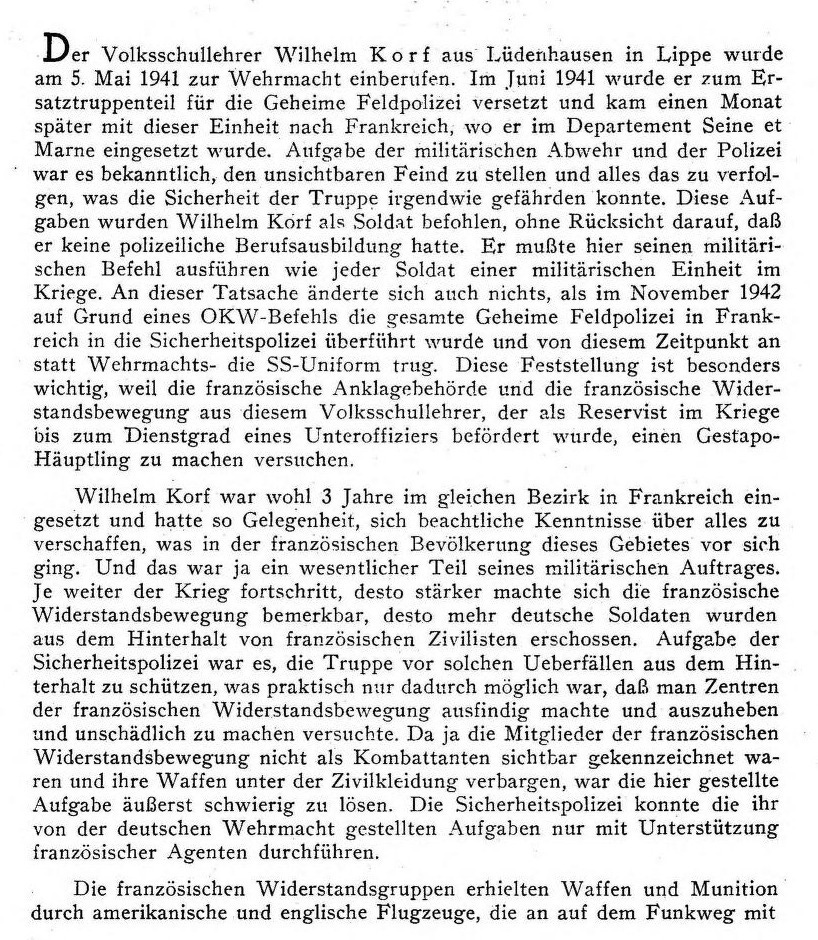
The elementary-school teacher Wilhelm Korf from Lüdenhausen in Lippe was called up into the Wehrmacht on May 5, 1941. In June 1941 he was posted to the replacement unit of the Geheime Feldpolizei [“Secret Field Police”] and a month later arrived with that unit in France, where he served in the Department of Seine-et-Marne. The job of military counter-intelligence and the police, as everyone knew, was to hunt down the invisible enemy and to pursue anything that might endanger the security of the troops. These duties were ordered to Wilhelm Korf as a soldier, with no regard for the fact that he had never received any professional police training. He had to carry out his military orders here exactly as every soldier in a wartime unit must. Nothing in that fact changed even when, in November 1942 under an OKW order, the entire Geheime Feldpolizei in France was transferred into the Sicherheitspolizei [“Security Police”] and from then on wore the SS uniform instead of the Wehrmacht one. This finding is especially important, because the French prosecution and the French resistance movement try to turn this elementary-school teacher—who as a reservist rose only to the rank of non-commissioned officer—into a Gestapo chief.
Wilhelm Korf spent roughly three years in the same district in France and so had the chance to gather considerable knowledge of everything that was happening among the French population there. And that, after all, formed an essential part of his military brief. The further the war advanced, the more strongly the French resistance made itself felt, and the more German soldiers were shot from ambush by French civilians. The task of the Sicherheitspolizei was to protect the troops from such attacks from ambush, which in practice could only be done by finding the centers of the French resistance and trying to round them up and neutralize them. Because the members of the resistance were not marked as combatants and hid their weapons under civilian clothes, the job set before it was hard to carry out. The Sicherheitspolizei could fulfill the tasks given it by the German Wehrmacht only with the help of French agents.
The French resistance groups received weapons and ammunition from American and British aircraft that dropped them at places arranged by radio with the groups. In the spring of 1944 the activity of the resistance in the Department of Seine-et-Marne had grown so strong that a weapons and ammunition dump was suspected inside their own area. Every effort was poured into finding that dump.
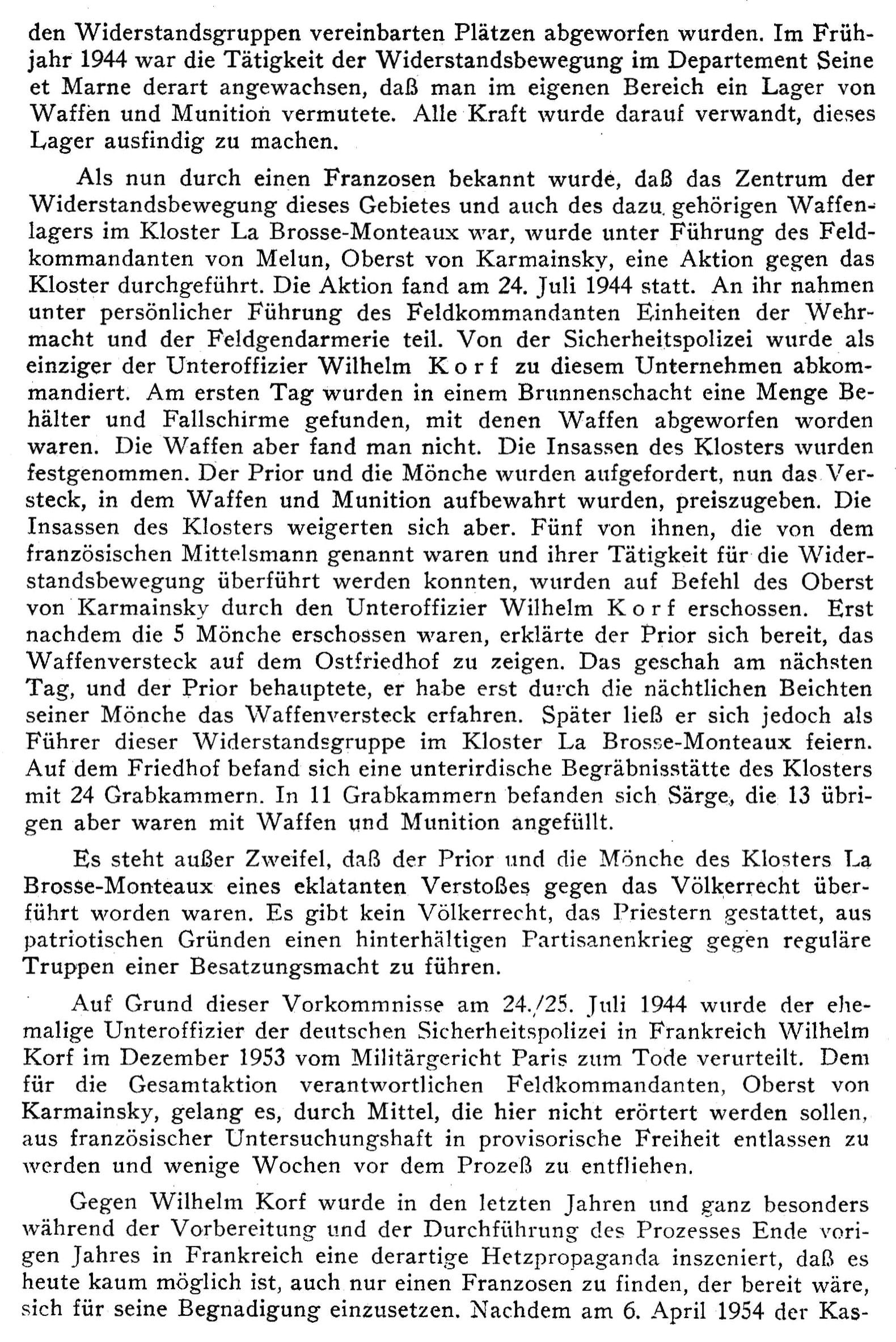
When word came through a Frenchman that the center of the resistance in the area, and of the weapons dump that went with it, lay in the monastery of La Brosse-Monteaux, an operation against the monastery was launched under the field commander of Melun, Colonel von Karmainsky. The action took place on July 24, 1944. Units of the Wehrmacht and the Field Gendarmerie took part under the field commander’s personal lead. From the Sicherheitspolizei only the non-commissioned officer Wilhelm Korf was detailed to the enterprise. On the first day a quantity of containers and parachutes used for dropping weapons was found in a well shaft. The weapons themselves were not found. The inmates of the monastery were taken into custody. The prior and the monks were ordered to reveal the hiding place where the weapons and ammunition were stored. They refused. Five of them, named by the French intermediary and shown to have worked for the resistance, were shot on Colonel von Karmainsky’s order by non-commissioned officer Wilhelm Korf. Only after the five monks had been shot did the prior agree to show the weapons hideout on the eastern cemetery. That happened the next day; the prior claimed he had learned of it only through his monks’ nighttime confessions. Later, however, he let himself be celebrated as the leader of the resistance group in the monastery of La Brosse-Monteaux. On the cemetery stood an underground burial place of the monastery with 24 chambers. Eleven held coffins; the other 13 were packed with weapons and ammunition.
There can be no doubt that the prior and the monks of the monastery of La Brosse-Monteaux had been shown guilty of a flagrant breach of international law. No international law permits priests, for patriotic reasons, to wage a treacherous partisan war against the regular troops of an occupying power.
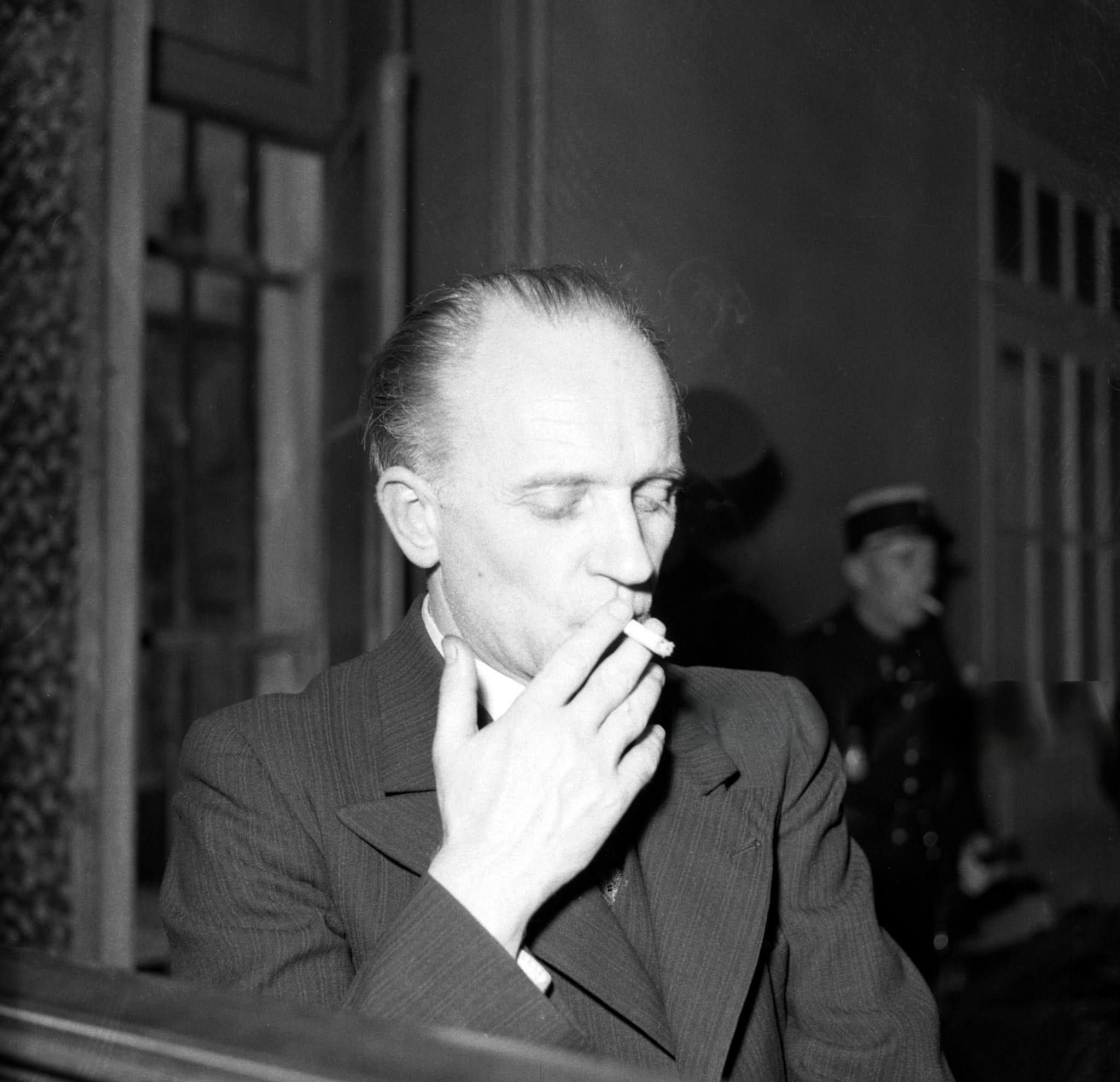
On the strength of these events of July 24–25, 1944 the former non-commissioned officer of the German Sicherheitspolizei in France, Wilhelm Korf, was sentenced to death by the Paris military court in December 1953. The field commander responsible for the whole operation, Colonel von Karmainsky, managed—by means that will not be discussed here—to be released from French investigative custody into provisional freedom and to escape a few weeks before the trial.
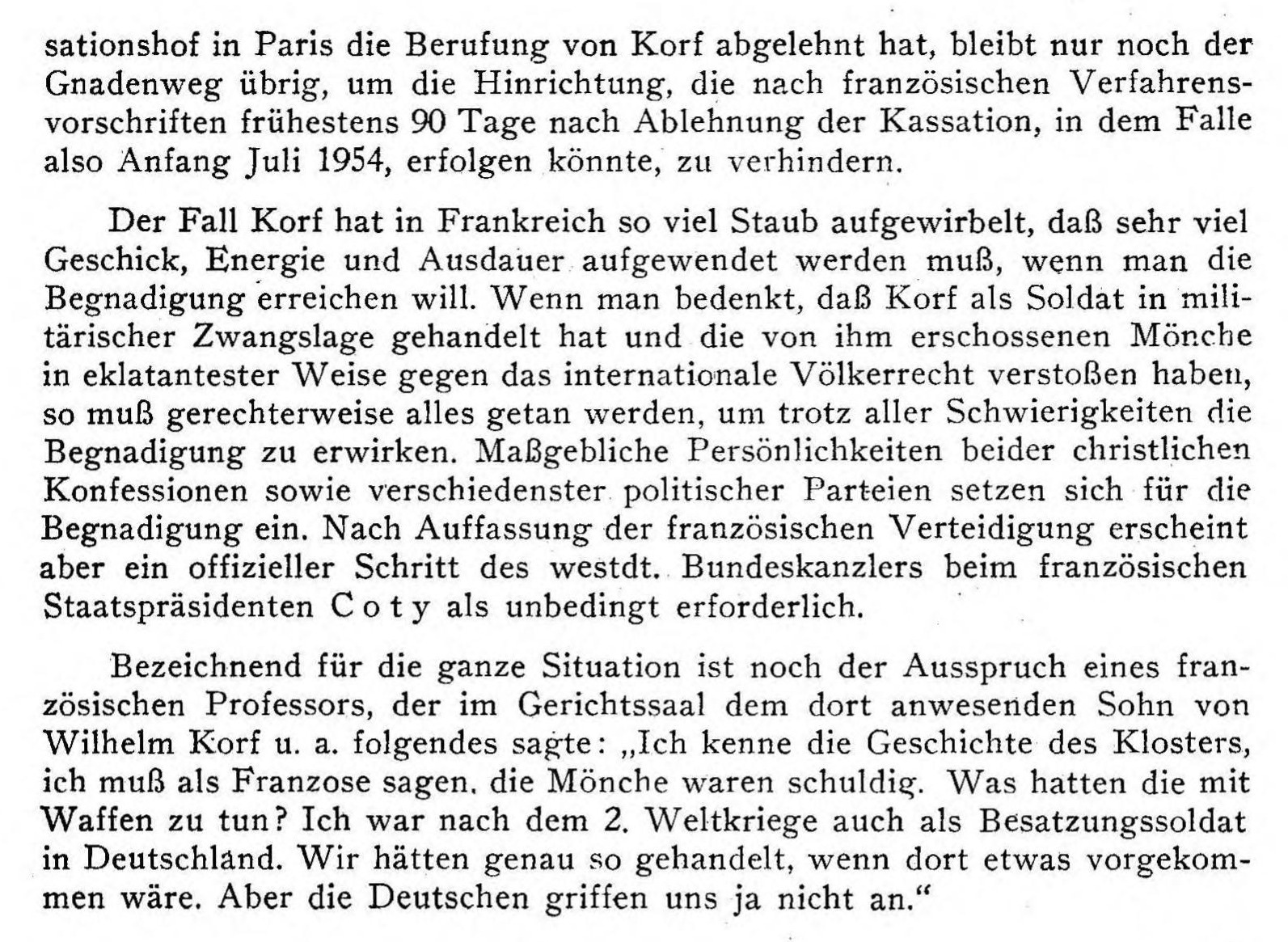
In recent years, and especially during the preparation and the running of the trial at the end of last year in France, such a campaign of inflammatory propaganda was mounted against Wilhelm Korf that today it is scarcely possible to find even one Frenchman willing to speak up for his pardon. After the Court of Cassation in Paris rejected Korf’s appeal on April 6, 1954, only the path of clemency remains if the execution is to be stopped—an execution that under French procedural rules could take place at the earliest 90 days after the rejection of the cassation, in this case therefore at the beginning of July 1954.
The Korf case has stirred up so much dust in France that a great deal of skill, energy and perseverance will be needed if the pardon is to be won. When one remembers that Korf acted as a soldier under military constraint and that the monks he shot violated international law in the most flagrant way, then fairness demands that everything possible be done, despite every difficulty, to secure the pardon. Leading figures from both Christian confessions and from the most varied political parties are working for the pardon. In the view of the French defense, however, an official approach by the West German Federal Chancellor to the French President Coty is indispensable.
Characteristic of the whole situation is the remark of a French professor who said, among other things, to Wilhelm Korf’s son present in the courtroom:
“I know the history of the monastery; I must say as a Frenchman that the monks were guilty. What did they have to do with weapons? After the Second World War I myself served as an occupation soldier in Germany. We would have done exactly the same if anything of the kind had happened there. But the Germans never attacked us, after all.”
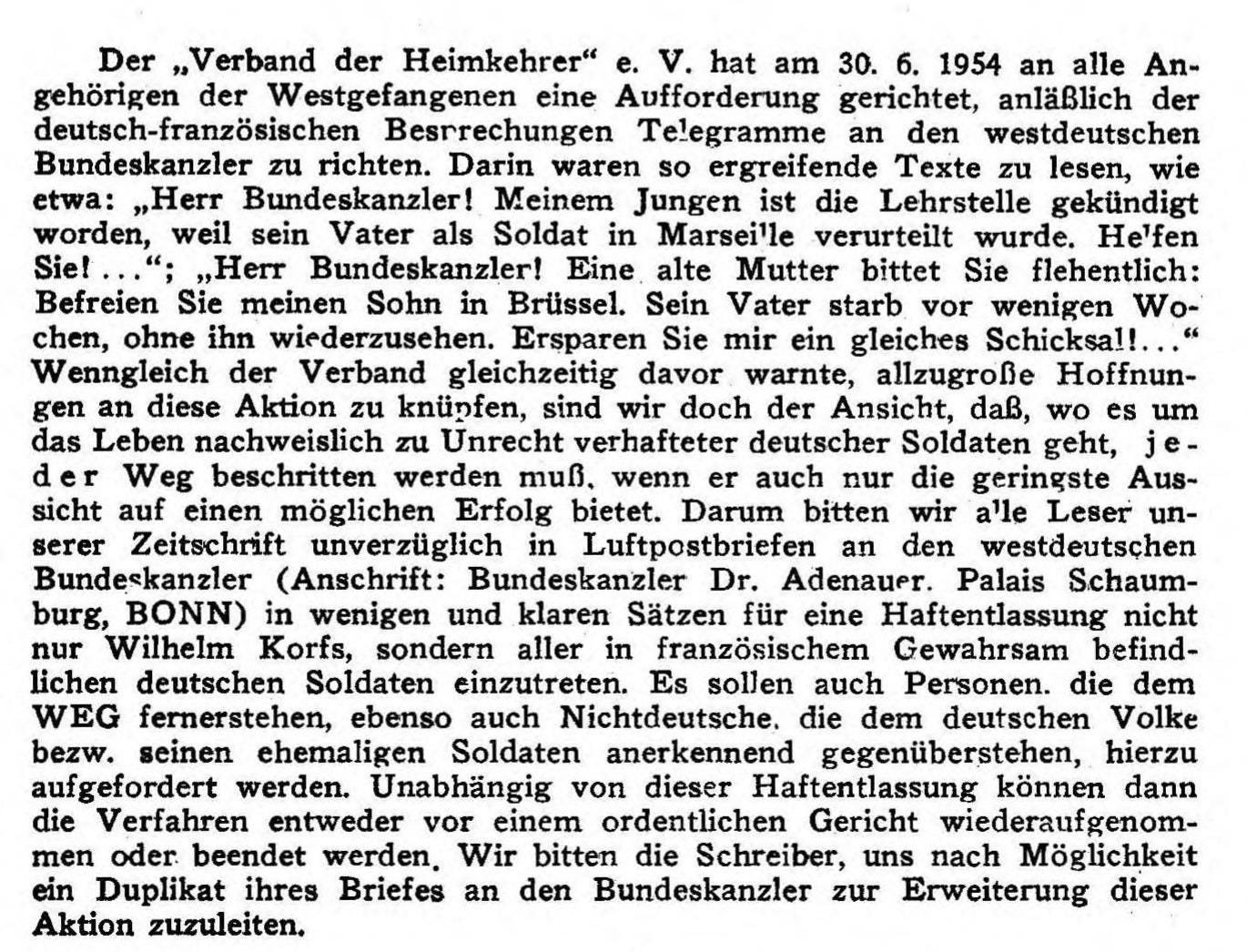
On June 30, 1954 the “Association of Returnees” (registered society) sent all relatives of Western prisoners a request that, on the occasion of the German-French talks, they telegraph the West German Federal Chancellor. In those messages one could read moving lines such as:
“Mr. Federal Chancellor! My boy’s apprenticeship has been canceled because his father was sentenced as a soldier in Marseilles. Help! […]”;
“Mr. Federal Chancellor! An old mother begs you urgently: free my son in Brussels. His father died a few weeks ago without seeing him again. Spare me the same fate! […]”
Although the Association also warned against placing too much hope in the action, we still believe that where the lives of demonstrably unjustly held German soldiers are at stake every possible path must be tried if it offers even the slightest chance of success. We therefore ask every reader of our journal to write at once by airmail to the West German Federal Chancellor (Address: Federal Chancellor Dr. Adenauer, Palais Schaumburg, BONN) in a few clear sentences urging the release from custody not only of Wilhelm Korf but of all German soldiers held by the French. People more distant from Der Weg, and non-Germans who look with recognition on the German Volk or its former soldiers, should be invited to join in as well. Independently of any such release the cases can then be reopened before a regular court or brought to a close. We ask the writers, if possible, to send us a copy of their letter to the Chancellor so the action can be widened.
Dan Rouse’s Note: Wilhelm Korf’s appeal was rejected by the Court of Cassation on April 6, 1954. In the months that followed, the superiors of the congregation themselves—Father Henri Tassel and the Superior General, Father Léo Deschâtelets—petitioned the President of the Republic for clemency. The presidential pardon was granted in early 1955; the sentence was thereby commuted to life imprisonment at hard labor. Korf was released from prison in 1960.

Original Title: Der Gall Wilhelm Kort
Attributed Author: unattributed.
“Der Weg” Issue: Volume 8, Issue 8 (August 1954)
Page(s): 569-571 [Scan LINK]
Der Weg - El Sendero is a German- and Spanish-language magazine published by Dürer-Verlag in Buenos Aires, Argentina, by Germans with ties to the defeated Third Reich.
Der Weg ran monthly issues from 1947 to 1957, with official sanction from Juan Perón’s Government until his overthrow in September 1955.
See the end of this article for source details.
Comments
Nothing yet. Say the first thing.
Sign in to join the conversation.