
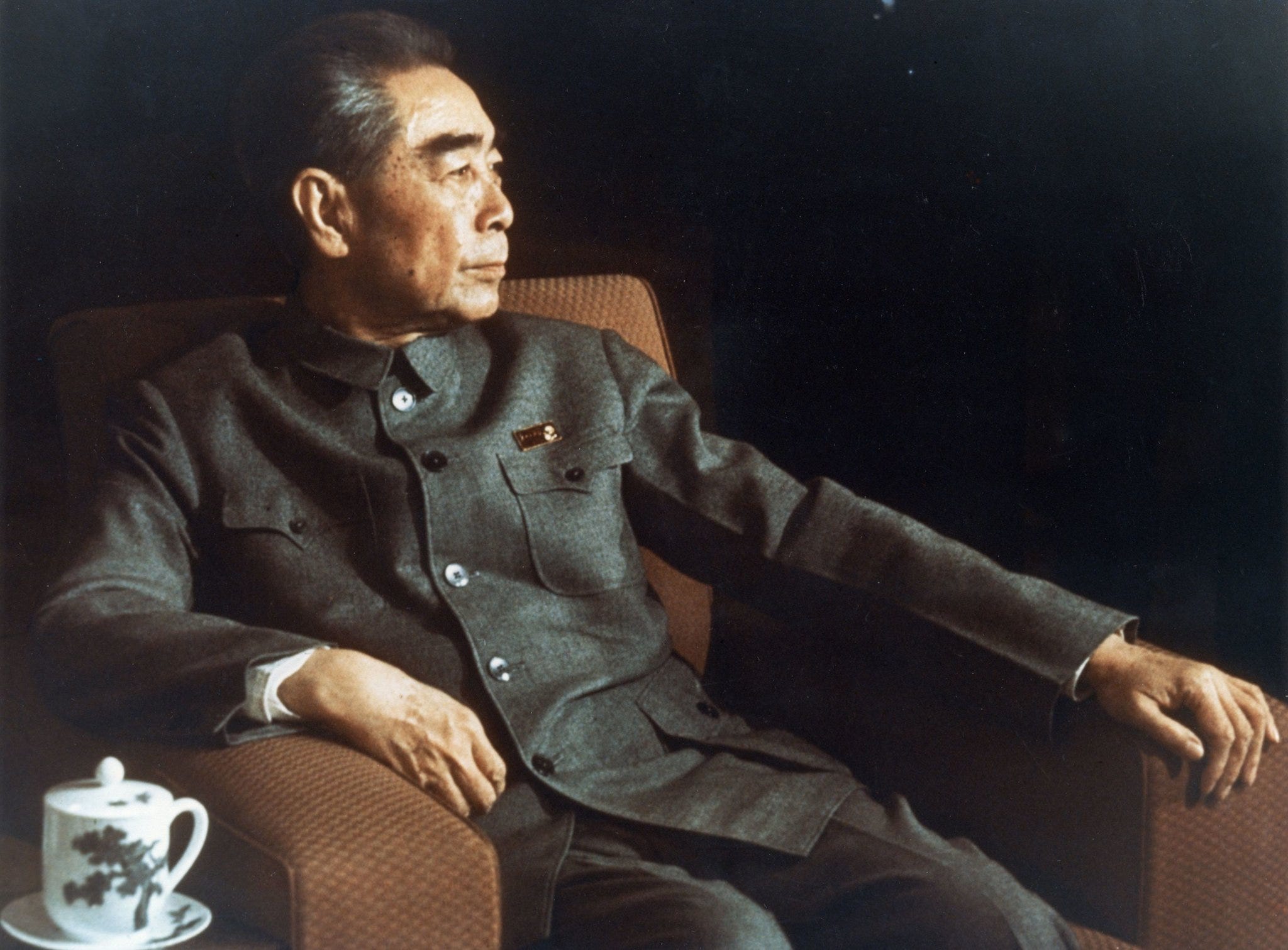
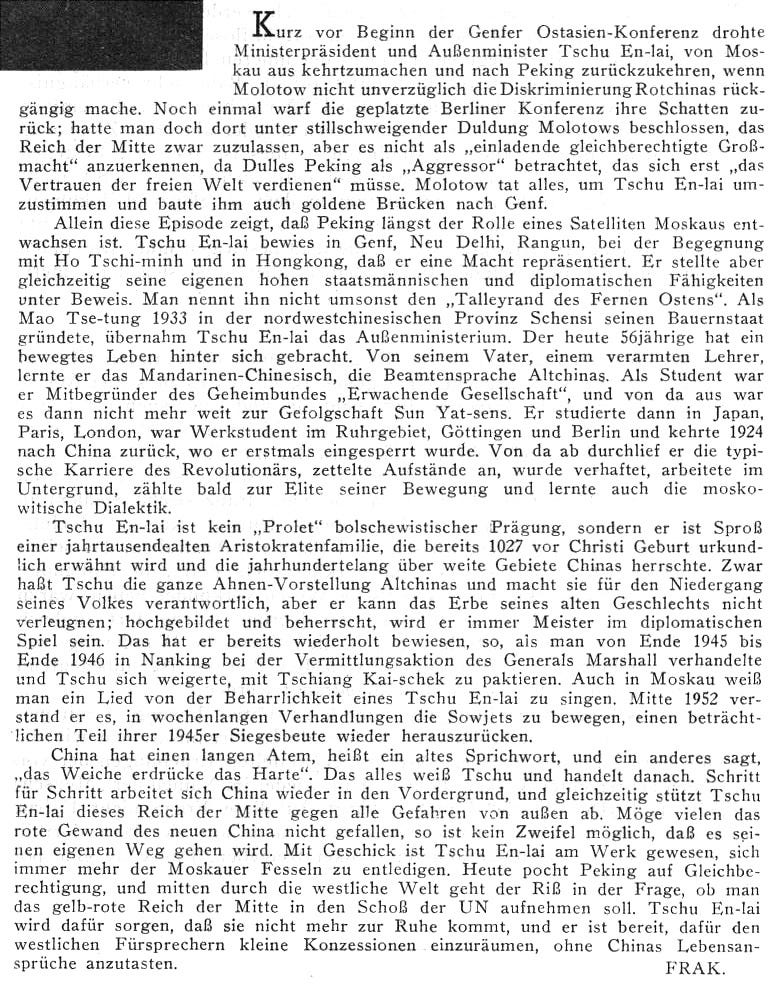
Shortly before the Geneva East Asia Conference opened, Premier and Foreign Minister Zhou Enlai threatened to turn back from Moscow and return to Beijing if Molotov did not at once reverse the discrimination against Red China. Once again the collapsed Berlin Conference cast its shadows; for there, under Molotov’s tacit tolerance, it had been decided to admit the Middle Kingdom yet to refuse to recognize it as an “inviting equal great power,” since Dulles viewed Beijing as an “aggressor” that first had to “earn the trust of the free world.” Molotov did everything to win Zhou Enlai over and built him golden bridges to Geneva.
This single episode shows that Beijing has long since outgrown the role of a Moscow satellite. Zhou Enlai proved in Geneva, New Delhi, Rangoon, at the meeting with Ho Chi Minh, and in Hong Kong that he represents a power. At the same time he displayed his own highly statesmanlike and diplomatic gifts. He is not called the “Talleyrand of the Far East” for nothing. When Mao Zedong founded his peasant state in the northwestern Chinese province of Shaanxi in 1933, Zhou Enlai took over the foreign ministry. Today the 56-year-old has lived a turbulent life. From his father, an impoverished teacher, he learned Mandarin Chinese, the official language of old China. As a student he helped found the secret society “Awakening Society,” and from there it was only a short step to following Sun Yat-sen. He then studied in Japan, Paris and London, worked as a student laborer in the Ruhr, Göttingen and Berlin, and returned to China in 1924, where he was locked up for the first time. From that moment he followed the classic revolutionary path: he stirred uprisings, was arrested, worked underground, soon ranked among the elite of his movement, and also mastered the Muscovite dialectic.
Zhou Enlai is no “proletarian” of Bolshevik stamp; he is the scion of a millennia-old aristocratic family that was recorded as early as 1027 B.C. and that for centuries ruled over wide stretches of China. Though Zhou hates the whole ancestral ideology of old China and blames it for his people’s decline, he cannot disown the heritage of his ancient line; highly cultivated and self-possessed, he will always master the diplomatic game. He has proved this more than once, as when from late 1945 to late 1946 talks took place in Nanking under General Marshall’s mediation and Zhou refused any pact with Chiang Kai-shek. Moscow, too, knows a thing or two about Zhou Enlai’s tenacity. In mid-1952, after weeks of bargaining, he induced the Soviets to hand back a sizable share of their 1945 victory spoils.
China has a “long breath,” an old proverb says, and another declares, “the soft overcomes the hard.” Zhou knows this and acts on it. Step by step China pushes back into the foreground, while Zhou Enlai steadies the Middle Kingdom against every outside threat. Many may dislike the red garment of the new China, yet there is no doubt it will follow its own road. With skill Zhou Enlai has been freeing himself ever further from Moscow’s fetters. Today Beijing demands equal rights, and a rift runs clean through the Western world over whether the yellow-red Middle Kingdom should be taken into the U.N.’s fold. Zhou Enlai will see that the question never settles, and he is ready to grant Western advocates small concessions so long as China’s vital claims stay untouched.
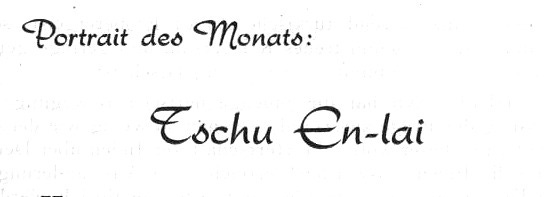
Original Title: Portrait des Monats: Tschu En-lai
Attributed Author: FRAK
“Der Weg” Issue: Volume 8, Issue 8 (August 1954)
Page(s): 586 [Scan LINK]
Der Weg - El Sendero is a German- and Spanish-language magazine published by Dürer-Verlag in Buenos Aires, Argentina, by Germans with ties to the defeated Third Reich.
Der Weg ran monthly issues from 1947 to 1957, with official sanction from Juan Perón’s Government until his overthrow in September 1955.
See the end of this article for source details.
Comments
Nothing yet. Say the first thing.
Sign in to join the conversation.