
Dan Rouse’s Note: Another fascinatingly prescient and early anti-Holocaust Myth text from Der Weg. See Ludwig Fanghänel’s 2012 article on CODOH examining the author Stephen F. Pinter (1888–1985), who likely wrote the below article under the pseudonym Warwick Hester. To quote Fanghänel:
“Warwick Hester’s observations and arguments are more than 50 years later astonishingly precocious. And the forces that deter free discussion are still the same. Thus, the reason why the author dared describe his experiences only under a pseudonym needs no explanation.”
Pinter is particularly interesting because he was an Austrian-born American lawyer who worked as a U.S. War Department attorney investigating Nazi concentration camps after World War II, prior to or concurrent with his publication of the present article.
WARWICK HESTER:1
I am grateful to you for sending me the Heimann article from the July issue. It is the question that has occupied me (and, as I know from experience, a great many people in Germany and across the world) ever since it first appeared. Whether the article produces this clarity at a single stroke is neither certain nor important, for whose voice could ever rise above the tempest of the world press. That you, mindful of the nature of truth, which may lie buried in the rubble of lies yet cannot be dissolved in it, have with this article set foot on the road of inner freedom, even if only for a small step, is my firm conviction. I (and not I alone) have awaited this step all the more because until now I always felt that you yourself lacked certainty on this burning question. You and I alike were for a longer or shorter time impressed by the endless, brazen publications about German cruelties and crimes, so that we came close to believing them, and this despite an instinctive feeling deep in the soul that fought against it.
This hard-to-define feeling of resistance was, I freely admit, the real driving force behind my journeys through the European countries from 1946 to the present. In those years I never missed a chance and spared no effort to speak with people of every background and nationality who had taken any part in the events of the war. From the conversations, inquiries, observations and the study of files and documents, a picture took shape for me. It may not be exact in every detail, yet as a whole it is probably true.
My interest centered mainly on whether any plan for genocide had ever existed in Germany, which institution was charged with it, which carried it out, and by what means the execution was performed. As you know, I hold nearly every published claim made in this direction and have gone to considerable expense and trouble checking each one separately. The files of the Nuremberg trials first pointed to their unreliability: none of the accused in any of those trials admitted knowledge of or participation in the alleged mass murders. Examination of the witnesses and their statements reveals an enormous number of false testimonies and perjuries, and even instigation to perjury by the prosecution authorities themselves, enough to justify complete mistrust. The verdicts and the press reports rested solely on these false statements.
There was talk, for instance, of special vehicles for gassing people, vehicles said to have killed hundreds of thousands if not millions. Yet not a single vehicle of that kind could be produced at Nuremberg, a demonstration no prosecuting authority in the world would have passed up. Despite the complete occupation of Germany it proved impossible to bring this instrument of mass extermination, described in precise detail, before the public for a simple reason: it did not exist. One of the ordinary army delousing vans used for clothing would at best have drawn the laughter of world opinion.
There was also the documentary film Todesmühlen [“Death Mills”], shown as evidence to the major war criminals. It shook the accused deeply and made them believe that, without their knowledge, a murder machine organized down to the smallest detail had existed. That belief was false, though the accused never learned of the falsehood before their deaths. Only five months later the forgery came to light.
During my two stays I visited every camp in the German western zones that was open to me. In none of these supposedly terrible murder sites did I find gas chambers or any other installations that could have allowed the mass execution of people. In Dachau, for example, the guide pointed out a series of such places that on closer look proved to have been installed after the war; they were not genuine but mere dummies. I spoke with two German employees of our army who had taken part in these works of deception for visitors.
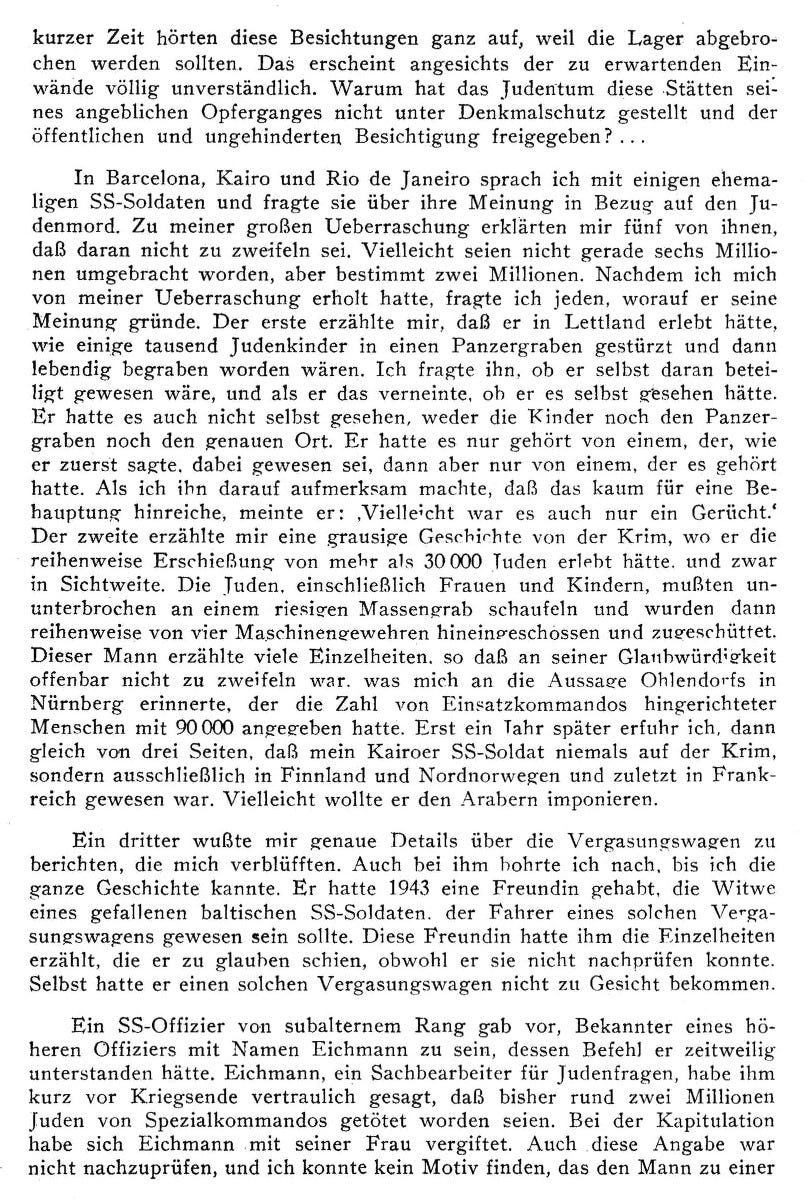
One after another I spoke with 14 Jews who had been interned for some time at Maidanek and who had in part testified about the gas chambers there in trials and to the press. In private, and because they took me for one of their own, they told me they had never seen gas chambers there or in any other camps where they had been, nor had they witnessed mass executions. Whether true or false, a pharmacist explained, no longer mattered; what mattered was bringing the Germans to their knees. The intellectuals among them said this was their personal revenge, since they could not themselves go out and kill a few Germans. In fact, visitors to Maidanek and Auschwitz (strangely, only a few, almost exclusively Jewish journalists were admitted) were not allowed to inspect the alleged extermination sites directly or from inside; they were merely led past a few buildings and told these were the gassing sites. After a short time even these tours stopped because the camps were to be dismantled. Given the objections one would expect, this seems incomprehensible. Why has Jewry not placed these “sites of its alleged sacrifice” under monument protection and opened them to free public inspection?
In Barcelona, Cairo, and Rio de Janeiro I spoke with several former SS soldiers and asked their opinion about the murder of the Jews. To my great surprise, five of them said there was no doubt about it. Perhaps not six million had been killed, but certainly two million. After recovering from my surprise, I asked each man on what he based his view. The first told me that in Latvia he had seen several thousand Jewish children thrown into an anti-tank ditch and buried alive. I asked whether he himself had taken part; when he said no, I asked whether he had seen it with his own eyes. He had not. He had neither seen the children, nor the ditch, nor the exact place. He had only heard it from someone who, he first claimed, had been present, and then from someone who had merely heard it. When I pointed out that this was hardly enough for an assertion, he answered, “Perhaps it was only a rumor.” The second told a gruesome story from the Crimea: he had watched more than 30,000 Jews, including women and children, shot in rows within sight of him. They had to dig continuously at a huge mass grave and were then shot by four machine guns and covered over. He gave many details, so that his credibility seemed beyond question, reminding me of Ohlendorf’s Nuremberg figure of 90,000 killed by the Einsatzkommandos. A year later I learned, from three separate sources at once, that this Cairo SS soldier had never been in the Crimea at all; he had served only in Finland, northern Norway and finally France. Perhaps he wanted to impress the Arabs.
A third man could give me exact details about the gassing vans that astonished me. I kept probing until I had the whole story. In 1943 he had a girlfriend, the widow of a fallen Baltic SS man who was said to have driven such a van. She had told him the details; he seemed to believe them, although he could not check them. He himself had never set eyes on a gassing van.
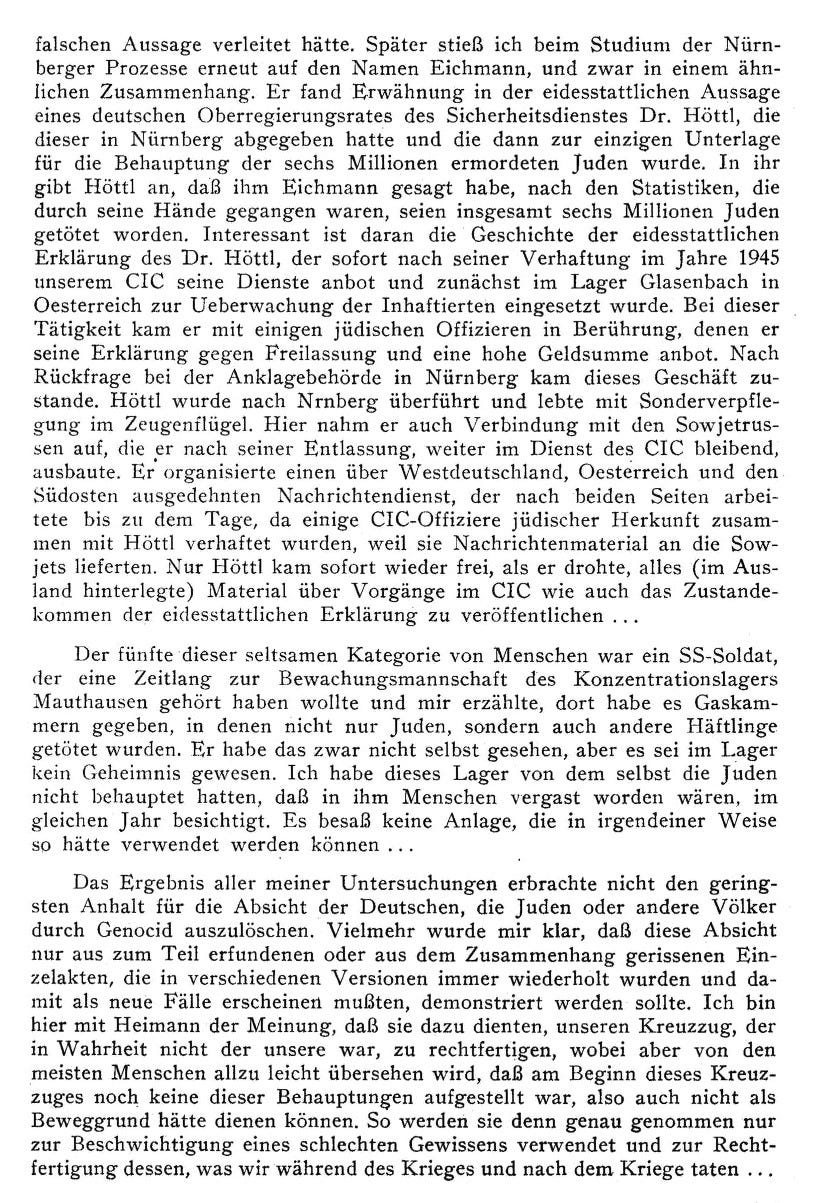
An SS officer of junior rank claimed to have known a higher officer named Eichmann under whose orders he had temporarily served. Eichmann, a desk officer for Jewish questions, had confidentially told him shortly before the end of the war that special commandos had so far killed roughly two million Jews. At the capitulation, Eichmann and his wife had poisoned themselves. This claim too could not be verified, and I could find no motive for a false statement. Later, studying the Nuremberg records, I came across the name Eichmann again in a similar connection. He appears in the sworn statement of Dr. Höttl, a senior government counselor in the Security Service, given at Nuremberg; that statement became the sole basis for the claim of six million murdered Jews. Höttl says Eichmann told him that, according to statistics that had passed through his hands, a total of six million Jews had been killed. The history of Höttl’s sworn declaration is interesting. Immediately after his arrest in 1945 he offered his services to our CIC (Counter Intelligence Corps) and was first assigned to the Glasenbach camp in Austria to help supervise the prisoners. There he met several Jewish officers and offered them his declaration in exchange for release and a large sum of money. After the Nuremberg prosecution was consulted, the deal went through. Höttl was transferred to Nuremberg and lived on special rations in the witnesses’ wing. From there he also made contact with the Soviets, a contact he expanded after his release while remaining in CIC service. He organized an intelligence network across West Germany, Austria and the Southeast that worked both sides until the day several CIC officers of Jewish origin were arrested together with Höttl for supplying material to the Soviets. Only Höttl was released at once, after he threatened to publish everything (documents he had deposited abroad) about CIC operations and about how the sworn declaration had been obtained.
The fifth of this odd group was an SS soldier who claimed to have served for a time in the guard detail at Mauthausen and told me there had been gas chambers there in which not only Jews but other prisoners were killed. He had not seen them himself, he said, but it had been no secret in the camp. I inspected the same camp that year; Jewish sources had never claimed people were gassed there. It contained no installation that could have been used for such a purpose.
The result of all my investigations yielded not the slightest evidence of any German intention to wipe out the Jews or any other people by genocide. What became clear instead was that this intention was to be demonstrated only from individual acts that were partly invented or torn from their context, then repeated in varying versions so that they appeared as new cases. I agree with Heimann that these claims served to justify our crusade, which was never ours. Most people easily overlook that at the start of that crusade none of these assertions had yet been made and therefore could not have served as a motive. Strictly speaking they are used only to soothe a bad conscience and to justify what we did during the war and after it.
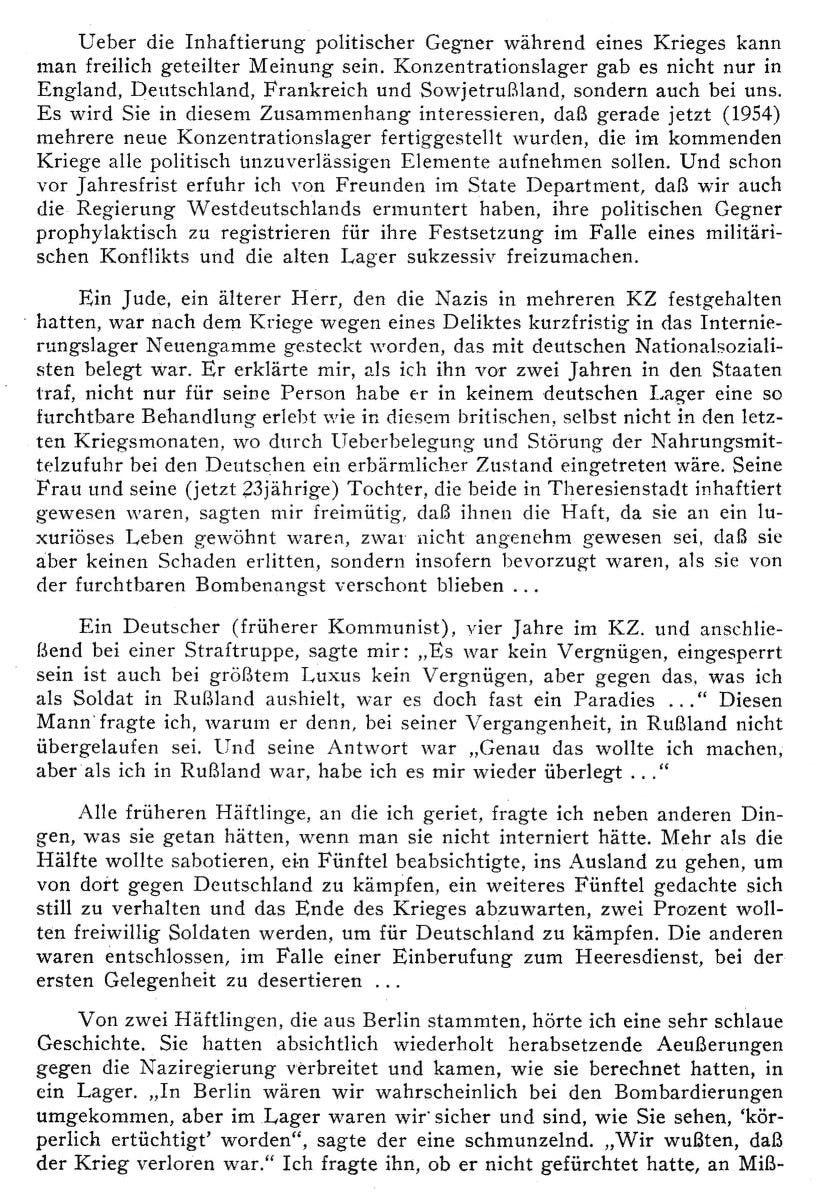
Opinions may of course differ about the internment of political opponents in wartime. Concentration camps existed not only in England, Germany, France and Soviet Russia but among us as well. It may interest you to know that just now (1954) several new concentration camps have been finished; in the coming war they are to hold all politically unreliable elements. And only a year ago friends in the State Department told me we have also encouraged the West German government to register its political opponents in advance so they can be detained if a military conflict breaks out, and to clear the old camps step by step for that purpose.
A Jew, an elderly gentleman whom the Nazis had held in several concentration camps, was put after the war for a short time into the internment camp Neuengamme for a minor offense; the camp was filled with German National Socialists. When I met him two years ago in the U.S., he told me that in no German camp, not even in the last months of the war when overcrowding and disrupted food supplies had produced wretched conditions among the Germans, had he experienced treatment as terrible as in that British camp. His wife and his daughter (now 23), both of whom had been interned at Theresienstadt, told me frankly that the detention, coming from a life of luxury, had not been pleasant, yet they had suffered no harm and had even been privileged in that they were spared the constant terror of the bombs.
A German, a former Communist who spent four years in a concentration camp and then in a penal unit, said to me: “It was no pleasure; being locked up is never a pleasure even in the greatest luxury, but compared with what I endured as a soldier in Russia it was almost a paradise.” I asked why, given his past, he had not deserted once he reached Russia. His answer was: “That is what I meant to do, but when I was in Russia I thought better of it.”
I asked every former prisoner I met, among other things, what he would have done if he had not been interned. More than half said they would have sabotaged; one-fifth said they intended to go abroad and fight Germany from there; another fifth said they planned to keep quiet and wait for the end of the war; 2 percent said they wanted to volunteer as soldiers and fight for Germany. The rest said they were resolved, if called up, to desert at the first opportunity.
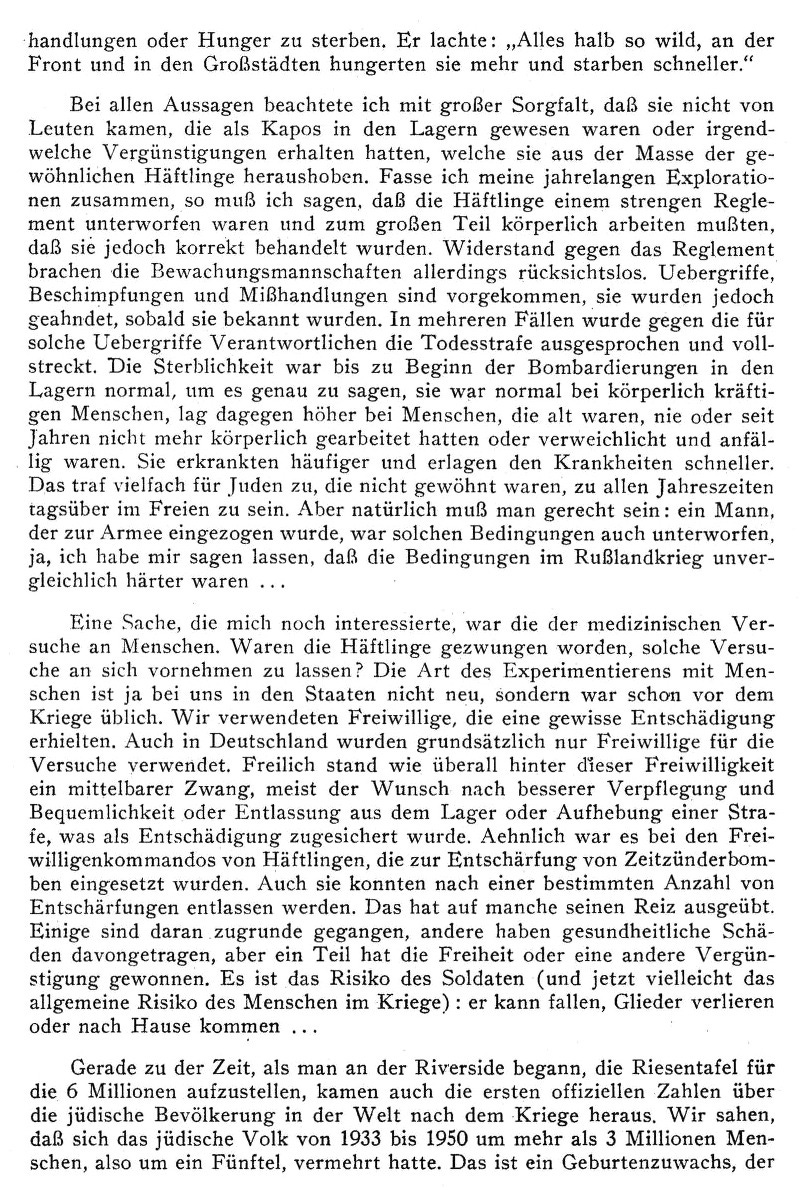
From two prisoners who came from Berlin, I heard a shrewd story. They had deliberately repeated disparaging remarks about the Nazi government and, as they had calculated, ended up in a camp. “In Berlin we would probably have been killed in the air raids,” one said with a grin, “but in the camp we were safe and, as you can see, we were even physically toughened. We knew the war was lost.” I asked whether he had not feared dying of mistreatment or hunger. He laughed: “All half so bad. At the front and in the big cities they starved more and died faster.”
With every statement I took care that it did not come from men who had been Kapos or who had received privileges setting them apart from the ordinary mass of prisoners. Summarizing years of inquiry, I must say that the prisoners lived under a strict regimen and most of them had to perform physical labor, yet they were treated correctly. The guards broke resistance to the rules ruthlessly. Excesses, insults and mistreatment occurred, but they were punished as soon as they became known. In several cases the death penalty was imposed and carried out on those responsible. Mortality remained normal until the air raids began; more precisely, it was normal among the physically strong, higher among the old, those who had never or long since stopped doing physical work, or who were soft and susceptible. They fell ill more often and died more quickly. This applied especially to many Jews unaccustomed to being outdoors in every season. Yet one must be fair: a man drafted into the army faced the same conditions, and I have been told the conditions on the Russian front were incomparably harder.
One further matter still interested me: medical experiments on human beings. Had the prisoners been forced to undergo them? Experimenting on people was not new in the U.S.; it was practiced before the war. We used volunteers who received some compensation. In Germany, too, only volunteers were used in principle. Of course an indirect pressure always stood behind the “voluntariness,” usually the hope of better food and comfort, release from the camp, or the lifting of a punishment, all of which were promised as compensation. The same was true of the volunteer squads of prisoners sent to defuse time-fuse bombs. After a set number of successful defusings they could be released. That prospect attracted some. A few died, others suffered lasting injury, but a portion gained freedom or another privilege. It is the soldier’s risk (and perhaps now the general risk of any human being in war): he may fall, lose limbs, or come home.
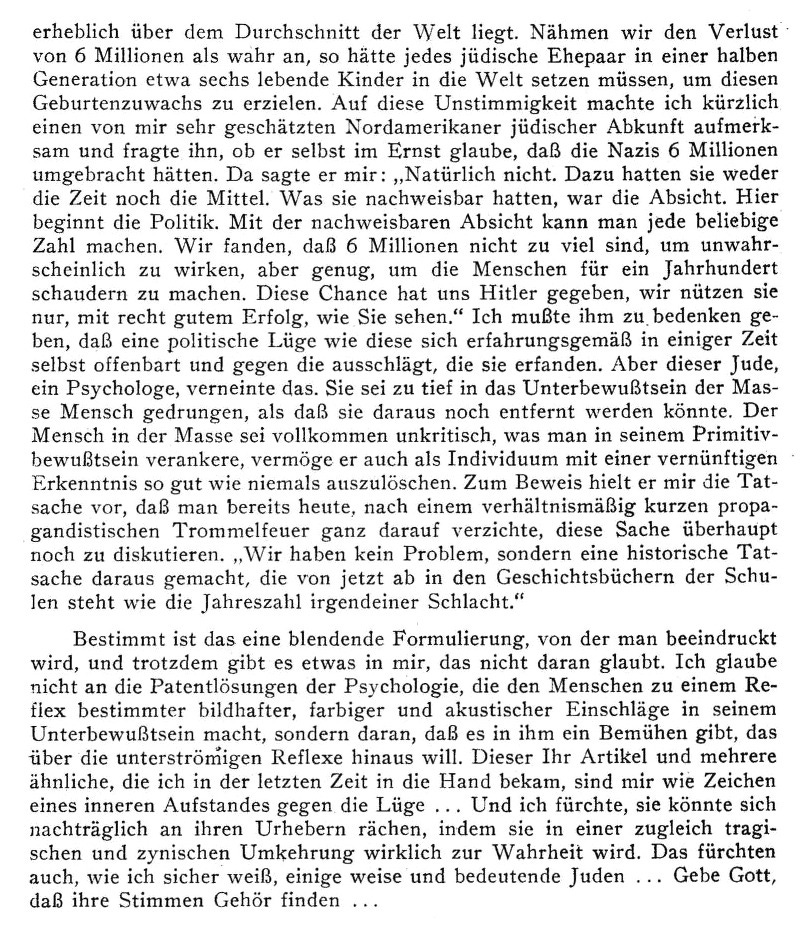
Just when they began erecting the giant tablet for the six million at Riverside, the first official figures on the postwar Jewish population of the world also appeared. We saw that from 1933 to 1950 the Jewish people had increased by more than three million, that is, by one-fifth. That birth increase lies well above the world average. If the loss of six million were true, every Jewish couple would have had to produce about six living children in half a generation to reach that growth. I recently pointed out this inconsistency to a North American of Jewish descent whom I respect, and asked whether he himself believed the Nazis had killed six million. He answered:
“Of course not. They had neither the time nor the means. What they demonstrably possessed was the intention. That is where politics begins. With a demonstrable intention one can invent any number one likes. We decided six million was not so large as to seem impossible, yet large enough to make people shudder for a century. Hitler gave us that chance; we are simply using it, and with considerable success, as you can see.”
I felt obliged to remind him that a political lie of this kind has a way of exposing itself in time and turning against those who invented it. But this man, a psychologist, denied it. The lie, he said, had sunk too deep into the subconscious of the mass man ever to be removed. The mass man is uncritical; even the individual with rational insight can almost never extinguish what is anchored in his primitive consciousness. As proof he pointed to the fact that today, after a relatively short barrage of propaganda, no one even discusses the matter anymore.
“We have turned it from a problem into a historical fact that from now on stands in the school history books like the date of any battle.”
It is a brilliant formulation, and one is impressed by it. Yet something in me refuses to believe it. I do not accept the patent solutions of psychology that reduce a human being to a reflex of pictorial, colored and acoustic impressions in the subconscious. I believe there is in him an effort that wants to rise above those undercurrents. This article of yours, and several similar ones I have lately held in my hands, strike me as signs of an inner revolt against the lie. And I fear the lie may yet avenge itself on its authors by becoming, in a tragic and cynical reversal, the actual truth. Some wise and significant Jews, I know, share that fear. May God grant that their voices are heard.

Original Title: Auf den Straßen der Wahrheit
Attributed Author: Warwick Hester (possible alias of Stephen Pinter)
“Der Weg” Issue: Volume 8, Issue 8 (August 1954)
Page(s): 572-578 [Scan LINK]
Der Weg - El Sendero is a German- and Spanish-language magazine published by Dürer-Verlag in Buenos Aires, Argentina, by Germans with ties to the defeated Third Reich.
Der Weg ran monthly issues from 1947 to 1957, with official sanction from Juan Perón’s Government until his overthrow in September 1955.
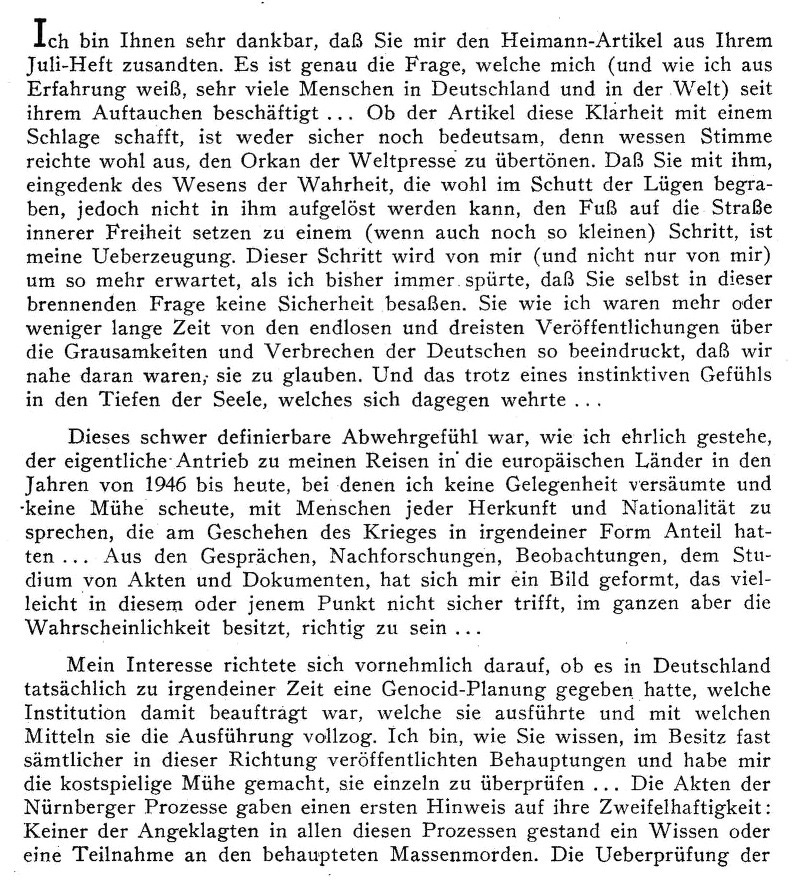
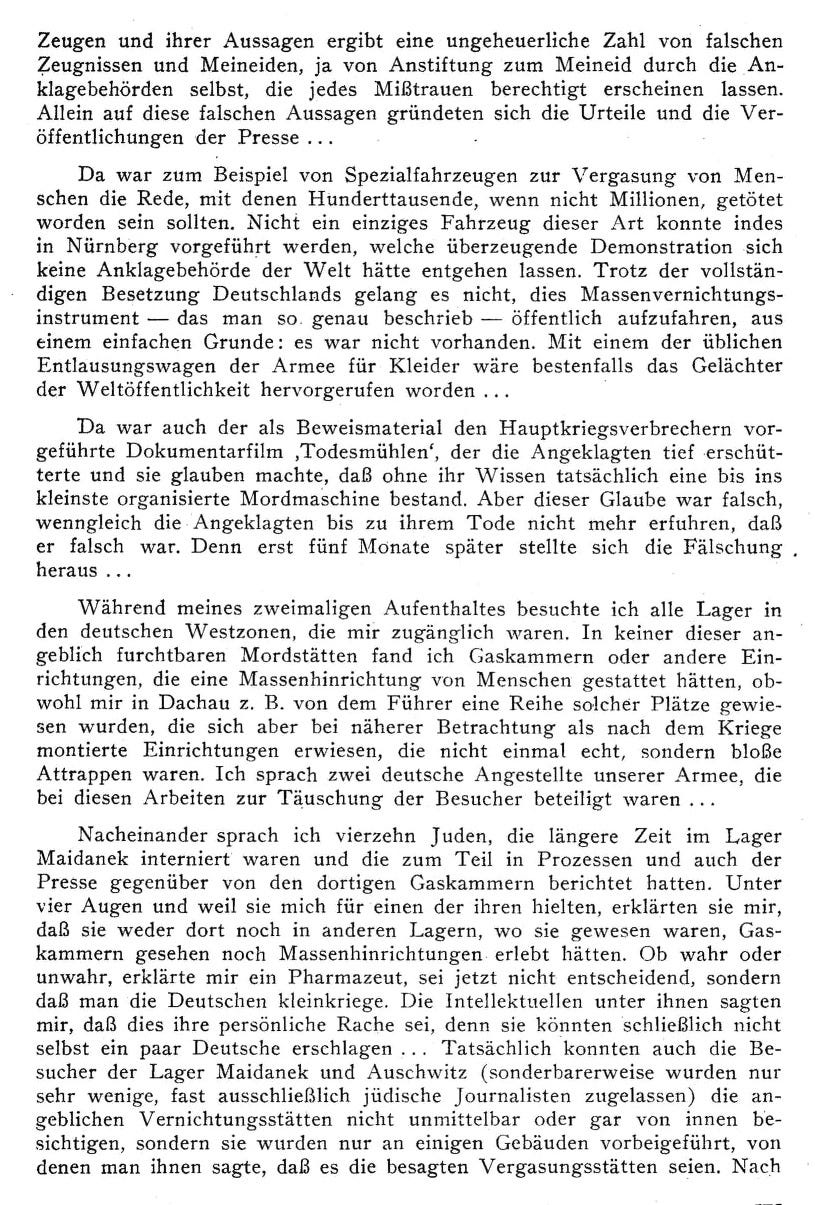
See the end of this article for source details.
Comments
Nothing yet. Say the first thing.
Sign in to join the conversation.