
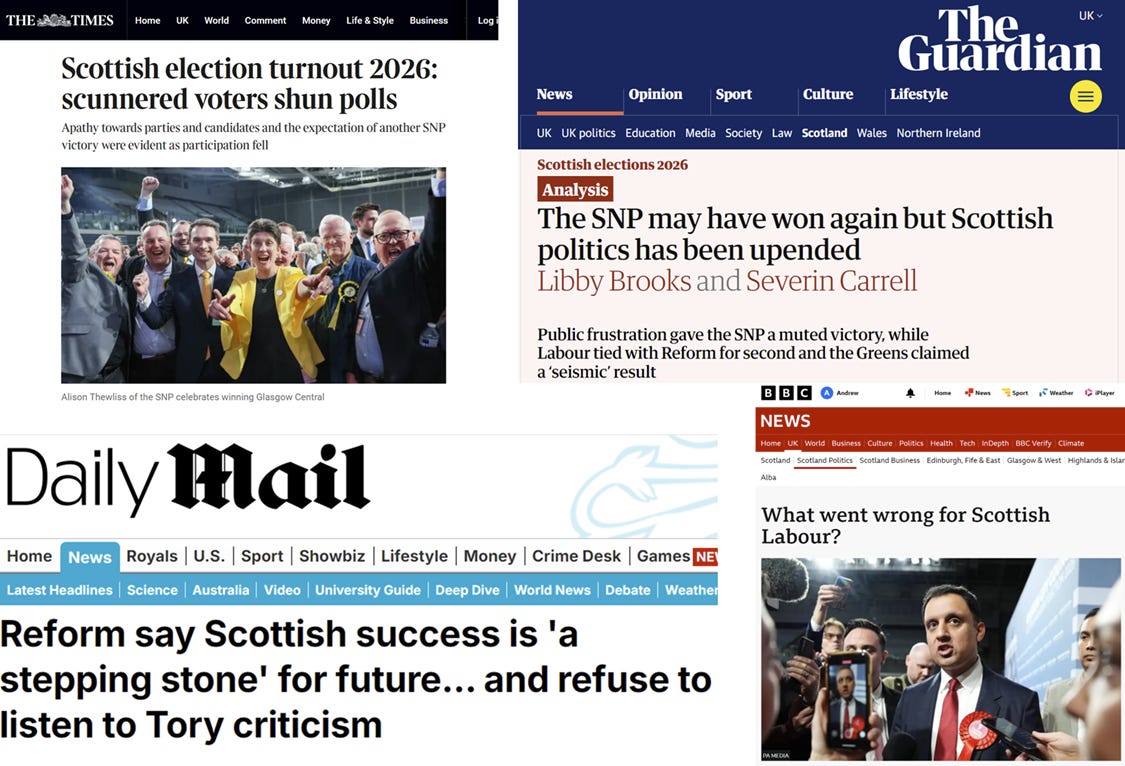
The Scottish Parliament elections are over for another five years. When the Westminster bubble gives it any attention, it’s to look at us in the distance through the filter of tradition—and try to make sense on their terms. “The rise of Farage’s Reform”, “Labour’s fall”, “The Green effect”. It’s all about the London parties they’re familiar with, and depend on.
That would only be of academic interest if it weren’t that Scotland has no control over the broadcasters and other media filling our online and airways. That power currently sits in Westminster.
In 2025 only 2.9% of the broadcast mentions hitting Scotland and the UK included our most popular party—The SNP. And I would happily accept a bet that a large majority of those were negative mentions.
And as for all that other noise about the London parties so close to their hearts? Let’s inject some objectivity.
Well Labour has certainly declined by any measure—but this is hardly news in Scotland. It has been in constant decline since the Scottish Parliament was re-started in 1999. The bubble has noticed because it’s now also a thing in England.
What about Reform’s “rise”?
In England the bubble only experiences London parties. They also get to field candidates in Scotland, but here they come up against Scottish parties as well. And they are consistently less popular.
Labour may have been in constant decline, but the Tories never succeeded. And Farage’s Reform? They’re down there with the others.
Incidentally, that’s the Scottish Parliament, but what about Scotland’s councils? Currently, 43% of our councillors are SNP — by far the largest group. Contrast this with England where Labour and the Tories are neck and neck on only 26%. This is the same as Plaid Cymru in Wales.
The Scottish Parliament elections are split in two: one vote based on FPTP (first past the post) constituencies just like Westminster, and one based on PR (proportional representation) regional lists. If you do well in the constituencies you get deliberately penalised in the list. Otherwise, the SNP would win about 90% of the seats, and that’s just not fair, is it.
In the constituencies you vote for a person. In the list it’s just a party, and the party decides the people who get the seats.
Farage’s Reform won not a single constituency seat. In fact his candidates were so unpopular that they came third or worse in 83% of Scotland’s seats. Safe to say that they were not the most attractive bunch. Cult Farage only won seats by promoting his party brand, not those candidates. As my local Reform candidate said on ITV News: “I don’t know if I necessarily believe in Climate Change, we always have climate”.
Belatedly, the bubble has been challenged to comment on the actual result: for the fifth time, the SNP proved overwhelmingly popular. And what did they come up with?
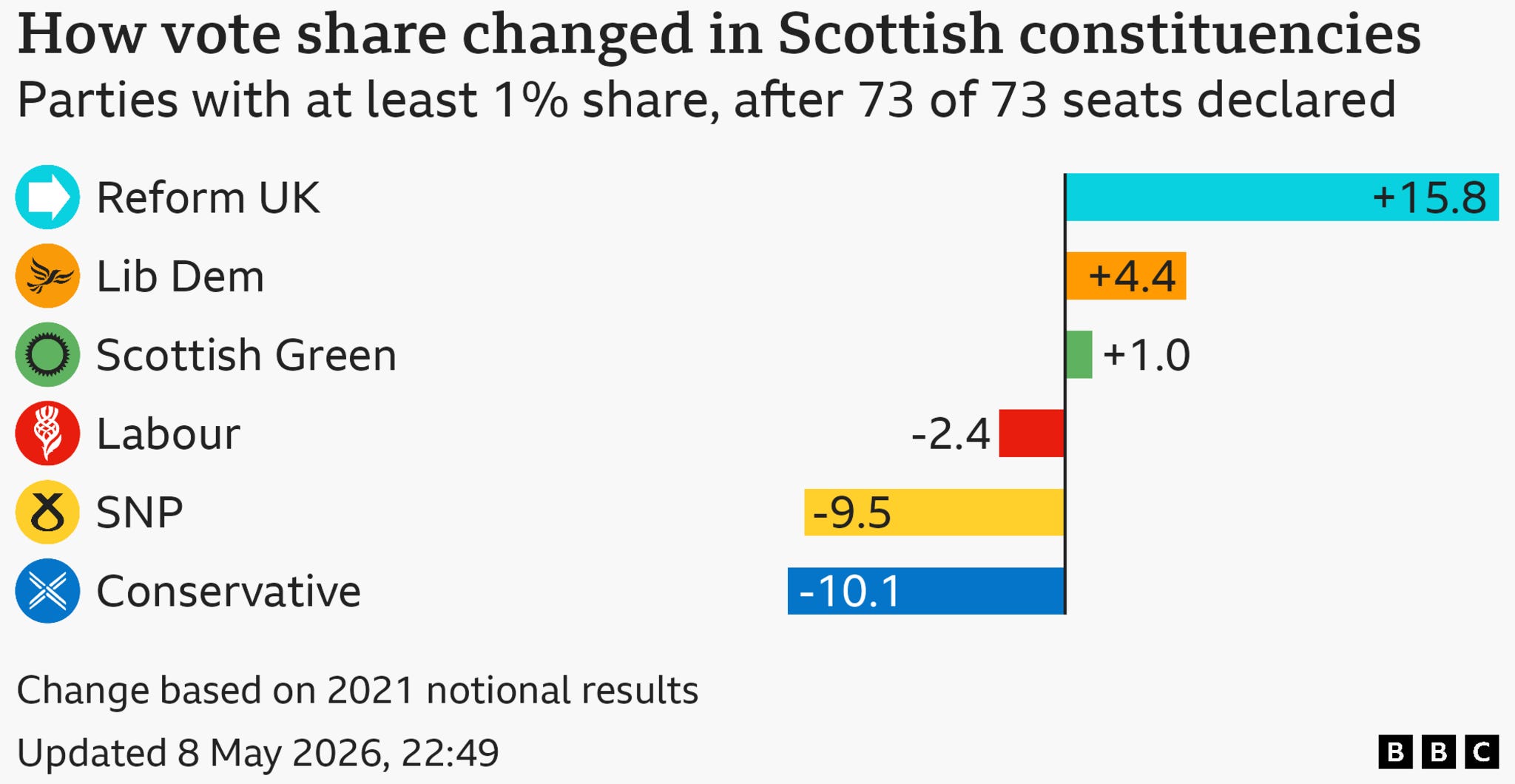
SNP vote share is down! They’re no longer as popular! Nobody wants independence anyway! It’s all about cost of living and the NHS!
Yes, SNP vote share is down, but it remains much higher than Labour’s at the last Westminster election. In fact, it was higher than Labour’s at any election in the last twenty years (excluding the first Corbyn one, but they don’t talk about that). Must try harder.
So, just like the bubble, we’ve been avoiding the elephant in the room: independence. This is not an “issue” like the cost of living or the NHS. It’s something that over-arches all priorities, promising to help Scotland better address them all. So of course we want reduced cost of living, a better performing NHS etc. but we can simultaneously want those things now, whilst aiming for a place where we can more thoroughly address them. And that place is called a Scotland, independent once again, and back in the centre of Europe as part of the EU.
This should be self-evident even to the bubble: The Scottish Parliament has been mostly full of pro-independence MSPs for the last 25 years. And it has never been a bigger number.
Comments
Nothing yet. Say the first thing.
Sign in to join the conversation.