
Wilkes Barre (which, in my personal experience, is pronounced “Wilkes Berry”, “Wilkes Bear” or “Wilkes Bar” with equal frequency (and “Berry” is allegedly the correct one)) is a small Pennsylvanian town nestled in the shadow of Scranton, one of the Keystone State’s particularly dismal offerings. Beyond reason, this humble burg is responsible for some of modern hardcore’s sea-change moments, delivering styles and aesthetics that have been emulated and adopted the world over – more bands are ripping off Cold World now than ever, for example. Eventually the Wilkes Barre hardcore story will be written (and I’m willing to be interviewed for the Home Base and Ed Gieda chapters), in which Ned Russin will undoubtedly be a key figure.
Now based out of another ground-zero for hardcore, Washington DC, Russin plays bass and sings in Glitterer, though he most famously did the same for Title Fight, a group’s whose stylistic evolution continues to reverberate with hardcore obsessives and dabblers alike. They’re one of those rarified bands whose legacy has consistently expanded through their absence, having played their last show nearly nine years ago. Never say never, but Russin has always focused on the present rather than the past, and he does so with candor and contemplation, coming from a self-evident love of hardcore and its underground community. When it’s in your blood, it’s in your blood, and it wouldn’t make sense any other way.
His takes in the Joint Custody record-shop newsletter (go subscribe now!) offer valuable insight into the way his mind perceives, wrestles with and falls in love with music – that whole crew is deeply thoughtful without being pretentious about it, but Russin’s writing goes especially deep, his passion undeniable. As he confirms below, his sights remain on what’s next, so I’m extra thankful he was willing to think back for a moment and share his worst song with us, which you can listen to here.
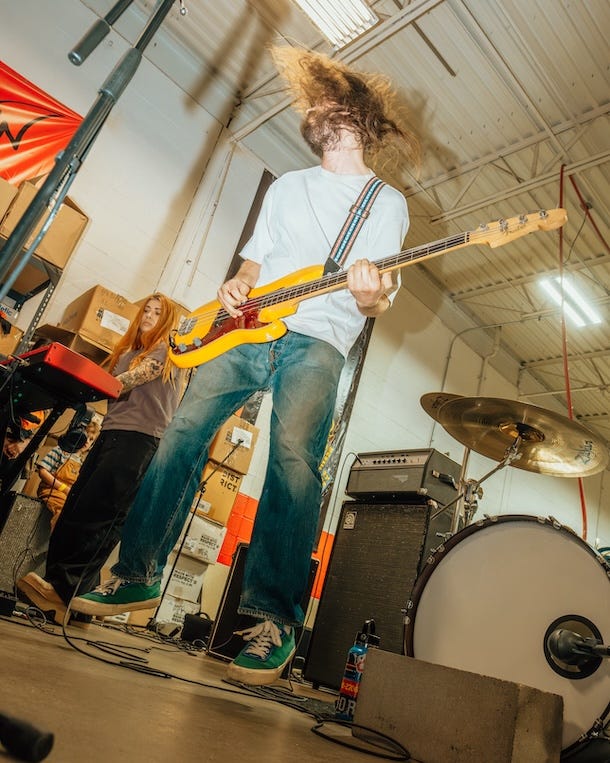
NR: Okay, I’ve been writing and releasing music since I was twelve years-old but it feels a little unfair to pick on those songs. It’s tough to flat out say “worst” but the song I wish we either left off the record or worked on more is a Title Fight song called “Calloused” off Floral Green. It’s on the B-side of the record when things start to wind down and it’s supposed to be this anthemic moody alt-rock kind of thing but I have a few qualms with it.
One: I used a distortion pedal on the bass. I never used pedals, partially on my Ian shit, but also because I know I would destroy them if I brought them on tour. I wanted to expand my tonal palette by adding some different sounds and threw a random pedal in front of the amp. At the time I wasn’t very interested in or knowledgeable about pedals, or gear at large for that matter, and not that I really am now but I know enough at this point to know that the cheap Tube Screamer clone was a bad choice. Not my best tone moment.
Two: I think the chorus is lacking. The hook really became Jamie’s response vocals, and more specifically the “baby” was what made me most interested, and the little guitar lead, but what stands as the chorus right now is really a pre-chorus in my mind and nothing comes to back it up.
Three: In terms of sequencing I think this screws up the flow, shifting the momentum laterally rather than moving forward. I also dislike records with an odd number of tracks because it makes the sides uneven, but that’s not reason enough to dislike this song, just another reason in my mind to make an excuse why it’s a potential contender for the chopping block.
YGR: I get the impression that you’re someone who really appreciates the album format, and the fact that you’re bothered by the placement of this song relative to the rest of the album seems to back that up. Do you write music with a sense of where you’d like it to end up – say, album opener, interlude, side two breather, etc. – or do you just write song after song and then figure out how to best fit them together after the fact?
NR: It’s a little of both. Starting out, it’s always just writing songs. There are definitely some ideas whose placement is pretty easy to see early on, but it’s just a very rough sketch. Then, once we hit a certain point where a record starts to take shape, I just try to take stock of where we’re at. You don’t want to have too many songs that have the same kind of components, so I’m always trying to just make sure it’s varied yet cohesive, and then later once we start to sequence it, that it has some sort of propulsion.
YGR: What’s your relationship like with pedals now?
NR: I’ve got a drawer full of them. I use them for demoing at home but mostly just offer them to friends when they’re playing a show or are recording. I don’t really know why I have them to be honest. I play in one band in DC where I use an octave pedal, but that’s it.
YGR: Your “worst song” pick strikes me as a rational one, based more in logical reasoning than any sort of emotional gut reaction. Is that fair to say? What’s your relationship like with your songs once you’ve shared them with the world – do you view them more as your precious babies, or your quality goods, or not remotely either?
NR: Yeah, I think that’s a fair assessment. I mostly feel like when a song is done and recorded, it’s done and I don’t want to go back to it. More like a kid I’m sending off to college than a precious baby. You’ve put in the work and you got it as figured out as you can, and then you just let go and cede control hoping you got it right. I obviously try to reflect but I try not to stew. I want to keep moving forward instead of focusing on the past.
No posts
Comments
Nothing yet. Say the first thing.
Sign in to join the conversation.