
In the late 1980s, federal regulators in Texas faced an unusual problem: what are they supposed to do with thousands of half-built condos financed by bankrupt thrift banks. The buildings had no buyers, no tenants, and mounting maintenance costs. What was the solution? Federal regulators decided to burn them down. It was cheaper to demolish and torch the properties than to maintain them while waiting for a market that would never recover.
This was the end stage of the Savings and Loans Crisis, a $124B financial disaster that had been building since the 1960s.
(If you want to read part 1 on how the Savings & Loans Institution (also known as thrifts or S&Ls) was even created and rebuilt by President FDR click here. If you want to read how Nixon, Ford, and Carter continually put band-aids on a dying industry, read here.)
In short in part II, Nixon and Ford repeatedly bailed out thrifts. Meanwhile, Carter tried deregulation with the Depository Institutions Deregulation and Monetary Control Act of 1980 (DIDMCA), which raised deposit insurance from $40K to $100K, killed interest rate caps on thrifts, and allowed thrifts to invest 20% of their portfolios in consumer loans, credit cards, and business loans. Now it’s Reagan’s turn.
During Reagan’s early months, he signed the Economic Recovery Tax Act of 1981. This law reduced the depreciation schedule from 30+ years to a 15-year accelerated depreciation. For those who don’t know accounting, depreciation is a non-cash expense. I’m simplifying the law, but in general let’s say the physical building of a property is worth $1.5M, Reagan’s depreciation law allows you to deduct $100K per year from your expenses. If you earned $90K from your property, you can legally report that you made -$10K from your property, allowing you to write off losses. This was done to spur business investment.
The second major thing his administration did was that the Federal Home Loan Bank Board (FHLBB) authorized troubled thrifts to issue “income capital certificates” that the Federal Savings & Loans Insurance Co. (FSLIC) would buy. This wasn’t real money; accounting rules simply allowed thrifts to count these certificates as capital. It was a paper bailout to disguise insolvency.
The real math was ugly. Thrifts needed a $25B cash injection. The FSLIC had only $6B in reserves, meaning a real bailout would require an additional $19B in taxpayer and bondholder funds.
To sidestep a visible taxpayer bailout, the FHLBB authorized “Regulatory Accounting Principles” (RAP). These principles allowed thrifts to defer immediate losses and count “Goodwill” as tangible capital. This was accounting magic to mask technical insolvency, allowing zombie thrifts (thrifts with negative net worth) to continue operating with full government backing.
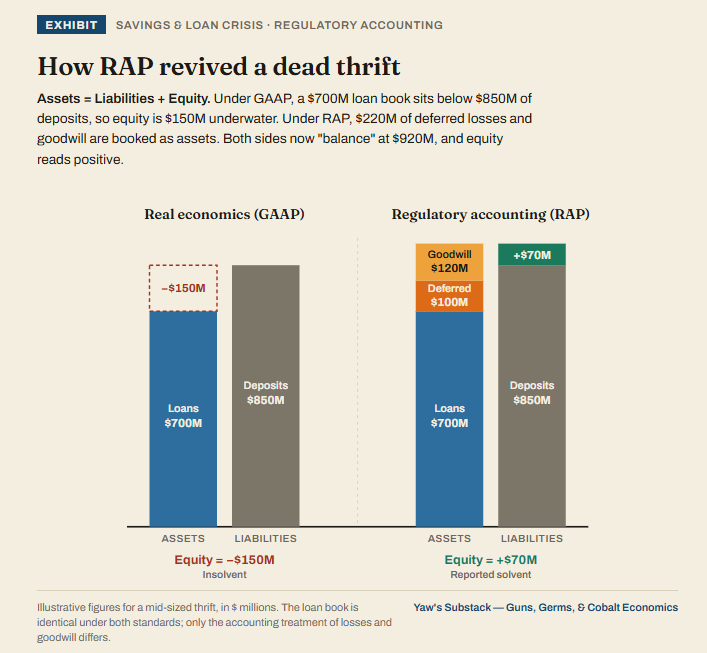
In addition, Reagan signed the Garn-St. Germain Depository Institutions Act of 1982. If Carter’s DIDMCA had started deregulation, then Garn-St. Germain turbocharged it into a casino. The cope hope was that thrifts could gamble grow their way back to solvency. This did not happen.
Thanks to Reagan, thrifts could now make risky commercial real estate loans, buy high yield junk bonds, and fund other speculative ventures. Between 1982 to 1985, thrift industry assets grew 56%, not necessarily because the real economy was booming, but because zombie thrift banks were doubling down on high-stakes bets.
This created a moral hazard. Because Carter’s DIDMCA law raised deposit insurance to $100K, the risk of a thrift failing had shifted entirely from depositor to taxpayer. Insolvent thrifts had nothing to lose, which invited sweeping fraud.
With interest rate caps removed and the government guaranteeing every penny up to $100K, a new financial innovation scheme emerged on Wall Street: Brokered Deposits.
A Wall Street firm like Merrill Lynch would take $50M from a pension fund in NY, slice it into 500 chunks of $100K each, and scatter them across thrifts offering the highest above-market rates. Every slice of $100K was fully insured by the FSLIC, so the pension fund took zero-risk, the Wall Street firm took a broker’s fee, and an insolvent thrift in Dallas got an instant infusion of cash.
This severed the link that defined thrifts since the 1830s. A thrift no longer grew on local community trust and reputation; but rather, it grew on yield. A zombie thrift bank in a tiny town with negative net worth could be bankrolled by Wall Street firms as long it advertised juicy, above-market rates. A dying thrift could attract millions overnight because no depositor cared whether the institution was sound when the government was on the hook.
But now, thrifts had millions in “hot money”, but the thrift faced a structural trap. To pay out 14% to depositors, they couldn’t just issue 7% home mortgages anymore, and rarely any homeowner wanted a 18% mortgage interest rate. Thrifts had to chase high-yielding “long shots” that exceeded the 14% rate the thrift offered: risky commercial real estate, junk bonds, and speculative land plays. And thanks to accounting forbearance (the government ignoring bad balance sheets), thrift owners often gave loans to “friends” for fraudulent & nonsensical real estate projects.
The thrift, Empire Savings, provides the quintessential case study. Empire’s assets ballooned from $39M to $270M in 11 months through aggressive, fraudulent lending, mainly from speculative real estate.
The scheme worked like this:
Developers would buy a piece of raw land and continually flipped it back and forth to artificially inflate its appraised paper value from $3M to $30M.
The thrift would issue a massive construction loan based on that fake valuation. In this case, loans would be 70% of the land’s value. 70% of 30M is $21M.
Actual development costs were actually worth a fraction of that amount, maybe $2.5M.
The remaining $18.5M was cleanly pocketed up front by developers as “incentives” and split with thrift owners via kickbacks and massive 1% origination fees (1% of 21M is $210K per deal).
These giant, fraudulent loans actually made the thrift’s balance sheet look incredibly healthy on paper, because loans, while being a liability for the borrower, are assets for financial institution. Bigger assets made thrift’s soaring liabilities (the volatile brokered deposits) look comfortably covered. This artificial solvency allowed thrifts to attract more Wall Street-brokered deposits, repeating the loop until developers stopped making interest payments exposing the worthless loans underneath. In many cases, developers used the loan proceeds to make interest payments, a trick that bought time until default. Many of these real estate projects weren’t completed and had no tenants to pay down the debt. When Empire collapsed, taxpayers paid $300 million through the FSLIC.
Empire wasn’t an isolated case. In fact, Empire was one case out of legion.
The fraud scheme worked until 1986. The thrift industry hit a brick wall made of two simultaneous disasters.
In 1986, Reagan undid his initial tax bill. As said before, after 1981, the U.S. tax code was a giant subsidy for real estate speculation. High-earning professionals (like a doctor in New York) could use “passive losses” from investing in a half-empty condo in Dallas (collecting no rent but still incurring costs like depreciation, property taxes, insurance, & maintenance, making the condo loss making) to offset their personal income tax bills. Reagan’s 1986 tax reform killed those deductions and extended depreciation schedules, which reduces the non-cash depreciation expense you can claim each year. Essentially, to pay for the 1986 tax cuts, Reagan raised revenues by killing “passive loss” deductions. The investment logic of having a loss-making real estate investment offset their day-job salary to reduce their income taxes died overnight. Thousands of investors dumped their holdings simultaneously, and property values cratered. The collateral backing thrift loans was suddenly worth a fraction of the loan amount.
The Oil Price Collapse. In the same year, the oil market imploded. Non-OPEC production had risen in the North Sea (UK and Norway) and Prudhoe Bay (Alaska). OPEC members like Nigeria and Venezuela were cheating on their production quotas, pumping extra oil to service sovereign debts. When Saudi Arabia, the “swing producer”, flooded the market after 1985, nearly doubling output from 2.4 million to 5 million barrels a day, oil prices crashed. As a result, the oil industry in oil-states (Texas, Oklahoma, Louisiana), which needed higher prices to justify drilling, laid off engineers, rig workers, and geologists en masse. The loyal demand for housing in these states evaporated.
Texas was ground zero for both shocks.
The tax code killed the investors; the oil bust killed the tenants. Thrifts that took brokered deposits and poured money into speculative Texan real estate and construction loans were now holding loans that no one could repay on properties that no tenants were renting. With Texas not attracting tenants for empty real estate, no one was paying off their thrift loan. By 1988, 40% of all thrift failures had occurred in Texas. At auction, regulators recovered at best 75% on $400 billion in defaulted assets. With maintenance costs piling up on vacant properties (fencing, guards, insurance, taxes, repairs) and no tenants to collect rent from, the FSLIC decided it was cheaper to demolish and burn unfinished condos than maintain them.
Between 1986 and 1991, over 1K thrifts died.
By 1989, when George H.W. Bush took office, a major political scandal erupted: the “Keating Five”. Five U.S. senators (4 Democrats + Republican John McCain) were accused of improperly pressuring federal regulators to save Charles H. Keating Jr, the chairman of the Lincoln Savings & Loan Association, which was then under federal investigation by the FHLBB.
Lincoln Savings was an absurd case of fraud, growing from $1B to ~$5B in assets in less than a decade, fueled by junk bonds, speculative real estate, and systematic investor deception. When Lincoln collapsed 1989, taxpayers federally insured $3.4B in savings deposits.
~23K Lincoln bondholders, many retirees, were defrauded after being misled that these high-risk securities were safe, government-insured savings products. Keating cultivated political influence by providing political contributions and luxury travel, including Bahamas trips and resort stays, to the five senators and their associates. While none of the senators were convicted, several of them were reprimanded by the Senate Ethics Committee. The scandal turned the S&L crisis from a boring regulatory story into a public outrage.
Bush decided the bleeding had to stop. He passed the Financial Institutions Reform, Recovery, and Enforcement Act (FIRREA) of 1989. The main thrift regulator, the Federal Home Loan Bank Board, and the main insurer, the FSLIC, were both abolished. The Resolution Trust Corporation was created and funded to shut down 747 failing thrifts holding over $400 billion in dead loans. The crisis finally ended on December 31, 1995, when the RTC closed under Clinton. The total cost to taxpayers: $124B.
The entire story of thrifts was the slow death of an outdated financial model.
Thrifts made sense in the 1830s when American capital markets were primitive, long-term mortgages barely existed, and ordinary households had few ways to pool savings. The industry nearly died during the Great Depression, and the New Deal then rebuilt it around a simple formula: short-term deposits funding long-term fixed-rate mortgages, protected by deposit insurance and interest-rate controls. That system worked in a stable post-WWII world. It stopped bank runs, expanded homeownership, and helped create suburbia.
But by the 1960s and 1970s, banks, money market funds, and treasury securities offered savers better returns than regulated thrifts could legally pay. Depositors pulled their money. Thrifts remained stuck holding mortgages issued at 5-7% while savings rates climbed to double digits. Their assets were bleeding in value as interest rates climbed up and their liabilities were walking out the door as banks and other financial institutions offered more competitive products. The industry was economically dead long before it was politically dead. If you are a Gen-Z or millennial in the United States, you may have only thought thrifts were cheap clothing stores from a Macklemore song. Frankly, by the 1960s, thrifts weren't doing anything unique anymore. I don't need a regulated utility like a thrift to give me a mortgage. I can just go to a bank.
At that point, American Presidents could do the following:
Bailout thrifts
Pretend Insolvency didn’t exist
Allow thrifts to gamble their way to back to solvency
Let Thrifts Die
Recapitalize thrifts by making the government absorb losses. The government would buy the thrift’s below-par mortgages (mortgages paying 6% in a 12% interest rate environment), and replace them with government bonds paying market rates.
America chose options 1 through 4 in that order over the decades. Now using cognitive empathy, let’s come up with different narratives of who to blame.
If I put my tech bro/libertarian hat on, the clear fault is the U.S. government. The New Deal locked thrifts into a business model that depended on capped savings rate deposits to fund long-term fixed-rate mortgages on razor-thin margins where the taxpayer would insure deposits. This only works when inflation is low, rates are stable, financial competition doesn't exist, and capital markets are underdeveloped. The New Dealers weren't enlightened monarchs. They were answering "how do we restart housing now?" not "will this institution make sense in 40 years?" By the 1966 credit crunch, this model was dead.
Also, LBJ, Nixon, and Ford politicized housing finance. Carter created forbearance. And Reagan built an incentive structure where it was obvious that crooks would exploit it.
Imagine a casino hands you chips and tells you: “Keep everything you win, and if you lose, the casino will cover it.” No rational person bets small. You shove everything to high bets, because a win is yours and a loss is someone else’s. That was a zombie thrift’s exact incentive. With government-guaranteed deposit insurance covering the downside and shareholders keeping the upside, by-the-book lending was the only guaranteed way to stay dead. Also, Reagan’s deregulation to let insolvent firms gamble with state-backed insured money isn’t “free market.” It’s “if it’s heads I win, if it’s tails taxpayers lose.”
And the fraud? Frankly, fraud was a rational response. Extreme risk gives you a lottery ticket while insurance covers the downside. If you are insolvent, by-the-book lending guarantees you a slower death: start at -100, grind your way to -85 over five years, and you’re still a zombie, because dead was zero.
But the problem with the market-friendly hat is that I am blaming the very government-insured guarantees and interest-rate controls that ended the bank runs in the Great Depression. The logic is sound, but I am handwaving away the social problems those guarantees existed to solve.
If I put my social democrat hat on, I would blame Reagan’s deregulation. I would care more about the social goals of government policy than the bad incentives my regulations created. The government did something valuable by stabilizing home finance, expanding homeownership, and ending panic thrift withdrawals. Then inflation, interest rate spikes in the 70s, and Reagan’s deregulation killed the system.
Under this view, the Republican bailouts under Nixon and Ford weren’t big enough. What thrifts needed was recapitalization, or possibly nationalization. America at that time needed to take on debt of roughly a quarter a trillion (which exceeded America’s total government revenue in the early 1970s) and buy all the mortgages from the thrifts. That would have given thrifts a clean start. There should have never been Carter-style forbearance or Reagan deregulation creating fraud and the death of an entire industry. The problem wasn’t government, the problem was insufficient policy design and inadequate regulation.
The issue is that “better policy design” and “inadequate regulation” are handwave words. It assumes politicians optimize for long-term policy, when in both Democrats (LBJ) and Republicans (Nixon), we see that the American political economy is geared more for avoiding blame and political considerations than good sustainable policy.
In the 1960s, LBJ was politically attacked since the government was essentially borrowing money and using taxpayer dollars to buy mortgages. He took Fannie Mae off the government balance sheet to avoid that political attack. Nixon did bailouts not because he believed in thrifts but because he could extend and pretend and give the problem to future presidents. Also, no one was going to spend a quarter trillion dollars to recapitalize thrifts at any point from the 1960s to 1980s. It would have been political suicide during the Vietnam war and would have been hated by the American taxpayer. Regulators and Presidents aren’t enlightened monarchs. You couldn’t make bad math work for an industry once interest-rate shocks happened.
The sad part is, America is not unique in this. The S&L crisis was a combo of “pretend and extend” or “gamble to solvency or death”. Other countries have similar stories. I’ll give three:
Japan in the 1990s:
Japan’s “Lost Decades” banking crisis is basically the “pretend and extend” aspect of the American S&L Crisis, except you keep insolvent banks alive for decades and live with the sluggish growth of bankrupt banks.
The Eurozone Debt Crisis from 2008 to 2018:
Italian banks held Italian government bonds, Spanish banks held Spanish bonds, Portuguese banks held Portuguese bonds, and Greek banks held Greek bonds. Everyone initially thought they were safe until Greece defaulted, Italy’s debt servicing costs exploded due to rollover risk (Italy had to refinance old debts at ~4% interest rates into new debts at ~7%), Spanish banks looked fragile due to a real estate bubble burst, Portugal had a mix Greek, Spanish, and Italian problems. Bond prices fell, interest rates spiked, and mark-to-market losses appeared (when assets lose value hard, so there’s a difference between what bonds are worth on paper and what they could actually be sold for). Instead of allowing banks to recognize losses (which would have been a doom loop), the EU just pretended the banks weren’t insolvent. Greece defaulted and needed IMF loans, Italy continues to manage the crisis, Spain got a real estate crash and partial EU cleanups, and Portugal had a restructuring & an IMF loan. This was a clear “pretend and extend”.
Zombie LGFV & Zombie in China, 2018 to present:
China sits somewhere between Japan's Lost Decades and the American thrift crisis but with far more control. The Chinese central government is allowing state-owned banks to "pretend and extend" for insolvent Local Government Financing Vehicles (LGFVs), similar to Japan and Nixon-era America. But the difference between China and America or Japan is that China has capital controls. Chinese households can't easily pull yuan out of banks, convert yuan to dollars/euros/pound sterling and then park foreign currency into foreign assets. As a result, capital controls give China more time to fix its crisis than the U.S. or Japan ever had. China allowed some visible failures like Evergrande's death in 2024 rather than indefinite bailouts, so that's less total denial than Japan. But, where China resembles “gamble to solvency or die” like Reagan-era America is that the Communist Party of China wants to grow local governments out of insolvency, but instead of Texan real estate, they want them to lend into winning EV companies, renewable batteries, aerospace, semiconductors, and advanced manufacturing.
The real reason I spent so much time discussing the Savings & Loans Crisis is because it provided the legal & financial architecture and the psychological playbook for the 2008 Great Financial Crisis (GFC). You cannot understand GFC without understanding why the government created Fannie Mae, Freddie Mac, & deposit insurance or why Wall Street created Mortgage-Backed Security market in the first place.
The biggest difference, of course, is that normal Americans largely ignored the Savings & Loans Crisis. Thanks to Carter, deposits were insured up to $100K, so even if a thrift died from some fraudulent condo deal in Texas, that had almost no impact on your middle class family in Ohio or Wisconsin. The multi-billion-dollar pain was socialized through taxes & bond issuances, not lost consumer deposits.
But the thrift crisis left behind a culture of regulatory arbitrage.
By the 2000s, the thrift industry was largely obsolete, but firms like Washington Mutual, Countrywide, and IndyMac still chose to have thrift charters because the Office of Thrift Supervision (OTS) was a friendlier and less intrusive regulator than getting a national bank charter, regulated by the Office of the Comptroller of the Currency (OCC), a state-charter regulated by the Federal Deposit Insurance Corp(FDIC), or a bank holding company regulated by the Federal Reserve.
This allowed these thrifts to load up lending to un-lendable people (subprime mortgages) with minimal interference. We’ll talk about the Great Financial Crisis soon.
Comments
Nothing yet. Say the first thing.
Sign in to join the conversation.