
Are you interested in a one-on-one mentoring session with myself, alongside written feedback on a sample of your work? I’m doing a giveaway of just that - scroll to the bottom for deets! But first…

What is your relationship to technology? Whether we’re talking your personal phone, your time on your social media platform of choice, how much screen-time your child is exposed to, what to do about “AI”: do you feel like you are in control? Like you have agency in those dynamics?
I would wager the answer is no. Not because I doubt your personal discipline, nor because I’m coming from a place of judgment, but because the dis-empowerment you feel is by design. We have been socialised, institutionally, economically, even narratively, into a sense of powerlessness. Headlines are largely pessimistic: “AI ‘could be last technology humanity ever builds’, expert warns in ‘doom timeline’”, claims the Independent. “Inside a growing movement warning AI could turn on humanity,” yells the Washington Post. Search phone addiction online and thousands of results pop up. “Severe phone addiction. Help me save my life,” reads one Reddit plea.
Forget about the kids. We are not alright.
But… might we be.
All is not lost. I refuse to capitulate. I refuse to give up my agency in relation to technology, and I believe you should too: I’m straight out evangelical about it. We deserve better.
Part of this comes from the stubbornness that got me into endless trouble as a child, that same quality that led me to buying a notoriously unreliable first car (the Alfa Romeo 156, though it did have gorgeous mango leather seats), founding a youth organisation at sixteen and ending up plastered on the front pages of the Australian press by twenty-five. I don’t like being told what to do, or how to behave at the best of times, but especially not by some group of annoying engineers (or salespeople!) from Silicon Valley.
So yes, part of this is general obstinacy. Part of it is engineering-related arrogance, thanks to a degree in mechanical engineering and being raised with a healthy dose of STEM-superiority. But, a sizeable chunk of this attitude is political. There is enough in this world that tries to strip me of my agency, I’ve spent a lifetime standing against that. I’ll be damned if I let techno-fascism take over without a fight.
Now. A few caveats.
Obviously, much of what we are dealing with at the individual level is deeply structural. I’m talking about resisting multi-billion dollar institutions that are throwing continent-sized buckets of money at forcing dependency on their products and services, targeting everyone from vulnerable children to complex nation-states. This is no mean feat, and the leaders of these exploitative, profit-making enterprises do not have our best interests at heart. Indeed, CEO of Palantir, Alex Karp said in March 2026 that the company’s technologies were “dangerous societally,” but that “if we don’t do it, our adversaries will do it,” which is frankly the justification for every bad thing, ever.
That being said. What’s the best way to eat an elephant? Bit by bit.

What does it look like to instill, or re-instill a sense of agency in one’s relationship to tech? I’ll share what it looks like for me, in the hope that it might spark something for you.
We start by believing it is possible. If we cannot imagine something, there is little chance we will be able to achieve it. So, I invite you to imagine your ideal relationship with tech. I’m talking your true ideal, not this is what I think is possible, or, this is what I would accept – but your genuine, dream scenario.
Is it a fully automated smart home where you don’t have to worry about surveillance or your intimate data being sold off? Is it being able to pick up your phone and complete a task without being distracted by something else, wasting twenty minutes, then putting your phone down again, forgetting the reason you picked it up in the first place? Is it being able to think about what they cunningly call ‘Artificial Intelligence’ without worrying that soon, you’ll be out of a job?
For me, it’s simple. I want the technology in my life to serve my needs, not make them more difficult. ‘My needs’ is doing some heavy lifting here: it’s not only referring to my day-to-day requirements (stay in touch with friends and family, communicate with co-workers, sell my books), but more profound human desires (enable and deepend my spiritual practice, maintain and further develop my knowledge and critical thinking skills, hone my chosen craft, etc).
Having a clear sense of what I want technology to do for me, I can then go about figuring out what tools, platforms and avenues best serve those needs. Easier said than done perhaps, but if I start from a place of knowing what I am optimising for, I can make more informed decisions.
We can do it, folks. It’s not rocket science – and I’ve done that (plus, rocket science isn’t that hard, it just has persuasive PR. Not unlike ‘AI’).
E.g. I want to be able to stay in contact with my friends, but I want to do so in a way that feels secure and not overwhelming. To deal with the latter, I’ve turned off all notifications on my phone (this is why I keep missing your call, I’m sorry), and for the former, I prioritise using the Signal Messaging app. The most privacy focused of all messaging platforms, Signal is free, open-source and uses end-to-end encryption (a bare minimum for any secure communication). Most importantly, it’s not an app most people in the world use. This is what I call useful friction. By making something slightly, but not entirely, inconvenient, I filter out a significant chunk of ‘noise’. If you really need a response from me, you’ll message me on Signal. Has it annoyed a bunch of people? Sure! But I personally feel so much more in control of my messaging time. I’m not faced with hundreds of anxiety inducing unread notifications whenever I want to send my bestie a ranty voicenote.
I’ve also recently implemented a separation: I now have a work and personal phone. This felt initially impossible as a freelancer, given so much of my work and personal life are intertwined. But I decided to give it a try, and it worked! My personal phone has only a handful of apps: Signal, Soundcloud, mobile banking, and podcasts. It means when I’m off work I’m still reachable, but only by those I want to be reached by. I couldn’t access Instagram even if I wanted to – my password manager lives on my work computer. Creating this boundary around my tech has felt enabling, and given me another lever to feel like I’m in control.
Fine, whatever, I hear you say. So you’re using Signal and you have a separate phone. None of this is groundbreaking, or new, or changing the game. The system is still rigged, and what about AI?
My approach to the broad set of tools under the umbrella of ‘Artificial Intelligence’ is the same as any other. Identify what I want from the relationship, how the tool can best serve my needs, then deploy with an experimental mindset: trial, test, evaluate, tweak, then try again.
When something is entirely new, a natural response is to shirk away from the discomfort. Don’t listen to that urge. Lean in (RIP Sheryl). Engage with a beginners, childlike mindset: have a play.
In the case of Generative Large Language Models (like ChatGPT), I started by spending some time learning how they actually worked. What was new here: was it simply a tweak, or a true transformation? Deciphering reality from the hype can be a challenge, but especially when deep-pocketed VCs up and down every coast are invested in making you believe one thing. But don’t let the jargon of engineers disuade you: agency begins with understanding, and no-one is incapable of learning how things work.
Once I got my head around the mechanics (“okay, machine learning is trying to mimic the structure of the human brain, rather than working things out from a straightforward equation, it’s more akin to finding layers of patterns in large swathes of data”), I could more accurately discern what the tool might be useful for (summarising a document) versus not (generating pitch ideas). Before I began experimenting, I made some decisions informed by my politics. Ethically, I did not want to use models that were built using stolen Intellectual Property, and I did not want to contribute to the bottom lines of companies I morally disagreed with. So, I began experiments with platforms that were value aligned: Proton’s Lumo, Tinfoil, Ollama. I played around and tested all sorts of tasks I thought the tools might be helpful for: copy for my website, the perfect 200 word bio, ideas for a new TV show, editing an op-ed. Going in with an intention to make something work for me, meant that I could evaluate the results with eyes wide open.
None of these solutions are perfect. I still rant and rage at the fact that I have to download an app to pay for parking when standing in front of a perfectly serviceable coin machine still nailed to the concrete footpath. But, I have broadly made it my mission to ensure that I never feel like I have no choice when it comes to tech. ‘They’ want you to feel this way – ‘they’ being profit making enterprises that will take every single bit and byte of your life as a datapoint for advertisers and authoritarian regimes. But we don’t have to accept it as read. We don’t have to use their products. We don’t have to buy their bs. We can start from a position of power, remembering that we are in control of our relationship with the tools around us. They are not magic, nor are they en-souled. They are simply chips and wires, run by people who hope we’ve missed the lesson in the Wizard of Oz.
For those who have made it this far, well done! Details of my summer giveaway below…
(and it’s a pretty banging offer, if I don’t say so myself!!)
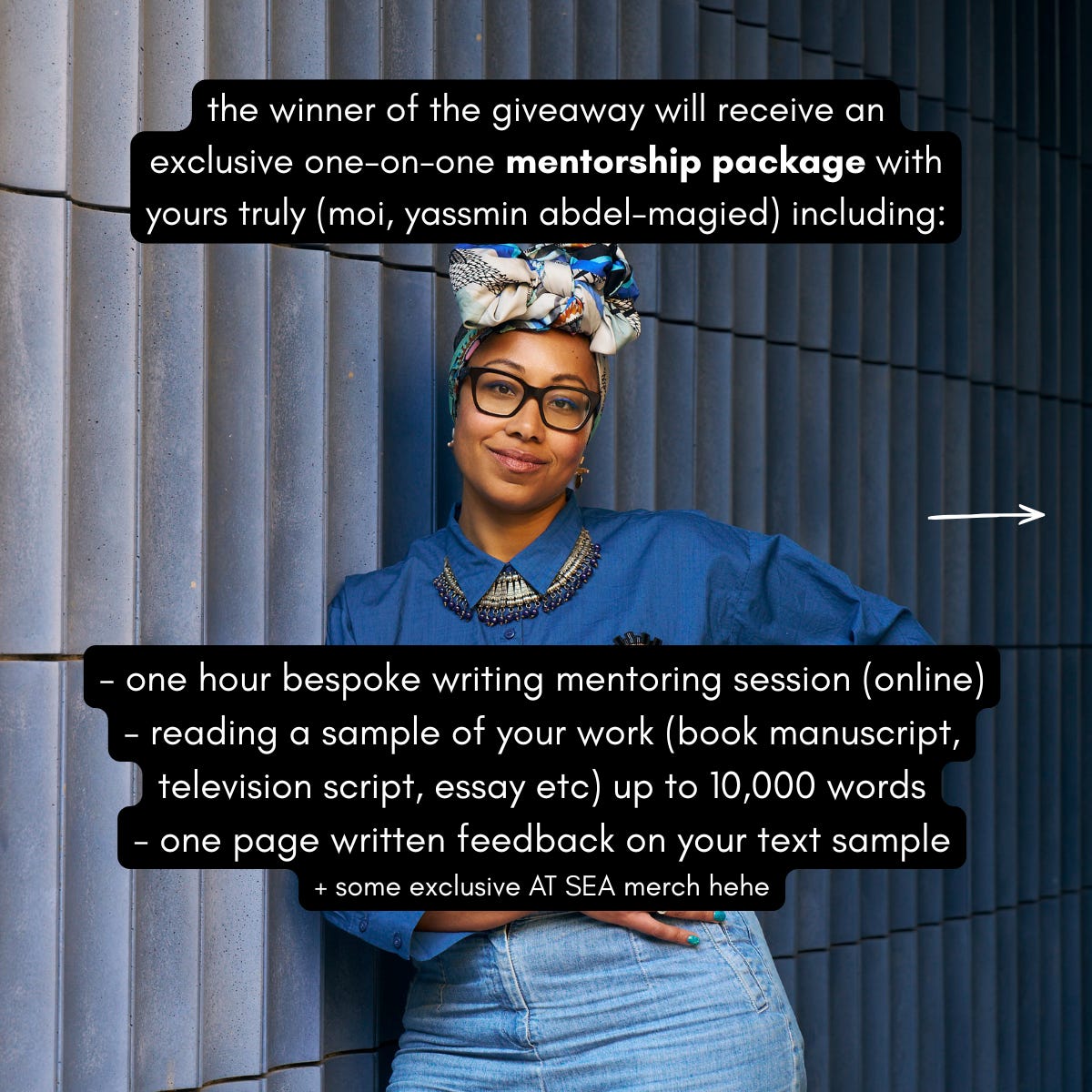
How do you enter?
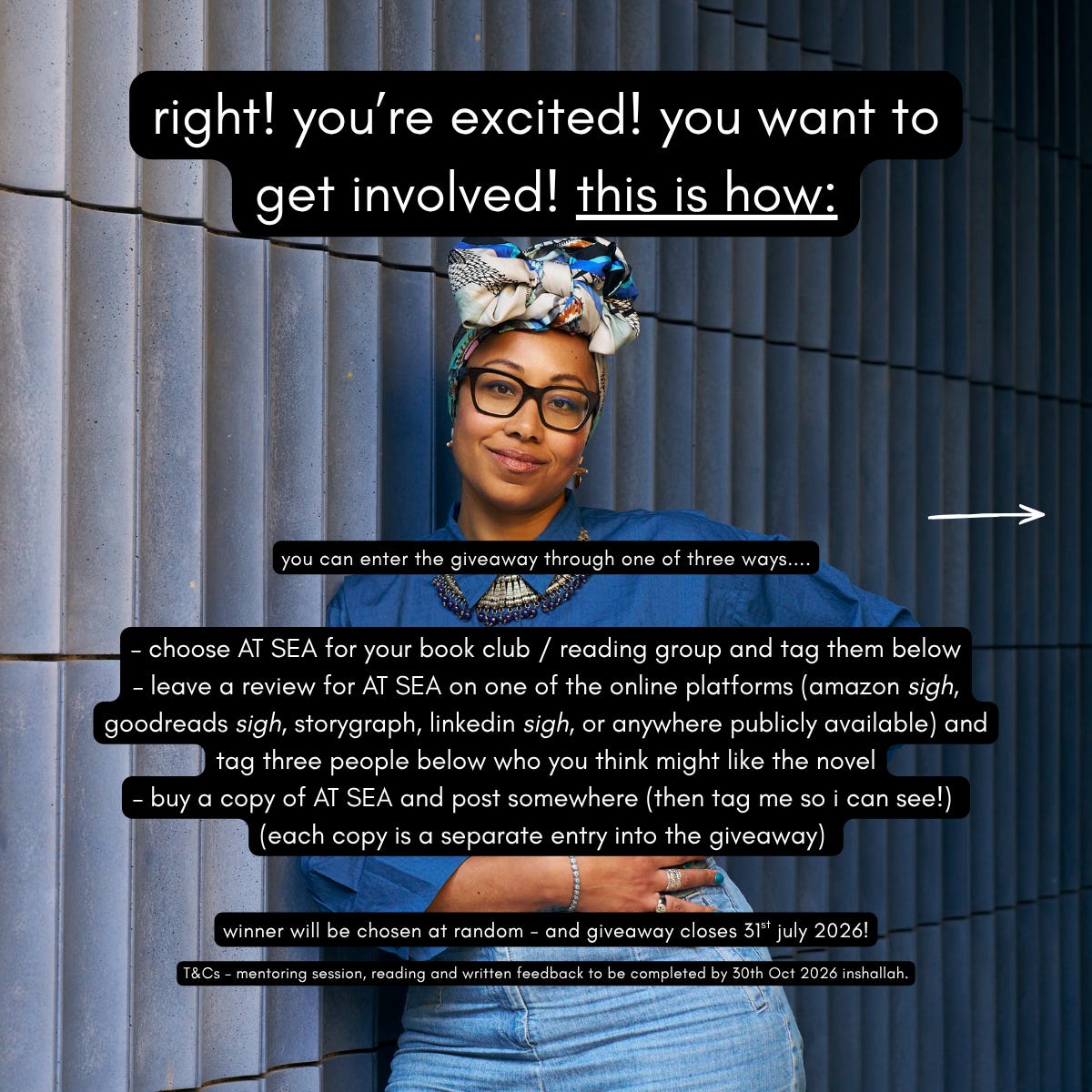
For folks on social media (insta, twitter etc) the giveaway closes on 31st of July. For you, my lovely substack subscribers, you can enter until the 2nd of August (next Sunday!). If you don’t want to comment below with your ‘proof of entry’, just reply to this email or send me a message directly.
Before I leave you to your weekends, a couple of bits and bobs about AT SEA you might have missed:
— This fabulous conversation with the Readings bookshop in Melbourne (who also gave the novel a brilliant review, thanks team!) saying it was ... a rare find amid a mid-year bumper crop of new fiction, both intimate in scope and unsettling in its broader prescience.
— In conversation with the Australia Institute:
— and this lovely interview highlighting one of my favourite places, the London Library!
Also, in my usual mention of the latest on Sudan, this recent documentary interviewing survivors of the genocide in El-Fasher is definitely worth your time.
That’s all for now, wonderful readers. Hope you have a restful remainder of the weekend, and a blessed week ahead, inshallah. For those entering the giveaway, good luck!
Comments
Nothing yet. Say the first thing.
Sign in to join the conversation.