
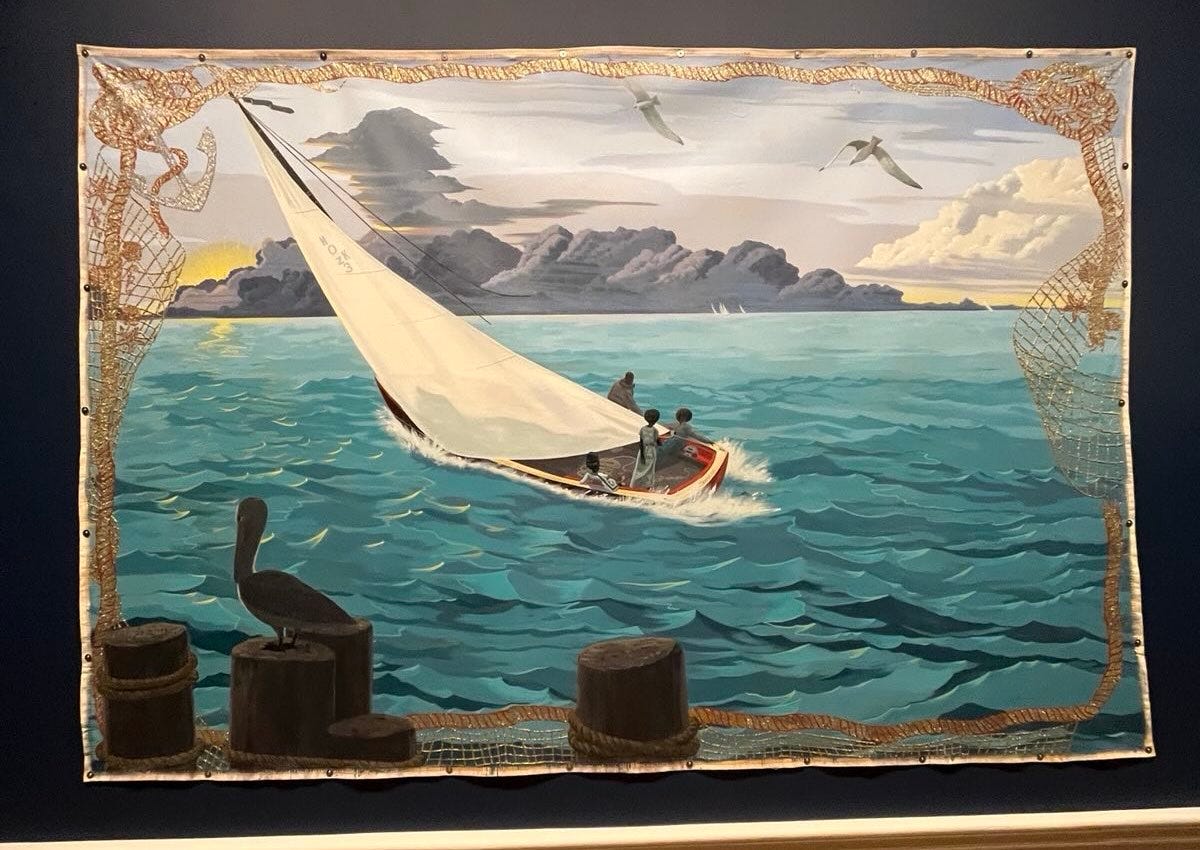
“Do you have a therapist?”
The question, asked by a friend as we stood in front of a Kenny Marshall James painting depicting enslaved Africans cross the middle passage, took me by surprise. I had been talking about Sudan, venting frustration about something or other, so I had to pause and collect my thoughts, before responding.
“A therapist?” I felt wrong footed, unsure why the conversation had shifted so suddenly. “What for?”
“Well, to deal with all of this,” she gestured. “How do you work through all of these feelings?”
I couldn’t dismiss the thought fast enough. I replied somewhat defensively, angrily, my palpable frustration a disproportionate response to her kind and concerned query. In the moment, I wasn’t even aware of why I was taking such offence: members of my family work in therapeutic services, I have had therapy in the past, I have often extolled the importance of such treatment to others. Why was I reacting like the concept of ‘working through my feelings on Sudan’ with a therapist was borderline insulting?
“I don’t want to have to explain what’s going on,” was one reason I offered. While a weak and superficial take, it was not entirely untrue. Being diaspora Sudanese in this moment is to constantly be explaining, justifying, educating. There is little room for the actual emotion; one cannot be in tears when producing an instagram reel on ‘three things you should know about Sudan’. That being said, any therapist worth their salt would do the prep work to understand the context, so hopefully a session wouldn’t be about the geopolitical implications of the current war, but on my personal well-being. No, that couldn’t be the real reason.
“I don’t want to have to talk about my feelings to someone who has never had a genocide happen to their people,” was another of my defensive arguments. I said this line with much stronger invective and with a loud enough voice that I don’t think I imagined seeing my friend flinch. There is a seed of truth here, but again, it doesn’t entirely stack up to scrutiny. Someone doesn’t have to go through the same trauma to be a good listener, a useful interlocutor, a kind and wise counsellor or guide during a difficult time. Yes, there is an ready-made closeness and intimacy that arises from shared experience, but that alone isn’t enough. So once more, it was a justification papering over something deeper.
As I reflected on the conversation in the days afterward, I was reminded of a relative of mine who volunteers with the Sudan Solidarity Collective. We had recently met up for coffee in Vancouver, and ours was the first conversation in a long time I found myself able to relax. There was a shared understanding, both said and unsaid, but not only that, we seemed to be grappling with the same demons - the loss of our homes, the frustration over the divisions within the Sudanese communities, the desire to do as much as we could with an understanding that we would never be able to do enough. She ‘got it’.
But after a back and forth, including lamenting the violence of having the RSF trash and graffiti family bedrooms, my cousin leaned back and sighed. We had been discussing the loss of memory and material goods, but the SSC was also working with those who had just escaped the genocide in El-Fasher, on foot.
“People were texting in the Whatsapp Group like ‘we’ve just gotten out’, and within 48 hours they were asking us about setting up new community kitchens in the places where they’d set up camp.”
Tears were in both our eyes.
“Subhanallah, the resilience!” I exclaimed, or something to that effect, though there was nothing I could say that could do justice to what these people were finding the strength to do. My cousin said what we were both thinking. “How can I complain when that is what our people are facing?”
If they were able to continue, surely we could too.
I know this is not the ideal thinking. I know it doesn’t work that way. I know; indeed, I have said the same thing to many of my activist friends over the years. Don’t work yourself to the bone out of guilt, don’t deny your feelings, take care of yourselves because we are in it for the long haul. Alhamdulilah, I think I am doing alright in this regard. I’m trying as best as I can to pace myself, to share work, to manage expectations.
And yet. I do not think I have it in me to ‘go there’. If I’m honest, that was what my knee jerk reaction to my friend’s question was all about. What is happening in Sudan, what is being done to Sudanese people, how the way the very fabric of the land and the society is being torn asunder, all while the tragedy - despite its historic scale - is so deeply invisibilised; all of it feels so utterly rage inducing, so overwhelmingly angering, I do not trust myself to open that pandora’s box. I feel it within me, most of the time, a burning coal of fury I keep buried under a thick layer of ash I top up with prayers and supplications, begging Allah to keep my temper in check.
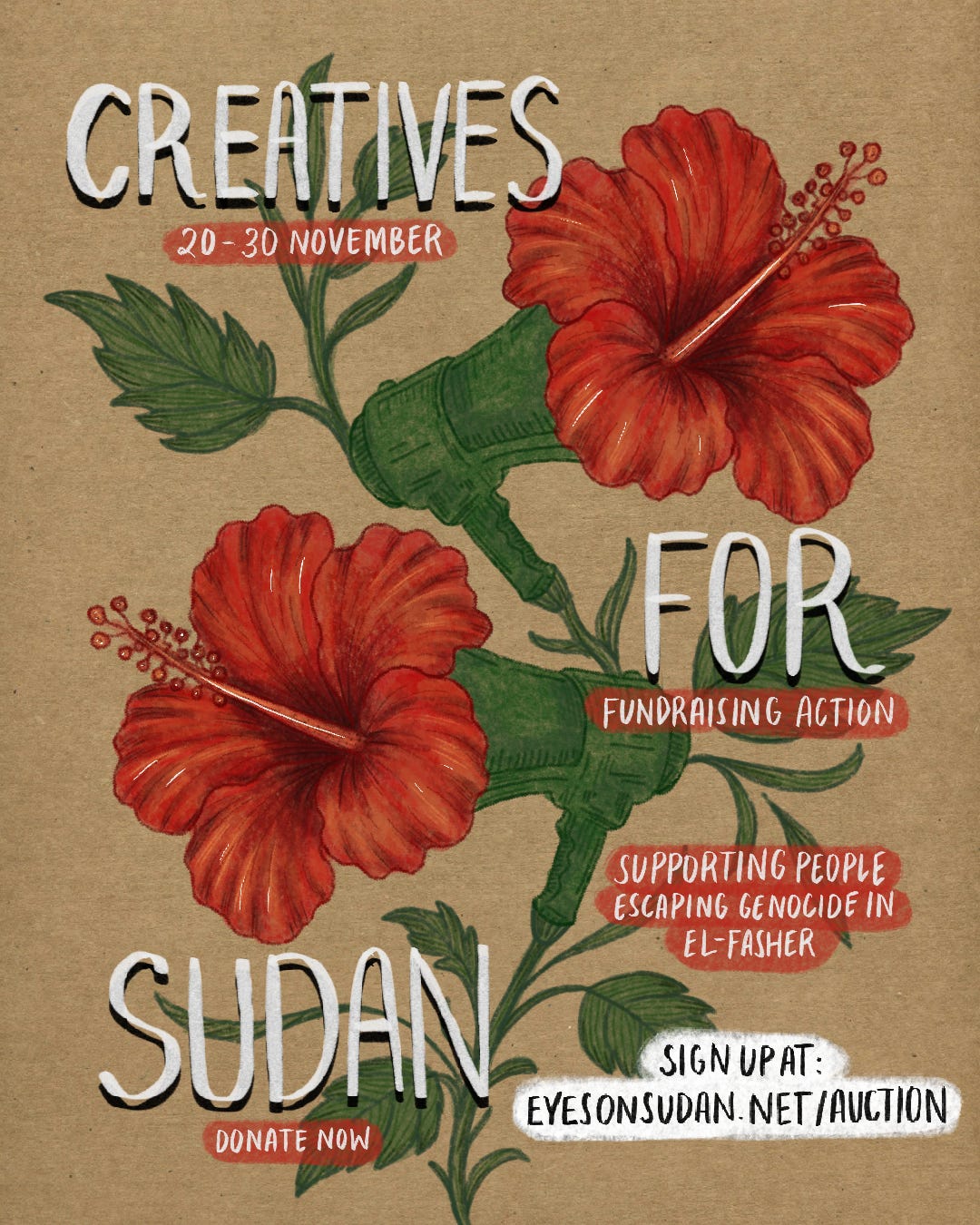
Maybe my friend is right. Maybe I do need to talk to someone about it, otherwise said rage might poison my life in other ways. But I don’t think I can bring myself to do that right now, and honestly, I don’t know if I ever will. Instead, I will continue channeling the heat into my writing, into my organising (if you’re a creative, please donate to our fundraising auction), into my prayer. Maybe there is no working ‘through’ something like this. Maybe there is only living with it, and doing our best not to pass the anger on.
In moments like these, I realise I sound more and more like the older generation; my aunts and uncles and elders who had all the time in the world to talk politics, and never spoke a word on how they felt about it. I had imagined our generation would be different. I had hoped so. But now, I understand their choices, the necessity of compartmentalising. What is the use of talk in these times, talk that will only remind me of my rage. If we must speak, let us speak of joy. Let us speak of anything else but the demons that plague us, because they have already taken too much.
A version of this piece was originally published on The New Arab. Also, for Turkish language readers, check out this interview I did on Sudan for Perspektif.
Comments
Nothing yet. Say the first thing.
Sign in to join the conversation.