
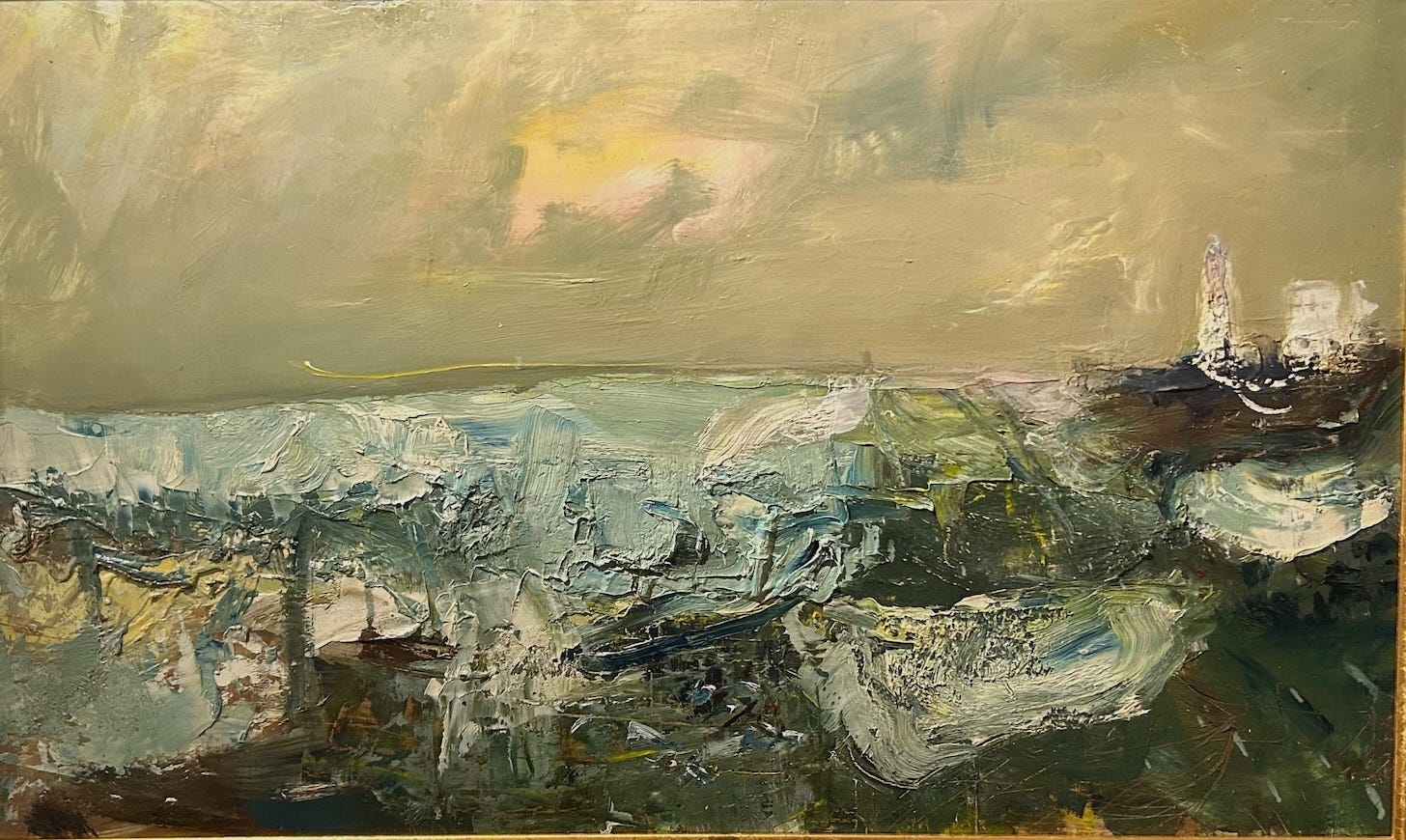
Joan Eardley (1921 - 1963) was a well-known artist in the North of England and Scotland having trained at the Glasgow School of Art. Her death from breast cancer at the age of 42 brought her career to an untimely end, for had she lived longer it’s posible she would have gone on to become internationally recognised as one of the greatest women artists of her time.
Eardley was elected an Academician of the Royal Scottish Academy in February 1963 but only a few months later she had become gravely ill; she was awarded the status of Royal Academician posthumously in 1964.
Each time I see Eardley’s art a little part of me mourns her loss and I feel it deeply as, over the next weeks, I’m spending hours with her—I’m invigilating at the Granary Gallery, Berwick-upon-Tweed, where a collection of her seascapes is presented by the Maltings (Berwick) Trust. As I look, and look, and look again at each of the paintings my stomach knots with admiration, and sadness for what might have been because there’s so much vigour in her work.

Eardley moved from Glasgow to the east coast of Scotland, to a fishing village called Catterline, 100 miles or so north of Berwick as the crow flies. There she braced the weather and painted frothy seas crashing against rocks and Catterline’s cottages strung along the grassy clifftop. Her favoured process was to sketch and paint en plein air.
Ribbons of oil paint squeezed from tubes and dollops of house paint scooped from cans landed on her canvases trapping sand, vegetation, insects, and whatever other detritus was borne by the wind. Eardley relished the serendipity of it all. She painted with her body, preferring large canvases, but they all had to be carried by her, strapped to her back as she travelled by foot, bicycle, or on her old Lambretta scooter—she didn’t own a car.
Strolling across the wooden floor boards, I observe the visitors looking at the paintings; my job is to make people feel welcome, to ensure they have a positive gallery experience, and most importantly, to safeguard the artwork.
At times the gallery is hushed, at others conversations take place in corners and the whole space becomes animated, and then halfway through a shift when I hadn’t noticed the painful squeaking sound, a visitor walked past me smiling guiltily and said, ‘I wish I’d worn a different pair of shoes.’
One surprise has been the length of time some people spend with the art. It’s a little frustrating not being able to enter their private world to ask ‘what is it that seizes your attention?’ I can chat with the visitors of course, indeed it’s encouraged, but only to support their gallery experience, not to interrupt it.
I noticed one lady following the expected route from painting to painting, only to return to the beginning and do it again. And again. And again. She circled the space for at least an hour and a half. This pleased me no end. How lovely it is, I thought, to have the time to luxuriate in the presence of this artist. How, in this safe space, it was possible to skirt around other visitors, to repeatedly stroll and stop, stroll and stop, and manage to ignore squeaky shoes to find just the right spot to stand and stare.
Another visitor was intrigued by three paintings in particular; he had looked at them all, but stayed with these three—they happened to be near where I rested on my ‘invigilator’ chair. He stood back and took a photo of each painting. Then he took close-up shots of parts of the paintings—all with his smartphone. He had borrowed a collapsible stool from the desk attendant and positioned it exactly where he wanted to sit. He would look up at the painting then down to his phone to check details by blowing up the images on his screen.
One of these paintings, The Tod Lighthouse, Catterline, (1961-62) featured above, is a favourite of mine. Seen in the subdued light of the gallery its soft hues—of blue, white, brown, yellow, green, pink—blend to form a harmonious whole.
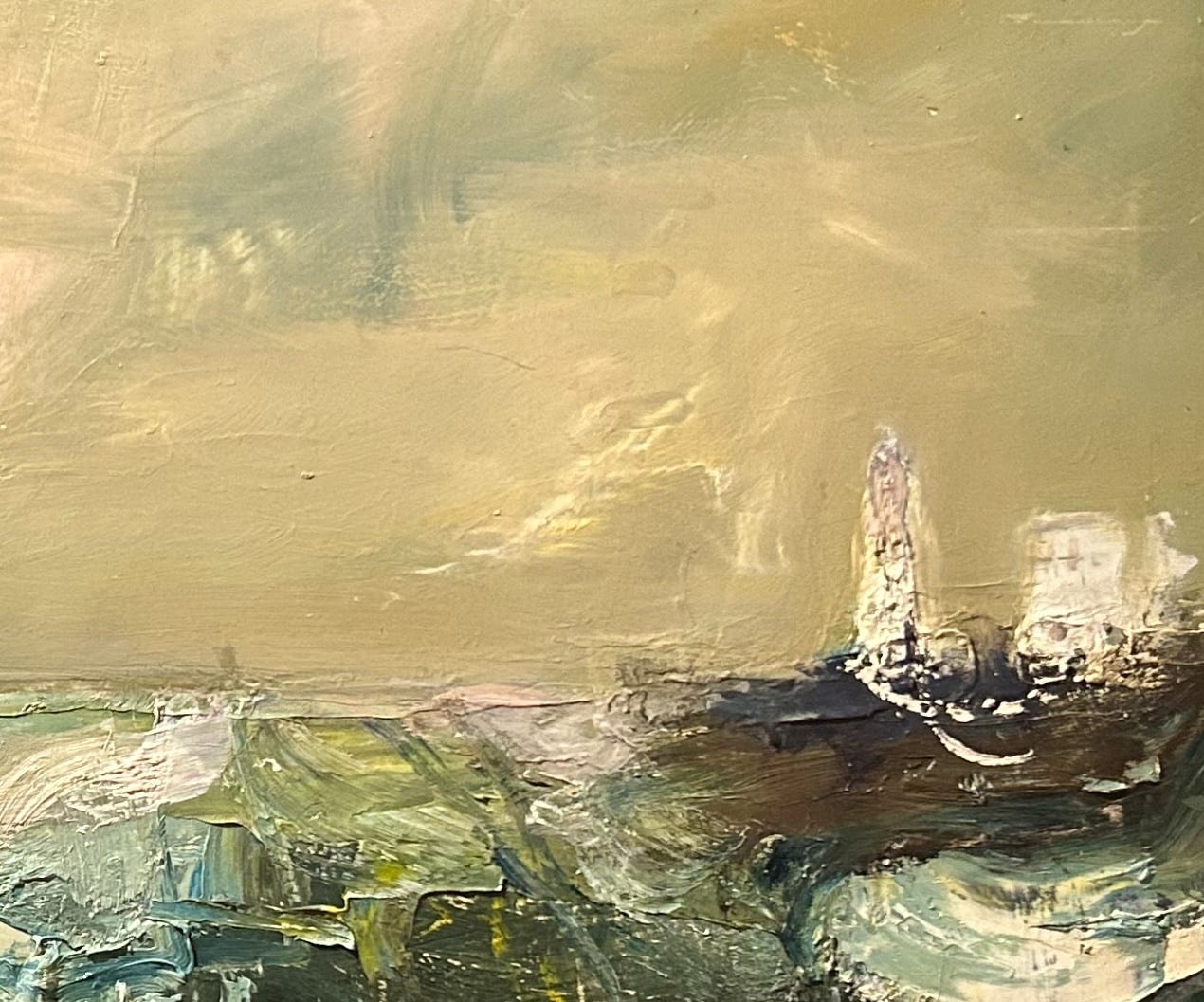
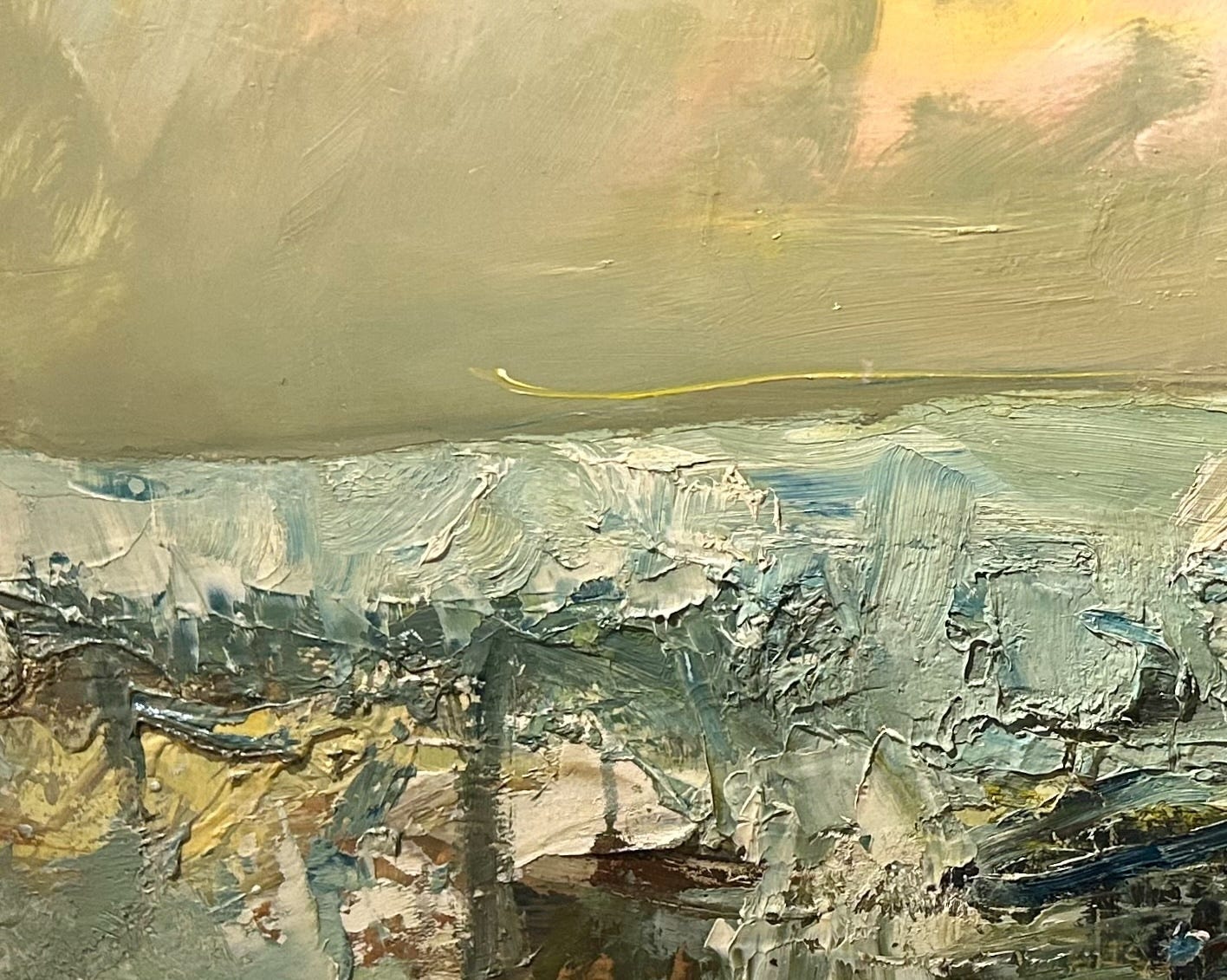
In these close-ups, the raw energy of the sea is found in the brush strokes and the thick layers of paint. And a delicate pink is used for the lighthouse, which is so unexpected. Added to which a dashing yellow line is painted horizontally; this could be read as a false horizon, or a reflection from the sun which hides behind the clouds; to me it acts like a ‘go-faster’ stripe, a psychological and visual motif that suggests speed, which compounds the strength of the waves and the speed of the current beneath.
Reflecting on this visitor’s method of looking, it struck me that he was in visual dialogue with Eardley’s paintings, developing his relationship with them through close observation. In between time he chatted with me and I learned, unsurprisingly, that he was a fan of Joan Eardley and took every opportunity possible to view her work.
It would be remiss of me to write about Joan Eardley’s seascapes without mentioning her earlier work in Glasgow. There, she painted the poorer districts of the city—the run-down buildings and children on the streets. This urban backdrop invited Eardley to visually record life as it was in all its decay and innocence. In this early work, her carefree energy is evident in the mark-making, with paint and pastel moving quickly over the canvas signalling a sense of hope rather than despair.
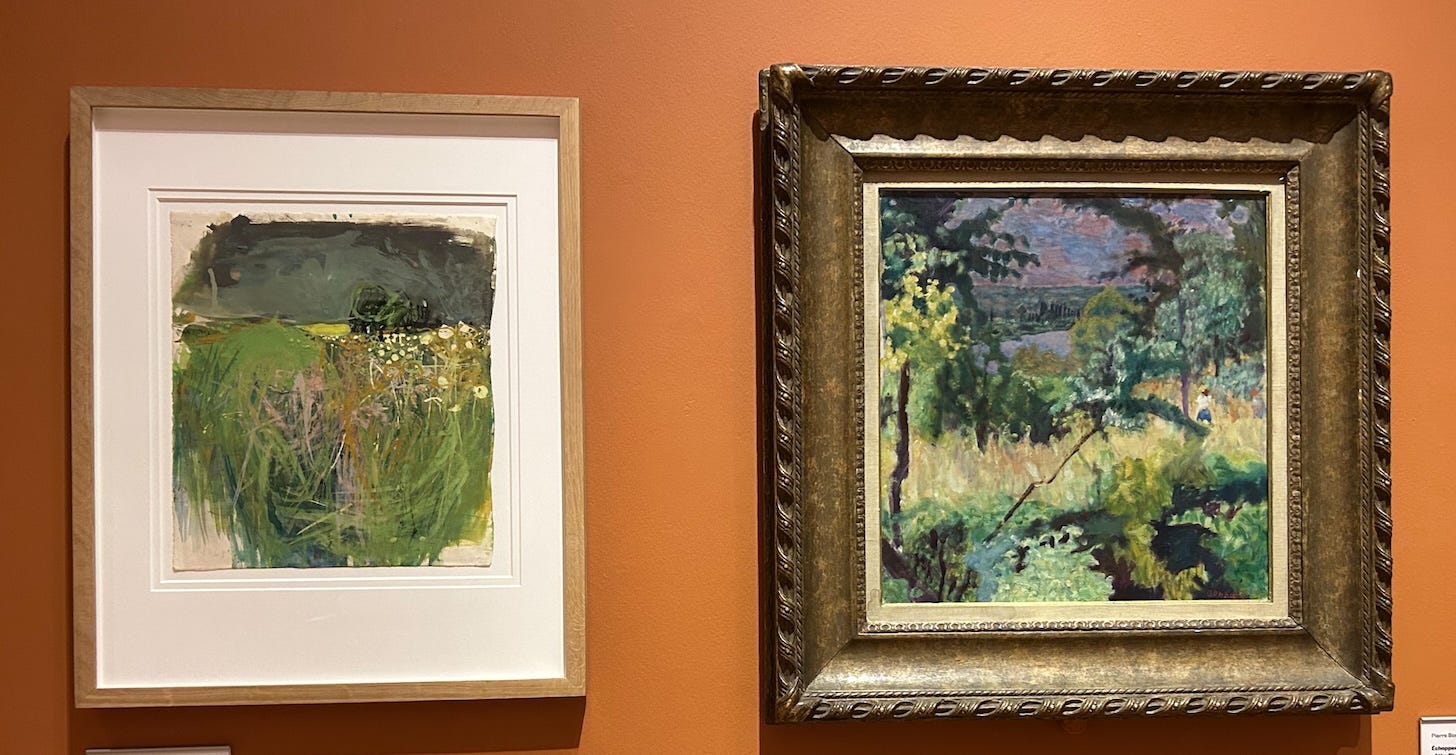
Earlier this year, a number of those paintings were displayed in Edinburgh at the National Galleries of Scotland. I managed to get along to see them and was astounded by the way they were displayed. Viewing Eardley side by side with some of the greats like Monet and Constable encouraged comparison and my eyes darted to and fro as I sought similarities and differences. Here’s an example: Eardley’s ‘Hedgerow with Grasses and Flowers’ (gouache and oil on paper) was displayed next to Pierre Bonnard’s ‘Échappee Sur la Rivière, Vernon’ (View of the River Vernon, oil on canvas, 1923). They paired perfectly in my opinion, each bringing out new details to explore in the other.
Eardley’s move from Glasgow to the shores of the North Sea was a gradual process, but she fell in love almost immediately when she first saw the rugged coastline at Catterline. Its vistas and its people touched her heart and there was no going back.
Leila Riszko, Curatorial Assistant of Modern and Contemporary Art at the National Galleries of Scotland, wrote online about her first rented cottage:
‘When she moved into No. 1 – a single room dwelling – it had a bare earth floor and no ceiling. Using an old canvas sail, she divided the room in half; one side became a bedroom, the other a kitchen and studio space. In the bedroom she fitted a rough wooden floor, with an old ship’s matting for carpet. Then, she and her friend Angus Neil made a ceiling out of rejected canvases and boards nailed to the beams.’
Life was hard in this tiny village, a small place compared to Glasgow, yet it held everything Eardley needed for her to grow as an artist. She would often go out when a storm was approaching, and relished being in the elements while painting a scene.
The landscape is in constant motion, fluctuating, changing, while the artist is stationary in their attempt to capture a scene. I imagine Eardley fully immersing herself in the natural environment at Catterline, to become part of the landscape. Time would fly by, just as insects and bits of plant material would attach themselves to her canvas.
Over the months and years she became loved by the local residents and embedded in Catterline’s society. So much so that when, in the 1970s, a new building development was proposed behind No. 1, it was quashed on the grounds that the cottage had ‘historical importance’.
One of the gallery visitors told me they’d been to Catterline and said, ‘Once you see the actual village these paintings make sense, they come to life, they carry meaning that you just wouldn’t appreciate if you hadn’t been there.’
In a short film (link below), Eardley says, ‘The more I know a place, or the more I know a particular spot, the more I find to paint.’
So, I now need to make a trip. A pilgrimage. To Catterline.
For when a familiar place is depicted by an artist you begin to see it through their eyes rather than your own. And then the questions come: Why did they choose this or that position from which to paint? Those houses? This beach? What made this place stand out for them? What strengths or limitations do they transmit?
And the conversation continues…
Have you ever visited a place because you saw it in a painting?
Had you heard of Joan Eardley before reading this post?
For this week’s writing prompt consider a pilgrimage that you’d like to make. Write a short piece (max 500 words) that flows from a wish, to a plan, to an action. This could be about a pilgrimage you’ve already undertaken, or even one that you’ll never make but can only imagine.
Offer for Annual Paid Subscribers: If you’d like to receive private personal feedback on a piece of writing inspired by this prompt, send me a DM with the word AUGUST OFFER. I’ll respond with an invitation and instructions on how to submit. You’ll get detailed craft notes on your work. This offer expires on 30 September 2026.
Images are taken by me in the galleries.
Joan Eardley | The Sea at Catterline was curated by James Lowther from The Maltings (Berwick) Trust in collaboration with The Fleming Collection, and consists of seventeen paintings. It’s open to the public until 11 October 2026. See more here.
Joan Eardley | The Nature of Painting shown at Edinburgh was curated by Senior Librarian, Kerry Gledhill. See more here.
And here’s the short film I mentioned, I think you might enjoy it.
The best way to support this work is to become a paid subscriber but if you're not ready for that yet, a cup of tea is always welcome.
Comments
Nothing yet. Say the first thing.
Sign in to join the conversation.