
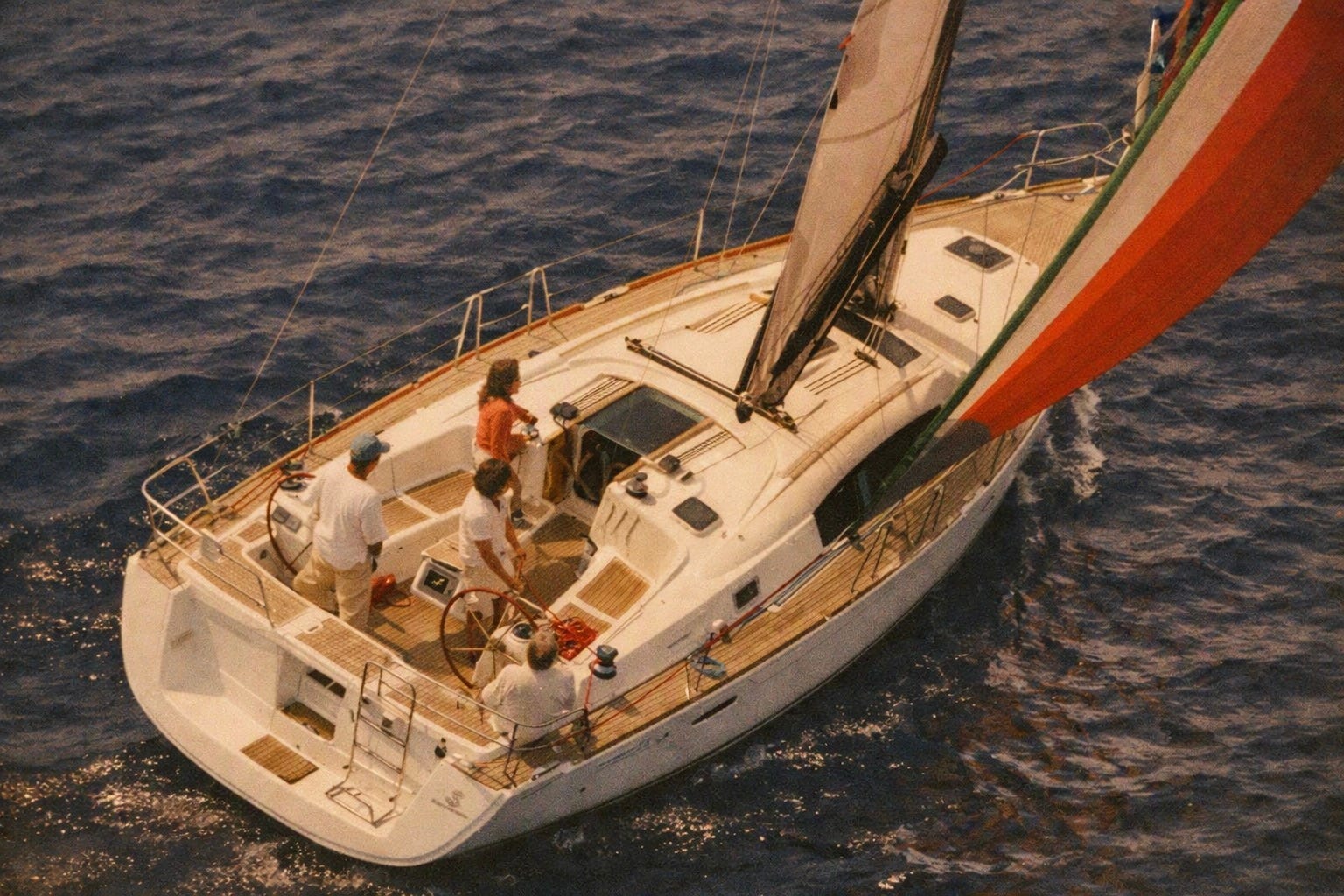
In the 1980s, we always rented a sailboat every summer, sometimes in Italy, sometimes in Croatia, now in Greece.
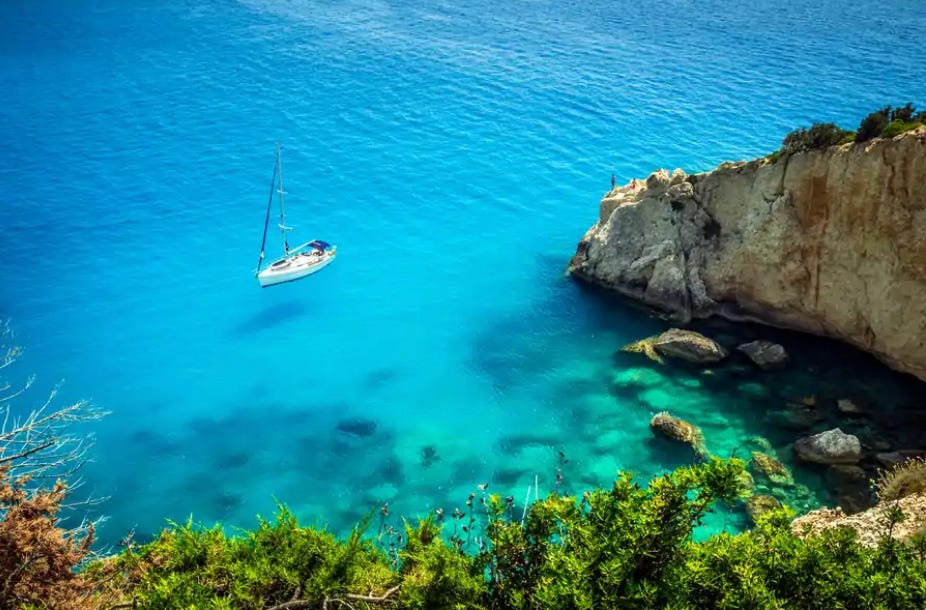
That year, 1987, we decided on the Ionian Islands of Greece. Unlike the Cyclades and the Dodecanese archipelago, the Ionian Islands are lush green, covered in forests and dotted with thousands of olive trees. They are not buffeted by the incessant summer Meltemi wind, which blows up to 50 knots during the day; they are close together and allow for short sailings. Rich in history and monumental and architectural testimonies to the four-century rule of the Serenissima Republic of Venice, they offer a gentle landscape, enriched by a wide variety of plants, such as oaks, eucalyptus, broom, and Mediterranean scrub, making them the Greek islands that most closely resemble Italian landscapes.
The Ionian archipelago comprises seven major islands, known as the Heptanesian Islands (from the Greek for “seven islands”), and smaller islets: Corfu, Paxos, Lefkas, Ithaca, Kefalonia, Zakynthos, and Kythira, which, however, is administratively part of Attica.
Corfu is the most popular island for international tourists, who appreciate its charm and lively European town atmosphere, with its arcaded cafés and landscaped lawns, the narrow streets of the Jewish quarter, and artisan workshops. Paxos, along with its smaller sister Antipaxos, is renowned for its beaches with warm, crystal-clear waters. Kefalonia is the largest island in the archipelago, ideal for those who love the sea softened by cool breezes. Lefkas, on the other hand, resembles a peninsula rather than an island, given its proximity to the mainland, to which it is connected by a drawbridge. The small villages dotted inland hold architectural gems, hidden among verdant valleys dotted with olive trees, vines, and oleanders. The beaches of Ithaca, the island of Ulysses, are almost unknown to vacationers, but offer marvelous views to those who venture there. Zante, the Zakynthos sung by the Italian poet Ugo Foscolo, which we studied in high school, is the ideal destination for those who love swimming with sea turtles or gazing out to sea from the mountaintops overlooking the island. Kythira enchants with its natural beauty, combined with picturesque villages, Byzantine monuments, Venetian fortresses, monasteries, and country churches.
The Bénéteau Oceanis 47 of the international charter company Moorings awaits us at the Gouvia Marina in Corfu, where hundreds of charter boats are moored.
The crew consists of seven, including a three-year-old child and a doctor, which doesn’t hurt. He’s actually a psychiatrist, but he still has some rudiments of somatic medical science. Among the onboard equipment, which complements and personalizes the company’s extensive standard equipment, stands out an inflatable green crocodile for the bathing delight of our little crew member, which adorns the deckhouse of the Oceanis 47 in an unusual way.
Roberto Franzoni’s sailing adventures continue as a podcast too. 👇
After the tedious check-in procedures, checking the equipment and counting every single item in the inventory, and the instructions and recommendations of the scrupulous Moorings staff, we finally set sail, enjoying the northerly breeze that gently pushes the Bénéteau 47 and refreshes us from the early August heat.
Our goal is to reach Zakynthos, but without obligation. No one is forcing us to travel too many miles.
We reach Paxos, which offers us a quiet, sheltered mooring in front of the village of Lakka. Now we have 35 miles to go to the mouth of the Lefkas Channel, one of the most picturesque passages of the journey. Three miles long, it separates the island of Lefkas, which otherwise would appear to be a peninsula, from the mainland, and allows entry into the so-called “inland sea,” where Meganisi, which in Greek means “large island,” even though it isn’t that large, and Skorpios, the private island of the Onassis family, guarded closely by security guards, stand out.
We moor nearby, in a cove off Meganisi, where another sailboat, larger than ours, is already anchored. Once the sun sets and dinnertime has passed, the neighbors’ boat transforms into a thunderous disco, with disco music blaring, of course, drowning out the intense chirping of crickets, which have been handed down by the cicadas, a sweet lullaby that lulls our little crew member to sleep. With these youngsters all wild on deck and on the deckhouse roof, not only is it impossible to sleep, but all the poetry of the bay has been destroyed. We arm the tender and elect a delegation of diplomats to negotiate an hour of silence. The wild dancers’ reaction is rude and pretentious: “We have the right to have fun too.” What can we do? The only thing to do is change bays, since we have neither bazookas nor torpedoes to sink them. The next bay is finally quiet. During the night, a pleasant onshore breeze picks up, cooling our Oceanis 47 even more than if she had air conditioning. But in the morning, a bitter surprise plunges the little one into despair. The inflatable crocodile, named Drilly, is gone. Evidently, we hadn’t tied it up, and the night breeze has blowed it away in the blue sea. Tragedy! The other six adult crew members try to console Drilly’s little orphan as best they can. With a little imagination and a lot of patience, we invent stories of happy crocodiles swimming freely in the sea, enjoying themselves by eating jellyfish and providing preventive protection against the stinging burns that result from the deadly contact with the planktonic animal’s tentacles.
After this critical moment, we head for Zakynthos. The island is well known in Italy as the birthplace of the poet Ugo Foscolo, who dedicated his famous sonnet “A Zacinto” to it. But it was Homer who first praised its splendor, christening it with the romantic nickname “Flower of the East” (Flower of the East) due to its lush vegetation. Franco, overcome by the emotions of classical memories, perches himself on the bow like a figurehead and recites to the wind the incipit of Foscolo’s sonnet: “Né più mai toccherò le sacre sponde ove il mio corpo fanciulletto giacque, Zacinto mia, che te specchi nell’onde del greco mar da cui vergine nacque Venere…”. (Never again will I touch the sacred shores where my infant body lay, my Zacynthus, that mirror you in the waves of the Greek sea from which Venus was born a virgin...).
After the obligatory visit to the renowned wreck’s beach, hoping to see some sea turtles, we reverse course to head for Ithaca, randomly quoting Homer, the Odyssey, and Dante’s Divine Comedy, trying to delve into the depths of our memory for reminiscences of that classical high school that everyone on board had attended, at least three decades earlier.
Looking for a real challenge, not just a dive off the coachroof? Find it with Doi and the CS&RB II Busnelli. 👇
In the blue waters of the deep bay of Aetos, the second accident occurs. I have a passion for diving from the deckhouse. And to be more challenging, I try to dive from the center of the deckhouse, against the boom, at the height of the full beam, leaping to clear the lifelines. I dive, come up, dive again, come up, dive again, come up, and so on. But every time I bring water aboard and soak the deckhouse roof, which eventually becomes slippery. I leap for yet another dive, but my feet slip on the wet, I lose my balance, I’m about to crash into the lifelines, I put my hands out, gripping them, and the kinetic energy increased by my weight sends me spinning around them, causing my chin to hit the hull violently. It’s as if I’ve been uppercut by Cassius Clay and Mike Tyson simultaneously. I let myself fall into the water, dazed, with a searing pain in my jaw. I struggle back on board while the doctor comes out into the cockpit, alarmed by the loud bang against the hull, which he thought was caused by a boat ramming us. It was actually my chin. He looks at me and bursts into laughter. “You have two mouths,” he exclaims, as a wound as big as my mouth has opened on my chin. He examines me and pronounces the wound needs stitching. He asks me if I want to be accompanied ashore to find a doctor or if I want him to stitch me up, as he has brought a small first aid kit, including needles and thread. “Do you trust me?” he asks timidly. “The last time I stitched was during my military service.” I trust him.
Improvise an operating room in the salon, using the table as a bed. His wife assists him like a nurse. The other crew members are sent outside so as not to disturb them, but given the corner windows of the Oceanis 47 which partially rise up onto the deckhouse, they watch the operation from outside as if from a specula. The little one is particularly curious and excited, gluing his face and eyes to the glass. I see him, and we exchange knowing glances. The doctor asks me if I want a glass of whiskey as an anesthetic. I’m completely stunned by the blow, and I don’t feel anything; I’m already anesthetized. I suggest he drink it himself, since I see him a little excited. He proceeds to sew, with four stitches neatly sewn. The hand is always good. I didn’t feel anything, and I find myself stitched up, medicated, refreshed. All on board our Oceanis 47. I try to equip the horseshoe life jacket to swim while keeping my chin well out of the water. Works. Now I count the damage. In the violent blow, I broke a capsule of a molar and a three-unit bridge. Total: four teeth to redo. The dentist’s bill in September amounts to four thousand dollars.
The most expensive dive of my life. After that, I stopped diving from the deckhouse.

Stories like this are the heartbeat of Yacht Lounge. If you value this level of insight, join our 3,800 active readers to receive weekly perspectives you won’t find anywhere else.
Negli anni Ottanta d’estate noleggiavamo sempre una barca a vela, talvolta in Italia, talvolta in Croazia, ora in Grecia.
Quell’anno, il 1987, decidemmo per le isole Ionie della Grecia. A differenza delle Cicladi e dell’arcipelago del Dodecaneso, le isole Ionie sono verdissime, ricoperte di boschi e con migliaia di ulivi. Non sono sferzate dall’incessante Meltemi estivo che di giorno soffia fino a 50 nodi; sono vicine tra loro e consentono navigazioni brevi. Ricche di storia e di testimonianze monumentali e architettoniche del dominio della Repubblica Serenissima di Venezia, durato quattro secoli, offrono un paesaggio dolce, arricchito da una grande varietà di piante, come querce, eucalipti, ginestre e macchia mediterranea, che le rende le isole greche che più di tutte ricordano il paesaggio italiano.
L’arcipelago delle isole Ionie comprende sette isole maggiori, che costituiscono il cosiddetto Eptaneso (dal greco le sette isole), e isolotti minori: Corfù, Paxos, Levkas, Itaca, Cefalonia, Zante e Cerigo, che, però, dal punto di vista amministrativo fa parte dell’Attica.
Corfù è l’isola più frequentata dal turismo internazionale, che ne apprezza il fascino e la vivacità da cittadina europea, con i caffè sotto i portici e i prati all’inglese, le viuzze del quartiere ebraico e le botteghe di artigiani. Paxos, con la piccola Antipaxos, è rinomata per le spiagge dalle acque calde e cristalline. Cefalonia è l’isola più grande dell’arcipelago, ideale per chi ama il mare addolcito da brezze fresche. Lefkas, invece, più che un’isola sembra una penisola, data la sua vicinanza alla terraferma, con la quale è collegata attraverso un ponte mobile. I piccoli paesini disseminati nell’entroterra custodiscono gioielli d’architettura, nascosti tra valloni verdeggianti, punteggiati di ulivi, viti e oleandri. Le spiagge di Itaca, l’isola di Ulisse, sono quasi sconosciute ai vacanzieri, ma regalano scorci meravigliosi a chi vi si avventura. Zante, la Zacinto cantata dal poeta Ugo Foscolo, che studiammo al liceo, è la meta ideale per chi ama nuotare in compagnia delle tartarughe marine o guardare il mare dalle vette dei monti che sovrastano l’isola. Cerigo incanta per le sue bellezze naturali, unite ai villaggi pittoreschi, ai monumenti bizantini, alle fortezze veneziane, ai monasteri e alle chiese di campagna.
Il Bénéteau Oceanis 47 della compagnia internazionale di charter Moorings ci aspetta al marina Gouvia di Corfù, dove sono ormeggiate centinaia di barche da charter.
Le avventure veliche di Roberto Franzoni continuano anche in podcast. 👇
L’equipaggio è composto da sette persone, tra cui un bambino di tre anni e un dottore, che non guasta. In realtà è uno psichiatra, ma qualche rudimento di scienza medica somatica gli è rimasto. Tra le attrezzature di bordo, che completano e personalizzano la ricca dotazione standard della compagnia, spicca un coccodrillo verde gonfiabile per la delizia balneare del nostro piccolo membro dell’equipaggio e che adorna in maniera inconsueta la tuga dell’Oceanis 47.
Dopo le noiosissime procedure di check-in e di controllo delle dotazioni e della conta di ogni singolo pezzo dell’inventario, le istruzioni e raccomandazioni dello scrupoloso personale della Moorings, finalmente prendiamo il mare, godendo della brezza da nord che spinge il Bénéteau 47 delicatamente e ci rinfresca dalla calura dell’inizio di agosto.
L’obiettivo è di raggiungere Zante, ma senza impegno. Nessuno ci obbliga a percorrere troppe miglia.
Tocchiamo Paxos che ci offre un ormeggio tranquillo e ridossato davanti al villaggio di Lacca. Ora ci aspettano 35 miglia per raggiungere l’imbocco del canale di Lefkas, uno dei passaggi più suggestivi del viaggio. Lungo 3 miglia, separa dalla terraferma l’isola di Lefkas, che altrimenti sembrerebbe una penisola, e consente di entrare nel cosiddetto “mare interno”, dove spiccano Meganisi, che in greco vuol dire isola grande, anche se tanto grande non è, e Skorpios, l’isola privata della famiglia Onassis, guardata a vista da armigeri della sicurezza.
Ci ormeggiamo nelle vicinanze, in un’insenatura di Meganisi, dove è già all’ancora un’altra barca a vela, più grande della nostra. Tramontato il sole e passata l’ora della cena, la barca dei vicini si trasforma in una fragorosa discoteca, con musica ovviamente disco a tutto volume, che si sostituisce, coprendolo, all’intenso frinire dei grilli, che hanno ricevuto le consegne dalle cicale, dolce ninna-nanna che concilia il sonno al nostro piccolo membro d’equipaggio. Con questi ragazzi scatenati in coperta e sul tetto della tuga non solo non si riesce a dormire, ma è stata ammazzata tutta la poesia della baia. Armiamo il tender ed eleggiamo una delegazione di diplomatici che vadano a negoziare un’ora per il silenzio. La reazione degli scatenati ballerini è sgarbata e pretestuosa: “anche noi abbiamo diritto di divertirci”. Che fare? L’unica è cambiare baia, dato che non possediamo né bazooka, né siluri per affondarli. La baia successiva è finalmente tranquilla. Nella notte si alza una brezza in terra piacevolissima che rinfresca il nostro Oceanis 47, meglio che se avesse l’aria condizionata. Ma alla mattina un’amara sorpresa getta nella disperazione il piccolo. Il coccodrillo gonfiabile, nominato Drilly, non c’è più. Evidentemente non l’avevamo legato e la brezza notturna se l’è portato via. Tragedia. Gli altri sei membri adulti dell’equipaggio cercano di consolare come possono il piccolo orfano di Drilly. Con un po’ di fantasia e con molta pazienza inventiamo storie di coccodrilli felici che navigano liberi nel mare e se la godono mangiando meduse e facendo un servizio preventivo contro le bruciature urticanti del letale contatto con i tentacoli dell’animale planctonico.
Superato questo momento critico, ci dirigiamo verso Zante. L’isola è molto nota in Italia per aver dato i natali al poeta Ugo Foscolo che le dedicò il famoso sonetto “A Zacinto”. Ma fu Omero a decantarne per primo lo splendore battezzandola con il romantico soprannome di Fiore di Levante, per via della sua rigogliosa vegetazione. Franco in preda alle emozioni dei ricordi classici, si installa a prua come una polena e recita al vento l’incipit del sonetto di Foscolo: “Né più mai toccherò le sacre sponde ove il mio corpo fanciulletto giacque, Zacinto mia, che te specchi nell’onde del greco mar da cui vergine nacque Venere…”.
Dopo l’immancabile visita alla spiaggia del relitto, sperando di vedere delle tartarughe marine, invertiamo la rotta per puntare su Itaca, citando a caso Omero, l’Odissea, la Divina Commedia di Dante, cercando di sondare nei meandri della memoria le reminiscenze di quel liceo classico che tutti i presenti a bordo hanno frequentato, almeno tre decenni prima.
Chi cerca la sfida vera, altro che un tuffo dalla tuga, la trova con Doi e il CS&RB II Busnelli. 👇
Nelle acque blu della profonda baia di Aetos accade il secondo incidente. Io ho la passione dei tuffi dalla tuga. E per essere più sfidante mi impegno a tuffarmi dal centro della tuga, contro il boma, all’altezza del baglio massimo, spiccando un salto per superare le draglie. Mi tuffo, risalgo, mi rituffo, risalgo, mi rituffo, risalgo e via così. Ma ogni volta porto acqua a bordo e bagno il tetto della tuga che alla fine diventa scivoloso. Spicco il salto per l’ennesimo tuffo, ma i piedi scivolano sul bagnato, perdo l’equilibrio, sto per schiantarmi sulle draglie, metto le mani avanti impugnandole e l’energia cinetica aumentata dal peso mi fa compiere un giro attorno alle stesse che mi fa battere violentemente il mento contro lo scafo. È come se avessi ricevuto un uppercut contemporaneamente da Cassius Clay e da Mike Tyson. Mi lascio cadere in acqua intontito con un dolore alla lancinante mascella. Risalgo faticosamente a bordo, mentre il dottore esce in pozzetto, allarmato dal colpo rumoroso contro lo scafo, che credeva fosse stato provocato da una barca che ci aveva speronato. Era invece il mio mento. Mi guarda e scoppia in una risata. “Hai due bocche”, esclama, poiché sul mento mi si è aperta una ferita grande come la bocca. Mi visita e sentenzia che occorre cucire la ferita. Mi chiede se voglio esser accompagnato a terra in cerca di un medico o se voglio essere cucito da lui, che ha portato una piccola dotazione di pronto soccorso, tra cui aghi e filo. “Ti fidi?” mi chiede timido, “l’ultima volta che ho praticato una cucitura è stata durante il militare”. Mi fido.
Improvvisa una sala operatoria in quadrato, usando il tavolo come lettino. La moglie lo assiste come un’infermiera. Gli altri dell’equipaggio vengono mandati fuori per non dare fastidio, ma data la finestratura angolare dell’Oceanis 47 che sale parzialmente sulla tuga, assistono dall’esterno all’operazione come da una specola. Il piccolo è particolarmente curioso ed eccitato, incollando il viso e gli occhi al vetro. Lo vedo e ci scambiamo sguardi d’intesa. Il dottore mi chiede se voglio come anestetico un bicchiere di whisky. Io sono completamente rintronato dal colpo e non sento niente, sono già anestetizzato. Gli suggerisco di berselo lui, dato che lo vedo un po’ emozionato. Procede alla cucitura, con quattro punti ben cuciti. LA mano è sempre buona. Non ho sentito niente e mi ritrovo cucito, medicato, rinfrancato. Il tutto a bordo del nostro Oceanis 47. Mi ingegno di armare il salvagente a ferro di cavallo per fare il bagno tenendo il mento ben fuori dall’acqua. Funziona. Ora conto i danni. Nel colpo violento ho rotto una capsula di un molare e un ponte di tre elementi. Totale quattro denti da rifare. Il conto del dentista a settembre ammonta a 4 milioni di lire.
Il tuffo più caro della mia vita. Dopo di allora ho smesso di tuffarmi dalla tuga.

Storie come questa sono il cuore di Yacht Lounge. Se apprezzi questo tipo di narrazione, unisciti ai nostri 3.800 lettori attivi per ricevere ogni settimana approfondimenti che non troverai altrove.
No posts
Comments
Nothing yet. Say the first thing.
Sign in to join the conversation.